Nepal earthquake: Hospitals overflowing, rural towns cut off as death toll continues to climb
Updated about an hour ago
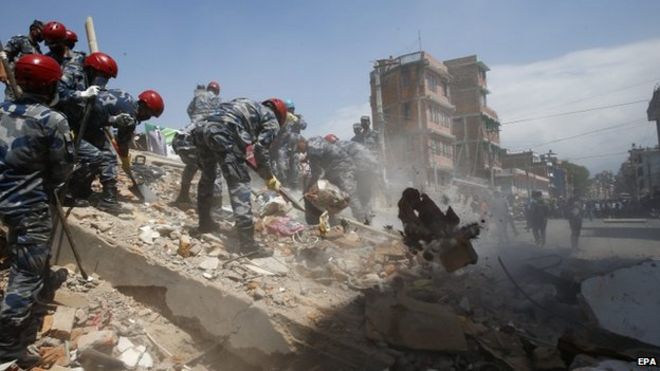
Photo: Nepalese rescue personnel help a trapped earthquake survivor in Kathmandu. (AFP: Prakash Mathema)
Hospitals in Nepal are struggling to treat thousands of injured earthquake survivors, as the country's national disaster management chief raised the official death toll to 3,218.
[...]
UN Emergency Coordinator for the 2005 Pakistan earthquake, Andrew McLeod, said the disaster in Nepal could end up taking even more lives than the earthquake in Pakistan and a lot more buildings are vulnerable to collapse due to a lack of building standards in Nepal.
"A major disaster like this will send an entire generation of Nepalese backwards in economic development and it will take every bit of a decade for this country to really recover," he told The World Today.
.. 'it is the silent we have to worry about' Andrew McCloud on Sydney tv news just now .. unheard from villages are 2 days walk away .. fears the death toll could be 10000 plus ..
The bodies of about 100 Nepali and foreign trekkers have been found in a remote village that was buried by an avalanche following last month's massive earthquake, officials say.
Nepali police and local volunteers recovered the bodies on the weekend from the ruins of Langtang village, 60 kilometres north of Kathmandu, which is on a trekking route popular with Westerners.
The Department of Foreign Affairs and Trade (DFAT) says it holds grave concerns for an Australian man whose last know location was in Langtang.
Australian officials are being sent to the Langtang Valley, DFAT said.
Nepalese officials said the entire village, which included 55 guesthouses for trekkers, was wiped out by the avalanche following the April 25 earthquake.
"Local volunteers and police personnel are digging through six-feet [deep] snow with shovels looking for more bodies," Langtang's assistant chief district officer Gautam Rimal said.
He said the dead included at least seven foreigners but only two had been identified.
Photo: The village included 55 guesthouses for trekkers before the earthquake. (Facebook: Lynda Paju)
It was not clear how many people were in Langtang at the time of the avalanche but other officials said about 120 more people could be buried under the snow.
"We had not been able to reach the area earlier because of rains and cloudy weather," Uddhav Bhattarai, the district's senior bureaucrat, said on Sunday.
India's National Disaster Response Force (NDRF), which was among the first foreign organisations to arrive after the quake, said it had been asked by the Nepalese government to conclude its search and rescue operation.
"All the search and rescue teams, not the relief [teams] ... have been asked to return," NDRF director General O.P. Singh told Indian television.
Around 60 European Union citizens remain unaccounted for after the devastating earthquake in Nepal, an EU source said.
The figure is far lower than an estimate of 1,000 missing EU citizens given by a senior EU official last week.
The 60 were people who were reported to be in Nepal at the time of the earthquake and who could not yet be contacted.
Nepal government keeps Mt Everest open
Photo: Nepal has asked foreign teams to wrap up search and rescue operations as hope of finding survivors fades. (Reuters: Olivia Harris)
At least 18 trekkers were killed on Mount Everest, where avalanches hit the slopes of the world's highest peak.
US military aircraft and personnel arrived in Nepal on Sunday and were due to begin helping ferry relief supplies to stricken areas outside the capital, a US Marines spokeswoman said.
The deployment is expected to ease the piling up of relief material at Kathmandu airport, Nepal's only major airport.
The United Nations said 8 million of Nepal's 28 million people were affected by the quake, with at least 2 million needing tents, water, food and medicines over the next three months.
Around 1.7 million children remain in urgent need of humanitarian aid in the worst-hit areas, according to the United Nations Children's Fund.
Reuters [ slideshow ]
1 of 63 Bhaktapur residents clear the rubble from their homes which were destroyed in the earthquake. Reuters: Athit Perawongmetha
3 of 63 An elderly woman sits outside a destroyed dwelling in Solu Khumbu. Tenzin Khando Sherpa
15 of 63 A man walks through the rubble of houses damaged by the earthquake in Bhaktapur near Kathmandu. AFP: Menahem Kahana
18 of 63 A woman sits among the rubble of her house in a village in Sindhupalchowk, Nepal. Reuters: Danish Siddiqui
25 of 63 A man sits on the rubble of his damaged house following Saturday's earthquake in Bhaktapur, Nepal April 27, 2015. Reuters: Adnan Abidi
40 of 63 An injured person is carried by rescue members at Everest Base Camp. AFP: Roberto Schmidt
46 of 63 People sit with their belongings outside a damaged temple in Kathmandu. Reuters: Navesh Chitrakar
54 of 63 A man stands surrounded by dust and bricks in the Patan district. ABC News: Siobhan Heanue
58 of 63 People take refuge at a school in Kathmandu after the earthquake. Reuters: Navesh Chitrakar
By any stretch, a magnitude-7.3 quake is a big one.
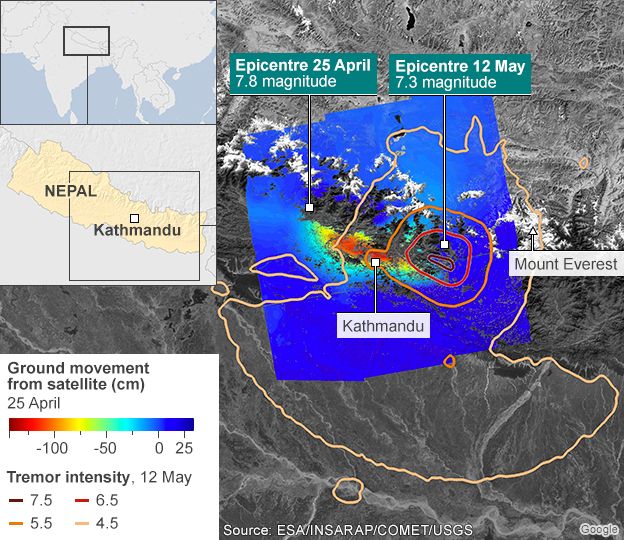
Tuesday's shaker in Nepal is not quite as bad as the 7.8 tremor on 25 April - which was 5.5-times as energetic - but it is a major quake nonetheless.
The location is different. The epicentre this time is about 80km east-northeast of Kathmandu, halfway to Everest. A fortnight ago, the event began 80km to the northwest of the capital.
But just that observation is instructive because of what we have learnt in the past two weeks.
In April, we saw the fault system rupture eastwards from the epicentre for 150km. And the immediate analysis suggests Tuesday's tremor has occurred right at the eastern edge of this failure.
In that context, this second earthquake was almost certainly triggered by the stress changes caused by the first one.
Indeed, the US Geological Survey had a forecast for an aftershock in this general area.
Its modelling suggested there was 1-in-200 chance of a M7-7.8 event occurring this week. So, not highly probable, but certainly possible.
Quake experts often talk about "seismic gaps", which refer to segments of faults that are to some extent overdue a quake.
Tuesday's big tremor may well have filled a hole between what we saw on 25 April and some historic events - such as those in 1934, which occurred further still to the east.
A comparison of 25 April and 12 May
The graphic shows satellite measurements of the ground movement in April's big quake, overlaid with an early model of expected shaking from Tuesday's tremor.
* Satellites can measure the relative movement of the ground towards and away from them, in "before" and "after" images of a quake zone. Reds therefore indicate areas of uplift, while blues denote land that has subsided. The 12 May epicentre, together with its expected radiating pattern of shaking, is centred right at the eastern end of the 25 April rupture. ___________________________________________________________________________________________________________________________________________
There are early reports of deaths and injuries, and one has to hope the outcome this time will be less severe.
Buildings that were left damaged and precarious on 25 April may well have been felled in the following days' aftershocks, or have been put out of bounds. This could limit the casualties this time. But further landslides and avalanches in the mountainous terrain are a persistent risk. And, of course, another big tremor does nothing for the frayed nerves of an already anxious population.
For the future, it is clear there are still large segments of the fault that retain strain, and these regions are where resilience planning is likely to be concentrated.
Satellite images show the 25 April quake did not rupture all the way to the surface, meaning there is potential for another big quake just to the south of Kathmandu. And there are particular concerns to the west, as well.
"I think if you spoke to most people, they would say the biggest patches that didn't break a fortnight ago were the shallower patches, south of Kathmandu; and also west of Kathmandu, or at least west of where it started on 25 April at Pokhara," explained Dr John Elliott from the Nerc Centre for the Observation and Modelling of Earthquakes and Tectonics (Comet) .. http://comet.nerc.ac.uk/ .. at Oxford University, UK.
"So, there is that whole portion of western Nepal that hasn't gone since the 1500s. This aftershock was quite big at 7.3 but we'd have concerns still about 8.0s to the west of Pokhara," he told BBC News.
Shake assessments
The death toll from the 25 April earthquake now stands at more than 8,000. This is a dreadfully high number, but it is worth remembering the estimates that were produced by the predictive models on that day. These suggested the number of dead could be in the tens of thousands.
It is very probable that the final toll will be higher than what has so far been recorded, but there are indications that the numbers might not be quite so high. An interesting story is emerging about the shaking on 25 April. It seems the fault may have ruptured in a smoother fashion than might have been anticipated, resulting in less destruction.
Dr Susan Hough from the US Geological Survey has been reviewing the data.
She told the BBC: "We can see directly that central Nepal moved up about 1.5m during the earthquake and also to the south, but it did so very gradually, if you will.
"You can see that in videos that show the ground just moving back and forth with a very long period, on the order of five seconds.
"So, you would have had buildings in Kathmandu that were able to ride out what would have been essentially long swells of the ground moving beneath them."
Jonathan.Amos-INTERNET@bbc.co.uk and follow me on Twitter: @BBCAmos


 Market Data
  Markets


 AI
AI