"unfucking believable" on full screen, the quote is from one of the videos .. sorry, to read 2 confirmed dead .. hope that's not a 'so far' .. according to Wikipedia
The most extreme tornado in recorded history was the Tri-State Tornado, which roared through parts of Missouri, Illinois, and Indiana on March 18, 1925. .. http://en.wikipedia.org/wiki/Tornado_records
Back then "living through a tornado was difficult indeed"
.. it came shrouded in cloud, in disguise .. "it killed nearly 700 people in three states" .. 'began NNW of Ellington Missouri .. 11 killed before it crossed the Mississippi into Illinois .. in southern Illinois 613 died' ..
---
The Tri-State Tornado of 1925
By James Hyde On March 18, 2014 · 6 Comments
On March 18, 1925 a dark “smokey fog” touched down approximately three miles northwest of Ellington, Missouri. It would become known as the Tri-State Tornado. By all accounts the Tri-State Tornado was one for the record books.
The Tri-State Tornado is currently the U.S. record holder for longest tornado track (219 miles), most deaths in a single tornado (695), and most injuries in a single tornado (2027). While it occurred before the modern record, it is considered by all accounts to be a F5/EF5 Tornado. It crossed the three states, thus it’s namesake “Tri-State,” tearing through thirteen counties of Missouri, Illinois, Indiana. It crossed over and destroyed or significantly damaged nine towns and numerous smaller villages.
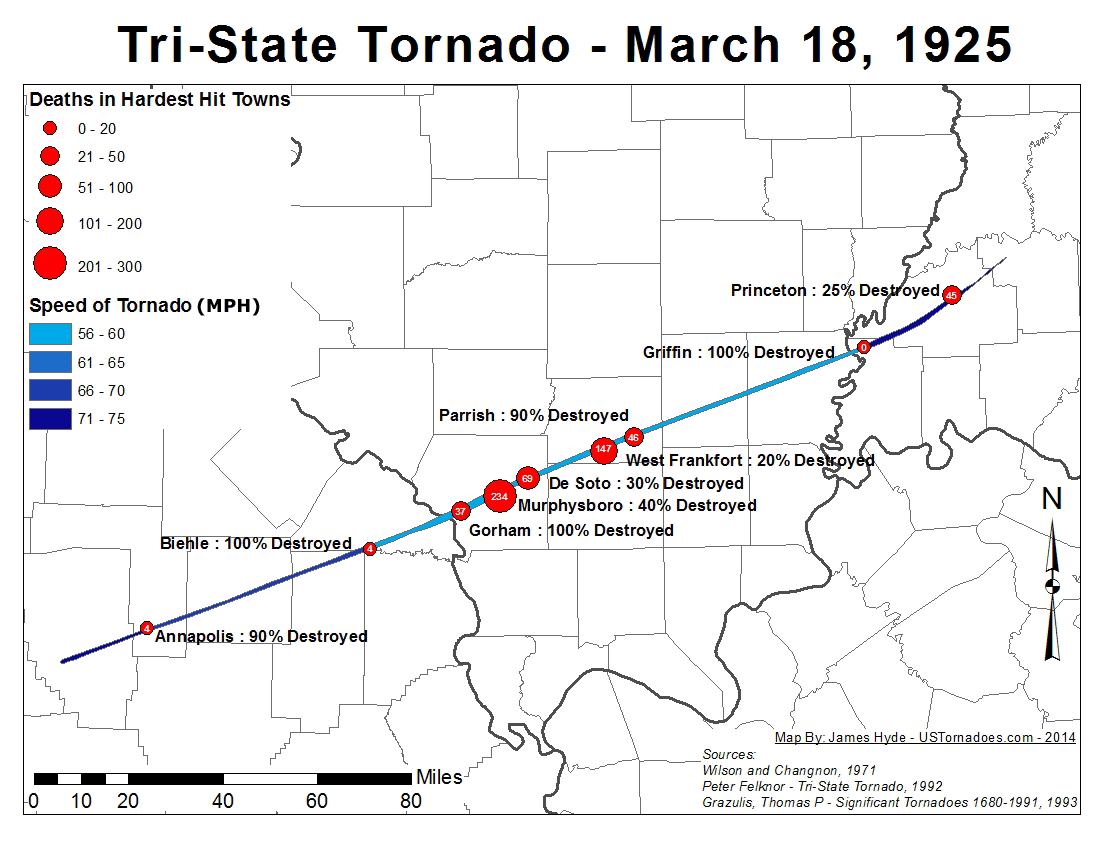
The track of this tornado has been lost to the 89 years of growth of vegetation and development by humans. One map .. http://upload.wikimedia.org/wikipedia/commons/a/ac/Tri-State_Tornado_trackmap_%28PAH%29.jpg , done by Wilson and Changnon in 1971, seems to provide the most accurate path of this tornado. However, in searching for an electronic or digitized copy of this map I could not find one. I decided to re-create their map in geographic software as seen below.
Re-Creation of the Wilson, 1971 Tri-State tornado path and resulting deaths in hardest hit towns.
The resulting map perhaps shows why this tornado was so deadly. First off was the speed of the tornado. The average speed across it’s life span was an astonishing 62 miles per hour, with forward speeds at times reaching 73 mph. Also worth noting is that the tornado followed a slight topographical ridge with a series of mining towns perfectly aligned the path. Despite the staggering death toll and thousands of injuries, the stories that have emerged from the are quite astonishing. Using the map above, we can see where some of these stories came from.
In Annapolis, Mo., the day was quite hazy with just a few thunderclaps in the distance, then at 1:30 p.m. the “smokey fog” came down from above the small Ozark hills town. It came and left so quickly that nobody knew what had really happened. The only logical explanation was a twister of some sort. 90 percent of the town was destroyed. When the tornado approached the town of Beihle, Mo. a double tornado was reported along a three mile stretch. It is unclear whether this phenomenon was a satellite tornado around a parent tornado, or if the old tornado was dying and a new one forming. Regardless, the damage path went on.
Crossing the Mississippi river, the tornado then struck the town of Gorham, Il. Gorham was a town of about 500 people and of those 500, 37 were killed and 250 injured. One notable effect in Gorham was the grass being torn from the ground in a gully on the east of town. The next town was Murphysboro. Eugene Porter reported the tornado to be “about a mile wide”. The town of Murphysboro suffered heavy losses, with 234 casualties reported along with 623 injuries. About 100 square blocks of the town were destroyed along, with another 70 by a fire after the tornado.
Perhaps the most astonishing show of power came from the next town in line, DeSoto, Il. Trees were snapped off at knee height and stumps then ripped out of the ground. No structure was left standing in the tornado’s path. Of the 69 people killed in DeSoto, 33 were killed in a school.
Next up, West Frankfort was a mining town, and as such most of the men worked in the mines. When the electricity went out, the miners went to the surface to see what the problem was. The miners came to the surface of a destroyed landscape. Most of the 148 deaths and 400 injuries in West Frankfort were women and children given the men were in the mine.
A man in Parrish, Il. survived the tornado by clinging to a railroad track while the town was destroyed. 46 people died and at least 100 were injured here. Between Gorham and Parrish, 541 lives were taken.
The tornado continued northeast, and over the next hour mostly farms and an occasional school house or general store were destroyed. Once into Indiana, the town of Griffin was destroyed, followed by the south side of Princeton.
In Princeton, residents saw a “blackness” move across the south side of town, no one in north Princeton knew or even guessed that the other southern half of the town had been destroyed until injuries and bodies started showing at the hospital. 45 people were killed and 152 injured there. The tornado then weakened and dissipated as it took a more northeasterly direction, finally dissipating just southwest of the town of Petersburg, In.
Total time on the ground of the Tri-State tornado was 3 hours and 30 minutes. During that time, it traveled 219 miles and killed 695 people. Most of them in Illinois.
The meteorological conditions surrounding the tornado are also just as interesting as the tornado itself. The residences in the fully destroyed town of Gorham, Illinois recalled the morning being rainy and drizzly, with dark and gloomy skies and little wind. For anybody who follows severe weather, this is seen as an oddity. Often, areas that see tornadoes are at least partly sunny and windy in the morning, as moist air runs along the surface and the sunshine heats it, only to be exploded into massive thunderheads in the afternoon.
Robert Maddox, et al. did a fantastic analysis of the meteorological conditions on the day of the tornado (full report .. http://www.flame.org/~cdoswell/publications/Maddox_etal_TriStateMeteor.pdf ). What they found was that the tornado ran along what is called the triple point, the intersection between the warm front, cold front, and occluded front, near the center of low pressure. The image below from their report shows the position of the tornado relative to the surface features.
The Tornado Frontal Positions and Tornado Damage Path – By Maddox et al. , 2013
* In West Frankfort, Il. a farmer found a barber chair from some other town, and a bond — that was in a safe to begin with — was found 125 miles away and later mailed back. A house was also left standing while the trees surrounding it were cut off at the trunk or uprooted.
* A man in Griffin, IN reported that he grabbed a door-handle and the house blew away, leaving the door handle with him.
* A popcorn man in Murphysboro, Il. was reportedly tossed up in the air “to the height of a one story building” then set back down a block away. His popcorn stand moved three feet and was still on it’s wheels.


 Market Data
  Markets


 AI
AI