.. suggestion one was arrested in the street outside, but no mention of that on tv .. also that the target was not the cafe, there was interruption on the street so the cafe became it .. most all is speculation now ..
14 December 2014 Last updated at 21:19 ET
VIDEO - Armed police have sealed off Martin Place in central Sydney
Several people have been taken hostage by at least one armed man at a Lindt cafe in the centre of Sydney.
Hundreds of armed police have sealed off the normally busy Martin Place in Sydney's central business district.
Pictures on Australian television have shown at least three people with their hands up against a window, and a black flag with Arabic writing.
Australian Prime Minister Tony Abbott has described the incident as "deeply concerning".
He said it was not yet clear who was behind the incident or what their motives were, but said law enforcement agencies were well-equipped to respond.
In a brief news conference, he said the National Security Committee had been briefed, and urged Australians to go about their lives but to be alert.
"I can think of almost nothing more distressing, more terrifying than to be caught up in such a situation, and our hearts go out to these people," he said.
Streets have been closed around the building and people moved out of the area
New South Wales Police said in a statement .. https://www.facebook.com/nswpoliceforce?rf=105636842804324 .. that an "armed incident" was under way, and that "specialist officers are attempting to make contact with those inside a cafe".
The police said nearby offices had been evacuated as a precaution and asked people to remain indoors and way from open windows.
Many people were arriving at work as the area was shut down __________________________________________________
At the scene: Wendy Frew, BBC Australia Editor Online
Colleagues of people inside the building are waiting outside for new
Martin Place is a public pedestrian thoroughfare through the heart of Sydney, joining its parliamentary, legal and retail districts.
It is full of media, members of the public and the police, with what appear to be anxious colleagues of people trapped inside the building, waiting for news. Several surrounding blocks are cordoned off.
Police are at this stage not giving media briefings at the site - dozens of police cars have arrived at the scene, with more continuing to come. __________________________________________________
The incident began as people were arriving for work in Martin Place on Monday morning.
There is a heavy police presence in the heart of Sydney
Witnesses saw a man with a bag and gun walk into the Lindt chocolate shop and cafe. Police shut down the area, closing roads and moving people away. The Martin Place station was also closed.
Shortly after, television footage showed at least two people, thought to be employees of the cafe and who were visibly distressed, holding a black sign with the Islamic creed written on it up to the window.
The BBC's Security Correspondent Frank Gardner said the flag was similar to but not the same as that used by the Islamic State militant group in the Middle East.
An Australian Broadcasting Corporation reporter said that gunfire had been heard at the scene - but this has not been confirmed.
No injuries have been reported from the incident, according to a police spokesperson.
Terror threat
Police have also said that they are dealing with an "incident" at the Sydney Opera House, which has been evacuated.
Local media are reporting that a suspicious package was found there on Monday, though it was unclear whether it was connected to the Martin Place incident.
People were evacuated from office buildings have gathered in nearby Hyde Park
Speaking in Canberra, Mr Abbott said that the incident was still unfolding, and urged caution. But he said the "whole point of politically motivated violence is to scare people out of being themselves".
"Australia is a peaceful, open and generous society - nothing should ever change that and that's why I would urge all Australians today to go about their business as usual," he said.
Australia has been facing a growing terror threat in recent months, in part connected to the fight against the Islamic State.
About 70 Australians are believed to be fighting for militant groups in the Middle East while another 20 have returned home.
In September, the largest anti-terror raids in Australian history were carried out in Sydney and Brisbane after intelligence emerged that people were planning to carry out random attacks on Australian soil. One person was charged with terror offences.
Anti-terror legislation was passed in October, which critics said was too severe. Mr Abbott has said the threat meant "the delicate balance between freedom and security may have to shift".
The Lindt Cafe is located in a plaza in the heart of the city's financial and shopping district that is usually packed with shoppers at this time of year.
It is home to the state premier's office and the headquarters of two of the nation's largest banks. The state parliament house is also only a few streets away.
Are you in Sydney? Have you witnessed the hostage situation? You can get in touch by emailing haveyoursay@bbc.co.uk
If you are willing to talk to a BBC journalist, please leave your number.
Of course the Australian government knew of the American government's torture regime. Even allegedly Australians present while it was being perpetrated.
Ethics Fallacies, Myths, Distortions and Rationalizations
.. prompted by Scalia/CIA honchos/conservative pollies/evangelicals/Tea Party personhoods and others .. yeah, sure, lol, we are all human and so most all of us indulge in some of these at times .. yet, seriously .. guys as Scalia and Cruz treat many if not all of them as an art form .. prompted here by Scalia's torture defense(s) .. maybe 2. 7. and 9. fit them the best .. 'specially 9. The Saint's License ..
Discussions about ethical issues, not to mention attempts to encourage ethical behavior, are constantly derailed by the invocation of common misstatements of ethical principles. Some of these are honest misconceptions, some are intentional distortions, some are self-serving rationalizations, and some, upon examination, simply make no sense at all.
Some common ones are listed here. It is not a complete list, and additions are welcome. All of us can benefit from reviewing them from time to time, so that we may detect them in the arguments of others, and be aware of what we are doing when we use them ourselves.
1. The Golden Rationalization, or "Everybody does it"
This rationalization has been used to excuse ethical misconduct since the beginning of civilization. It is based on the flawed assumption that the ethical nature of an act is somehow improved by the number of people who do it, and if "everybody does it," then it is implicitly all right for you to do it as well: cheat on tests, commit adultery, lie under oath, use illegal drugs, persecute Jews, lynch blacks. Of course, people who use this "reasoning" usually don't believe that what they are doing is right because "everybody does it." They usually are arguing that they shouldn't be singled out for condemnation if "everybody else" isn't.
Since most people will admit that principles of right and wrong are not determined by polls, those who try to use this fallacy are really admitting misconduct. The simple answer to them is that even assuming they are correct, when more people engage in an action that is admittedly unethical, more harm results. An individual is still responsible for his or her part of the harm.
If someone really is making the argument that an action is no longer unethical because so many people do it, then that person is either in dire need of ethical instruction, or an idiot.
2. The Gore Misdirection "If it isn't illegal, it's ethical."
Former Vice-President Al Gore earned himself a place in the Ethics Distortion Hall of Fame with his defense of the immortal Buddhist temple fundraising visit, in which he noted that because "no controlling legal authority" had declared his visit illegal, it was therefore not an ethical violation.
Ethics is far broader than law, which is a system of behavior enforced by the state with penalties for violations. Ethics is good conduct as determined by the values and customs of society. Professions promulgate codes of ethics precisely because the law cannot proscribe all inappropriate or harmful behavior. As Mr. Gore must know, much that is unethical is not illegal. Lying. Betrayal. Nepotism. Many other kinds of behavior as well, but that is just the factual error in the Gore Delusion.
The greater problem with it is that it omits the concept of ethics at all [see "Ethics vs. Compliance"]. Ethical conduct is self-motivated, based on the individual's values and the internalized desire to do the right thing. Al Gore's construct assumes that people only behave ethically if there is a tangible, state-enforced penalty for not doing so, and that not incurring a penalty (that is, not breaking the law) is, by definition, ethical.
Nonsense, of course. We will acknowledge that Mr. Gore undoubtedly does not believe this, and that he was put in the difficult position of having to offer a televised defense of questionable ethical behavior that in a highly charged political context. Still, it is wrong to intentionally muddle the ethical consciousness of the public.
Closely related to the Gore Misdirection is……
3. The Compliance Dodge.
Simply put, compliance with rules, including laws, isn't the same as ethics. Compliance depends on an individual's desire to avoid punishment. Ethical conduct arises from an individual's genuine desire to do the right thing. The most unethical person in the world will comply if the punishment is stiff enough. But if he can do something unethical without breaking the rules, watch out!
No set of rules will apply in all situations, and one who is determined to look for loopholes in a set of laws, or rules, or in an ethics code, so that he or she can do something self-serving, dishonest, or dastardly, is likely to find a way. This is one reason why the ubiquitous corporate ethics programs that emphasize "compliance" are largely ineffective. By emphasizing compliance over ethics, such programs encourage the quest for loopholes. Remember that when Enron's board realized that one of its financial maneuvers violated its Code of Ethics, it made compliance possible by changing the Code.
When an organization or society makes compliance…doing the right thing to avoid unpleasant consequences… the focus of its attempt to promote ethical conduct, it undermines the effort by promoting confusion in the not-infrequent circumstances when doing the right thing hurts. The better approach, and the one promoted by Ethics Scoreboard, is to teach and encourage good behavior and ethical virtues for their own sake. When the inevitable loophole opens up in the rules, when the opportunity to gain at someone else's expense is there and nobody will ever know, it is the ethical, not the compliant, who will do the right thing.
4. The Biblical Rationalizations
"Judge not, lest ye not be judged," and "Let him who is without sin cast the first stone," have been quoted by scoundrels and their allies and supporters for centuries. Neither quotation means what those guilty of ethical misconduct would have us believe, but the number of people who accept the misreading is substantial.
"Judge not, lest ye not be judged" (Matthew 7:1) is frequently cited to support the position that it is inherently wrong to judge the conduct of others. Of course, if this were indeed the intended meaning, it would rank as one of the most anti-ethical sentiments ever put into print, a distinction we would not expect from the Bible. For the very concept of ethics involves the development of customs and practices that evoke approval from one's group and those in it, and there cannot be any approval without judgement. Judging the actions of others and communicating (and perhaps even codifying) that judgement is the way ethical standards are established and maintained. To use the Biblical text in this manner is to make ethical standards all but impossible.
"Judge not..." stands instead for two tenets of wisdom, both debatable (but not here):
* Don't judge people.
Ethics involves the judgement of behavior, which is everyone's duty in a society. Judging the whole of a person, however, as wicked, or immoral, or good, is beyond the ability of human beings. Except in very rare cases, we cannot look into a human being's soul and determine that because he or she has done wrong, that person is a bad person.
* Be prepared to be judged by the same standards you use to judge others.
It should also be noted that in several other places the Bible specifically instructs us to "judge."
"Let him who is without sin cast the first stone" (John 8: 7,10,11) is frequently used to support the contention that only those who are perfect, that is, saints, are qualified to condemn the behavior of others. This use of the Bible passage illustrated the insidious nature of using famous phrases divorced from their contexts. The quote is from the tale of the adulteress, in which Jesus admonishes a crowd preparing to stone an adulteress, and exhorts her to "go and sin no more." It is a story about redemption, a caution against hypocrisy, and an extension of the Golden Rule, as Jesus is calling for sympathy and empathy rather than righteous anger.
One must also remember that stoning was a life-threatening ritual in Biblical times. Like many metaphorical passages in the Bible, this metaphor can be carried too far, and has been. There is a big difference between participating in the physical wounding of an individual when one has been guilty of similar failings, and simply disapproving such conduct and calling for appropriate punishment. Interpreting the passage to mean that nobody can ever be punished or admonished for ethical misconduct except by the ethically pure is simply a cynical justification for a universal lack of accountability and responsibility.
5. The "Tit for Tat" Excuse
This is the principle that bad or unethical behavior justifies, and somehow makes ethical, unethical behavior intended to counter it. The logical extension of this fallacy is the abandonment of all ethical standards. Through the ages, we have been perplexed at the fact that people who don't play by the rules have an apparent advantage over those who do, and "If you can't beat 'em, join 'em!" has been the rallying cry of those who see the abandonment of values as the only way to prosper.
The very concept of ethics assumes that winning isn't the only thing, Vince Lombardi to the contrary, and that we must hold on to ethical standards to preserve the quality of civil existence.
Although maxims and aphorisms cause a lot of confusion in ethical arguments, this one is still valid in its simple logic: "Two wrongs don't make a right."
6. The Trivial Trap Also known as "The Slippery Slope."
Many argue that if no tangible harm arises from a deception or other unethical act, it cannot be "wrong:" "No harm, no foul." This is truly an insidious fallacy, because it can lead an individual to disregard the ethical nature of an action, and look only to the results of the action. Before too long, one has embraced "the ends justify the means" as an ethical system, otherwise known as "the terrorism standard."
Closely related to The Results Obsession is the "white lie" syndrome, which embodies the theory that small ethical transgressions are not ethical transgressions at all.
Both carry the same trap: the practice of ethics is based upon habit, and one who habitually behaves unethically in small ways is nonetheless building the habit of unethical behavior. Incremental escalations in the unethical nature of the acts, if not inevitable, are certainly common. Thus even an unethical act that causes no direct harm to others can harm the actor, by setting him or her on the slippery slope.
7. The King's Pass
One will often hear unethical behavior excused because the person involved is so important, so accomplished, and has done such great things for so many people that we should look the other way, just this once. This is a terribly dangerous mindset, because celebrities and powerful public figures come to depend on it. Their achievements, in their own minds and those of their supporters and fans, have earned them a more lenient ethical standard. This pass for bad behavior is as insidious as it is pervasive, and should be recognized and rejected when ever it raises its slimy head. Quite separate from the corrupting influence on the individual of The King's Pass is its ability to corrupt others through…
8. The Dissonance Drag
Cognitive dissonance is an innately human process that can muddle the ethical values of an individual without him or her even realizing that it is happening. The most basic of cognitive dissonance scenarios occurs when a person whom an individual regards highly adopts a behavior that the same individual deplores. The gulf between the individual's admiration of the person (a positive attitude) and the individual's objection to the behavior (a negative attitude) must be reconciled. The individual can lower his or her estimation of the person, or develop a rationalization for the conflict (the person was acting uncharacteristically due to illness, stress, or confusion), or reduce the disapproval of the behavior.
This is why misbehavior by leaders and other admired role models is potentially very harmful on a large scale: by creating dissonance, it creates a downward drag on societal norms by validating unethical behavior. Tortured or inexplicable defenses of otherwise clearly wrong behavior in public dialogue are often the product of cognitive dissonance.
9. The Saint's License
This rationalization has probably caused more death and human suffering than any other. The words "it's for a good cause" have been used to justify all sorts of lies, scams and mayhem. It is the downfall of the zealot, the true believer, and the passionate advocate that almost any action that supports "the Cause", whether it be liberty, religion, charity, or curing a plague, is seen as being justified by the inherent rightness of the ultimate goal. Thus Catholic Bishops protected child-molesting priests to protect the Church, and the American Red Cross used deceptive promotions to swell its blood supplies after the September 11, 2001 attacks. The Saint's License allows charities to strong-arm contributors, and advocacy groups to use lies and innuendo to savage ideological opponents.
A close corollary of the Saint's License is "Self-validating Virtue," in which the act is judged by perceived goodness the person doing it, rather than the other way around. This can also be applied by the doer, who reasons, "I am a good and ethical person. I have decided to do this; therefore this must be an ethical thing to do." Effective, seductive, and dangerous, these rationalizations short-circuit ethical decision-making, and are among the reasons good people do bad things.
10. The Futility Illusion "If I don't do it, somebody else will."
It is a famous and time-honored rationalization that sidesteps doing the right thing because the wrong thing is certain to occur anyway. Thus journalists rush to be the first to turn rumors into front page "scoops," and middle managers go along with corporate shenanigans ordered by their bosses, making the calculation that their refusal will only hurt them without preventing the damage they have been asked to cause. The logic is faulty and self-serving, of course. Sometimes someone else won't do it. The soldiers asked to fire on their own people when the Iron Curtain governments were crumbling all refused, one after another. Sometimes someone else does it, but the impact of the refusal leads to a good result anyway. When Elliot Richardson was ordered by Richard Nixon to fire Watergate Special Prosecutor Archibald Cox, he refused and resigned. Cox ended up being fired anyway, but Richardson's protest helped turn public opinion against the White House. Even if neither of these are the final result, the individual's determination to do right is always desirable in itself. The Futility Illusion is just a sad alternative to courage.
11. The Consistency Obsession
Philosopher Emmanuel Kant demanded that ethical principles pass muster as universal, to be applied by all people in all circumstances…the Categorical Imperative. But the fact is that no ethical system or principle is going to work all the time. The point of ethics, and professional ethicists often lose sight of this, is to do the right thing, not to construct the perfect formula for doing the right thing. It is not only acceptable, it is necessary to use a variety of ethical approaches to solve certain problems. In real life, situations come up that just don't fit neatly into the existing formulas. Recognize that, and you will have an easier time dealing with them.
12. Ethical Vigilantism
When a person who has been denied a raise he was promised surreptitiously charges personal expenses to a company credit card because "the company owes me," that is Ethical Vigilantism: addressing a real or imagined injustice by employing remedial cheating, lying, or other unethical means. It has its roots in many of the fallacies above: Tit for Tat, the Golden Rationalization, The Trivial Trap, The Saint's License. Its results are personal corruption, harm to innocent parties, and the forfeiture of the moral high ground. Nobody is "owed" the right to lie, cheat, or injure others.
13. Hamm's Excuse: "It wasn't my fault."
This popular rationalization confuses blame with responsibility. Carried to it worst extreme, Hamm's Excuse would eliminate all charity and much heroism, since it stands for the proposition that human beings are only responsible for alleviating problems that they were personally responsible for. In fact, the opposite is the case: human beings are responsible for each other, and the ethical obligation to help someone, even at personal cost, arises with the opportunity to do so, not with blame for causing the original problem. When those who have caused injustice or calamity either cannot, will not or do not step up to address the wrongs their actions have caused (as is too often the case), the responsibility passes to whichever of us has the opportunity and the means to make things right, or at least better.
This rationalization is named after American gymnast Paul Hamm, who adamantly refused to voluntarily surrender the Olympic gold metal he admittedly had been awarded because of an official scoring error. His justification for this consisted of repeating that it was the erring officials, not him, who were responsible for the fact that the real winner of the competition was relegated to a bronze medal when he really deserved the gold.
14. The Comparative Virtue Excuse: "There are worse things."
If "Everybody does it" is the Golden Rationalization, this is the bottom of the barrel. Yet amazingly, this excuse is popular in high places: witness the "Abu Ghraib was bad, but our soldiers would never cut off Nick Berg's head" argument that was common during the height of the Iraq prisoner abuse scandal. It is true that for most ethical misconduct, there are indeed "worse things." Lying to your boss in order to goof off at the golf course isn't as bad as stealing a ham, and stealing a ham is nothing compared selling military secrets to North Korea. So what? We judge human conduct against ideals of good behavior that we aspire to, not by the bad behavior of others. One's objective is to be the best human being that we can be, not to just avoid being the worst rotter anyone has ever met.
Behavior has to be assessed on its own terms, not according to some imaginary comparative scale. The fact that someone's act is more or less ethical than yours has no effect on the ethical nature of your conduct. "There are worse things" is not an argument; it's the desperate cry of someone who has run out of rationalizations.
15. Woody's Excuse: "The heart wants what the heart wants"
This was Woody Allen's famous "explanation" for courting, bedding, and ultimately marrying Mia Farrow's adopted daughter, as Allen was living with Farrow and essentially functioning as his soon-to-be lover's adoptive father. It is a particularly cynical and logically thread-bare rationalization, relying on popular sentimental concepts of romance rather than any legitimate system of right and wrong. When the heart "wants" something that it is wrong to acquire, this should carry no more justification that when some other body part is involved. The brain may "want" revenge, other people's money and to be successful at any cost. The stomach and the palate can "want" food, even when it must be stolen. The libido "wants" pleasure and gratification, even if it is adulterous. Ethical people possess consciences, self-control, and the rational ability to deny and resist "wants" that involve betrayal, hurtful conduct, crimes and wrong-doing. Woody's Excuse boils down to "If you want it badly enough, it is OK to take it," essentially equating passion and obsession with good. Good movies, maybe, although Woody hasn't had much luck making those lately either. But this rationalization doesn't make good people, and good people usually don't rely on it.
Secret WWII camp interrogators say torture wasn't needed
By Laura StricklerCBS NewsDecember 9, 2014, 6:23 PM
IMAGE - Interrogators at the WWII Secret Interrogation Site Outside of Washington DC CBS News
During World War II, the U.S. military interrogated high-level Nazis at a secret camp outside of Washington D.C. but interrogators did not use torture, according to researchers who have combed through classified documents and interviewed dozens of wartime interrogators.
The camp, known as "P.O. Box 1142," predated the CIA and was run by military intelligence services and the Naval intelligence service. Young German Jewish men who had escaped Nazi Germany were recruited to interrogate the prisoners.
"You don't get people to talk by beating them or waterboarding or anything of that nature," said Rudolph Pins a 94-year-old former Nazi interrogator told CBS News' Seth Doane .. http://www.cbsnews.com/videos/the-pow-camp-where-nazi-secrets-were-uncovered/ . He said that in contrast, the strategy was to make the prisoners comfortable so they would talk, "If you make life for certain prisoners fairly easy, they will relax," he explained.
[ .. it is an excellent video .. it really does expose the misinformation spread by Cheney and other defenders of torture .. ]
Interrogation transcripts from PO Box 1142 at the National Archives in Maryland show interrogators were trained not in torture tactics, but in techniques that would gain the trust and confidence of the prisoners. One interrogation viewed by CBS News showed this strategy in play:
Interrogator: Come in. Good morning. Would you like to take a seat?
Prisoner: Thank you.
Interrogator: Due to a misunderstanding you were brought into the wrong room. That was my fault, not your fault. How did you sleep?
Prisoner: Good.
Interrogator: Were you warm enough?
Prisoner: Very warm, almost too warm.
Transcript of Secret Nazi Interrogation from PO Box 1142 CBS News
National Park Service Ranger Brandon Bies interviewed over 70 former interrogators from PO Box 1142 on the topic and said: "To our knowledge, no. There was no torture here. This is a question that was asked in every interview the [Park Service] conducted, and we have found no evidence that there was anything remotely resembling torture that happened here."
However, interrogators did use psychological tricks.
Uncooperative prisoners were told that if they did not cooperate they would be turned over to the Russian military. Interrogators even went so far as to dress in Russian military uniforms to convince the prisoners they would soon be transferred to Russian officials who promised rougher treatment.
A few years into his research Bies says he was contacted by the Defense Intelligence Agency asking if they could arrange a meeting to discuss the interrogation tactics used at PO Box 1142. Bies says he met with agents from the D.I.A. half a dozen times to review newly declassified documents and discuss what he had learned from the interrogators.
In Bies' research he also reached out to former Nazi prisoners to hear their impressions of the camp.
Anthony Leonhardt was a guard at a Nazi work camp who was later held prisoner at PO Box 1142. He told Bies that he recalled one prisoner being hit and it was reported to the Red Cross.
Leonhardt said during his stay at PO Box 1142 he was only interrogated once. He said interrogators showed him pictures of concentration camps but he told Bies he thought the images were doctored.
In addition to the World War II interrogation camp in Washington, the military also ran camps in North Africa, Italy, Southern France, Northern France and England. Prisoners from the Pacific theater were taken to a camp in Northern California called Camp Tracy according to documents at the National Archives.
The camp near Washington DC was bulldozed in 1946 and all of the documents were either destroyed or classified. They were gradually declassified in the last ten years.
Congressman down in the mouth over domain name scandal
The Rachel Maddow Show 12/15/14
Rachel Maddow tip-toes around the story of an obscene domain name owned by Republican Congressman Blake Farenthold, and congressman's promise to give up ownership now that public attention has blown up the story.
In a Do-Nothing Congress, Blake Farenthold is Enjoying the View
Congressman Blake Farenthold Ari Phillips
Blake Farenthold, the tea party congressman from Corpus Christi, has settled into a routine where distraction is just part of the job.
by Ari Phillips Published on Friday, June 20, 2014, at 11:31 CST
It’s 5:45 p.m. on a muggy, late spring Thursday evening in Washington, D.C. and Texas Congressman Blake Farenthold is making the 300-yard walk from the National Republican Club of Capitol Hill to the Capitol for a vote.
We’ve just finished a half-hour interview in a dimly lit room in a subterranean level of the club. I’d been following him on social media but wanted to go beyond the tweets to see how a tea party outsider, who’d left his comfortable life in Corpus Christi four years ago, had made the transition to incumbent lawmaker.
Farenthold was making the trek to the House to vote “yes” on House Resolution 567—”Providing for the Establishment of the Select Committee on the Events Surrounding the 2012 Terrorist Attack in Benghazi.”
“Benghazi”—as the attacks on the U.S. diplomatic mission in Libya have come to be known—is an almost all-consuming issue for congressional Republicans these days, and the special committee created by that legislation should keep the fires of outrage and accusation stoked at least through November.
For congressmen like Farenthold, a conservative Republican and member of the House Tea Party Caucus, lawmaking is largely a sideshow. Farenthold came in on the tea party wave of 2010, edging the Democratic incumbent by a mere 800 votes. Gerrymandering by the Texas Legislature gave him a much more Republican district to run in and he coasted in 2012 with 57 percent of the vote. This year, his Democratic opponent is not expected to pose much of a challenge.
Now in his second term serving Texas’ 27th District—a large scrap of South Texas that ranges from Farenthold’s hometown of Corpus Christi up the coast toward Houston—Farenthold has settled into a routine where distraction is just part of the job.
In four years, Farenthold has passed one bill and if he’s known outside his district—where more than one out of five lacks health insurance and 23 percent of kids live in poverty—it’s probably because Bill Maher recently made him the [sic - a] target of his “Flip a District” segment [ http://www.youtube.com/watch?v=QwXo7SUy__c (next below)].
An avid user of social media, Farenthold’s Twitter, Instagram, Facebook and Foursquare accounts chronicle the life of a tea party congressman in a do-nothing Congress. Here’s a photo of his leather loafers and the cramped seating on the plane back to Corpus Christi, where he returns almost every weekend. Here he is at Pete’s Dueling Piano Bar in Fort Worth during the Texas GOP Convention. Or the China Garden Super Buffett in Corpus Christi. “Mhbvhmkkbjngrvyhc,” he inadvertently wrote on Foursquare. “Bhnhxbg*sqt.” Frequent late-night visits to bars on the campaign trail in 2010 earned him the “Crunked” and “Bender” badges on Foursquare.
But Farenthold, who co-hosted a Corpus right-wing radio show before running for Congress, loves the job.
“If you look at what I’ve done in my life it’s like God was preparing me to run for office and be a congressman but I didn’t know it,” said Farenthold. He said his work in radio taught him how to communicate with the public, his time as a lawyer how to draft legislation, and his computer consulting business how to deal with the issues of signing the front of the check rather than the back. It was less clear what his time in Congress is preparing him for.
“The line I use at home is I don’t stay up here long enough for the stupid to rub off on me,” said Farenthold, who is stout and wide chested with dark curly hair that has acquired a congressional grey wisp, during our interview in the Republican Club. “That usually gets a chuckle.”
Of course, Farenthold is hardly alone in his itinerancy. U.S. Rep. Joaquín Castro (D-San Antonio), recently lamented to the Observer [ http://www.texasobserver.org/qa-u-s-rep-joaquin-castro/ ] that he spends more time on airplanes than on the House floor. But Farenthold doesn’t complain.
“The travel was a pain in the butt until I realized this is the one time when there’s no telephone ringing,” he said. “Once I claimed the travel time as my own I can now download a movie or some TV shows to watch on my iPad. Now I actually look forward to getting on the airplane.”
Once Farenthold deplanes, there’s no shortage of demands needing attention in his district of nearly 700,000 residents. Corpus Christi is a major international trade hub, servicing the booming Eagle Ford Shale region. His district is nearly half Hispanic and the border is just a few hours’ drive. There are sensitive wetlands and polluting petrochemical refineries, not to mention persistently high pockets of poverty and the ever-present threat of hurricanes.
And then there’s getting a chuckle from constituents, another priority. Farenthold manages his own social media accounts which provide an outlet for his many humorous sallies. A recent Instagram photo shows him scowling alongside two other congressmen. The photo is captioned “#regram Not my best look but I do have cool #amigos on @HouseJudiciaryCommittee.”
He’s also posted selfies with Texas Gov. Rick Perry and shown himself eating ice cream with fellow House Republican Darrell Issa. He’s done some entertaining Amazon.com reviews—though only one since joining Congress—including for earphones, a bartending book, a Jimmy Buffet album and a mango splitter:
“I love mangos and hate preparing them, so I figured it was worth a gamble on this. Wow! Much to my surprise it works like a charm, making slicing mangos a breeze even for breakfast at 5:00am.”
When not entertaining his followers, Farenthold’s main concern is that an “overzealous” federal government will stifle growth in his district, which is endowed with significant oil and gas deposits newly accessible through fracking in the Eagle Ford Shale. Farenthold wants to expedite the permitting of new liquefied natural gas (LNG) terminals that would export Texas’ cheap natural gas abroad.
His district is home to one of the largest concentrations of petrochemical refineries in the nation as well as thousands of square miles of beaches, ecologically-rich estuaries and the endangered whooping crane.
Farenthold addressed environmental concerns in passing, saying “we’ve got to protect the environment and we’ve got to be safe, but let’s set the goal posts and allow the companies to meet them and not change the rules in the middle.”
He also recently signed a letter from 29 Texans in Congress to EPA Administrator Gina McCarthy opposing the agency’s planned regulation of carbon dioxide from existing power plants. In the past Farenthold has called climate change a “scare tactic used by groups with a political agenda.”
Farenthold has politics in his blood but not the kind you would expect. His step-grandmother, his grandfather’s second wife, Frances Tarlton “Sissy” Farenthold, was the only women in the 1968 Texas House of Representatives and co-sponsored, with Barbara Jordan, the Equal Legal Rights Amendment to the Texas Constitution. She went on to run for Texas governor twice as a progressive Democrat.
Farenthold’s family on both sides has prospered in Texas for generations. His great-grandfather, Rand Morgan, made money in farming, ranching and the oil business in South Texas. According to [ http://www.rollcall.com/50richest/the-50-richest-members-of-congress-112th.html ] Roll Call, Farenthold is the 39th wealthiest member of Congress, with assets of $8.5 million. The Center for Responsive Politics, a Washington, D.C.-based research group, has estimated that if Farenthold’s family businesses and trusts are included, he’s worth about $35 million. A Corpus Christi airport terminal is named after Farenthold’s stepfather, Hayden Head, Sr., a partner at Kleberg Law Firm [ http://corpus-christi.attorneydirectorydb.org/attorneys/kleberg-law-firm-a-professional-corporation ], where Farenthold spent seven years on his path to becoming a Congressman.
When it comes to immigration reform, Farenthold faces quite a dilemma. As a tea partier, he must take care not to anger the anti-amnesty crowd, but he represents a district that is more than half Hispanic and sits on the House Judiciary Committee, which has effectively bottled up immigration-related legislation.
In an interview after a town hall last summer in Gonzales, Texas, Farenthold outlined his approach to negotiations. “My deal is you start as far to the right as you can get, and go to the conference committee with the Senate, and hopefully end up with something you can live with. Getting to citizenship is going to be tough, but never say never.”
He’s also talked about [ http://thinkprogress.org/immigration/2013/08/12/2449661/gop-congressman-supports-legalizing-undocumented-youths/ ] a “compassionate solution” that gives undocumented youths brought to the country by their parents, or DREAMers, a pathway to citizenship while their parents get deported. But last year he voted to restart deportation of DREAMers after President Obama signed an executive order giving some undocumented youth a temporary reprieve from deportation.
With immigration reform at a congressional standstill, Farenthold’s attention on the House Judiciary Committee is fixed on a new pet project—trying to force the resignation of Attorney General Eric Holder over the Fast and Furious program, a federal gun-tracking effort that went awry.
Last year Farenthold joined a contingent of hardline Republicans in an effort to impeach Holder. Since then, he’s introduced legislation prohibiting federal employees found in contempt of Congress from receiving government paychecks.
Farenthold has sponsored 18 bills and has had one signed into law—the OPM IG Act [ https://www.govtrack.us/congress/bills/113/hr2860/text ], which authorizes the the inspector general in the Office of Personnel Management to use a revolving fund for audits and investigations.
In May he introduced a bill [ http://beta.congress.gov/bill/113th-congress/house-bill/4686/text ] calling for the removal of a part of Mustang Island, a barrier island in his his district, from the Coastal Barrier Resources System (CBRS), which restricts development on protected coastal areas that serve as buffers to storms and important ecological zones. Areas in the coastal system can’t receive federally-subsidized flood insurance through the controversial National Flood Insurance Program, including Tortuga Dunes, an “ultra-luxury, master-planned community” under development on Mustang Island.
Farenthold doesn’t have a deep policy background, but he knows the ins and outs of the media. He studied Radio, Television and Film at UT-Austin in the early 1980s, during which time he was a radio DJ, and co-hosted Lago in the Morning, a conservative talk radio program in Corpus, until he began his political career.
“Working in radio taught me not to be afraid of a microphone or getting in front of the camera,” he said. “It also helped me understand how to shorten answers to where they fit into sound bites.”
He went on to say he doesn’t want to be “one of those people who die in office,” but will probably stick around for about a decade. “If you look at my history I typically last about 10 years at a job then I feel like I’ve mastered it and go on.”
Having eaten only a few bites of the popcorn he ordered, Farenthold’s communications director, who he called “the hardest working person on his staff,” told him it was time to head back to the Capitol. As we emerged into the lobby of the Republican Club, Farenthold barely broke stride shaking hands with several back-patting congressmen as he left the club for the short walk to the Capitol. After the Benghazi vote he would head back to Texas for the weekend, but only after admiring the view. D.C.’s famous cherry blossom season had recently passed, and the majestic mall was littered with wilted flower petals that tourists navigated around. At the other end, Farenthold could see the Washington Monument, recently reopened after a three-year repair job.
“There’s nothing like walking out of the Capitol and down the Capitol steps and looking at the Supreme Court and the Library of Congress,” said Farenthold. “I will stop regularly and take a picture.”
He still seems amazed to be here at all.
Copyright 2014 The Texas Observer (emphasis added)
In an interview [ http://www.msnbc.com/hardball/watch-goper-cant-bring-himself-say ] on Friday's edition of MSNBC's "Hardball," Rep. Blake Farenthold (R-Texas) got into a heated discussion with host Chris Matthews about whether Sen. Ted Cruz (R-Texas) was eligible to be president.
By John Bresnahan and Jake Sherman 12/16/14 6:23 PM EST
Texas GOP Rep. Blake Farenthold is being sued by his former spokeswoman over allegations of gender discrimination and that he created a hostile work environment and improperly fired her after she complained.
Lauren Greene, Farenthold’s communications director until July, claims another Farenthold aide said the lawmaker had “sexual fantasies” and “wet dreams” about Greene.
Greene — who says Farenthold “regularly drank to excess” — says Farenthold told her in February 2014 that he was “estranged from his wife and had not had sex with her in years.”
Greene filed a lawsuit in U.S. District Court in the District of Columbia last week. The lawsuit was first disclosed by the National Law Journal.
Farenthold, first elected to Congress as part of the GOP wave of 2010, has adamantly denied any wrongdoing.
But Greene’s complaint paints a picture of a junior lawmaker seemingly out of control and protected by his staff from getting into any trouble publicly.
“Farenthold regularly drank to excess, and because of his tendency to flirt, the staffers who accompanied him to Capitol Hill functions would joke that they had to be on ‘red head patrol to keep him out of trouble,’” Greene’s complaint alleges. “On one occasion, prior to February 2014, during a staff meeting at which [Greene] was in attendance, Farenthold disclosed that a female lobbyist had propositioned him for a ‘threesome.’”
According to Greene, Bob Haueter, Farenthold’s chief of staff, “belittled” her and shut her out of senior staff meetings.
“On June 10, 2014, in response to Haueter’s complaint about [Greene’s] shirt … which Haueter claimed was transparent and showed [Greene’s] nipples, Farenthold told [another woman staffer] that [Greene] could show her nipples whenever she wanted to,” Greene’s complaint asserts.
Greene said Farenthold avoided meeting one-on-one with her, and she also felt awkward about meeting with Farenthold.
When Greene complained to Farenthold directly in June about her problems with Haueter, she was “marginalized and undermined” by the Texas Republican, and then fired several weeks later, Greene said.
As required by the 1995 Congressional Accountability Act, Greene sought mediation with Farenthold’s office before filing her lawsuit.
Greene started in Farenthold’s office in January 2013, according to LegiStorm, a service that tracks congressional employees. Greene also worked for former Oklahoma Republican Rep. John Sullivan between September 2009 and January 2013.
Kurt Bardella, a Republican spokesman hired by Farenthold to deal with the Greene case, said that the Texas Republican had done nothing wrong and would respond to all of Greene’s allegations.
“As is the case with any pending legal situation, the Congressman cannot comment on the specifics of the complaint, however, it goes without saying that both the Congressman and the members of his staff who are included in this complaint have a very different view of the allegations than Ms. Greene,” Bardella said in a statement.
”For the record, the Office did not and does not discriminate based on sex or any other unlawful factor. The Congressman is eager to respond to Ms. Greene’s allegations through the appropriate legal process and is confident that once all of the facts are revealed, he will be cleared of any wrongdoing.”
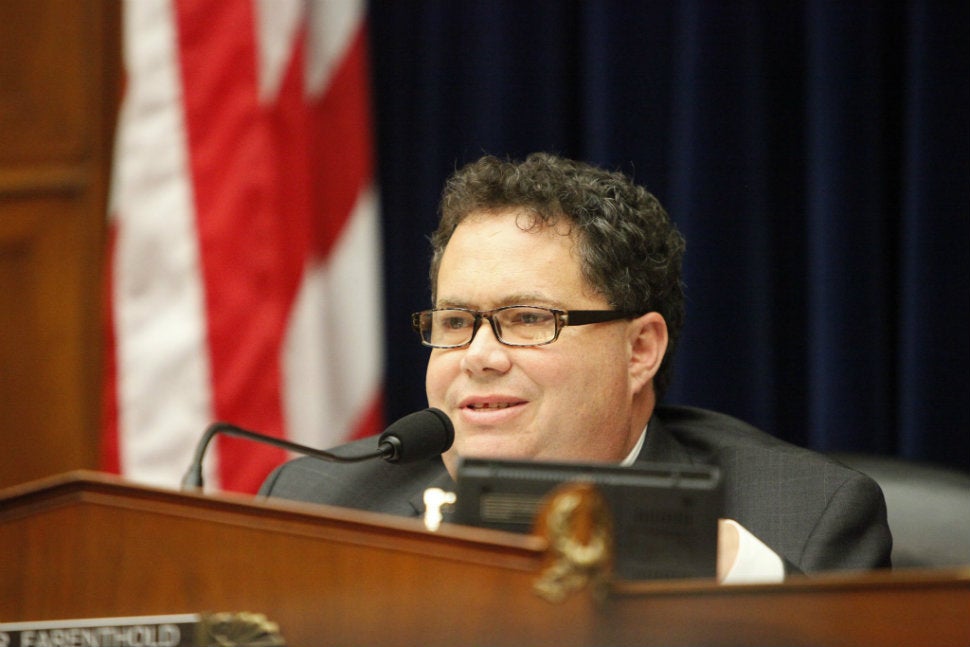
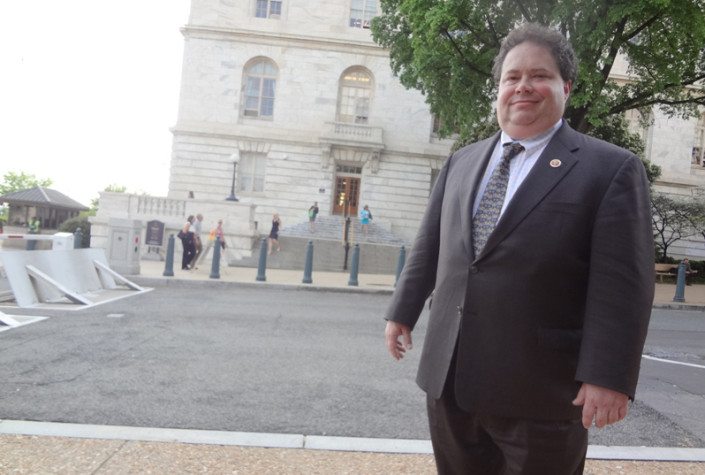
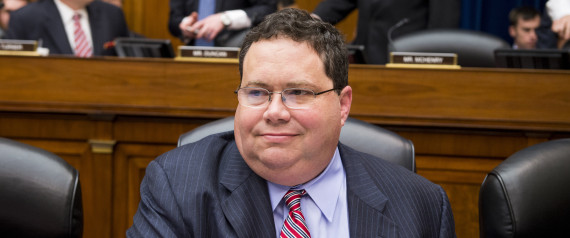
The voters have elected bros to Congress before and they will do so again in the future. We’ve even had a bro for President. I think you know who I’m talking about. The voters of the 27th district of Texas have topped everyone by electing the bro-est bro to ever walk the halls of Congress: Blake Farenthold. One might even call him a dudebro, and that is why he is malaka of the week.
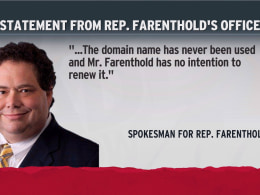
It’s been a tough week for Malaka Dudebro. We learned that in his days as a tech bro, he owned a rather colorful domain name: Blow-Me.org. Did I say during his time as a tech bro? He’s owned it continuously since 1996 according to a piece by Andrew Kaczynski of Buzzfeed [ http://www.buzzfeed.com/andrewkaczynski/blow-me-domain (blurbed, first item this post)]. A spokesbro for Malaka Dudebro had this to say about that:
“Prior to serving in Congress, Mr. Farenthold operated a computer consulting company that routinely bought domain names including the one in question. The domain name has never been used and Mr. Farenthold has no intention to renew it.”
That’s very responsible. Of course, Congressman Dudebro was first elected in 2010. He’s obviously too busy to deal with ephemera such as Blow-Me.Org as you can see from the picture below:
Farenthold is the bro on the right in the duck jammies. The mere sight of him makes me want to duck and cover. The pajama party pictures were published in October, 2010 [ http://gawker.com/5665630/politician-stands-next-to-a-lingerie-model-while-wearing-duckie-pajamas ], which means that he was elected in a broslide. Actually, it was very close but I suspect that the bros of his district saw that picture and decided to elect one of their own even if he has an eerie resemblance to dorky cherub Thurman Merman of Bad Santa fame:
Congressman Dudebro may *look* like the advent calendar loving, sandwich obsessed Thurman Merman, but he’s pure Willie T. Stokes underneath that bro-fro:
A former staffer with Rep. Blake Farenthold (R-TX) is suing the congressman’s office over an alleged hostile work environment and sexual harassment, including that the congressman communicated he was having “wet dreams” about the staffer and insinuated that she had semen on her skirt.
Greene alleges that Farenthold, a congressman who made headlines [ http://www.buzzfeed.com/andrewkaczynski/blow-me-domain (again, blurbed, first item this post)] earlier this week for being listed as the registrant for the URL blow-me.org in 1999 —only recently releasing it, made a number of attempts to gauge whether she was interested in having sex with him. The complaint filed by Greene alleges that Farenthold told Greene that he was estranged from his wife and had not had sex with her in years. It also said that he suggested that something on her skirt looked like semen.
“On one specific occasion, Farenthold told Greene that she had something on her skirt and that he hoped his comment wouldn’t be taken for sexual harassment,” the complaint said. “A reasonable person would infer that Farenthold was joking that she had semen on her skirt.”
The suit also alleges that staffers felt Farenthold flirted too much and when they joined him on Capitol Hill functions they joked that they were on “red head patrol” to make sure Farenthold didn’t do anything untoward. Farenthold also once said during a staff meeting that a female lobbyist propositioned him to have a “threesome” once.
Most of the attention in the lawsuit has fallen on another staffer relaying allegedly relaying comments from Farenthold to Greene where he said that he had “wet dreams” and sexual fantasies about her. Farenthold, according to the lawsuit, knew those comments would reach Greene.
Farenthold’s “wet dream” remark takes us into the realm of literal malakatude and is, quite frankly, gross. I’m surprised that he didn’t suggest that Ms. Greene do a video for Girls Gone Wild or some such shit. It’s so disgusting that I’ll even pass on making any Monica Lewinsky dress jokes.
Prior to Ms. Greene’s law suit, Farenthold was your common garden variety teabagger. He’s dabbled in birtherism, speculated about impeachment, and voted against the interests of the people in his district. Now he’s become an embarassment to his caucus and a full blown bro-saster. Of course, the country is full of bros like Farenthold; oafish toads who mistakenly think they’re irresistible to women. I guess he took Henry Kissinger’s aphorism “power is the ultimate aphrodisiac” too literally and that is why Blake Farenthold is malaka of the week.
Sen. Feinstein’s tweets from the trenches December 11, 2014 [...] Drone roundup At a congressional hearing Wednesday, one congressman revealed what he’s asking Santa for this year: Rep. Blake Farenthold (R-Tex.) wants his very own drone. “I’ve got a quadcopter on my Christmas list, as I suspect quite a few people do,” Farenthold told Peggy Gilligan, the Federal Aviation Administration’s associate administrator for aviation safety. These aerial robots are used primarily to take photos from above. Commercially sold “unmanned aerial vehicles” are increasingly popular — you can buy one online for as little as $32 or as much as $900 — but the FAA has been slow to develop regulations to ensure they are operated safely. Our colleague Craig Whitlock, who covered the House Transportation and Infrastructure hearing on commercial drone security, wrote that there is concern the small devices could hit a plane, causing an accident. The FAA, which has imposed some prohibitions while it works on broader regulations, is finding it difficult to regulate drone use. In other drone news, a New York reporter probably wishes there were tighter regulations. Chain restaurant TGI Fridays had the inspired idea to fly a drone with a mistletoe around its restaurant in Brooklyn to encourage patrons to kiss. Which was all sweet and nice until the drone lost control and hit a Brooklyn Daily photographer, slicing her nose and chin. According to the newspaper, the drone operator was unfazed. “If people get hurt, they’re going to come regardless. People get hurt in airplanes, they still fly,” David Quiones said. “There is a risk involved — anything flying, there is risk.” But seriously, congressman, if you get your Christmas wish, be careful. [...] http://www.washingtonpost.com/politics/sen-feinsteins-tweets-from-the-trenches/2014/12/11/a174e2a0-817c-11e4-8882-03cf08410beb_story.html [with comments]
===
previously in Fat Fuck Farenthold fat fuck exploits -- in addition to (linked in) the post to which this is a reply and preceding and (other) following, see also (linked in):
Talking about "police reform" obscures the task. Today's policies are, at the very least, the product of democratic will.
Ta-Nehisi Coates Dec 22 2014, 10:00 AM ET
The reactions to the murders of two New York police officers this weekend have been mostly uniform in their outrage. There was the predictable gamesmanship exhibited in some quarters, but all agree that the killing of Wenjian Liu and Rafael Ramos merits particular censure. This is understandable. The killing of police officers is not only the destruction of life but an attack on democracy itself. We do not live in a military dictatorship, and police officers are not the representatives of an autarch, nor the enforcers of law handed down by decree. The police are representatives of a state that derives its powers from the people. Thus the strong reaction we have seen to Saturday's murders is wholly expected and entirely appropriate.
For activists and protesters radicalized by the killings of Michael Brown and Eric Garner, this weekend's killing may seem to pose a great obstacle. In fact, it merely points to the monumental task in front of them. The response to Garner's death, particularly, seemed to offer some hope. But the very fact that this opening originated in the most extreme case—the on-camera choking of a man for a minor offense—points to the shaky ground on which such hope took root. It was only a matter of time before some criminal shot a police officer in New York. If that's all it takes to turn Americans away from police reform, the efforts were likely doomed from the start.
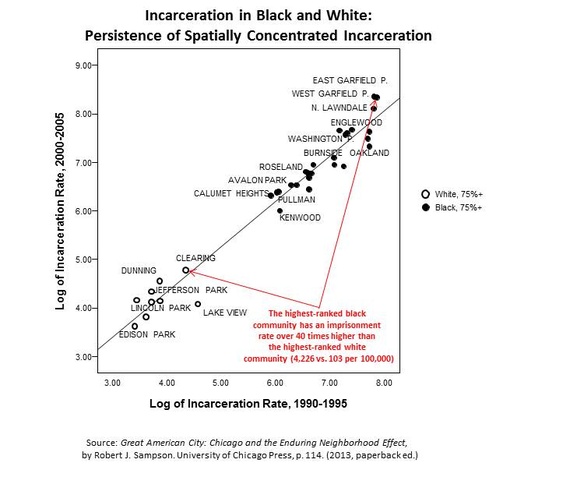
The idea of "police reform" obscures the task. Whatever one thinks of the past half-century of criminal-justice policy, it was not imposed on Americans by a repressive minority. The abuses that have followed from these policies—the sprawling carceral state, the random detention of black people, the torture of suspects [ http://en.wikipedia.org/wiki/Jon_Burge ]—are, at the very least, byproducts of democratic will. Likely they are much more. It is often said that it is difficult to indict and convict police officers who abuse their power. It is comforting to think of these acquittals and non-indictments as contrary to American values. But it is just as likely that they reflect American values. The three most trusted institutions in America [ http://www.gallup.com/poll/1597/confidence-institutions.aspx ] are the military, small business, and the police.
Implicit in this notion is that outrage over killings by the police should not be any greater than killings by ordinary criminals. But when it comes to outrage over killings of the police, the standard is different. Ismaaiyl Brinsley began his rampage by shooting his girlfriend—an act of both black-on-black crime and domestic violence. On Saturday, Officers Liu and Ramos were almost certainly joined in death by some tragic number of black people who were shot down by their neighbors in the street. The killings of Officers Liu and Ramos prompt national comment. The killings of black civilians do not. When it is convenient to award qualitative value to murder, we do so. When it isn't, we do not. We are outraged by violence done to police, because it is violence done to all of us as a society. In the same measure, we look away from violence done by the police, because the police are not the true agents of the violence. We are.
We are the ones who designed the criminogenic ghettos. We are the ones who barred black people from leaving those ghettos. We are the ones who treat black men [ http://www.youtube.com/watch?v=CofLE3q3Qh0 (next below)]
When defenders of the police say that cops do the work ordinary citizens are afraid of, they are correct. The criminal-justice system has been the most consistent tool for making American will manifest in black communities. The tool for exercising that will is not the proliferation of ice cream socials. I suspect, we would like to know as little about criminal justice system as possible. I suspect we would rather the film of Eric Garner's killing not exist. Then we might comfort ourselves with the kind of vague unknowables that dogged the killing of Michael Brown. ("Did he have his hands up? Was he surrendering? Was he charging?") Garner, choked to death and repeating "I can't breathe," trapped us. But now, through a merciless act of lethal violence, an escape route has been revealed. This overstates things. To the extent that this weekend's murders obscure the legacy of Eric Garner, it will not be due to the failure of protests, nor even chance. The citizen who needs to look away generally finds a reason.
I wonder if there is some price attached to this looking away. When the elected mayor of my city arrived at the hospital, the police officers who presumably serve at the public's leisure turned away in a display that should chill the blood of any interested citizen. The police are not the only embodiment of democratic society. And one does not have to work hard to imagine a future when the agents of our will, the agents whom we created, are in fact our masters. On that day one can expect that the tactics intended for the ghettos will enjoy wider usage.
The Case for Police Reform Is Much Bigger Than Michael Brown There are clearer, more persuasive illustrations of law-enforcement misbehavior and the need to rein it in. Nov 26 2014
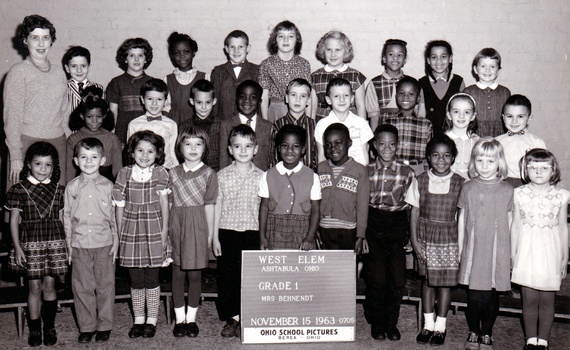
Mrs. Norton's third-grade class. The author is in the second row from the top, next to the teacher. Courtesy of Connie Schultz
How to find the fragile middle in a time of racial tension
Connie Schultz Dec 23 2014, 7:00 AM ET
My earliest memories of my father’s racism are rooted in the family dinners of my childhood.
Dad sat to my left, always. My mother sat across from me, with my little brother seated to her right. My two younger sisters sat at opposite ends. In the 1960s, our table was metal, and small. There was no escaping whatever was on our father’s mind.
I cannot quote verbatim his tirades, and I am grateful for that small mercy, but I remember his tone with a bone-deep weariness. Raised voice, fist on the table. He was angry with black people for reasons that depended on his day at the plant, a song on the radio, a story he’d read in the afternoon paper. To this day, I hear the n-word and can see the contortions in his face.
Most daughters want to be daddy’s little girl. This aspiration was lost on me at an early age. I loved my father, always, and feared him too often, but by age 6 or so I knew there was something wrong about him. He would rant about black people he’d never met, and I would see the faces of my classmates, my friends. Silently, I’d pick at the fried Spam or pile of goulash on my plate and think about Sandy and Gary and Valerie and Phillip, and sometimes my eyes would sting. It was not the natural order of things to be so young and know your father had no idea what he was talking about.
I live in Cleveland, where a 12-year-old black boy named Tamir Rice was recently shot and killed by a white police officer. The community at large professed outrage, but when I attended his public funeral it was filled with black mourners, and I left wondering if maybe most of us white people think this isn’t our problem anymore. After weeks of reading and moderating public comment threads about the deaths this year of Tamir and two other unarmed black males, Michael Brown and Eric Garner, I can’t ignore this dark and familiar something clawing at my heart.
There are moments when it feels like we’re inching back toward the 1960s, but back into communities that are far more segregated, by race and means. If you are black and poor, you can now spend your entire childhood knowing only other poor, black children. If you are born lucky and grow up surrounded by mirror images of your good fortune, it’s easy to see yourself as a majority stakeholder in a world primed to do your bidding.
Last week, I walked down to the basement of my home to dig up class pictures from my elementary-school days. I haven’t looked at those faces in 20 years, I’ll bet, but I could summon the names of just about every child in them, and the complicated memories that tag along.
There we are, lined up shoulder-to-shoulder on risers in the basement of West Elementary School, hands to our sides, faces wide. In each picture, half of the class is black. Those black faces, as surely as the color of my eyes and the gaps between my two front teeth, are evidence of my roots. At the same time, they telegraph the lifelong struggle of my father, who for so long saw their existence in my life as a failure in his.
I grew up in Ashtabula, a working-class town of 20,000 people an hour east of Cleveland. Mom stayed home with us in the early years. Dad worked for the Cleveland Electric Illuminating Company on Lake Erie’s shore. His job made him big and strong and often angry for reasons we didn’t understand. He worked in maintenance. Until I was 10, I thought that meant he was a custodian, when in reality he held one of the most skilled jobs at the plant. We were raised to understand that our father went to work so that he could take care of us. Our curiosity ended there.
We lived in a rental house on U.S. Route 20, on the integrated side of town. The West End, we called it. The house is still there, and has been boarded up for years. Our street was all white, but the short walk to school delivered me to classrooms evenly divided between white and black kids. In second grade, we had eight black kids, seven white. By fourth grade, the numbers jumped to 15 each. My third-grade teacher, Mrs. Norton, was black. This was a big deal in my neighborhood. My mother often mentioned that Mrs. Norton had a lot of class, but she said this only to her girlfriends. Never at the dinner table.
The author is in the top right. Courtesy of Connie Schultz
I grew up surrounded by children who didn’t look like me, and my only problem with that, aside from the constant tension with my father, was that I wanted to be them. The girls were my confidants, my touchstones. We played with each other’s hair and swapped barrettes and ribbons like boys trading baseball cards. I loved their music, from the Motown on their kitchen radios to the gospel songs in their churches, where worshippers praised God like they knew him, instead of sitting ramrod-straight week after week waiting to make his acquaintance.
I loved their mothers, too. Ours was not an “I love you” kind of home, and I melted in the arms of these women who called me “child” and “honey” and always ordered me to sit at their tables for after-school snacks. Surely they noticed that their children were never invited to my home, but I never felt they held that against me.
My father had no idea that I visited my black friends’ churches or stepped foot in their homes. I don’t remember my mother ever saying we were keeping our secrets. The conspiracy was implicit; the necessity understood.
Here begins the long list of excuses I’ve made for my father in my head all of my adult life.
He grew up on a farm in Northeast Ohio, surrounded by other white, rural folk, many of them family. By his lights, the high point of his life was his senior year in high school, when the local newspaper heralded him as one of the best point guards in the state. I have his scrapbook from that year. It’s full of yellowed newsprint and black-and-white glossy photos starring a skinny hotshot with sweaty red hair from Nowhere, Ohio. I have his collection of felt varsity letters, too. Nearly 60 years old, and in pristine condition.
My father had a chance to go to college on a basketball scholarship. I learned this only after his death, when my sisters found the letter from the university’s basketball coach. He never mailed in the appointment card, never used the bus ticket. Instead, Mom became pregnant with me, and Dad got a marriage license and a union card the same year. By the time he was banging his fist on the dinner table in 1963, he was still four years from 30 and the father of four. Everywhere he looked, he saw his missed opportunities blooming in someone else’s life.
When I started junior high school in 1969, my father and I were arguing all the time, sometimes about boys, occasionally about hemlines, but usually about race. He was full of contradictions. He liked a black guy at work, but that’s because he didn’t “act black.” He loved The Supremes until I played them constantly, at which point he set a limit on how many black artists’ records I could buy with my babysitting money. One a month, tops. He smashed my 45 of Aretha’s “Respect” into a pile of pieces when I violated the rule.
The timing of his attempt to rein me in couldn’t have been worse, because everything was changing at school. Within days of my seventh-grade year, the kids who had come from the all-white elementary school on the other side of town took note of my companions at the lunch table and started calling me a n— lover. The kids from the mostly black elementary school badgered my friends for hanging out with the white girl. The same mothers who used to pull me to their bosoms now acted like they didn’t see me in the hallways and at Friday-night games, and nodded terse hellos to my parents.
My father saw a glimmer of hope in my feelings of abandonment. So much for friendship. Blood’s thicker than water. Guess you’re learning that God made us different for a reason.
Courtesy of Connie Schultz
I had spent most of my childhood identifying with children who did not look like me, and in a fit of pubescent angst, decided it was time to change that. A week before school pictures, I talked a neighbor lady into cutting my long hair and giving me a white girl’s Afro with a Toni perm.
My mother collapsed on the sofa and fanned her face with her apron. My father refused to be seen in public with me. When he found out I had a crush on a black boy, he grounded me for weeks. I bought tubes of QT [ http://www.youtube.com/watch?v=03_7wzQjT7c (next below)]
and worked on my tan.
My father and I were at war.
By the time I was a senior in high school, in the fall of ’74, my dad had finally managed to save enough money to buy a house on the white side of town. For the first time, I had my own room, and he took me to Sears to buy a bedroom set. A peace offering, but détente was temporary. I left for college and joined the school newspaper. I was back at it, this time with an audience. After a disastrous sophomore summer home, he ordered me to live elsewhere, and I happily complied.
If the story ended there, at the gulf of our divisions, I would feel no hope now in these troubled times. I would look at those class pictures from my childhood and see a failed experiment in good intentions. I’d have to tell myself that some white people, white people like my father, are just unreachable.
For years, I wondered: How good is a daughter’s liberation if her father only sees it as his failure? Where’s the victory in that? Maybe it’s enough for those who don’t care what their father thinks, but I always did. I didn’t want his approval. I wanted his agreement that he’d been wrong all along about black people. More to the point, I wanted him to admit he’d been wrong about me.
I wish I could say I stayed true to my roots in a rocket-straight trajectory from that first-grade picture to today. I raised my two children in diverse school systems, deliberately so, but after they graduated from high school I just as deliberately spent eight years in an all-white suburb on Cleveland’s west side. I didn’t move there because everyone looked like me—I had married then-U.S. Representative Sherrod Brown [ http://www.amazon.com/His-Lovely-Wife-Memoir-Beside-ebook/dp/B000SCHBCA ], and we had to live in his congressional district—but I should have known that a lifetime of something else would render me a hypocrite under the circumstances. If I’ve learned anything about myself in the last few years, it’s that somewhere inside me resides a five-year-old capable of delivering withering criticism. A child remembers, always.
Last year we moved into the city of Cleveland, where I’ve worked as a journalist for more than 30 years. I can’t run to the drugstore or fetch a loaf of bread without crossing paths with faces that remind me of what I came from—of who I came from, I should say. Some suburban acquaintances have questioned our move with various versions of the same indictment: What were you thinking? Always, I am able to answer: Home. I was thinking of home.
My father died in 2006. He lived seven years longer than my mother. She never got in the middle of our fights about race, but it was her short illness and death, at 62, that helped us find our way to a fragile middle.
The turning point arrived without warning in a hospital waiting room.
It was late August 1999. My mom was weeks from dying. Dad and I were a tag team of concern. We spent our days sitting in offices and waiting rooms, sometimes with Mom, sometimes without her. Over and over, my father would whisper to me, “This should be happening to me. I should be the one who is dying.”
On this particular morning, Dad and I sat wedged together in a packed room, our backs against a wall. We were waiting for Mom, again.
To get to this place, this moment, we had walked behind the black orderly who pushed Mom’s wheelchair down the hall. We had thanked the black receptionist who directed us where to sit. We had just nodded hello to the black resident who always made my mother smile.
My father leaned his head against the wall and closed his eyes.
“God,” he said, “they’re everywhere now.”
I clenched the armrests and tried to control my breathing as I turned to look at him. Tears pooled at the corners of his eyes. For the first time ever, he reached for my hand.
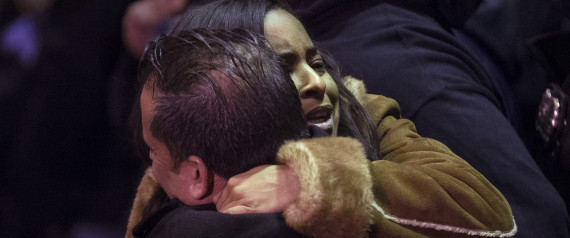
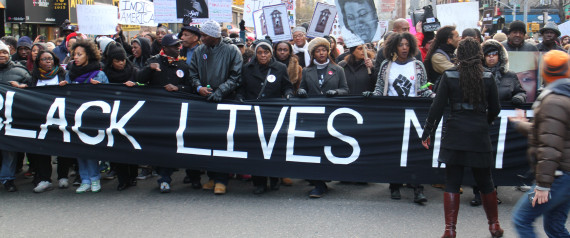
#BlackLivesMatter Condemns NYPD Cop Killings: 'Not Our Vision Of Justice' Mourners gather before the bodies of two fallen NYPD police officers are transported from Woodhull Medical Center, Saturday, Dec. 20, 2014, in New York. An armed man walked up to two New York Police Department officers sitting inside a patrol car and opened fire Saturday afternoon, killing both officers before running into a nearby subway station and committing suicide, police said. 12/21/2014 http://www.huffingtonpost.com/2014/12/21/nypd-cop-killings-blacklivesmatter_n_6362400.html [with comments]
My own hidden biases punched me in the gut last week, as I stared in disbelief at a test result on my computer screen. Before I started the racial-bias assessment, a disclaimer explicitly warned me that those who are not prepared to receive uncomfortable news should not proceed. I was too intrigued to turn back, but it turns out I was unprepared for the outcome.
As I read the results, I thought about what it means to be black and biased against other black people. Does it mean harboring a subconscious contempt for my race? Or considering myself to be part of the blessed segment of an otherwise unfortunate lot? Is it even possible for a black person to be racist against black people? In a moment of self-dramatization, I felt as if Kanye had just announced on national television that I didn’t care about black people.
Then, the tropes saturated my thoughts. I wondered if my bias was the undergirding of the sort of intra-race prejudice colloquially expressed in phrases like “Uncle Tom,” “crab in a barrel,” and “acting white.” Since my results were the same as the 88 percent of white Americans who show a bias [ http://healthland.time.com/2010/10/11/seeking-the-authentic-self-how-do-you-know-if-youre-really-racist-or-sexist/ ] in favor of white people, it seems to me that this demonstrated “strong preference” is the very definition of acting white—a well-worn pejorative that pained me as an awkward adolescent and suddenly felt fresh again.
The Project Implicit [ https://www.projectimplicit.net/index.html ] test [again, the author is referring specifically to the "Race IAT" listed at/accessible via https://implicit.harvard.edu/implicit/selectatest.html ] has been around for a few years, but a recent Mother Jones article titled, “The Science of Why Cops Shoot Young Black Men [ http://www.motherjones.com/politics/2014/11/science-of-racism-prejudice ]” gave it wider currency and helped explain the role of implicit bias in the recent events in Ferguson, Cleveland, and Staten Island, where the aggressive policing of black people turned deadly. The IAT measures the ability to quickly and correctly sort selected words as positive and negative and to distinguish faces as belonging to a white or black person. Through a series of paired word and face sequences, the test detects in milliseconds the time it takes the respondent to associate black faces with positive and negative words relative to the time it takes to match white faces. When a respondent pairs black faces and negative words more quickly than other pairings, it reveals implicit bias.
As difficult as it was to learn about my black-on-black bias, such results are fairly common. This is sadly comforting. The data reveal [ https://implicit.harvard.edu/implicit/demo/background/faqs.html#faq19 ] that black respondents’ implicit biases are split just about evenly between pro-white and pro-black. Other research has also shown [ http://www.cos.gatech.edu/facultyres/Diversity_Studies/Nosek_HarvestingImplicit.pdf ] that black participants tend to have a strong pro-black explicit bias. A conflict emerges: When blacks are asked about their predilections, they express a solid preference for their group over whites, but, in general, performance on the IAT suggests they subconsciously hold a slight preference for whites over blacks.
This dynamic is obviously a direct result of racism. Too often, racism is seen as a social phenomenon that happens to black people. But it happens through black people as well. That is, the negative associations thrust upon black people and black culture can color how we black people view each other. Blacks and whites receive the same narratives and images that perpetuate stereotypes of black criminality and flippancy while synonymizing white culture with American values. It is to be expected that there will be an observable impact on black intragroup perceptions.
The construct of racism is efficiently designed to politically and socially subjugate a segment of the population. For the oppressed, a natural response is to advocate for conformity with the dominant culture as an appeal for equal treatment. If black people were only more respectable, one line of argument runs, they would be less subject to the ills of racism.
The contrast between black respondents’ explicit and implicit biases is a fingerprint of the politics of respectability, a term coined by Evelyn Brooks Higginbotham in her book In Righteous Discontent: The Women's Movement in the Black Baptist Church, 1880-1920 [ http://www.amazon.com/Righteous-Discontent-Movement-Baptist-1880-1920/dp/0674769783 ]. In her conception, the politics of respectability involves the “reform of individual behavior as a goal in itself and as a strategy for reform.” Higginbotham argued that black Baptist women “rejected white America’s depiction of black women as immoral, childlike, and unworthy of respect of protection” by teaching blacks to mind their manners, dress and speak appropriately, and remain free from sexual and other vices. Thus, the politics of respectability say that if black people behaved more like the proffered white ideal, the result would be equal treatment and the demise of racial discrimination. This tactic was a form of political protest based on an appeal to white humanity, but it has had troublesome side effects.
This thread has persisted in black scholarship and society for decades. From W.E.B. DuBois’ Talented Tenth [ http://teachingamericanhistory.org/library/document/the-talented-tenth/ ] in 1903 to Bill Cosby’s infamous [ http://www.theatlantic.com/magazine/archive/2008/05/-this-is-how-we-lost-to-the-white-man/306774/ ] Pound-Cake Speech a hundred years later, the politics of respectability has often taken on the quality of black theology. Members of the black community are told that wearing the mask, playing the game, and being twice as good are the keys to making it in America. It’s as if to say, “If we only knew how to act, racism would just fall away.” This is, of course, absurd. Good behavior and attire deemed proper do not abrogate racism. Discrimination does not come with a dress code.
The politics of respectability is really a coping mechanism. It affirms the inferiority and unattractiveness of black culture. And it contributes to the formation of implicit biases that lead black people to prefer white people over their own.
But it’s not the only option. Unable to live with my “strong automatic preference,” I took the test a few more times. Through repeated attempts, I trained myself to react evenly to the black, white, positive, and negative pairings. In a sense, through acknowledgement of the bias and a concerted effort to modify my behavior, I suppressed the implicit bias. By my fourth and final attempt, I exhibited no preference at all. If each of us is willing to recognize our implicit biases and police our actions accordingly, there may be hope for the racial aspect of the American experiment after all.
Theodore R. Johnson [ http://www.theatlantic.com/theodore-r-johnson/ ] is a writer and naval officer. He has served as a military professor at the Naval War College and as a 2011 – 2012 White House Fellow.
Wow. Eric Garner's youngest daughter, Erica, just came by memorial for NYPD cops. Told me she wanted to show solidarity for the families. 11:08 AM - 22 Dec 2014 https://twitter.com/Liz_Kreutz/status/547106301080522752 [with comments]
Hidden Racial Anxiety in an Age of Waning [. . .] Racism
Molly Riley/Reuters
Even as they quickly condemn the likes of Donald Sterling, surveys reveal whites have serious misgivings about a more diverse nation.
Robert P. Jones May 12 2014, 8:00 AM ET
Typically, April showers bring May flowers. This year, however, April also delivered a torrent of racially charged issues to the national stage. In Michigan, the U.S. Supreme Court upheld [ http://www.theatlantic.com/national/archive/2014/04/schuette/361063/ ] the ban on university-admissions programs that use race as a criterion in college admissions. Clippers owner Donald Sterling ignited a firestorm [ http://www.theatlantic.com/politics/archive/2014/05/This-Town-Needs-A-Better-Class-Of-Racist/361443/ (third item below)] when a recording surfaced in which he asked his mixed-race girlfriend not to post photos of herself with black people on Instagram or bring black people to NBA games. Nevada rancher Cliven Bundy garnered support from Senator Rand Paul and other prominent conservatives in the wake of his standoff with the federal government over cattle grazing rights. But most supporters hurried to distance themselves from Bundy when he offered these stunning remarks [ http://www.theatlantic.com/politics/archive/2014/04/cliven-bundy-wants-to-tell-you-all-about-the-negro/361152/ ] at a news conference:
I want to tell you one more thing I know about the Negro …. They abort their young children, they put their young men in jail, because they never learned how to pick cotton. And I’ve often wondered, are they better off as slaves, picking cotton and having a family life and doing things, or are they better off under government subsidy?
The nearly unanimous denunciations of both Sterling and Bundy makes clear that as nation, we have moved beyond the point where blatantly racist statements are publicly acceptable, easily explained away, and carry no real consequences.
When did this happen? While cultural shifts are difficult to pin down, there is good evidence that the country reached a tipping point in attitudes about racism sometime in the mid-1990s. For example, the Southern Baptist Convention, the nation’s largest Protestant denomination and an anchor of southern culture, finally came around to offering a sober apology [ http://articles.philly.com/1995-06-21/news/25690255_1_northern-baptists-slavery-southern-baptists ] for its former defense of slavery, Jim Crow segregation, and racism at its 1995 annual meeting in Atlanta.
Google’s Ngram viewer allows us to assess the relative usage frequency of the words “prejudice” and “racism” in American English books over time, revealing a confirming pattern. The frequency of the more generic word “prejudice” remains relatively stable from 1900 through 1970, when it begins to decline. According to the Oxford English Dictionary, the more normative word “racism” did not appear until 1902 [ http://www.npr.org/blogs/codeswitch/2014/01/05/260006815/the-ugly-fascinating-history-of-the-word-racism ], and its usage only begins to pick up in the mid-1960s just as major federal civil-rights legislation is passing. The term “racism” rises through the early 1970s, declines during the Reagan-era 1980s, but then rises sharply again in the 1990s. Most notably, the term “racism,” which relies both on the acknowledgment of racial bias and on a shared normative negative judgment, outpaces the term “prejudice” for the first time in the early 1990s and significantly exceeds it by the mid-1990s.
[dinky little interactive chart that won't embed here, illustrating the point just made, embedded]
Well before the election of the first black president in 2008, the condemnation of direct and open expressions of racism had become a social norm. While the fading acceptability of openly racist attitudes is to be celebrated, it clearly does not mean that race no longer matters or that racial tensions and anxieties have disappeared. In her scathing dissent [ https://supreme.justia.com/cases/federal/us/572/12-682/case.pdf ] in the Michigan case, Justice Sonia Sotomayor chastised her colleagues for downplaying the continuing significance of race:
Race matters…. This refusal to accept the stark reality that race matters is regrettable. The way to stop discrimination on the basis of race is to speak openly and candidly on the subject of race, and to apply the Constitution with eyes open to the unfortunate effects of centuries of racial discrimination.
For civil-rights activists, the challenge is that the open racism of the past may transmute into what Ta-Nehisi Coates describes [ http://www.theatlantic.com/politics/archive/2014/05/This-Town-Needs-A-Better-Class-Of-Racist/361443/ (again, third item below)] as an “elegant racism” that is less visible and that “disguises itself in the national vocabulary, avoids epithets and didacticism,” For researchers, journalists, and policymakers, the new challenge is that this positive social norm may make the public less willing to speak openly and candidly about race, a problem social scientists call “social-desirability bias.”
Recent research reveals that social-desirability bias remains active in the measurement of white anxieties about the changing racial composition of the country. In early 2013, the Public Religion Research Institute team set up a controlled survey experiment [ http://publicreligion.org/research/2013/03/march-2013-religion-politics-tracking-survey/ ] designed to assess anxieties concerning the changing racial makeup of the country. First, we asked respondents to tell telephone interviewers whether they agreed or disagreed with the statement, “The idea of an America where most people are not white bothers me.” Among whites, 13 percent admitted to an interviewer that the idea of a majority-minority America bothers them. There was only modest variation among white subgroups, ranging from 10 percent of younger whites young than 50 years of age at the low end to 18 percent of white Republicans at the high end who said an America that is not mostly white concerns them.
Next, we employed a technique called a list experiment, which is designed to allow respondents to indirectly express their views on sensitive subjects. We divided the survey respondents into two demographically identical groups and asked each group to tell us how many, but not which specific items from a list bothered them. One group was designated as a control group and received three control statements, while the other group was designated as a treatment group and received the same three control statements plus a fourth statement that read, “An America that is not mostly white.” Because the control and treatment groups were demographically identical, any variation in the average number of statements chosen between the groups is solely attributable to respondents in the treatment group picking the treatment statement. For any subgroup (but not for an individual), then, one can statistically estimate the proportion of respondents choosing the treatment statement by subtracting the mean number of statements chosen by the treatment group from the mean number of statements chosen by the control group. That number is presented in the chart below as the “indirect response.”
The indirect responses revealed significant social-desirability bias at work across all white subgroups and produced a much more dramatic spread in opinions among white respondents. Among white Americans overall, the indirect measure was nearly 20 percentage points higher than the direct measure (31 percent versus 13 percent). White non-born-again Christians and white non-southerners register the lowest indirect measures of concern, but even with these groups there is a double-digit social-desirability-bias effect at play. For example, while only 13 percent of whites outside the South say a majority-minority country bothers them, fully one-quarter register this opinion when the indirect measure is used.
Notably, the racial anxiety differences between white Republicans and white Democrats are significant on the direct question, with white Republicans more likely than white Democrats to say a majority non-white country bothers them (18 percent versus 11 percent). But this apparent difference disappears with the indirect measure; when white Democrats are given the opportunity to register this opinion indirectly, those expressing concern over racial changes jumps from 11 percent to 33 percent, while white Republicans expressing concern rises from 18 percent to 30 percent.
White born-again Protestants and white southerners, two overlapping groups, register both the highest indirect measures of anxiety about racial changes in the country and the strongest social-desirability-bias effect. When asked by a telephone interviewer directly about whether an America that is not mostly white bothers them, only 15 percent of white born-again Protestants are willing to agree. But that number climbs a stunning 35 percentage points when the question is posed indirectly. Similarly, the difference between the direct and indirect question among white southerners is 26 percentage points, 16 percent when asked directly but 42 percent when asked indirectly.
The core of Sotomayor’s dissent was that even after significant civil-rights legislation has passed, the Southern Baptist denomination has apologized, and the nation has elected a black president, race still matters. The data suggest we are still living in a liminal time, when outright racism is nearly universally condemned but when white Americans still carry significant unspoken anxiety and negative feelings about the shifting racial balance in the country.
It's easy for polite American society to condemn Cliven Bundy and banish Donald Sterling while turning away from the elegant, monstrous racism that remains.
A fair-minded reader will note that each of these conservatives is careful to not praise slavery and to note his or her disgust at the practice. This is neither distinction nor difference. Cliven Bundy's disquisition begins with a similar hedge [ http://www.youtube.com/watch?v=agXns-W60MI (next below)]:
"We've progressed quite a bit from that day until now and we sure don't want to go back." With so little substantive difference between Bundy and other conservatives, it becomes tough to understand last week's backpedaling in any intellectually coherent way.
But style is the hero. Cliven Bundy is old, white, and male. He likes to wave an American flag while spurning the American government and pals around with the militia movement. He does not so much use the word "Negro"—which would be bad enough—but "nigra," in the manner of villain from Mississippi Burning or A Time to Kill. In short, Cliven Bundy looks, and sounds, much like what white people take racism to be.
The problem with Cliven Bundy isn't that he is a racist but that he is an oafish racist. He invokes the crudest stereotypes, like cotton picking. This makes white people feel bad. The elegant racist knows how to injure non-white people while never summoning the specter of white guilt. Elegant racism requires plausible deniability, as when Reagan just happened to stumble into the Neshoba County fair [ http://www.nytimes.com/2007/11/13/opinion/13herbert.html ] and mention state's rights. Oafish racism leaves no escape hatch, as when Trent Lott praised Strom Thurmond's singularly segregationist candidacy.
Elegant racism is invisible, supple, and enduring. It disguises itself in the national vocabulary, avoids epithets and didacticism. Grace is the singular marker of elegant racism. One should never underestimate the touch needed to, say, injure the voting rights of black people without ever saying their names. Elegant racism lives at the border of white shame. Elegant racism was the poll tax. Elegant racism is voter-ID laws.
"The way to stop discrimination on the basis of race is to stop discriminating on the basis of race," John Roberts elegantly wrote [ http://www.oyez.org/cases/2000-2009/2006/2006_05_908 ]. Liberals have yet to come up with a credible retort. That is because the theories of John Roberts are prettier than the theories of most liberals. But more, it is because liberals do not understand that America has never discriminated on the basis of race (which does not exist) but on the basis of racism (which most certainly does.)
Ideologies of hatred have never required coherent definitions of the hated. Islamophobes kill Sikhs as easily as they kill Muslims. Stalin needed no consistent definition [ http://en.wikipedia.org/wiki/Kulak ] of "Kulaks" to launch a war of Dekulakization [ http://en.wikipedia.org/wiki/Dekulakization ]. "I decide who is a Jew," Karl Lueger said [ http://en.wikipedia.org/wiki/Karl_Lueger ]. Slaveholders decided who was a nigger and who wasn't. The decision was arbitrary. The effects are not. Ahistorical liberals—like most Americans—still believe that race invented racism, when in fact the reverse is true. The hallmark of elegant racism is the acceptance of mainstream consensus, and exploitation of all its intellectual fault lines.
Here is a lovely illustration of elegant racism:
This graph is from Robert J. Sampson's essential 2011 profile of Chicago, Great American City [ http://www.amazon.com/Great-American-City-Enduring-Neighborhood/dp/0226734560 ]. Sampson's data depicts incarceration rates in the early to mid-'90s in Chicago among black (black dots) and white neighborhoods (white dots.) Increasingly, sociologists like Sampson are showing us how our brute and strained vocabulary fails to articulate the problem of racism. Conservatives and liberals frequently wonder how it could be that unequal outcomes endure for blacks and whites, even after controlling for income or "class." That is because conservatives and liberals underestimate the achievements of white supremacy [ http://www.theatlantic.com/politics/archive/2014/03/other-peoples-pathologies/359841/ ] and still believe that comparisons between a "black middle class" and a "white middle class" have actual meaning. In fact, black and white people—of any class—live in wholly different worlds.
A phrase like "mass incarceration" obviates the fact that "mass incarceration" is mostly localized in black neighborhoods. In Chicago during the '90s, there was no overlap between the incarceration rates of black and white neighborhoods. The most incarcerated white neighborhoods in Chicago are still better off than the least incarcerated black neighborhoods. The most incarcerated black neighborhood in Chicago is 40 times worse than the most incarcerated white neighborhood.
The Justice Department announced today the largest monetary payment ever obtained by the department in the settlement of a case alleging housing discrimination in the rental of apartments. Los Angeles apartment owner Donald T. Sterling has agreed to pay $2.725 million to settle allegations that he discriminated against African-Americans, Hispanics and families with children at apartment buildings he controls in Los Angeles.
Throughout the 20th century—and perhaps even in the 21st—there was no more practiced advocate of housing segregation than the city of Chicago. Its mayors and aldermen razed neighborhoods and segregated public housing. Its businessmen lobbied for racial zoning. Its realtors block-busted whole neighborhoods, flipping them from black to white and then pocketing the profit. Its white citizens embraced racial covenants—in the '50s, no city had more covenants in place than Chicago.
If you sought to advantage one group of Americans and disadvantage another, you could scarcely choose a more graceful method than housing discrimination. Housing determines access to transportation, green spaces, decent schools, decent food, decent jobs, and decent services. Housing affects your chances of being robbed and shot as well as your chances of being stopped and frisked. And housing discrimination is as quiet as it is deadly. It can be pursued through violence and terrorism, but it doesn't need it. Housing discrimination is hard to detect, hard to prove, and hard to prosecute. Even today most people believe that Chicago is the work of organic sorting, as opposed segregationist social engineering. Housing segregation is the weapon that mortally injures, but does not bruise. The historic fumbling of such a formidable weapon could only ever be accomplished by a graceless halfwit—such as the present owner of the Los Angeles Clippers.
Like Cliven Bundy, Donald Sterling confirms our comfortable view of racists. Donald Sterling is a "bad person." He's mean to women. He carouses with prostitutes. He uses the word "nigger." He fits our idea of what an actual racist must look like: snarling, villainous, immoral, ignorant, gauche. The actual racism that Sterling long practiced, that this society has long practiced (and is still practicing) must attract significantly less note. That is because to see racism in all its elegance is to implicate not just its active practitioners, but to implicate ourselves.
Far better to implicate Donald Sterling and be done with the whole business. Far better to banish Cliven Bundy and table the uncomfortable reality of our political system. A racism that invites the bipartisan condemnation of Barack Obama and Mitch McConnell must necessarily be minor. A racism that invites the condemnation of Sean Hannity can't be much of a threat. But a racism, condemnable by all civilized people, must make itself manifest now and again so that we may celebrate how far we have come. Meanwhile racism, elegant, lovely, monstrous, carries on [ http://www.thisamericanlife.org/radio-archives/episode/512/house-rules ].
Nashville, TN's Petty (@Petty615) takes Samuel L. Jackson up on his challenge and portrays his views on the societal issues we have been facing the last few months.
In this week’s address, the President reflected on the significant progress made by this country in 2014, and in the nearly six years since he took office.
*
Weekly Address: America’s Resurgence Is Real
The White House Office of the Press Secretary December 20, 2014
WASHINGTON, DC — In this week’s address, the President reflected on the significant progress made by this country in 2014, and in the nearly six years since he took office. This past year has been the strongest for job growth since the 1990s, contributing to the nearly 11 million jobs added by our businesses over a 57-month streak. America is leading the rest of the world, in containing the spread of Ebola, degrading and ultimately destroying ISIL, and addressing the threat posed by climate change. And earlier this week, the President announced the most significant changes to our policy towards Cuba in over 50 years. America’s resurgence is real, and the President expressed his commitment to working with Congress in the coming year to make sure Americans feel the benefits.
The audio of the address and video of the address will be available online at www.whitehouse.gov at 6:00 a.m. ET, December 20, 2014.
Remarks of President Barack Obama Weekly Address The White House December 20, 2014
Hi, everybody. As 2014 comes to an end, we can enter the New Year with new confidence that America is making significant strides where it counts.
The steps we took nearly six years ago to rescue our economy and rebuild it on a new foundation helped make 2014 the strongest year for job growth since the 1990s. Over the past 57 months, our businesses have created nearly 11 million new jobs. And in a hopeful sign for middle-class families, wages are on the rise again.
Our investments in American manufacturing have helped fuel its best stretch of job growth since the ‘90s. America is now the number one producer of oil and gas, saving drivers about 70 cents a gallon at the pump over last Christmas. The auto industry we rescued is on track for its strongest year since 2005. Thanks to the Affordable Care Act, about 10 million Americans have gained health insurance in the past year alone. And since I took office, we have cut our deficits by about two-thirds.
Meanwhile, around the world, America is leading. We’re leading the coalition to degrade and ultimately destroy ISIL. We’re leading the global fight to combat the Ebola outbreak in West Africa. We’re leading global efforts to address climate change, including last month’s joint announcement with China. We’re turning a new page in our relationship with the Cuban people.
And in less than two weeks, after more than 13 years, our combat mission in Afghanistan will be over, and our war there will come to a responsible end. Today, more of our troops are home for the holidays than at any time in over a decade. Still, many of our men and women in uniform will spend this Christmas in harm’s way. And as Commander-in-Chief, I want our troops to know: your country is united in our support and gratitude for you and your families.
The six years since the financial crisis have demanded hard work and sacrifice on everyone’s part. But as a country, we have every right to be proud of what we’ve got to show for it. More jobs. More insured. A growing economy. Shrinking deficits. Bustling industry. Booming energy.
Pick any metric you want – America’s resurgence is real. And we now have the chance to reverse the decades-long erosion of middle-class jobs and incomes. We just have to invest in the things that we know will secure even faster growth in higher-paying jobs for more Americans. We have to make sure our economy, our justice system, and our government work not only for a few, but for all of us. And I look forward to working together with the new Congress next year on these priorities.
Sure, we’ll disagree on some things. We’ll have to compromise on others. I’ll act on my own when it’s necessary. But I will never stop trying to make life better for people like you.
Because thanks to your efforts, a new foundation is laid. A new future is ready to be written. We have set the stage for a new American moment, and I’m going to spend every minute of my last two years making sure we seize it.
On behalf of the Obama family, I wish all of you a very Merry Christmas.