News Focus
News Focus
icon url

fuagf

09/08/14 12:07 AM

#227987 RE: fuagf #227420

Mideast Water Wars: In Iraq, A Battle for Control of Water

"The 9 biggest myths about ISIS"

25 Aug 2014: Analysis

Conflicts over water have long haunted the Middle East. Yet in the current fighting in Iraq, the major dams
on the Tigris and Euphrates rivers are seen not just as strategic targets but as powerful weapons of war.


by fred pearce
---
ABOUT THE AUTHOR
Fred Pearce is a freelance author and journalist based in the UK. He serves as environmental consultant for New Scientist magazine and is the author of numerous books, including The Land Grabbers. Previously for Yale Environment 360, he has reported on tensions surrounding oil exploration in Virunga National Park .. http://e360.yale.edu/feature/in_troubled_african_virunga_national_park_a_battle_over_oil_exploration/2761/ .. and why China may end coal's big boom .. http://e360.yale.edu/feature/peak_coal_why_the_industrys_dominance_may_soon_be_over_/2777/.
MORE BY THIS AUTHOR .. http://e360.yale.edu/author/Fred_Pearce/19/
---

There is a water war going on in the Middle East this summer. Behind the headline stories of brutal slaughter as Sunni militants carve out a religious state covering Iraq and Syria, there lies a battle for the water supplies that sustain these desert nations.

Blood is being spilled to capture the giant dams that control the region’s two great rivers, the Tigris and Euphrates. These structures hold back vast


AHMAD AL-RUBAYE/AFP/Getty Images
A Kurdish fighter looks at smoke rising on the horizon following U.S. airstrikes on Islamic State militants at Mosul Dam.

“Managing water works along the Tigris and Euphrates requires a highly specialized skill set, but there is no indication that the Islamic State possesses it,” says Russell Sticklor, a water researcher for the CGIAR, a global agricultural research partnership, who has followed events closely.

The stakes are especially high since the Islamic State’s capture earlier this month of the structurally unstable Mosul Dam on the Tigris, which Iraqi and Kurdish forces, supported by U.S. airstrikes, succeeded in retaking last week. Without constant repair work, say engineers, the Mosul Dam could collapse and send a wall of water downstream, killing tens of thousands of people.

Fights over water have pervaded the Middle East for a long time now. Water matters at least as much as land. It is at the heart of the siege of Gaza – the River Jordan is the big prize for Israel and the Palestinians. And over the years, water has brought Iraq, Syria and Turkey close to war over their shared rivers, the Euphrates and Tigris.

The Euphrates flows out of Turkey, and through Syria and into Iraq, before entering the Persian Gulf via the Mesopotamian marshes. The Tigris rises

"The Islamic State’s quest for hydrological control
began in Syria, when it captured the Tabqa Dam in 2013."


further east in Turkey and flows through territory currently controlled by the Kurdish army in Iraq. There, it follows a parallel path to the Euphrates before the two rivers mingle their waters in the southern marshes.

The two rivers water a region long known as the “Fertile Crescent,” which sustained ancient Mesopotamian civilizations. They were the first rivers to be used for large-scale irrigation, beginning about 7500 years ago. The first water war was also recorded here, when the king of Umma cut the banks of irrigation canals alongside the Euphrates dug by his neighbor, the king of Girsu.

Not much has changed. The dependence persists, and so do the disputes. The main difference today is that the diversion dams are bigger, and supply hydroelectric power as well as water. And that is why in recent months, many of the key battles in Iraq’s civil war have been over large dams.

The Islamic State’s quest for hydrological control began in northern Syria, where in early 2013, it captured the old Russian-built Tabqa Dam, which barricades the Euphrates as it flows out of Turkey. The dam, which is the


Wikimedia Commons/Yale Environment 360
Key dams along the Tigris and Euphrates rivers.

world’s largest earthen dam, is a major source of water and electricity for five million people, including Syria’s largest city Aleppo. It also irrigates a thousand square kilometers of farmland.

The Islamic State’s control of the Tabqa Dam has been haphazard, to say the least. In May, the reservoir behind it, Lake Assad, dramatically emptied. Many blamed Turkey for holding Euphrates water back behind its own dams upstream. But the Arab news service Al Jazeera quoted engineers at the dam as saying that their new masters had ordered them to maximize the supply of electricity. That required emptying the reservoir’s water through the dam’s hydroelectric turbines.

Since late May, the Islamic State has been trying to refill the reservoir by rationing electricity from the dam, with blackouts in Aleppo for 16 to 20 hours a day. Meanwhile, other fighting groups have shut down a water pumping station, cutting off clean water supplies for a million people in Aleppo. The UN’s under-secretary for humanitarian affairs, Valerie Amos, condemned this as a “flagrant violation of international law.”

From the Tabqa Dam, the Euphrates flows downstream through Iraq. Close to Baghdad, in the center of the country, it meets the Fallujah

"After Islamic State forces took the Fallujah Dam, vast
areas of farmland and thousands of homes were flooded."


Dam, which diverts water for massive irrigation projects that produce the crops that feed the country. In early April, Islamic State forces captured the dam. Reports of what happened next are confused, but it appears that the troops immediately shut the dam and stopped flow downstream.

This left towns such as Karbala and Najaf, a Shiite holy city 160 kilometers away, without water. But it also caused the reservoir behind the dam to overflow east, flooding some 500 square kilometers of farmland and thousands of homes as far as Abu Ghraib, about 40 kilometers away on the outskirts of Baghdad. Later, the rebels reopened the dam, causing flooding downstream.

This mayhem may have been a simple failure by Islamic State fighters to understand the hydrology of the river and the consequences of how it operated the dam. It may initially have been an attempt to deprive Shiite communities downstream of water. But Ariel Ahram, a security analyst at Virginia Tech University, suggests the eastward flooding was a deliberate act to repel Iraqi government forces attempting to retake the dam.

The UN secretary-general’s special representative in Iraq, Nickolay Mladenov, called the flooding deliberate .. http://www.iraq-businessnews.com/2014/05/15/un-concerned-at-deliberate-flooding-in-abu-ghraib/, and demanded the restoration of “legitimate” control of the river. The Iraqi government says it has since recaptured the Fallujah Dam .. http://www.iraqinews.com/features/all-gates-of-fallujah-dam-open-says-esawi/. But the conflict in the area continues, and events remain very worrying for anyone downstream.

But the battle for the Fallujah Dam may be a sideshow compared to that for much bigger Haditha Dam, further upstream on the Euphrates. This is the first Iraqi structure on the river after it flows out of Syria. At eight kilometers across, it is Iraq’s second largest dam. It regulates the river for the whole of Iraq, providing the majority of water for irrigation, as well as generating a third of the country’s electricity. It keeps the lights on in Baghdad.

Islamic State fighters controls nearby towns, and in recent weeks have launched repeated offensives to capture the Haditha Dam, which the Iraqi government is equally determined to hold onto. “If the dam fell, then a

"The Mosul Dam, the largest in Iraq, is an engineering disaster waiting to happen."

large source of electricity for the capital could be shut down,” says Sticklor.

If the Sunni rebels want to use water as a weapon of war against the Shiite south of the country, the Haditha Dam would be a potent weapon. “They could disrupt downstream flow, either by withholding water or releasing a wall of floodwater, as they did from Fallujah this spring,” says Sticklor. “It would have a potentially crippling effect on food production and economic activity in central and southern parts of the country.”

It could also be lethal. The water behind Haditha has long been recognized as a potential weapon of war. In late June, employees at the dam told the New York Times .. http://www.nytimes.com/2014/06/26/world/middleeast/isis-iraq.html .. that Iraqi government generals were prepared to open the floodgates against Islamic State forces rather than giving up the dam.

A decade ago, invading U.S. troops made the Haditha Dam their first target, fearing that Saddam Hussein would release a catastrophic flood. (He had a history of making hydrological war. After the first Gulf War, he built huge earthworks to divert both the Tigris and Euphrates away from the Mesopotamian marshes, where rebellious Shiites were hiding.)

The Islamic State fighters have also at times gained control of the other great river, the Tigris. Early on in their offensive, they grabbed the Samarra Barrage, just upstream of Baghdad, which diverts water to fields for irrigation. Messing that up could cripple the country’s breadbasket.

Much worse could happen at the Mosul Dam, which Iraqi and Kurdish forces recaptured from the rebels last week. That dam is the largest in Iraq. It barricades the Tigris about 40 kilometers upstream of Mosul, Iraq’s second largest city. Living downstream of the Mosul Dam on the River Tigris looks particularly risky right now.

The Mosul Dam is an engineering disaster waiting to happen. Back in 2007, the U.S. Army Corps of Engineers called it “the most dangerous dam in the world.” Its foundations are built on porous gypsum that is constantly being dissolved by water in the reservoir, creating sinkholes that threaten

"Climatologists predict the drought will be permanent and the Fertile Crescent ‘will disappear this century.’"

the structural integrity of the dam .. http://el.erdc.usace.army.mil/elpubs/pdf/tr07-10.pdf.

In 2011, the Iraqi government decided to let a two billion Euro contract to the Bauer Group, a Germany-based engineering company, to make the dam safe by constructing underground walls around its foundations. But the scheme has been on hold ever since, because of what the company has called the “political disturbances.” Nor is there progress on a plan to build another dam a little way downstream as a safety net to catch any moving wall of floodwater.

Despite the concerns, Iraqi government engineers have so far managed to keep the Mosul Dam working and the reservoir behind it full. To keep it intact, they have worked around the clock for years, pouring tens of thousands of tons of cement into grouting holes beneath the dam.

Last week, I contacted an Iraqi civil engineer, Nadhir Al-Ansari, now based at the Lulea University of Technology in Sweden, who had been planning to visit the dam this month to check on its state. He told me: “I had to cancel the trip. I tried to call the director of the dam on his personal mobile and there is no answer.”

The reservoir can hold more than 11 cubic kilometers of water. The U.S. Army Corps of Engineers’ report

[INSERT: Crime Scene – New Orleans
http://investorshub.advfn.com/boards/read_msg.aspx?message_id=106026409]

cited a 2004 study by Mark Wheeler of the U.S.-based engineering firm Black and Veatch that predicted a failure of the dam would flood Mosul city within three hours. The flood wave would peak at 20 meters high. Within 72 hours, it would hit Baghdad, still about four meters high.

Despite such disasters in the making, many more dams are on the drawing boards. The Kurds want to complete the half-built Bekhme Dam on a tributary of the Tigris in Iraq close to the Turkish border. At 230 meters

---
[IMAGE]
MORE FROM YALE e360

China’s Dirty Pollution Secret:
The Boom Poisoned Soil and Crops


Three decades of rapid economic development in China has left a troubling legacy – widespread soil pollution that has contaminated
food crops and jeopardized public health. In a three-part series, Yale Environment 360 looks at a grave problem that had been labeled a "state secret."
READ MORE - http://e360.yale.edu/feature/chinas_dirty_pollution_secret_the_boom_poisoned_its_soil_and_crops/2782/
---

high, it would be the largest yet in Iraq. And both Turkey and Iran are capturing ever more of the flows of rivers that drain into Iraq, with Turkey building dams on both the Tigris and Euphrates.

Last month British researchers Furat Al-Faraj and Miklas Scholz of the University of Salford reported the demise of the Diyala River. Called the Sirwan in Iran, it is a major tributary of the Tigris, watering crops east of Baghdad. But in the past 15 years, the Iranians have reduced its flow by more than half. And worse is to come in 2018, when the Iranians plan to complete a new dam .. http://www.salford.ac.uk/news/university-of-salford-researchers-call-for-iran-iraq-water-treaty. The Karkeh River once helped fill the Mesopotamian marshes. But Iran now takes so much of its water for irrigation that the river rarely crosses the border.

This dam-building flies in the face of growing evidence that the entire region is becoming drier. Below average rainfall has persisted for almost a decade now. Less rainfall combined with water diversions have reduced the flow of both the Tigris and Euphrates .. http://www.scirp.org/journal/PaperInformation.aspx?PaperID=35541 .. by more than 40 percent in recent years, says Al-Ansari. Some analysts say that the intense drought of 2007-2009, and the resulting failed crops, helped trigger Syria’s civil war by creating social breakdown as farmers became refugees and food prices soared in cities.

Japanese and Israeli climatologists predicted in 2009 that the drought is likely to be permanent and the Fertile Crescent, which has sustained the region for thousands of years, “will disappear this century .. http://www.newscientist.com/article/mg20327194.200-fertile-crescent-will-disappear-this-century.html.”

As the rivers empty, the temptation to fight over what remains can only grow. It is a true tragedy of the commons.

POSTED ON 25 Aug 2014 IN Business & Innovation Climate Policy & Politics Policy & Politics Pollution & Health Water Asia Middle East

http://e360.yale.edu/feature/mideast_water_wars_in_iraq_a_battle_for_control_of_water/2796/

IT'S GONNA GET HOTTER

See also:

(see big Kerry picture, about 9th from bottom, in a classic F6 post topped by Weathergirl Goes Rogue)

Climate Change Deemed Growing Security Threat by Military Researchers .. specific relevance to above article ..

"The most recent scientific reports on climate change warn that increasing drought in Africa is now turning arable land to desert. The national security report’s authors conclude that the slow but steady expansion of the Sahara through Mali, which is killing crops and leaving farmers starving, may have been a contributing force in the jihadist uprising in that African country in 2012. Since then, Al Qaeda in the Islamic Maghreb has seized control of northern Mali and remains in conflict with the Malian government.

The report warns that rising sea levels in the United States imperil many of the Navy’s coastal installations."
http://www.nytimes.com/2014/05/14/us/politics/climate-change-deemed-growing-security-threat-by-military-researchers.html [with comments]
http://investorshub.advfn.com/boards/read_msg.aspx?message_id=102161216

Hating Democracy in the Middle East?

American foreign policy, in order to be successful, is going to have to take stock of the changes in the region and adjust. [u[ There is every indication that the national security priesthood actually understands this and is now groping to develop a new approach to the region, though much of U.S. policy will depend on political outcomes in the Middle East and not what is written in the oped pages or said at Washington, DC foreign policy roundtables. .. http://investorshub.advfn.com/boards/read_msg.aspx?message_id=70773095

Replacing Maliki No Panacea For Iraq [yet, yes, a good step]
http://investorshub.advfn.com/boards/read_msg.aspx?message_id=103764365

Found: The Islamic State's Terror Laptop of Doom
http://investorshub.advfn.com/boards/read_msg.aspx?message_id=105872434

Drought Called a Factor in Syria's Uprising
http://investorshub.advfn.com/boards/read_msg.aspx?message_id=91327924

River of life
http://investorshub.advfn.com/boards/read_msg.aspx?message_id=71090136

Iran's Military Mastermind [Qassem Suleimani] Was Reportedly Present During Iraq's Biggest Victory So Far Against ISIS
http://investorshub.advfn.com/boards/read_msg.aspx?message_id=105994697

[Barak Barfi,] Friend of Steven Sotloff Challenges ISIS Leader to Debate on Islam
http://investorshub.advfn.com/boards/read_msg.aspx?message_id=105919053

Rand Paul Goes Full War Hawk, Says That, Unlike Obama, He Would "Destroy ISIS Militarily"
http://investorshub.advfn.com/boards/read_msg.aspx?message_id=105953848

Nato faces up to crises on its borders
http://investorshub.advfn.com/boards/read_msg.aspx?message_id=105919500
icon url

fuagf

09/14/14 1:11 AM

#228192 RE: fuagf #227420

Tomgram: Patrick Cockburn, How to Ensure a Thriving Caliphate

"The 9 biggest myths about ISIS"

The whole mess is depressing as hell, and it ain't gonna go away. I like particularly here the credits given to Bush and Cheney at the beginning. On Obama, mistakes, maybe, yeah, but at least, for mine, he has not invaded either of Iran, Libya or Syria. That's a real plus. Overall American foreign policy is not going to change much for a long time, and no one president would be able to fix the mess the Bush/Cheney invasion of Iraq created. Anyway...

---
h/t to Juan Cole for leading me to this article
Failed US War on Terror resulted from bizarre search for Moderate Jihadis
http://www.juancole.com/2014/08/resulted-bizarre-moderate.html
---

Posted by Patrick Cockburn at 8:08am, August 21, 2014.
Follow TomDispatch on Twitter @TomDispatch.

Think of the new “caliphate” of the Islamic State, formerly the Islamic State in Iraq and Syria (ISIS), as George W. Bush and Dick Cheney's gift to the world (with a helping hand from the Saudis and other financiers of extremism in the Persian Gulf). How strange that they get so little credit for its rise, for the fact that the outlines of the Middle East, as set up .. http://fpif.org/isis-spoils-great-loot-middle-east/ .. by Europe’s colonial powers in the wake of World War I, are being swept aside in a tide of blood.

Had George and Dick not decided on their “cakewalk” in Iraq, had they not raised the specter .. http://www.tomdispatch.com/post/9301/%20jim_lobe_on_timing_the_cheney_nuclear_drumbeat .. of nuclear destruction and claimed that Saddam Hussein’s regime was somehow linked .. http://open.salon.com/blog/je_robertson/2009/06/02/cheney_admits_to_lying_about_iraq-911_connection_sort_of .. to al-Qaeda and so to the 9/11 attacks, had they not sent tens of thousands of American troops into a burning, looted Baghdad (“stuff happens .. http://www.cnn.com/2003/US/04/11/sprj.irq.pentagon/”), disbanded .. http://www.cnn.com/2003/WORLD/meast/05/23/sprj.nitop.army.dissolve/ .. the Iraqi army, built .. http://www.tomdispatch.com/post/174807/engelhardt_the_great_american_disconnect .. military bases all over that country, and generally indulged their geopolitical fantasies about dominating the oil heartlands of the planet for eternity, ISIS would have been an unlikely possibility, no matter the ethnic and religious tensions in the region. They essentially launched the drive that broke state power .. http://www.theguardian.com/commentisfree/2014/aug/08/islamic-state-nightmare-not-holy-unholy-mess-iraq .. there and created the kind of vacuum that a movement like ISIS was so horrifically well suited to fill.

All in all, it’s a remarkable accomplishment to look back on. In September 2001, when George and Dick launched their “Global War on Terror” to wipe out -- so they then claimed -- “terrorist networks” in up to 60 countries .. http://news.bbc.co.uk/2/hi/americas/1547561.stm, or as they preferred to put it, “drain the swamp .. http://www.telegraph.co.uk/news/worldnews/northamerica/usa/1357781/US-asks-Nato-for-help-in-draining-the-swamp-of-global-terrorism.html,” there were scattered bands of jihadis globally, while al-Qaeda had a couple of camps in Afghanistan and a sprinkling of supporters elsewhere. Today, in the wake of the invasions of Afghanistan and Iraq and an air power intervention in Libya, after years of drone (and non-drone) bombing campaigns across the Greater Middle East, jihadist groups are thriving in Yemen and Pakistan, spreading through Africa (along with .. http://www.tomdispatch.com/blog/175714/nick_turse_blowback_central .. the U.S. military), and ISIS has taken significant parts of Iraq and Syria right up to the Lebanese border for its own bailiwick and is still expanding murderously, despite a renewed American bombing campaign that may only strengthen .. http://fpif.org/bombing-caliphate/ .. that movement in the long run.

Has anyone covered this nightmare better than the world’s least embedded reporter, Patrick Cockburn of the British Independent? [Lebedev owned since 2010: http://en.wikipedia.org/wiki/The_Independent] Not for my money. He’s had the canniest, clearest-eyed view .. http://www.lrb.co.uk/v36/n16/patrick-cockburn/isis-consolidates .. of developments in the region for years now. As it happens, when he publishes a new book on the Middle East (the last time was 2008), he makes one of his rare appearances .. http://www.tomdispatch.com/post/174916 .. at TomDispatch. This month, his latest must-read work, The Jihadis Return: ISIS and the New Sunni Uprising .. http://www.orbooks.com/catalog/jihadis-return/, is out. Today, this website has an excerpt from its first chapter on why the war on terror was such a failure (and why, if Washington was insistent on invading someplace, it probably should have chosen Saudi Arabia). It includes a special introductory section written just for TomDispatch. Thanks go to his publisher, OR Books .. http://www.orbooks.com/. Tom

Why Washington’s War on Terror Failed
The Underrated Saudi Connection

By Patrick Cockburn .. http://www.tomdispatch.com/authors/patrickcockburn

[This essay is excerpted from the first chapter of Patrick Cockburn’s new book, The Jihadis Return: ISIS and the New Sunni Uprising, with special thanks to his publisher, OR Books. The first section is a new introduction written for TomDispatch.][with three links]

---
There are extraordinary elements in the present U.S. policy in Iraq and Syria that are attracting surprisingly little attention. In Iraq, the U.S. is carrying out air strikes and sending in advisers and trainers to help beat back the advance of the Islamic State of Iraq and the Levant (better known as ISIS) on the Kurdish capital, Erbil. The U.S. would presumably do the same if ISIS surrounds or attacks Baghdad. But in Syria, Washington’s policy is the exact opposite: there the main opponent of ISIS is the Syrian government and the Syrian Kurds in their northern enclaves. Both are under attack from ISIS, which has taken about a third of the country, including most of its oil and gas production facilities.

But U.S., Western European, Saudi, and Arab Gulf policy is to overthrow President Bashar al-Assad, which happens to be the policy of ISIS and other jihadis in Syria. If Assad goes, then ISIS will be the beneficiary, since it is either defeating or absorbing the rest of the Syrian armed opposition. There is a pretense in Washington and elsewhere that there exists a “moderate” Syrian opposition being helped by the U.S., Qatar, Turkey, and the Saudis. It is, however, weak and getting more so by the day. Soon the new caliphate may stretch from the Iranian border to the Mediterranean and the only force that can possibly stop this from happening is the Syrian army.

The reality of U.S. policy is to support the government of Iraq, but not Syria, against ISIS. But one reason that group has been able to grow so strong in Iraq is that it can draw on its resources and fighters in Syria. Not everything that went wrong in Iraq was the fault of Prime Minister Nouri al-Maliki, as has now become the political and media consensus in the West. Iraqi politicians have been telling me for the last two years that foreign backing for the Sunni revolt in Syria would inevitably destabilize their country as well. This has now happened.

By continuing these contradictory policies in two countries, the U.S. has ensured that ISIS can reinforce its fighters in Iraq from Syria and vice versa. So far, Washington has been successful in escaping blame for the rise of ISIS by putting all the blame on the Iraqi government. In fact, it has created a situation in which ISIS can survive and may well flourish.

Using the al-Qa'ida Label

The sharp increase in the strength and reach of jihadist organizations in Syria and Iraq has generally been unacknowledged until recently by politicians and media in the West. A primary reason for this is that Western governments and their security forces narrowly define the jihadist threat as those forces directly controlled by al-Qa‘ida central or “core” al-Qa‘ida. This enables them to present a much more cheerful picture of their successes in the so-called war on terror than the situation on the ground warrants.

In fact, the idea that the only jihadis to be worried about are those with the official blessing of al-Qa‘ida is naïve and self-deceiving. It ignores the fact, for instance, that ISIS has been criticized by the al-Qa‘ida leader Ayman al-Zawahiri for its excessive violence and sectarianism. After talking to a range of Syrian jihadi rebels not directly affiliated with al-Qa‘ida in southeast Turkey earlier this year, a source told me that “without exception they all expressed enthusiasm for the 9/11 attacks and hoped the same thing would happen in Europe as well as the U.S.”

Jihadi groups ideologically close to al-Qa‘ida have been relabeled as moderate if their actions are deemed supportive of U.S. policy aims. In Syria, the Americans backed a plan by Saudi Arabia to build up a “Southern Front” based in Jordan that would be hostile to the Assad government in Damascus, and simultaneously hostile to al-Qa‘ida-type rebels in the north and east. The powerful but supposedly moderate Yarmouk Brigade, reportedly the planned recipient of anti-aircraft missiles from Saudi Arabia, was intended to be the leading element in this new formation. But numerous videos show that the Yarmouk Brigade has frequently fought in collaboration with JAN, the official al-Qa‘ida affiliate. Since it was likely that, in the midst of battle, these two groups would share their munitions, Washington was effectively allowing advanced weaponry to be handed over to its deadliest enemy. Iraqi officials confirm that they have captured sophisticated arms from ISIS fighters in Iraq that were originally supplied by outside powers to forces considered to be anti-al-Qa‘ida in Syria.

The name al-Qa‘ida has always been applied flexibly when identifying an enemy. In 2003 and 2004 in Iraq, as armed Iraqi opposition to the American and British-led occupation mounted, U.S. officials attributed most attacks to al-Qa‘ida, though many were carried out by nationalist and Baathist groups. Propaganda like this helped to persuade nearly 60% of U.S. voters prior to the Iraq invasion that there was a connection between Saddam Hussein and those responsible for 9/11, despite the absence of any evidence for this. In Iraq itself, indeed throughout the entire Muslim world, these accusations have benefited al-Qa‘ida by exaggerating its role in the resistance to the U.S. and British occupation.

Precisely the opposite PR tactics were employed by Western governments in 2011 in Libya, where any similarity between al-Qa‘ida and the NATO-backed rebels fighting to overthrow the Libyan leader, Muammar Gaddafi, was played down. Only those jihadis who had a direct operational link to the al-Qa‘ida “core” of Osama bin Laden were deemed to be dangerous. The falsity of the pretense that the anti-Gaddafi jihadis in Libya were less threatening than those in direct contact with al-Qa‘ida was forcefully, if tragically, exposed when U.S. ambassador Chris Stevens was killed by jihadi fighters in Benghazi in September 2012. These were the same fighters lauded by Western governments and media for their role in the anti-Gaddafi uprising.

Imagining al-Qa'ida as the Mafia

Al-Qa‘ida is an idea rather than an organization, and this has long been the case. For a five-year period after 1996, it did have cadres, resources, and camps in Afghanistan, but these were eliminated after the overthrow of the Taliban in 2001. Subsequently, al-Qa‘ida’s name became primarily a rallying cry, a set of Islamic beliefs, centering on the creation of an Islamic state, the imposition of sharia, a return to Islamic customs, the subjugation of women, and the waging of holy war against other Muslims, notably the Shia, who are considered heretics worthy of death. At the center of this doctrine for making war is an emphasis on self-sacrifice and martyrdom as a symbol of religious faith and commitment. This has resulted in using untrained but fanatical believers as suicide bombers, to devastating effect.

It has always been in the interest of the U.S. and other governments that al-Qa‘ida be viewed as having a command-and-control structure like a mini-Pentagon, or like the mafia in America. This is a comforting image for the public because organized groups, however demonic, can be tracked down and eliminated through imprisonment or death. More alarming is the reality of a movement whose adherents are self-recruited and can spring up anywhere.

Osama bin Laden’s gathering of militants, which he did not call al-Qa‘ida until after 9/11, was just one of many jihadi groups 12 years ago. But today its ideas and methods are predominant among jihadis because of the prestige and publicity it gained through the destruction of the Twin Towers, the war in Iraq, and its demonization by Washington as the source of all anti-American evil. These days, there is a narrowing of differences in the beliefs of jihadis, regardless of whether or not they are formally linked to al-Qa‘ida central.

[Note: linked to al-Qa‘ida central, or not, means, in the big picture, nada]

Unsurprisingly, governments prefer the fantasy picture of al-Qa‘ida because it enables them to claim victories when it succeeds in killing its better known members and allies. Often, those eliminated are given quasi-military ranks, such as “head of operations,” to enhance the significance of their demise. The culmination of this heavily publicized but largely irrelevant aspect of the “war on terror” was the killing of bin Laden in Abbottabad in Pakistan in 2011. This enabled President Obama to grandstand before the American public as the man who had presided over the hunting down of al-Qa‘ida’s leader. In practical terms, however, his death had little impact on al-Qa‘ida-type jihadi groups, whose greatest expansion has occurred subsequently.

Ignoring the Roles of Saudi Arabia and Pakistan

The key decisions that enabled al-Qa‘ida to survive, and later to expand, were made in the hours immediately after 9/11. Almost every significant element in the project to crash planes into the Twin Towers and other iconic American buildings led back to Saudi Arabia. Bin Laden was a member of the Saudi elite, and his father had been a close associate of the Saudi monarch. Citing a CIA report from 2002, the official 9/11 report says that al-Qa‘ida relied for its financing on “a variety of donors and fundraisers, primarily in the Gulf countries and particularly in Saudi Arabia.”

The report’s investigators repeatedly found their access limited or denied when seeking information in Saudi Arabia. Yet President George W. Bush apparently never even considered holding the Saudis responsible for what happened. An exit of senior Saudis, including bin Laden relatives, from the U.S. was facilitated by the U.S. government in the days after 9/11. Most significant, 28 pages of the 9/11 Commission Report about the relationship between the attackers and Saudi Arabia were cut and never published, despite a promise by President Obama to do so, on the grounds of national security.

In 2009, eight years after 9/11, a cable from the U.S. secretary of state, Hillary Clinton, revealed by WikiLeaks, complained that donors in Saudi Arabia constituted the most significant source of funding to Sunni terrorist groups worldwide. But despite this private admission, the U.S. and Western Europeans continued to remain indifferent to Saudi preachers whose message, spread to millions by satellite TV, YouTube, and Twitter, called for the killing of the Shia as heretics. These calls came as al-Qa‘ida bombs were slaughtering people in Shia neighborhoods in Iraq. A sub-headline in another State Department cable in the same year reads: “Saudi Arabia: Anti-Shi’ism as Foreign Policy?” Now, five years later, Saudi-supported groups have a record of extreme sectarianism against non-Sunni Muslims.

Pakistan, or rather Pakistani military intelligence in the shape of the Inter-Services Intelligence (ISI), was the other parent of al-Qa‘ida, the Taliban, and jihadi movements in general. When the Taliban was disintegrating under the weight of U.S. bombing in 2001, its forces in northern Afghanistan were trapped by anti-Taliban forces. Before they surrendered, hundreds of ISI members, military trainers, and advisers were hastily evacuated by air. Despite the clearest evidence of ISI’s sponsorship of the Taliban and jihadis in general, Washington refused to confront Pakistan, and thereby opened the way for the resurgence of the Taliban after 2003, which neither the U.S. nor NATO has been able to reverse.

The “war on terror” has failed because it did not target the jihadi movement as a whole and, above all, was not aimed at Saudi Arabia and Pakistan, the two countries that fostered jihadism as a creed and a movement. The U.S. did not do so because these countries were important American allies whom it did not want to offend. Saudi Arabia is an enormous market for American arms, and the Saudis have cultivated, and on occasion purchased, influential members of the American political establishment. Pakistan is a nuclear power with a population of 180 million and a military with close links to the Pentagon.

The spectacular resurgence of al-Qa‘ida and its offshoots has happened despite the huge expansion of American and British intelligence services and their budgets after 9/11. Since then, the U.S., closely followed by Britain, has fought wars in Afghanistan and Iraq, and adopted procedures normally associated with police states, such as imprisonment without trial, rendition, torture, and domestic espionage. Governments wage the “war on terror” claiming that the rights of individual citizens must be sacrificed to secure the safety of all.

In the face of these controversial security measures, the movements against which they are aimed have not been defeated but rather have grown stronger. At the time of 9/11, al-Qa‘ida was a small, generally ineffectual organization; by 2014 al-Qa‘ida-type groups were numerous and powerful.

In other words, the “war on terror,” the waging of which has shaped the political landscape for so much of the world since 2001, has demonstrably failed. Until the fall of Mosul, nobody paid much attention.

Patrick Cockburn is Middle East correspondent for the Independent and worked previously for the Financial Times. He has written three books on Iraq’s recent history as well as a memoir, The Broken Boy, and, with his son, a book on schizophrenia, Henry’s Demons. He won the Martha Gellhorn Prize in 2005, the James Cameron Prize in 2006, and the Orwell Prize for Journalism in 2009. His forthcoming book, The Jihadis Return: ISIS and the New Sunni Uprising, is now available exclusively from OR Books. This excerpt (with an introductory section written for TomDispatch) is taken from that book.

Follow TomDispatch on Twitter and join us on Facebook and Tumblr. Check out the newest Dispatch Book, Rebecca Solnit's Men Explain Things to Me.

Copyright 2014 Patrick Cockburn

http://www.tomdispatch.com/post/175884/tomgram%3A_patrick_cockburn%2C_how_to_ensure_a_thriving_caliphate/

===

U.S. military may move Niger drone base to Sahara desert city

WASHINGTON/NIAMEY Tue Sep 2, 2014 3:47pm EDT

(Reuters) - The United States is preparing a possible redeployment of its drones in Niger to set up a forward base in the Sahara closer to Islamist militants blamed for attacks across the region, U.S. military and Defense Department officials said.

Washington deployed unarmed surveillance drones in Niger after a French-led military operation last year destroyed an al Qaeda enclave in neighboring northern Mali. Supported by some 120 U.S. military personnel, they operate from a base outside the capital Niamey.

Under the new plan, which is still being assessed by the U.S. military, that base would be relocated to the city of Agadez around 750 km (460 miles) northeast of Niamey.

Continued: http://www.reuters.com/article/2014/09/02/us-niger-usa-drones-idUSKBN0GX2D020140902

~~~

Pentagon set to open second drone base in Niger as it expands operations in Africa

Comments 127


A drone sits at a French army base in Niamey, Niger. France and the United States have ramped up their cooperation in Africa to counter terrorist threats. (Martin Bureau/AFP/Getty Images)

By Craig Whitlock September 1

The Pentagon is preparing to open a drone base in one of the remotest places on Earth: an ancient caravan crossroads in the middle of the Sahara.

After months of negotiations, the government of Niger, a landlocked West African nation, has authorized the U.S. military to fly unarmed drones from the mud-walled desert city of Agadez, according to Nigerien and U.S. officials.

The previously undisclosed decision gives the Pentagon another surveillance hub — its second in Niger .. http://www.washingtonpost.com/world/national-security/drone-base-in-niger-gives-us-a-strategic-foothold-in-west-africa/2013/03/21/700ee8d0-9170-11e2-9c4d-798c073d7ec8_story.html .. and third in the region .. http://www.washingtonpost.com/world/national-security/us-deploys-80-military-personnel-to-chad/2014/05/21/edd7d21a-e11d-11e3-810f-764fe508b82d_story.html— to track Islamist fighters who have destabilized parts of North and West Africa. It also advances a little-publicized U.S. strategy to tackle counterterrorism threats alongside France, the former colonial power in that part of the continent.

More: http://www.washingtonpost.com/world/national-security/pentagon-set-to-open-second-drone-base-in-niger-as-it-expands-operations-in-africa/2014/08/31/365489c4-2eb8-11e4-994d-202962a9150c_story.html

See also:

Saudi strategy includes alliance with Pakistan
http://investorshub.advfn.com/boards/read_msg.aspx?message_id=97703453

In Syria, US sides with local jihadists to defeat global ones
http://investorshub.advfn.com/boards/read_msg.aspx?message_id=97722829

The Secret Of Al Qaeda In Islamic Maghreb Inc.: A Resilient (And Highly Illegal) Business Model
http://investorshub.advfn.com/boards/read_msg.aspx?message_id=95458373

Pakistan Taliban still deadly despite split
http://investorshub.advfn.com/boards/read_msg.aspx?message_id=103096888

Jihadists’ Surge in North Africa Reveals Grim Side of Arab Spring
http://investorshub.advfn.com/boards/read_msg.aspx?message_id=83623833

Negotiating With Terrorists: What's the Big Deal?
http://investorshub.advfn.com/boards/read_msg.aspx?message_id=102897703

The Central African Republic’s complex war, explained in the journey of a Muslim baby girl
http://investorshub.advfn.com/boards/read_msg.aspx?message_id=98500377

AFRICOM: Wrong for Liberia, Disastrous for Africa
http://investorshub.advfn.com/boards/read_msg.aspx?message_id=59092358

icon url

fuagf

09/27/14 12:14 AM

#228745 RE: fuagf #227420

How the US, its allies, and its enemies all made ISIS possible

.. please note only the bold headings are original, further bold is mine .. my apology to any
who feel directed by it .. it's just me .. sometimes .. :) .. and red here is yellow in the original


Updated by Zack Beauchamp on August 25, 2014, 2:30 p.m. ET @zackbeauchamp zack@vox.com


An Iraqi soldier. Stringer/Anadolu Agency/Getty Images

Who is to blame for the rise of Islamic State in Iraq and Syria (ISIS)? The group's stunning military advances in Iraq and Syria have, together, built the most important safe haven for Islamic extremists since Taliban-held Afghanistan, and possibly ever. So it is important to understand where ISIS came from — and how it got so strong.

The truth, as usual, isn't simple. No one person or group can be blamed for ISIS's rise. The Iraqi and Syrian governments played a major role, but so did the United States, Iran, and Gulf monarchies like Saudi Arabia. This doesn't just shed light on ISIS's past and on the tangled web of responsibility for its rise. It also illuminates much larger problems: the unpredictability of proxy wars, the danger of unintended consequences, the ways in which conflict can favor extremists, and the scale of how difficult it will be to eliminate all of the factors that have led to ISIS.

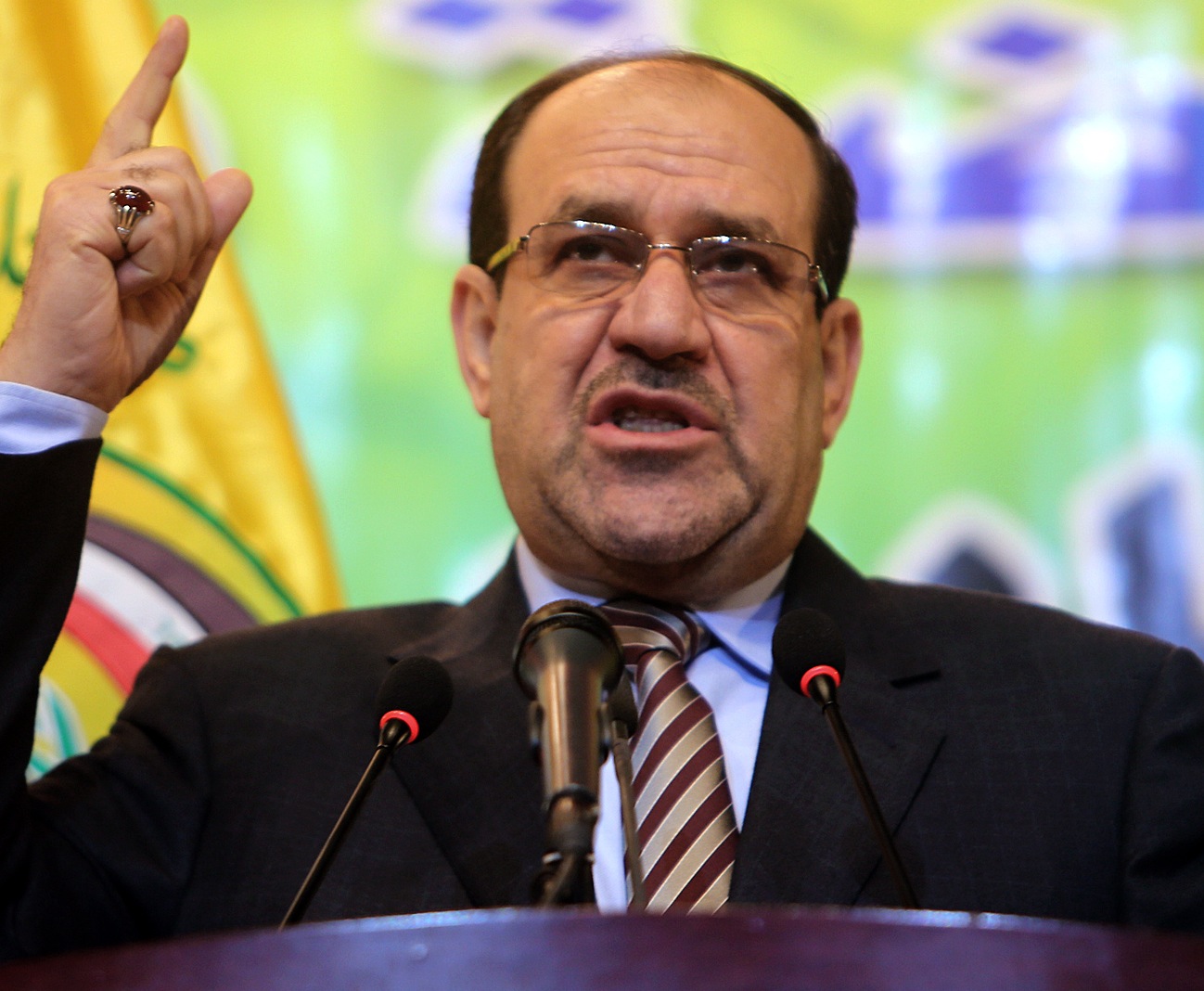
Iraqi leader Nouri al-Maliki and Iraq's Shias


Nouri al-Maliki. Sabah Arar/AFP/Getty Images

This is the most obvious culprit. Iraqi Prime Minister Nouri al-Maliki, a lame duck recently voted out by his own party, since 2006 has run an authoritarian, Shia government that systematically excluded Sunni Iraqis from power and favored the country's majority Shia population. That played a major role in allowing ISIS to push so successfully from Syria into Iraq this year. Here is an incomplete list of terrible Maliki policies that have contributed to this:

* Using Iraq's counterterrorism laws to imprison Sunni dissenters.

* Exploiting laws that prohibit Saddam-era officials from holding office (a number of those officials had been Sunni) to boot Sunnis out of the upper echelons of the government and military.

* Using deadly force to break up peaceful Sunni demonstrations against his government.

* Aligning himself with non-governmental Shia militias that had slaughtered Sunnis during the post-invasion civil war.

And there's much .. http://www.rferl.org/content/iraq-sunni-anger-causes/25432218.html, much .. http://www.foreignpolicy.com/articles/2014/06/19/how_maliki_ruined_iraq_armed_forces_isis .. more where that came from. Maliki's policies convinced a number of Iraqi Sunnis that the Iraqi government would never treat them equally, making ISIS and other Sunni militias seem like a comparatively attractive alternative. That's a big part of how ISIS managed to gain so much power in Sunni Iraq in such a short period of time.

---
INSERT: YUP, F6, "still regard Wing's 'panacea' piece as written much more so he could simply (re-)assert certain of his set/canned categorical 'insights' rather than actually shine any (new) light on anything

his [Joel Wing's] in the end just postulating that someone else would effectively be so similar as to be the same ignores/papers over the numerous really shitty/stupid/etc. things al-Maliki's done and failed to do, all very deliberately and as a genuine and thoroughly corrupt tyrant who gives no sign of giving a damn about anything other than his power and privilege or anyone other than himself" .. SPOT ON ..
http://investorshub.advfn.com/boards/read_msg.aspx?message_id=105167634 .. and yes, as you also knew then ..
---

But it's not just Maliki. Many other leading other leading Iraqi Shia politicians are as hostile to Sunnis as Maliki is, if not more so. Internal Shia politics have frustrated some of Maliki's more conciliatory attempts, such as his effort to reform the ex-Saddam laws he himself had used to oppress Sunnis. Still, blaming Maliki alone for ISIS's rise would miss the broader picture: Iraqi Shias as a group are skeptical of taking steps to help Sunnis feel more included.

Iraq's Sunnis (and Syria's)


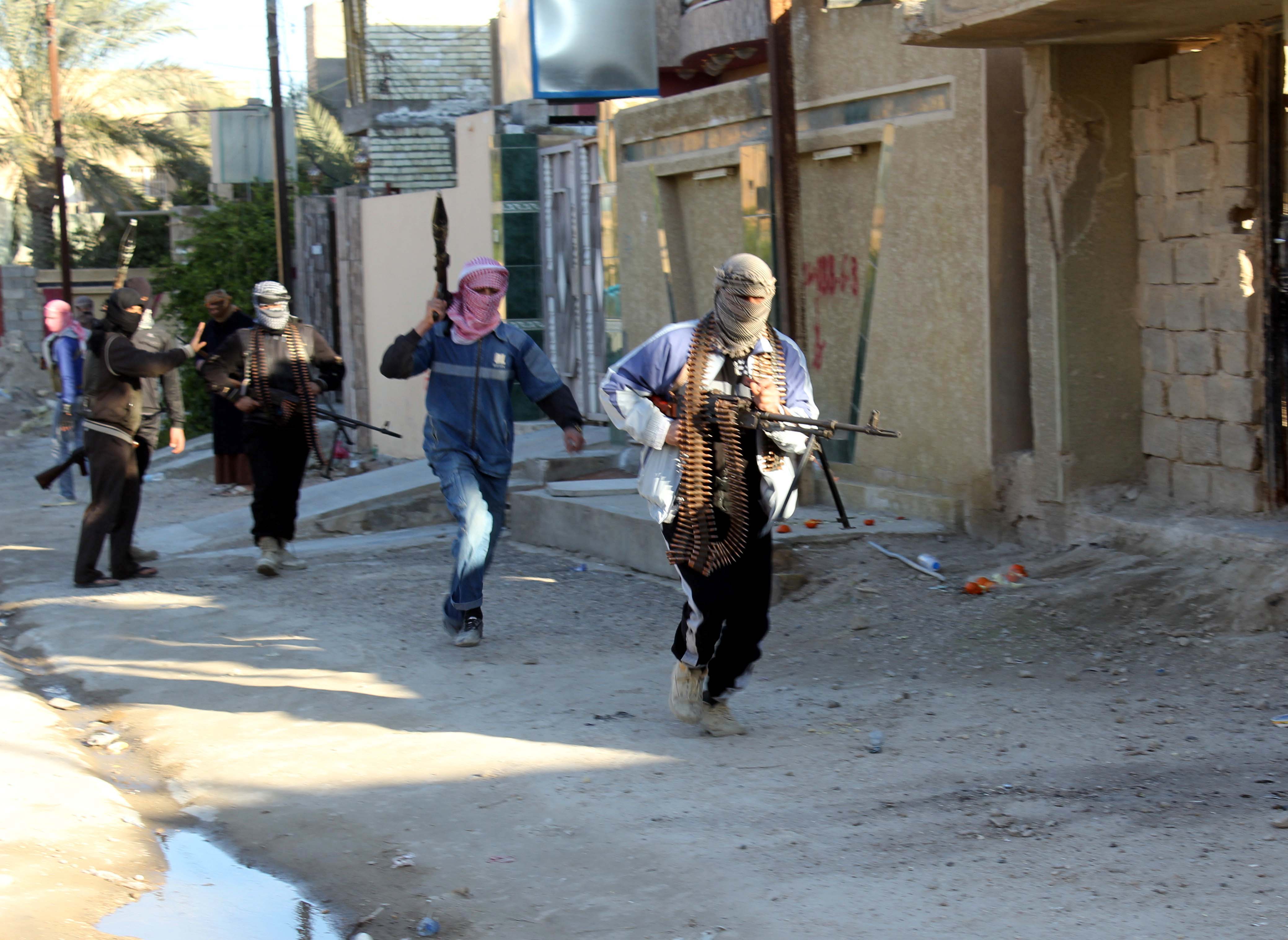
ISIS fighters in Kirkuk, Iraq, in February 2014. Stringer/Anadolu Agency/Getty Images

If there's one thing we learned from the defeat of ISIS's previous incarnation — al-Qaeda in Iraq — in 2008, it's that ISIS can't survive without popular support .. http://www.vox.com/2014/6/11/5800188/who-is-isis-how-they-conquered-mosul. So the tacit backing* .. http://www.vox.com/cards/isis-myths-iraq/isis-islam .. that ISIS is getting right now from a number of Iraqi Sunnis is critical to the organization's rise and continued viability. To be clear, this does not mean that all or even most Iraqi Sunnis are ISIS fans* .. http://www.vox.com/cards/isis-myths-iraq/isis-islam — the group also rules through fear and force, after all, and a number of Sunnis have fled ISIS's advance — but a real degree of popular Sunni support does exist.

Part of that tacit support is the result of Iraqi government policies. But other parts of it have to do with Sunni skepticism towards the Iraqi state itself.

---
INSERT: .. damned sectarianism .. Sectarian violence .. http://en.wikipedia.org/wiki/Sectarian_violence .. yes, inter-Christian wars AND inter-Islam wars ..

.. one huge negative to religion .. Maps of War 3000BC to 2000AD .. see a neat little video .. http://www.mapsofwar.com/ind/history-of-religion.html
---

"The most significant factor behind Iraq's problems," Georgetown University's Shireen Hunter writes .. http://www.lobelog.com/2014-06-the-real-causes-of-iraqs-problems/, "has been the inability of Iraq's Sunni Arabs and its Sunni neighbors to come to terms with a government in which the Shias, by virtue of their considerable majority in Iraq's population, hold the leading role." Basically, the Sunni minority ran the government when Saddam was in charge, and they believe they still ought to be the leading power today.

"All along, the goal of Iraqi Sunnis has been to prove that the Shias are not capable of governing Iraq," Hunter writes. "The Sunnis see political leadership and governance to be their birthright and resent the Shia interlopers." So long as Sunnis are hostile to the very idea of a majority Shia government — as any Iraqi democracy inevitably would be — they'll be willing to look for alternatives. Today, that means a certain amount of support for ISIS.

This is true to a degree in Syria as well, where Bashar al-Assad's Shia-run dictatorship has long alienated the country's Sunni majority. At first, angry Sunnis formed anti-Assad militias that were not principally about Islamist extremism, but as the war raged on, jihadist groups were able to take hold. That eventually included ISIS.

The United States


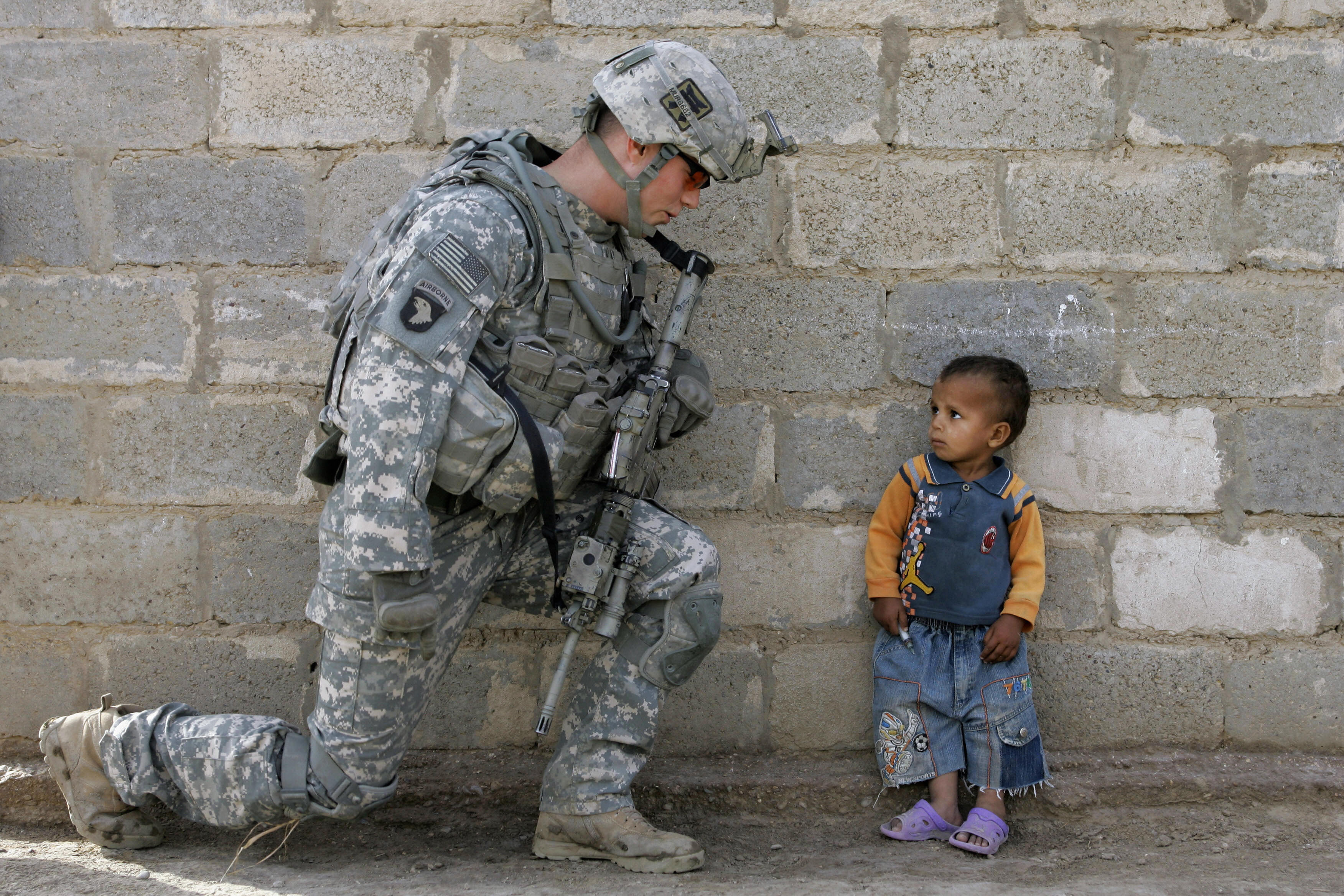
A US soldier with an Iraqi child in Baghdad, 2008. Mauricio Lima/AFP/Getty Images

The most obvious way in which the US bears responsibility for ISIS's rise is the 2003 invasion of Iraq. The United States invaded Iraq, accidentally sparked a sectarian civil war, and generally created the conditions for what was then al-Qaeda in Iraq to flourish. Without the American invasion, al-Qaeda in Iraq never would have been so strong, and ISIS never would have grown out of it.

While you may have heard that American inaction since its withdrawal from Iraq has been important in helping ISIS, that pales in comparison to the contribution of the invasion itself. A residual American force in Iraq may have been able to help blunt ISIS' Iraqi offensive in June 2014, and US bombing of ISIS targets in Syria might have weakened the group somewhat. But the predominant causes of ISIS's rise in the two countries — internal Iraqi politics and the Syrian civil war itself — couldn't be solved .. http://www.vox.com/2014/8/13/5991047/how-america-lost-the-middle-east .. through American military action.

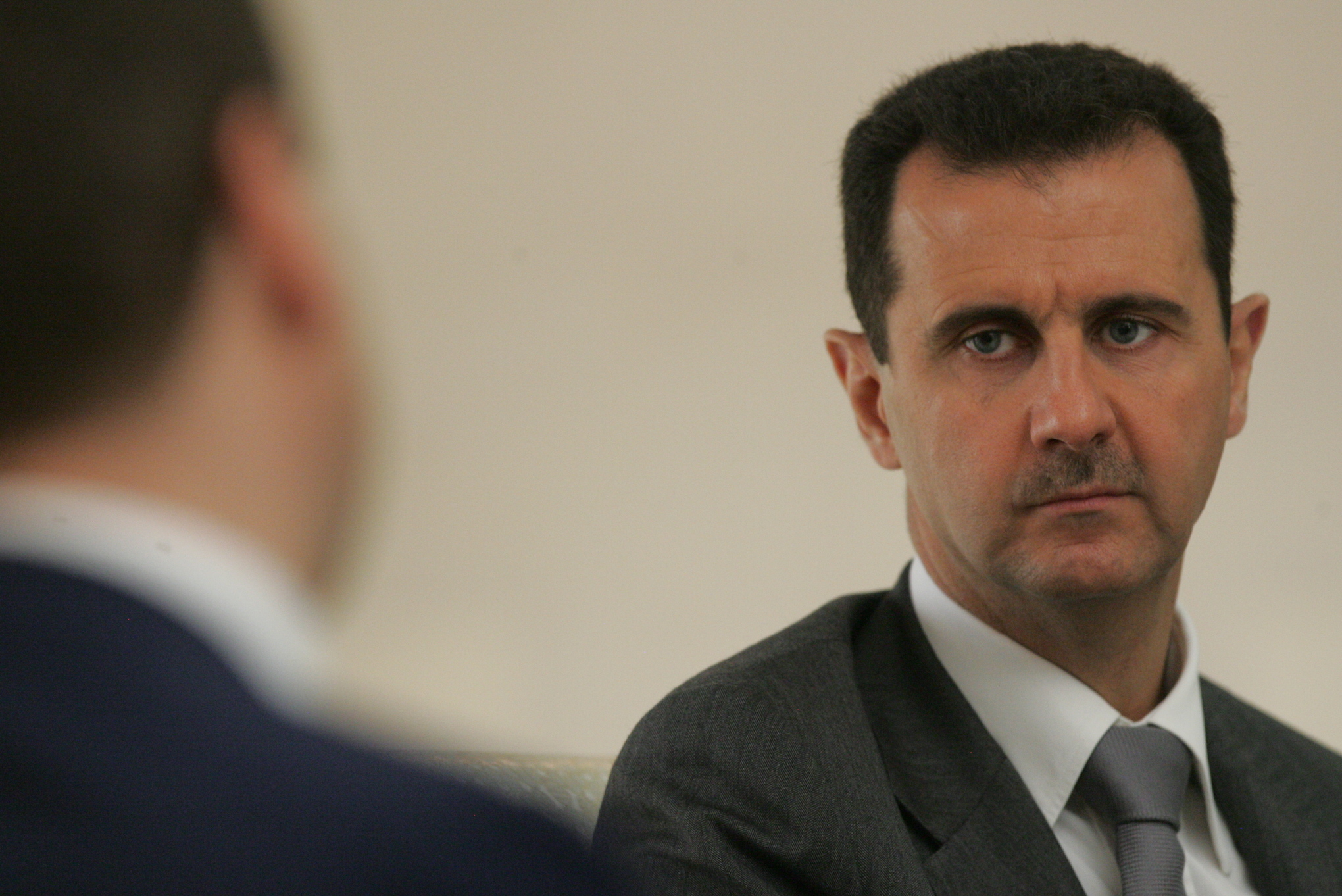
Syrian leader Bashar al-Assad


Bashar al-Assad. Sasha Mordovets/Getty Images

On paper, Syrian President Bashar al-Assad should be one of ISIS' greatest enemies. Assad runs a Shia dictatorship and ISIS is a Sunni extremist group. Assad is trying to regain his grip on all of Syria, and ISIS currently holds a big chunk of the country.

Except Assad has deliberately nurtured ISIS, or at least tacitly allowed its rise, as a means of marginalizing more moderate rebels whom outside powers like the US might have supported against him. The Syrian dictator and ISIS seem to have made an implicit deal: ISIS temporarily gets a relatively free ride in some chunks of Syria, while Assad gets to weaken his other opponents. This allows Assad to divide the rebels, and to force the world to choose between him and ISIS.

"When Islamic radicals took over Raqqa, the first province to fall under rebels' control in its entirety, it was remarkable that the regime did not follow the same policy it had consistently employed elsewhere," Syrian journalist Hassan Hassan writes .. http://www.nytimes.com/roomfordebate/2014/08/22/should-the-us-work-with-assad-to-fight-isis/assad-has-never-fought-isis-before, "which is to shower liberated territories with bombs, day and night." Assad left ISIS alone because its very existence made an international intervention to stop his mass murder of Syrians less likely.

If Assad had assaulted ISIS-held territory with the same fervor he brought to the fight against other Syrian rebels, the group almost certainly wouldn't be as strong as it is today.

Iran


Iranian Revolutionary Guard. Atta Kenare/AFP/Getty Images

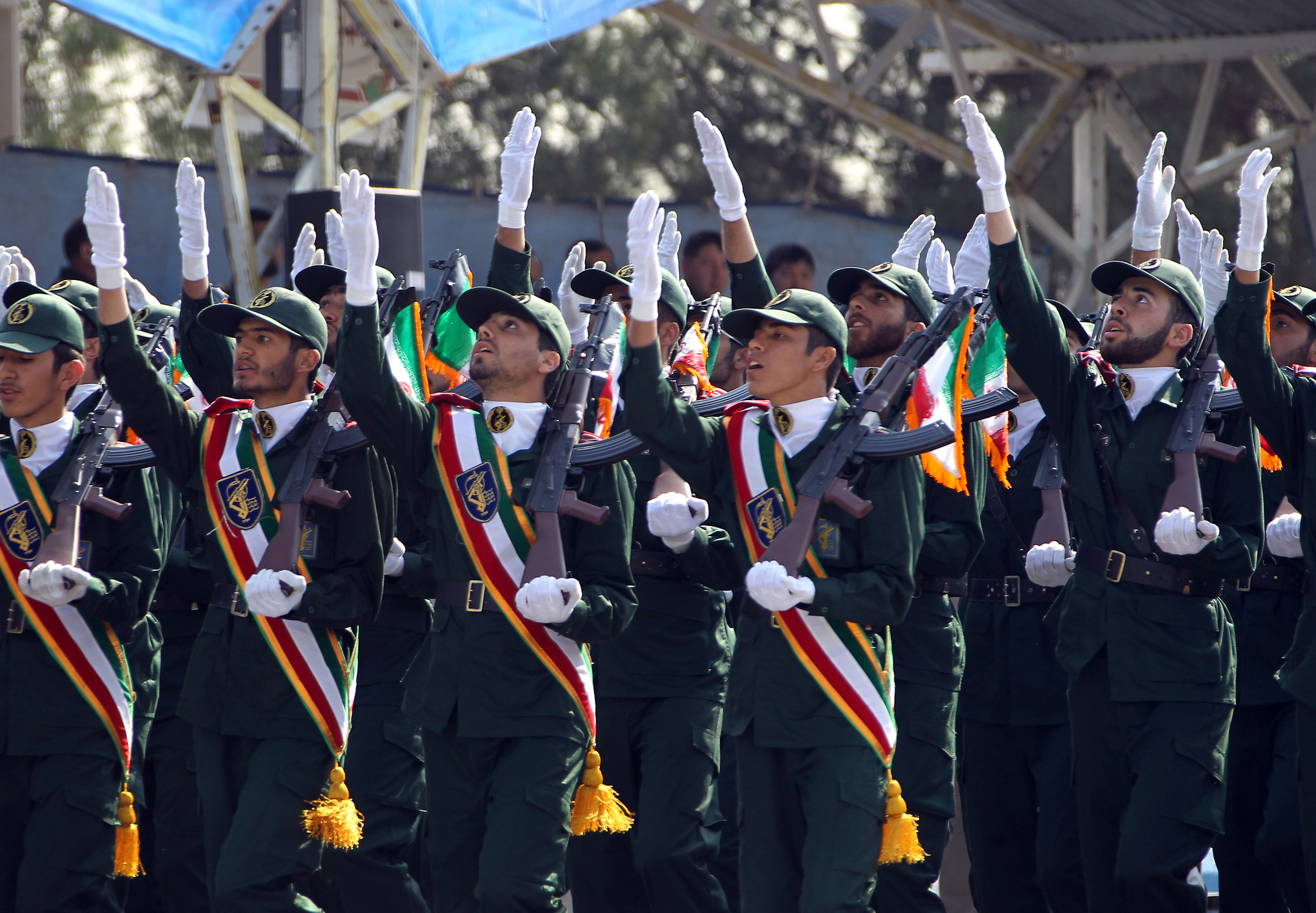
Though Iran is allied with Syria and helping Assad more than anyone, the Iranian government is much more serious about fighting ISIS. They're providing hefty military support to Iraq's campaign against the group, including battlefield direction from Qassem Suleimani, the powerful commander of the Iranian Revolutionary Guards' elite Quds force.

Yet like the US, Iran has played an important, if unintended, role in ISIS's rise — both in Iraq and Syria. Iran was Maliki's strongest backer in Iraq after the American intervention, decisively pushing .. http://www.newyorker.com/magazine/2014/04/28/what-we-left-behind .. Iraqi coalition negotiations in Maliki's favor after the 2010 elections. (The US also helped install him in power in the first place.) Iran has sponsored some of the hardest-line Shia militias in Iraq, such as Moqtada al-Sadr's Mahdi Army (Sadr now controls a major political party) and the Badr Organization .. http://musingsoniraq.blogspot.com/2013/07/iraqs-badr-organization-maintains-its.html. These militias, much like Maliki's premiership itself, helped push Sunnis away from the Iraqi government.

Iran has intervened heavily in Syria on behalf of Assad, both directly with Iranian forces and indirectly through its Lebanese client militia Hezbollah. In 2012, when Assad's fall seemed assured, Iran sent thousands .. http://www.newyorker.com/magazine/2013/09/30/the-shadow-commander .. of its own troops, Hezbollah fighters, and Iraqi Shia militias to support Assad. It also contributed an enormous quantity of arms and a $7 billion loan to the Syrian war effort.

Iran may very well have saved Assad. At the very least, they contributed mightily to his efforts against the more moderate rebels — creating space for ISIS to emerge as the strongest anti-government Syrian force, gaining in recruits and experience as the war went on.

Saudi Arabia, Qatar, and Kuwait


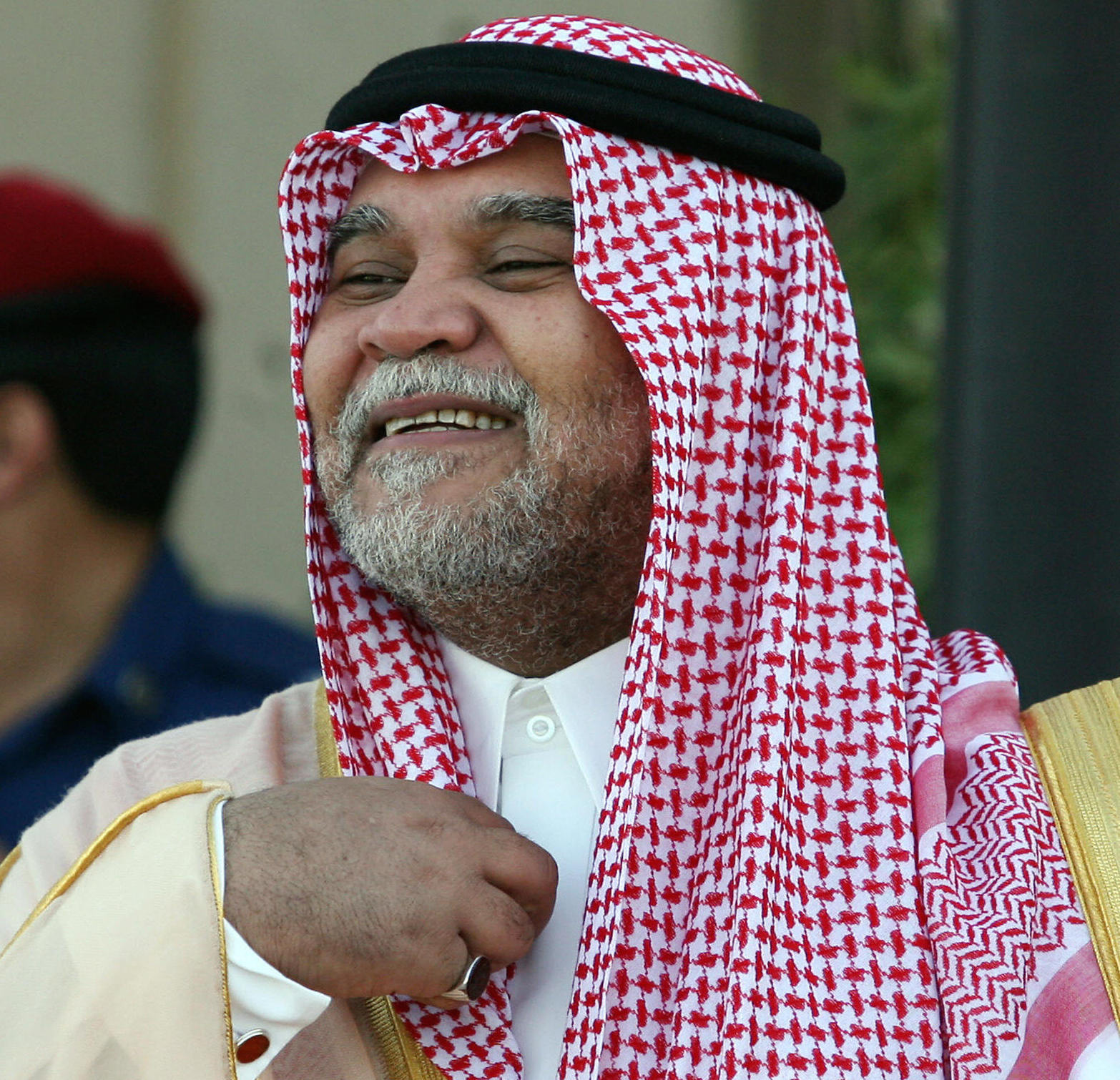
Saudi Prince Bandar bin Sultan, director of the Saudi intelligence agency from 2012 to 2014. Hassan Ammar/AFP/Getty Images

Today, ISIS makes most of its money from oil and organized crime-style rackets. But back in 2011 and 2012, ISIS didn't have this sophisticated fundraising apparatus. Instead, their funding came from friends in the Gulf monarchies — most notably Saudi Arabia, Qatar, and Kuwait.

That's not because these governments share ISIS's extreme jihadist worldview. Rather, it's that they hate the Assad regime and its ally Iran, and wanted to fund Assad's opponents. Just as the Cold War led the US to support far-right militias and governments because they opposed the Soviet Union, these wealthy Gulf states now find themselves indirectly helping ISIS in a regional proxy war against Iran and Assad.

Most of the money that initially went to ISIS, as Josh Rogin details in the Daily Beast .. http://www.thedailybeast.com/articles/2014/06/14/america-s-allies-are-funding-isis.html, came from private citizens in the Gulf States. Until recently, when the scope of the ISIS threat became clear, these countries had extraordinarily weak laws preventing money laundering. This allowed private donors, often with wink-wink-nudge-nudge sanction from the government, to ship huge amounts of money to Syrian rebel groups — including ISIS.

Today, none of these countries want to cop to supporting ISIS. "ISIS has been a Saudi project," the Atlantic's Steve Clemons quotes a senior Qatari official as saying. The Qataris only (only!) admit to funding Jabhat al-Nusra, which is al-Qaeda's branch in Syria. But funding and arms shipments between these groups are fungible. The only thing that's obvious now is that Saudi, Qatari, and Kuwaiti donors funneled a bunch of money towards Syrian rebel groups at the time ISIS most needed capital — and did it without much regard for who ended up getting the money.

http://www.vox.com/2014/8/25/6065529/isis-rise
icon url

fuagf

09/27/14 10:41 PM

#228784 RE: fuagf #227420

Glenn Greenwald’s Simplistic, Conspiratorial Response to U.S. Airstrikes in Syria

Bob Cesca on September 23, 2014


Ask anyone on the far-right, and they’ll tell you President Obama is an incompetent, effete terrorist capitulator. Ask anyone on the far-left and they’ll tell you he’s a cold-hearted baby killer who loves sinking his blood-soaked, warmongering talons into the necks of brown people. The fact that perceptions are so radically diverse indicates that Obama is neither. He’s likely somewhere between both options, which suggests a leader who doesn’t have an itchy trigger finger, but who also understands that sometimes the only way to confront aggression is with proportional aggression.

The Islamic State, ISIS, is carving up the Middle East, threatening U.S. interests, including the Iraqi government, beheading American journalists and murdering women and children. There’s no disputing this reality. Politically and strategically, the very least the president can do is exactly what he’s doing: strategic airstrikes to slow the ISIS advance toward Baghdad and hitting command-and-control inside Syria, while also supporting moderate rebels in that country. There aren’t any other acceptable options. As we’ve discussed before, it’s a Kobayashi Maru scenario — a no win situation, but one which demands a response. Will the outcome foment new challenges or new enemies? Possibly. It could also satisfy Obama’s stated goal of disrupting ISIS. We just don’t know, but had Obama done nothing, ISIS would’ve been allowed to advance unchallenged to God-knows-where. Or if he had committed battalions of ground forces engaging the terrorists in town-to-town street fights, the repercussions in terms of U.S. casualties would’ve been too costly and unpopular.

There’s no easy analysis, nor is there an easy solution. Unless, that is, you’re The Intercept‘s Glenn Greenwald who challenged Fox News today in the ongoing competition to provide the most simplistic responses to complicated matters. His post, titled “SYRIA BECOMES THE 7TH PREDOMINANTLY MUSLIM COUNTRY BOMBED BY 2009 NOBEL PEACE LAUREATE .. https://firstlook.org/theintercept/2014/09/23/nobel-peace-prize-fact-day-syria-7th-country-bombed-obama/,” whittles everything down to “warhawk demon murders brown people — tee-hee, har-har! ZING!” Once again, Greenwald’s reaction to the U.S. response in the wake of the decapitations of two journalists has been to snark and joke about it on Twitter and elsewhere.

Greenwald’s post exposes him as nothing more than a foreign policy dilettante who appears to have just stepped out of a 7th grade model U.N. session (with apologies to 7th grade model U.N. participants). To distill everything down to Meany Obama Kills More Arabs completely and conveniently oversimplifies the situation and the stakes. I’m sure President Greenwald would’ve come up with a solution that would’ve… what? We don’t know because he’s yet to propose any solutions whatsoever to the crisis in that region, other than simply returning us to a condition of isolation, allowing the chips to fall where they may.

By the way, Greenwald also dropped a supermassive conspiracy theory in the midst of his post, pitching the idea that a “feature” of U.S. foreign policy is to literally manufacture new enemies, “Continuously creating and strengthening enemies is a feature, not a bug. It is what justifies the ongoing greasing of the profitable and power-vesting machine of Endless War.”

Yep, and once we intentionally breed new legions of terrorists, we can suck them up into tornado funnels using our weather-weapons, forming Terrornadoes. You know, since controlled demolitions are so 2001.

Let’s be clear: I’ve been cautious, to put it mildly, about any further U.S. involvement in the Middle East. But it’s crucial to grasp the international and domestic stakes, including, yes, political considerations, and that nothing in the Middle East or elsewhere can be described in such facile terms.

http://thedailybanter.com/2014/09/glenn-greenwalds-simplistic-conspiratorial-response-u-s-airstrikes-syria/

Sadly, that's about where it all is. Well said, Bob.
icon url

fuagf

10/01/14 9:35 PM

#228892 RE: fuagf #227420

Isis in Syria: Besieged people of Kobane plead 'don't send us food or aid. Send us weapons'

IMAGE
Hermione Gee, one of the first reporters to enter the town facing an onslaught by Islamist
militants, found the remaining Kurdish residents holding out with a few AK47s and rockets

Hermione Gee Sunday 28 September 2014

The Syrian town of Kobane lies a mere 100 yards or so from Turkey, across a railway track that marks the border between the two countries.

The small crossing from Suruc on the Turkish side into Kobane used to be a gateway for trucks transporting goods in and out of Syria. These days, the only passage allowed out is for Syrian Kurds fleeing the advance of Islamic State (Isis) militants.

Employees at the Suruc customs and weigh station now sit idle, their compound a base for the Turkish Red Crescent, which is desperately trying to meet the needs of tens of thousands of refugees from Kobane and the surrounding villages.

On the other side of the border, guerrilla fighters belonging to the Kurdish People's Protection Units, or YPG, are holding off an onslaught by Isis militants who have besieged the small town for over a week.

Guarding one of the pedestrian gates into Kobane were two female guerrilla fighters belonging to the YPG, which has been in control of Kobane since 2012.

In stark contrast to the army uniforms worn by the Turkish soldiers on the other side of the border, the guerrillas wear traditional loose Kurdish trousers, topped with flack jackets and AK47s, with colourful embroidered scarves holding back their hair. The main entrance to the town is kept closed and guards cautiously peer through a small window in the heavy metal gate before opening it to cars that need to come through.


Smoke sweeps through the Kurdish town of Kobani Smoke sweeps through the Kurdish town of Kobani (Getty)

Ambulances bringing injured fighters back from the front-lines blare their sirens in warning, and the gate is quickly pulled back to allow them through. A convoy of small trucks taking fighters to the battlefield also signals its arrival with a blaze of horns as it speeds down the main street leading out of the town.

One fighter wearing a camouflage jacket and scarf tied around his head stands in the back of a pick-up truck, his gun already poised and at the ready.

More than 140,000 Kobane residents fled the town last week but many people have started to come back – some driven home by the miserable conditions in Suruc, others wanting to join the fight against Isis.

"I didn't want to leave my home," said Sabah, who fled to Turkey with her four young children. "But my children were frightened and they were crying all the time."

Their situation in Turkey was so bad, she said, that they after five days they decided to come home. "I'd rather be in my home. I'm scared, but I don't have a choice."

Like many of Kobane's residents, she is haunted by the memory of the recent massacres of Yazidi at the hands of Isis militants in the Sinjar region of Iraq. "We don't know what could happen to us."

Turkey has been intermittently preventing people from returning to Syria, worried about members of its own Kurdish guerrilla group, the Kurdistan Workers Party, or PKK, trying to join the YPG in the fight against Isis.

Kobane has been cut off for months; residents survive using small petrol-fuelled generators and the basic supplies they can smuggle in from Turkey.

Shops in the town sit empty and shuttered, with nothing to sell, while dozens of half-built buildings line the main road, their construction halted when the supply of materials was stopped.


A Turkish soldier guards the border A Turkish soldier guards the border (Getty)

On Thursday, the first humanitarian aid reached the town, when 12 trucks were allowed to cross the border into Kobane. Sent by the Barzani Charity Foundation, an NGO based in the Kurdistan Region of Iraq, the trucks brought rice, beans, baby formula, blankets and other supplies, both to the refugees in Suruc and to Kobane's besieged residents.

"We are the first NGO to enter Kobane," Musa Ahmed, deputy director of the foundation, told the handful of journalists allowed to accompany the convoy. "It is our duty to help Kurds everywhere; we want to serve outside the borders of the Kurdistan Region."

During a walk through the town, residents said that they really needed solders, not aid supplies.

"Don't send us food, we don't need food," one man screamed. "We will eat mud if we have to. Send us weapons, send us Peshmerga," he continued, and then fell on his knees in front of Musa Ahmed and started kissing his shoes. Another man in the crowd watched the scene silently, tears pouring down his face.

Both tears and desperate appeals for weapons are ubiquitous in Kobane. While the IS militants have weapons and armoured vehicles captured from the Iraqi army, the YPG has nothing but AK47s, rockets and a few revamped armoured vehicles. But equally prevalent is the residents' determination to fight.

"This is my uncle's gun," one young girl of about 12 told members of a Kurdish parliamentary delegation who visited Kobane last week. Holding up a rifle, she said: "But I want my own gun. If I had a gun, I could go and fight."

On Thursday, Maher Khalil returned to Kobane after taking his sister to Suruc to get her out of harm's way. "We saw what Isis did to women in Sinjar. They kidnapped them and now they're being sold in the market. But I'm going to defend my land," he said. "Now [the US] has started bombing, we can fight again. I don't care if I lose my life. If I die, I'll die fighting for my homeland."

Yesterday, explosions were heard again in and around the Kobane enclave, with US air strikes reported in the region. Speaking from Kobane, another resident said: "The situation is better now after the bombing, people have more hope. But we need more bombs, more bombs."

http://www.independent.co.uk/news/world/middle-east/isis-in-syria-besieged-people-of-kobane-plead-dont-send-us-food-or-aid-send-us-weapons-9760095.html

See also:

Other voices: Bleed the Islamic State of its funding, and you cripple its ability to dispatch jihadists
http://investorshub.advfn.com/boards/read_msg.aspx?message_id=106805585
icon url

fuagf

10/09/14 6:06 PM

#229075 RE: fuagf #227420

Turkey's tough choice: Take on ISIS or the PKK?

By Gönül Tol, Special to CNN
updated 12:11 PM EDT, Tue October 7, 2014


VIDEO: Will Turkey face ISIS on the ground?

STORY HIGHLIGHTS

* Gönül Tol: Turkey may be joining the anti-ISIS coalition to suppress Kurdish separatists

* The vote does not signal intervention against ISIS any time soon, she says

* Tol: The PKK has effectively become the West's best hope for on-the-ground troops

* The fight against ISIS has also empowered the PKK militarily, he writes

Editor's note: Gönül Tol is the founding director of The Middle East Institute's Center for Turkish Studies .. http://www.mei.edu/center-turkish-studies .. and an adjunct professor at George Washington University's Institute for Middle East Studies .. http://www.gwu.edu/~imes/. The views expressed in this commentary are entirely those of the author.

(CNN) -- Turkey is in a tough spot. It has ISIS militants threatening the Syrian border town of Kobani, inching ever closer to confronting Turkish security forces. In addition thousands of Syrian Kurds, fleeing ISIS attacks, have massed along its border, adding further to Ankara's troubles.

Amid mounting pressure to become more active in the U.S.-led international coalition against ISIS, the Turkish parliament last week overwhelmingly authorized its military to make incursions into Syria and Iraq; also to allow foreign troops to operate out of Turkish bases. The move has been greeted in Western capitals as a welcome sign that Turkey is finally fully on board with the anti-ISIS coalition.

Yet the Turkish parliament's actions herald neither a complete about-face in policy toward Syria nor immediate military action against ISIS. Indeed, Turkey's reasons for joining the war may be more to do with suppressing Kurdish separatists and removing the al-Assad regime than with destroying the jihadist group.

Toppling the leadership in Damascus and keeping in check the Syrian Kurds who are closely linked to the Kurdistan Workers' Party, or PKK, have long been Ankara's priorities in Syria.

VIDEOS
Turkey authorizes strikes on ISIS
ISIS forces enter Kobani, sources say
Biden regrets saying allies helped ISIS
Cam catches ISIS shelling Syrian city

The wording of last week's parliamentary resolution -- which states that "the terrorist elements of the outlawed PKK still exist in northern Iraq" .. http://www.al-monitor.com/pulse/tr/originals/2014/10/turkey-syria-iraq-caolition-ground-operation-against-isis.html#ixzz3FNBKmfZp -- suggests that Kurdish separatists still remain the Turkish government's top concern.

The vote does not signal intervention against ISIS any time soon .. http://www.washingtonpost.com/world/middle_east/turkish-parliament-authorizes-military-action-in-syria-iraq/2014/10/02/cca5dba8-7d0c-4e70-88bb-c84abbdca6d2_story.html: despite thousands of Syrian Kurdish refugees and ISIS's fast advance towards Turkey's southern border, Ankara seems unwilling to act. Turkey's defense minister Ismet Yilmaz said .. http://www.al-monitor.com/pulse/originals/2014/10/turkey-syria-iraq-caolition-ground-operation-against-isis.html#ixzz3FN2bfzXH: "Don't expect an imminent step after the approval of the authorization request."

Rather, the Turkish government is likely to give its full cooperation to the campaign against ISIS so that it can secure agreement of a U.S.-backed no-fly zone in Syria: this, Ankara believes, would address both concerns.

Turkey thinks that Assad regime's ability to attack mainstream opposition forces from the air has strengthened ISIS, causing the Free Syrian Army to flee and allowing the Islamic militants to capture the vacant territory. Enforcing a no-fly zone over Syria would ground al-Assad's air force and boost rebels fighting to topple him: it could also establish a Turkish military presence, ridding northern Syria of Kurdish fighters linked to the PKK and smothering the autonomous Kurdish region. Turkey has become increasingly uneasy about the emergence of yet another Kurdish entity on its frontier after the PKK-affiliated Syrian Kurdish groups established autonomy in northern Syria.

The military and diplomatic boost that the PKK has received through its effective fight against ISIS has also worsened the situation for Ankara. In response to the growing ISIS threat, the PKK, the Peshmerga, and the People's Protection Unit (the PKK-linked Kurdish militia group fighting in Syria), have established a united Kurdish front, with the PKK militants coming to the aid of Peshmerga fighters and halting the jihadi group's advance into the autonomous region of northern Iraq. The People's Protection Unit was the main force battling ISIS, and it helped thousands of Yazidis escape from the western part of the region as ISIS attacked.

---
"The PKK has effectively become the West's best hope for on-the-ground troops"
Gönül Tol
---

The PKK has effectively become the West's best hope for on-the-ground troops, winning the group positive reviews in Western media. Since the group started its assault against ISIS in northern Iraq, there has been a lot of talk in Western capitals about removing the PKK from the terror list.

The fight against ISIS has also empowered the PKK militarily: Turkey is concerned that that weapons sent to the Peshmerga might ultimately end up in the hands of the PKK at a time when Ankara is moving forward with a deal that would disarm its group. The Turkish government puts the blame for this on the West but Ankara's overtures towards its own Kurdish minority have been mostly strained by its own short-sighted Syria policy.

The ongoing conflict around Kobani has underscored the many challenges the Syrian war poses for the peace process Ankara launched in 2012 in an effort to end the 30-year old Kurdish insurgency. The intensified shelling in Kobani has angered Kurds on the Turkish side of the border, who have blamed the Turkish government for allowing ISIS to fester and not doing enough to stop its assault against Kurds.

Turkey's reluctance to get involved for fear of empowering Kurdish militants in Turkey is now contributing to the growing discord between Kurds and the government. Last week, after reports that Turkey closed the border gates .. http://tinyurl.com/on7hqh8 .. to impede the flight of Kurds from Kobani, Abdullah Ocalan, the PKK's imprisoned leader, warned that if ISIS carried out a "massacre" in Kobani then the peace process with the PKK could end.

If engaged by Ankara, the PKK-linked groups in Syria could be integrated into the moderate Syrian opposition and become an effective fighting force against the al-Assad regime. But the Turkish government's increasingly harsh rhetoric against the group signals that such a shift in Ankara's thinking is not in the works. Last week, Erdogan said .. http://www.csmonitor.com/USA/Foreign-Policy/2014/1002/Why-Turkey-is-joining-fight-against-Islamic-State-without-enthusiasm-video .. "While the ISIS terror organization is causing turmoil in the Middle East, there has been ongoing PKK terror in my country for the last 32 years, and yet the world was never troubled by it. Why? Because this terror organization did not carry the name 'Islam.'"

If Turkey keeps seeing the PKK a bigger threat than ISIS activities in Syria, then the legislation passed last week is unlikely to lead to a deeper involvement of Turkey in the fight against the jihadist group.

READ: Who is doing what in the coalition battle against ISIS?
http://cnn.com/2014/10/06/world/meast/isis-coalition-nations/index.html

READ: Exclusive: From school teacher to ISIS member
http://cnn.com/2014/10/06/world/meast/isis-female-fighter/index.html

The views expressed in this commentary are solely those of Gönül Tol.

http://www.cnn.com/2014/10/07/opinion/turkey-isis-pkk/

===

1980 Turkish coup d'état - http://en.wikipedia.org/wiki/1980_Turkish_coup_d%27%C3%A9tat

===

The PKK: Freedom Fighters or Terrorists?

.. some history, i don't know how balanced, accurate or biased this piece is, just that it is some history of an organization
and of a country, in an area highly relevant to conflict vs peace in our world today .. large excerpts from a much larger one ..

http://kurdistan.org/work/commentary/the-pkk-freedom-fighters-or-terrorists/

By Ismet G. Imset

Thursday, December 7, 1995

The Crisis

A burning war:

When in 1984 Turkey found itself faced with a series of armed attacks on military installations in the dominantly Kurdish-populated rural Southeast region, it immediately resolved on a traditional policy, to deal with these so- called “handful of bandits” in style, with weapons against weapons.

For Ankara officials and many Turks, the Kurdistan Workers Party (PKK) which launched the attacks, was nothing but “a remnant of the pre-1980 terrorism” which had spread throughout this strategically important country in the form of violent urban activities in the late 1970's, constituting an excuse for the US-backed September 12, 1980, military takeover.

Turkey’s enforced mono-ethnic identity was so well carved into millions of minds that no one even questioned the roots of the PKK, what this organization represented, whether its existence had legitimate social or political reasons, or whether the ethnic connotation in the name was anything further than a Marxist ploy to gain regional support.

Instead, both Turkish officials and western intelligence agencies preferred to treat the problem superficially, looking at it with the over-confident assumption that it was a “doomed terrorist group” from the very beginning and one which conspired to divide Turkey for regional foreign interests.

On the surface, every indication supported this view. The PKK’s manpower was then low, ammunition and armament was scarce and the organization, confronting Turkey’s enormous war machine, could clearly stay on its feet only with “outside” support — coming mainly from the regional countries attempting either to control their own Kurdish populations through promotion of crisis’ elsewhere or indeed aiming to cripple NATO- member Turkey as the Cold War dragged on.

Yet, despite repeated assurances from officials that this terrorist group had been “dealt with,” from only a 20-man urban based passive student movement in the late 1970s, the PKK had already grown into a 300 strong trained militant force in the early 1980s.

This expansion actually reflected what was in store for the future. Its number increased several fold over the following years and by 1994, Turkish military officials estimated that its active supporters and sympathizers in the Turkish Southeast alone numbered more than 400,000, added to over half a million Kurds supporting the organization throughout Europe. If Turkey’s current laws were fully applicable, this means that at least one million Kurdish origin citizens of the country are deemed by officials as “enemies” and could face capital punishment without question.

The PKK is known today to have extensive support among the Kurds of Turkey and Syria, and is gradually expanding into the Kurdish regions of neighboring Iran and Iraq as well.

The exact number of PKK combatants or fighters has been an issue of debate for many years. In 1991, the late president Turgut Ozal claimed there were 3,900 full-time guerrillas. In April 1993, however, the US State Department was to estimate the PKK had only 3,000 guerrillas and two to five thousand active supporters. In October 1993, The New York Times estimated that 10,000 PKK guerrillas were operating throughout Turkey and neighboring countries.

[...]

With the military takeover though, the conditions for a “just cause” to launch a war for freedom and democracy if nothing else, were stronger than ever and the very fact that a group of generals, using their force and weaponry had ousted an elected civilian regime and abolished the country’s constitution, spoke for itself in way of legitimacy for any form of resistance. The generals had taken over the country, closing down parliament, banning all political parties and placing their leaders, including the prime minister, under “protective custody.”

A summary of that period was recently published in a Turkish news magazine and is highly important in the context of the PKK’s own struggle and its reasons. It is, in reality, a full explanation of the immediate circumstances in which the organization launched its armed struggle and thus claimed that it was a legitimate one or a just war: Throughout the coup era in which the PKK launched its first organized operation in Turkish territory, a total of 650 thousand people were detained and most suspects were either beaten or tortured; over 500 people died while under detention as result of torture; 85,000 people were placed on trial mainly in relation to thought crimes or guilt by association; 1,683,000 people were officially listed in police files as suspects; 348 thousand Turks and Kurds were banned from traveling abroad; 15,509 people were fired from their jobs for political reasons; 114 thousand books were seized and burned; 937 films were banned; 2,729 writers, translators, journalists and actors were put on trials for expressing their opinions. One can hardly argue, as we enter the 21st century, that such a regime had any legitimacy other than to conform with the financial and political expectations of its foreign supporters.

It is true that urban terrorism between January 1979 to September 1980 had claimed the lives of 3,546 civilians and 164 security officers. Mass demonstrations had spread to the cities with “liberated zones” being established in urban and rural areas. In central Anatolia, fundamentalist Moslems, themselves arguing they were deprived of fundamental religious rights with the creation of the secular republic, were on the rampage. Hundreds had died in Sunni-Alawi sect clashes and thousands were placed in prison even before the coup. These justified the coup in the eyes of a Turkish majority as well as among Turkey’s western allies — despite the fact that Martial Law actually existed throughout Turkey as these developments took take place. Yet, the repressive nature of the overt military administration was so great that it soon started to bother all. Most of all the Kurds in Turkey.

The takeover in Turkey prompted the PKK’s limited number of supporters first to train with Palestinian fighters in the Middle East region and later to fight alongside them during the Israeli invasion of Lebanon. This cooperation then led to various regional movements opening their territories to the PKK, where it trained and prepared for warfare. It had also managed to spread among Turkey’s migrating Kurdish community abroad, specifically in Libya.

[...]

In contrast to the Turkish Security Directorate figures, U.S.-based Human Rights Watch/Helsinki reported that a total of 950 people had been killed in Kurdish-linked violence from 1984 to May 1988 and even before Ankara formally turned to the policy of “answering guns with guns,” the situation was desperate. In 1988, the same organization was warning in writing that “Indiscriminately, the Turkish army is terrorizing the local people on the grounds that they are supporting the terrorists… As a result of this, the Southeast region gives the image that it is completely besieged.”

The turning point:

After 1989, the PKK strengthened rapidly in the region facing almost no problems in finding new recruits, weapons or financial resources. It expanded among the people and established itself as a popular movement. In November 1989, following crucial local elections held in March, Turgut Ozal was elected as the eighth president of the Turkish Republic. His Motherland Party which came to power in 1984 was still in government but the local polls had reflected a decline in national support.

Ozal immediately appointed Parliament Yildirim Akbulut as prime minister with the aim of preventing the ANAP from falling apart and in belief that Akbulut would remain only as his mouthpiece. Akbulut’s first test, as with all Turkish prime ministers, was to deal with “terrorism.”

The turning point for the Kurdish issue was in March that year with a meeting of the National Security Council which ended with a government- backed decision to launch a major military and psychological crackdown on Kurdish separatists. “We have decided to answer guns with guns,” Akbulut announced after coming out of this seven hour meeting. He added that a series of measures would be taken both against the terrorists and their supporters.

According to these decisions, the Turkish press would be placed under a heavy censorship, citizens living in the region could be banished by local officials, anyone who supported the separatists or gave them aid would be sentenced to ten years imprisonment and the state would in no way tolerate PKK sympathizers.

The ANAP government, which was losing the support of the electorate, had accepted the military package and was looking for the support of the country’s armed forces. And, the impact of the decisions were seen almost immediately in the region with even more indiscriminate security operations leading to immense human rights violations everywhere.

The PKK, which was already strengthening, had then also caught the opportunity to establish local authority in various areas, filling the gap of state authority. Secret Kurdish schools started functioning in the darkness of the night. The number of court cases heard at Turkish civil courts declined rapidly as so-called PKK peoples’ tribunals came to being. In several provinces the PKK even set up its local police and intelligence units.

What was disastrous for Ankara in 1990, however, was a major change in the PKK’s own policy towards village guards. Until then, the organization was blamed to have terrorized the region with raids on villages and civilians. But in a 1990 party congress it decided to cease all such activities which could lead to civilian casualties and to concentrate more on military targets and political struggle. It also declared a general amnesty for all village guards, valid for a whole year, for anyone who turned in their guns and refused to collaborate with the state.

This move, unfortunately, did nothing to curb violence but changed its source. It literally forces Turkish troops to target village guards and families attempting to drop out of the system, to carry out mass arrests, deportations and a wave of arson attacks on civilian villages.

As the PKK moved to clean its own human rights record, turning to a more politicized struggle, Turkey was unknowingly deciding to get harsher. Thus, at this crucial junction point, wide-spread human rights violations on the Turkish part only supported the PKK’s argument and further strengthened the organization.

The Government

Since 1990, much of Turkey’s political scene has changed. From a time when even writing the word “Kurd” was banned and punishable, Ankara –in face of a serious Kurdish insurgency– has come to the point of accepting the existence of “a Kurdish identity.” Currently Suleyman Demirel is the President and the government is a temporary coalition between the conservative True Path Party and the Republican Peoples Party.

The main change, however, is the increase of military control over state affairs, often leading to claims that PM Ciller’s coalition is merely a rubber- stamp government for the Turkish army. Ciller has indeed abandoned all Kurdish policy issues to the military in general belief that the problem is only of terrorist origin. Her prime advisors on the issue are businessmen of Kurdish origin who have vast personal interest in the region and some, in the continuation of the conflict. For today’s Ankara, “there is no Kurdish problem. There is a problem of terrorism which we will eradicate.”

The year 1994 turned out to be one in which Turkey introduced yet a new dose of bitter medicine for the Kurds. From the very beginning of the so- called Ciller era, it became evident that Turkey’s military commanders were quite confident with the civilian administration and saw it as an ideal structure to work with. Ironically, this era of covert military rule actually started a year after the reputable Human Rights Watch/Helsinki issued its strongly worded report titled: “Destroying Ethnic Identity: The Kurds of Turkey.” Three years after this report, the New York Times was to carry a major commentary titled: “The Kurdish Killing Fields,” emphasizing how horrifying the conflict had become.

Under normal circumstances, a social democrat partner with a conservative right-wing party would have become a political problem but it was soon made clear by the junior coalition partner of the coalition that as long as its deputies remained in power, neither the coalition protocol (based on promises of democratization) nor other political principles of the party itself mattered. As for the senior coalition partner DYP, despite some resistance from the extreme hard-liners, the social democrats were an ideal camouflage.

Many practices and decisions which could not have been enforced under a right-wing administration alone were being put into life with only slight problems owing to the “social democrat” element which the conservatives exploited fully. Immediately after taking to power, Ciller went to work on the country’s economic problems and literally abandoned the whole decision making process in all security-related issues to the forces concerned. To deal with urban terrorism, the Turkish police force immediately implemented urgent measures with the support of the government. Despite an ailing human rights record owing to frequent disappearances under detention and alleged extra judicial killings, a major success was scored in this field.

The drive against urban terrorism turned out to be so successful that it increased the say of a specific group of individuals in the civilian security apparatus, later lining them up along with selected military commanders as well as the Emergency Law Regional Governor’s office. An undeclared secret command structure under the control of the military had come to being and those with the backing of the armed forces even within the police force were enjoying extensive authority. In the words of a senior intelligence officer, “by the year 1994, it was clear that Turkey was being run by a state within the state and we had nothing to do about it.”

The military-Ciller relationship appeared to be so strong that commanders in the troubled region had started to speak proudly of the “complete harmony” they enjoyed with the administration and were more and more often praising the prime minister’s capability to “grasp the situation.” According to former Chief of Staff Gen.Dogan Gures, Ciller was “worth 30 generals.” According to the Emergency Law governor, she was fully supportive of “the campaign on terrorism.” He in fact noted that “although the prescription is a painful one, it has to be administered.” Yet, according to Ankara-based observers, she had completely surrendered in.

Thus, on the one hand realizing the “Kurdish identity” for the sake of a western audience but on the other arguing that a “Kurdish problem” did not exist and the problem was of terrorist origin alone, Ankara turned once more to a fully military origin solution to solve the Southeast crisis. The solution, in the minds of those with the authority, is still simple. The solution to ethnic terror was state terror. If the state could make itself felt in the Southeast, if it could show to the people how “strong” it was, then — theoretically– the PKK could be isolated. No one in authority seemed to consider the internationally accepted alternative that the “strength” of the state comes not from using force but by representing democratic standards, respecting human rights and winning the confidence of its own people.

The result of this policy was best expressed in a September 1995 report issued by the Turkish Human Rights Foundation which noted that in the year 1994, Turkey’s repression of the Kurds had spilled over to western areas as well and not only the Kurds but a large part of the Turkish population was suffering from the results of this policy. The Foundation report boldly claimed that 1077 security personnel had been killed in clashes with the PKK in 1994 alone. And, the figures continued: 32 people were killed by police during controversial house raids; 1,128 people were tortured while under detention; 32 others were tortured to death while in police custody; 49 disappeared while under the custody of security officials; 97 were killed only for failing to stop when ordered to do so and 432 were killed in mystery murders generally attributed to security forces.

In 1994 the press –especially the Kurdish press– had suffered from the continuing repression dearly:

[...]

As if to emphasize the PKK’s argument for legitimacy, Turkey’s formal policy since the early 1990s has been one of preventing all attempts to find a peaceful and lasting solution to the Kurdish problem through open debate and dialogue. Among the most outstanding cases is that of Turkish sociologist Besikci who has spent most of his last decade in prison. Besikci, who carried out a sociological survey on the Kurds, was first fired from his job with a university then placed in prison. Since the incident, he has been sentenced to a total of 84 years jail on 40 separate cases related to his books and faces up to 198 years imprisonment with 27 more cases to go.

Even Turkey’s reknown author Yasar Kemal may now be jailed if found guilty on charges related to an article he wrote in January for the German news magazine Der Spiegel. Three separate charges have been brought up against him which could earn this 72-year-old intellectual 15 years of prison life. Ironically, one of the charges is related to alleged remarks of “racism” in the said article.

Many more examples can be listed. One outstanding and very recent example is related to 1080 Turkish intellectuals who collectively defied the laws and issued a book containing banned articles. They are all now being prosecuted and may face up to the three years in jail.

To put it bluntly, Turkey still fears to seek for a social, economic or cultural solution for the Kurds. It fears that any of these principle rights, actually guaranteed by international agreements, are nothing but “concessions,” and even to restore the principal human rights, would lead to ethnic demands and eventually to the division of the country.

As for what a June 1995 military briefing to newspaper owners in Ankara has shown, the army will not tolerate any demands for reforms on the issue and will not even consider a bi-lingual solution to the problem as it deems it as a concession to terrorism. No one in the hard-liner flanks seems to comprehend the idea that once the state restores confidence among the local people and the Kurds start to enjoy equal rights as well as the right to freely organize on the democratic platform, there will be a natural atmosphere for a voluntary unity — eventually isolating all remaining separatist demands and marginal methods and one which the PKK itself has promised to unconditionally support.

The military formula is one too easy. First, terrorism will be crushed fully and then Ankara “may” introduce economic reforms and social measures for further “Turkification” in the area. This plan involves a massive repopulation of the region, using ethnic Turkic emigrants as well, concentrating local Kurdish populations into “collective villages” where they can be assimilated and monitored easily and, finally, restoring the firm hand of the state in the region.

It is worth to mention here that the dominant military argument fails because it is based on the assumption that (a) Turkey is a democracy and terrorism has a short life span in democracies; (b) the Kurds are a Turkish people who side with the stronger force and thus strength and force is required and (c) Kurdish demands for independence will continue either until they are all fully assimilated or the pioneering groups are completely annihilated.

The formula is in fact so simple that since 1984, when the PKK was only a group of around several hundred fighters, Ankara has actually recruited for this organization and literally forced it to grow into a 30,000-strong guerilla force. It is so simple that it continues to constantly recruit for the guerrillas even more than the PKK could have recruited for itself. Again it is so simple that it has turned what initially appeared to be “a mere terrorist group,” based on marginal demands and ideology, into a major ethnic insurgency movement, an armed conflict group, backed by hundreds of thousands of people.

Refusing to see that local conditions or accept the ethnic repression of the Kurds, and the state of overall Turkish democracy are actually fanning the Kurdish revolt. Officials ignorantly insist the problem is one of terrorism and they will deal with terrorism first and then look into other aspects of the crisis. Their argument is based only on assumptions. The assumption that the Kurds have no democratic demands, that the complaints voiced aim only to divide Turkey, that the problem is created only by the foreign powers which back them and that unless terrorism is dealt with, any democratic rights to the Kurds will only further provoke terrorism to the extent of division.

In other words, instead of resolving on a new “state policy” on the Kurds, which would effectively end separation demands and lead to a solution through dialogue, Ankara has found it fit to “index” the whole of its state policy on the activities of a single organization and in doing so, has thus managed to continue its denial of a Kurdish identity or that the Kurds are basically an ethnic minority who don’t have their own state and who live in more than one different state — which under international laws gives them the right for self determination.

Changing Tactics:

The most recent change in the tactics and strategy of the PKK was recorded in 1990 when, as may be remembered, the organization halted all centrally controlled activities which could harm civilians. In 1993 there were several attacks on tourism targets, abduction of tourists and a three-month cease fire which Ankara wished later to ignore.

Instead of dealing with reforms that could hinder violence, Turkish officials chose to attack the PKK and anyone deemed to “sympathize” with the organization. In many cases this led to retaliation of sorts. In fact, the cease- fire itself was ended in a bloody PKK attack on a military convoy during which over 30 off-duty soldiers were killed. The Turkish press did not mention that a day before this attack, 12 PKK guerrillas in the same area had been killed and that constant Turkish air raids had continued, in provocative manner, on various PKK units.

After the cease-fire, the PKK concentrated more on centralizing control and selecting targets. This was a time of strong provocation. Not only were Turkish troops attacking all Kurdish villages and hamlets (and often torching them to the ground) but they were intentionally trying to provoke the people. In many cases, later relayed to state officials, gendermerie/commando A and B teams were involved in mutilating guerilla bodies (i.e. carving their eyes or hearts out) before shipping them back to their families.

It was in this period that a new argument, voiced for years by local commanders, was given an ear in Ankara. The major complaint in the region was that conventional forces were fighting guerrillas in “home territory” and this was complicating the struggle as it was impossible to differentiate between these forces and the civilians. “It would have helped” as an officer in Hakkari put it, “if we were operating in a foreign land. At least then we would know the enemy.”

In 1993, Turkey set out to create that enemy. Attacks on all “legal” Kurdish formations including political parties and newspapers were intensified. Villages were raided one after another. Torture became but a local part of life. Many of thousands of the “undecided” civilians, regarded as “suspects” by Turkey, were “forced” to join the guerrillas where they could be dealt with militarily and legally.

This was, perhaps, a bizarre example of a state promoting –by its own laws– a crime and criminal activities. But the military had their say and a major plan, drawn up in the early 1990s but rejected by Ozal and later by Prime Minister

http://kurdistan.org/work/commentary/the-pkk-freedom-fighters-or-terrorists/