All living things are meant to one day eventually die. As morbid as it may seem, it is an inevitable part of an ancient, ongoing natural cycle. We are born, we grow old, we die, and our remains turn to dust with the relentless passage of time. However, there are mysterious cases of those who mysteriously defy this unstoppable process of death and decay.
An enduring enigma in some parts of the world is the strange phenomenon of corpses that simply refuse to rot or decompose, remaining pristine for years and years after after a person’s death. The Catholic and Eastern Orthodox churches refer to these remains as “incorruptible corpses,” and claims that they are able to avoid the ravages of time and decomposition due to their holiness or some divine power. In fact such incorruptibility is considered to be an important part of the process of glorification into sainthood. Not only corpses, but also objects are said to be capable of becoming incorruptible, with such divine relics withstanding the ravages of time and remaining in a perfect condition free of rot or grime.
Alleged incorruptible relics at the Eastern Orthodox Church.
There is a clear distinction made between the state of incorruptibility and mummification, embalming, or any other man-made form of corpse preservation. Wherein embalmed or otherwise preserved corpses may indeed remain in remarkably good condition long after death, they are still nevertheless only able to do so through artificial means. Such corpses also exhibit a certain unnaturalness, stiffness, or other visual cues that betray their state of death. On the other hand, incorruptible corpses are said to remain completely unspoiled, supple, and life-like. They are typically said to be as flexible as in life, indeed to look precisely as they did in life, and are totally devoid of any signs of decomposition or artificial preservation. Such corpses are also thought to exude a sweet, floral scent known as an odor of sanctity rather than the harsh smell of earth or embalming chemicals. In addition, they are believed to have achieved this state due to supernatural forces rather than from any human intervention. Whatever the cause may be, such mysteriously preserved corpses have perplexed people for centuries.
One interesting case of such a mysterious corpse comes from the mission church at Isleta Pueblo in New Mexico, which was built in 1613 and is one of the oldest surviving mission churches in the United States. The story begins in the mid-1700s with a missionary by the name of Fray Juan Jose de Padilla. Padre Padilla was viciously attacked and stabbed to death by unknown assailants, upon which he was buried in the church floor near the high altar in 1756. Padre Padilla remained peacefully buried there without incident for 19 years before apparently deciding he’d had enough. During one Mass, the floor of the church, as well as the altar itself, began to rumble and quake for no discernible reason, accompanied by inexplicable strange noises from the ground. The people present could not fathom what was going on until the body of Padre Padilla suddenly broke up through the floor, which was earthen at the time.
Mission church in Isleta Pueblo.
When surprised churchgoers and clergy examined the body, they found that it not only looked as fresh as the day Padre Padilla had died, but was also remarkably moist, supple, and even warm to the touch. Even the clothes were perfectly clean and intact. By all accounts the body by every appearance seemed to still be alive. Puzzled by the apparent freshness of Padre Padilla’s body, various experts and church authorities thoroughly examined it, yet could come to no rational explanation for why it should be so strikingly well preserved. Having no concrete answers, the church decided to rebury the body, this time dressing Padre Padilla in the vestments of his Franciscan order and giving him a proper Franciscan burial. It was thought that respecting the remains in such a way would put the Padre at peace and prevent any further incidents. It didn’t work.
In 1819, Padre Padilla’s coffin once again burst through the floor of the church. Although 44 years had passed since the first time this had happened, Padre Padilla’s corpse was still completely fresh and his clothes were no more degraded than before. The remains were examined again yet no explanation could be found. The corpse was put on public display and all who looked upon it were taken aback by how a body buried so long could look so completely alive, as if the Padre were merely taking a nap.
One allegedly incorruptible corpse of a St. Bernadette.
Since so much time had passed since Padre Padilla’s death, and he had never been subjected to any sort of embalming process, the corpse was proclaimed by the church to be incorruptible. Further supporting this assessment was the clean odor of sanctity that emanated from Padre Padilla’s body, in this case reportedly smelling like freshly watered earth. The rising of Padre Padilla’s perfectly preserved corpse was deemed a miracle and the church became the object of a pilgrimage. It was said that pieces of the Padre’s clothing had miraculous healing powers.
The corpse would rise again on occasion, and Padre Padilla’s ghost was also frequently said to be sighted roaming the church grounds, further cementing his legend and entrenching him deep into the area’s myth and folklore. 134 years after the initial rising of the corpse, the French Franciscan Anton Docher was plagued by persistent knocking coming from under floor, which at the time was no longer earthen but rather covered with wooden boards. The strange knocking became so insistent that Docher decided to tear out the boards and dig under the floor to see at was going on. Legend has it that he proceeded to cut his arm in the process and developed a gangrenous infection that threatened the need for amputation. Locals said that Docher had incurred Padre Padilla’ wrath for having disturbed his grave. When Docher prayed to the Padre for forgiveness, his arm spontaneously and mysteriously healed. Docher would go on to stay at the church for many more years, becoming known as “The Padre of Isleta,” and was buried next to Padre Padilla when he died in 1928.
Interior of the church at Isleta Pueblo.
Padre Padilla’s corpse would continue to knock on the floor and erupt from his grave for many more years, each time looking completely intact and no more decomposed than he ever had. It wasn’t until the church covered the floor with concrete in the 1960s that such activity stopped. None of the phenomena associated with the corpse have ever been satisfactorily explained. It also remains a mystery as to whether Padre Padilla’s corpse is now finally at peace, or still knocking and clawing against the tons of concrete overhead, trying to get out once again.
Remains Of Saint Marianne Cope, Known For Leprosy Ministry, Return To Hawaii
The tapestry of Mother Marianne Cope hangs from St. Peter's Basilica at the Vatican as Pope Benedict XVI celebrates a canonization ceremony, Sunday, Oct. 21, 2012. ASSOCIATED PRESS
By JENNIFER SINCO KELLEHER Posted: 07/31/2014 10:23 am EDT Updated: 07/31/2014 10:59 pm EDT
HONOLULU (AP) — A white hearse pulled up to the entrance of a downtown Honolulu cathedral Thursday, carrying the remains of a saint known for caring for exiled leprosy patients in the 1880s.
A metal box containing the remains of St. Marianne Cope was carried into the Cathedral Basilica of Our Lady of Peace for what was a cross between a funeral Mass and a homecoming ceremony.
She was 80 when she died of natural causes in 1918 at the remote Kalaupapa peninsula on the island of Molokai, where leprosy patients were exiled. Her remains were exhumed from Kalaupapa in 2005 and taken to Syracuse, New York, where her religious congregation is based.
Born Barbara Koob in Germany, she immigrated with her family to Utica, New York, when she was a year old. In 1883, the nun accepted a mission to care for leprosy patients in Hawaii.
She gained sainthood in 2012 after the Vatican authenticated two miracles that were a result of her intercession.
Relocation from New York was necessary because the buildings of the campus where her remains were housed are no longer structurally sound, requiring the Sisters of St. Francis of the Neumann Communities to move to another part of Syracuse.
St. Francis sisters carried the box into the cathedral atop a carrier made out of koa wood in the shape of a canoe.
It makes sense to keep her remains in Honolulu, as opposed to Kalaupapa, which can be accessed only via plane or mule, said Bishop Larry Silva of the Honolulu diocese.
Hundreds packed into the cathedral, where people lined up for a chance to kiss the box, wrapped in a Hawaiian funerary cloth and draped with lei and a quilt bearing a Hawaiian flag design.
"The mortal remains of this frail creature of God...have an incredible spirit of their own, an aura that makes us want to be near them, to be changed by the very odor of holiness that emanates from them," Silva said in his homily. "We want to touch the relics of this woman who dedicated herself to healing, so that we may be healed and may be healers."
The remains — a full collection of her bones — arrived Sunday in a casket aboard a United Airlines flight from Newark, New Jersey, said diocese spokesman Patrick Downes.
After Thursday's Mass, diocese officials planned to place the sealed zinc-coated metal box containing the bones upright in a koa and glass cabinet in the cathedral. The display cabinet already contained her relic, a small box of bone fragments a nun brought to Honolulu in 2011. The relic was taken on a tour of the Hawaiian islands.
The diocese plans to build a chapel at the 170-year-old cathedral where her remains will be entombed underground, said Alika Cullen, cathedral general administrator.
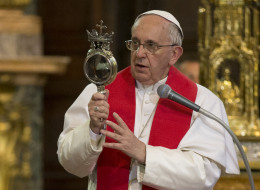
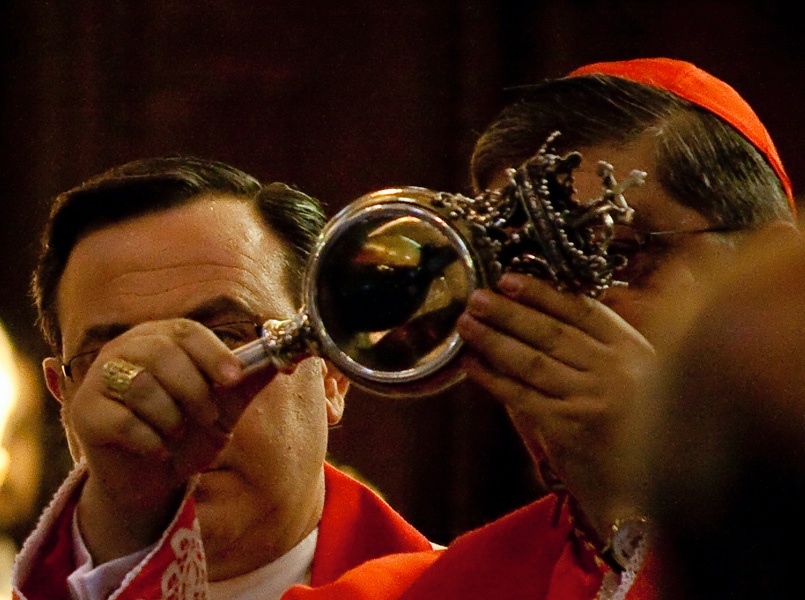
St. Gennaro’s Blood Relic Miraculously Liquefies In The Presence Of Pope Francis In Naples Pope Francis holds a relic believed to contain the blood of St. Gennaro. He's credited with a 'half-miracle' after the blood 'half-liquified' in his presence. [ http://www.huffingtonpost.com/2015/03/22/pope-francis-miracle_n_6920624.html ] Francis kisses the vial [ http://vaticaninsider.lastampa.it/en/the-vatican/detail/articolo/francesco-napoli-39932/ ] The first time the miracle has occurred in the presence of a pope since Pius IX March 21, 2015 [...] Today’s wondrous occurance knows just one precedent. It is the first time St. Gennaro’s blood relic has liquefied in the presence of a pontiff since the miracle occurred in the presence of Pope Pius IX in 1848. Pius IX was the longest-reigning elected pope in the history of the Catholic Church (31 years). He convened the First Vatican Council, which decreed papal infallibility; defined the dogma of the Immaculate Conception of the Blessed Virgin Mary, meaning that Mary was conceived without original sin; and he was the last Pope to rule as the sovereign of the papal states which fell to the Italian army in 1870. Fleeing the Mazzini riots in 1848, Pope Pius IX was rescued by a ship sent by Francis II of Bourbon, who took him to the Royal Palace of Portici. The Pope expressed his desire to go to the Cathedral of Naples. There the miracle of St. Gennaro occurred in his presence. As a token of his gratitude, the pontiff donated a golden chalice to the cathedral in the saint's honor. The chalice is today numbered among the “Ten Wonders of the Treasure of St. Gennaro.” [...] http://www.aleteia.org/en/religion/article/st-gennaros-blood-relic-miraculously-liquifies-in-the-presence-of-pope-francis-in-naples-5869691155251200 [with comments]
--
It’s a Miracle! Vatican Claims Coagulated “Blood” of St. Gennaro Liquefies After Pope Francis Kisses the Vial
The blood relic of St. Gennaro [a.k.a. Januarius], patron saint of Naples, [yesterday] miraculously liquefied in the presence of Pope Francis, the first time the miracle has occurred in the presence of a pontiff since 1848.
“His blood has half-liquefied,” the Archbishop of Naples, Cardinal Crescenzio Sepe, said at the conclusion of Pope Francis’ address to diocesan priest and religious in the city’s cathedral. “It’s a sign that St. Gennaro loves the Pope, who is neapolitan like us.”
Half-liquefied? Was it only a half-miracle, then? Not to these folks:
As Cardinal Sepe … announced the miracle, in the adjacent streets people could be heard shouting with neapolitan passion: “It’s a miracle, it’s a miracle!” …
The dried blood of St. Gennaro, which is preserved in two glass phials in the Naples Cathedral, traditionally liquefies three times a year: on the saint’s September 19 feast, which commemorates his martyrdom in the Catholic liturgical calendar; December 16, the date of the eruption of Mt. Vesuvius in 1631, which was believed to have been halted through the saint’s intervention; and the Saturday before the first Sunday in May.
The most stupendous miracle, and that which is greatly celebrated in the church, is the liquefying and boiling up of this blessed martyr’s blood whenever the vials are brought in sight of his head. This miracle is renewed many times in the year, in presence of all who desire to witness it; yet some heretics have endeavored to throw a doubt upon its genuineness, by frivolous and incoherent explanations; but no one can deny the effect to be miraculous, unless he be prepared to question the evidence of his senses.”
[The Church] has not allowed independent tests on the phials containing the blood.
Such suspicion-raising reticence has given rise to an obvious conclusion: that the whole thing is just a pious hoax. This [id.] is how it could be done:
In 1991 a group of Italian scientists — Luigi Garlaschelli and two colleagues, Franco Ramaccini and Sergio Della Sala — demonstrated that they could simulate the effect with a thixotropic gel, a substance that liquefies when agitated and resolidifies when allowed to stand.
[At] about the same time, two American researchers — forensic analyst John F. Fischer and paranormal investigator Joe Nickell — showed they could reproduce a liquefying and recongealing miracle blood using a colored oil-and-wax mixture. When slightly warmed by heat sources such as nearby candles and body heat, the bogus blood can suddenly liquefy. Nickell and Fischer jokingly attribute their phenomenon to “Saint Februarius.” …
Adding to skeptics’ suspicions, there are some twenty other saints’ bloods that liquefy, virtually every one of them from the Naples area – suggestive of some local secret.
It is, however, true, that Catholicism has the power to severely influence people’s vital fluids; the Church has made my blood boil on plenty of occasions.


 Market Data
  Markets


 AI
AI