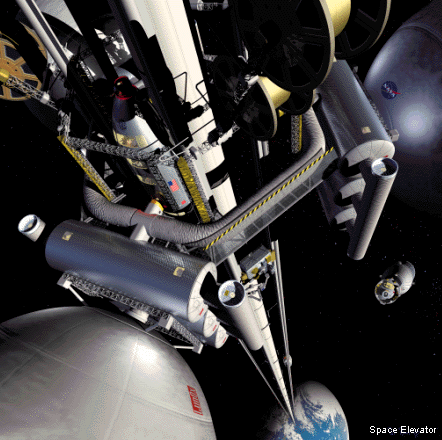
A critical and as-yet-realized component of a successful space elevator is a super lightweight, super strong material. This material will be used to create a composite ribbon upon which elevators will ride carrying cargo and people. Traveling to geostationary Earth orbit, at around 36,000 kilometers, the ribbon would be attached to a ground platform at the Equator. The end in space would be attached to a counterbalance mass, probably using the ribbon-deployment equipment, or perhaps even a captured asteroid. Electromagnetic propulsion is a candidate for launch and delivery, technology which has already been jump-started by current high-speed railway efforts. Another possiblity is laser propulsion, which you will read more about in our interviews, below.
No ribbon material exists today that meets the strength-to-weight requirements. However, carbon nanotubes (CNTs) look promising, since in one form they may be as much as 100 times as strong as steel, at 1/6th the weight. The problem with CNTs is that to date, nobody has figured out a way to either create them in the thousands of kilometer lengths necessary, or to use them to create a composite material that also meets the requirements. Several recent discoveries do however appear to indicate that a composite material may be available in the next few years.
There are other hurdles, such as propulsion, terrorist threats, and avoiding space debris, hurricanes, and lightening, which we cover in the interviews below. All of these hurdles appear to be dealt with using existing technologies and extensions of existing technologies, and achievable in the short-term.
In an article titled Audacious & Outrageous: Space Elevators by science writer Steve Price, we learn more about one writer's views and vision of the Space Elevator. "Yes, ladies and gentlemen, welcome aboard NASA's Millennium-Two Space Elevator. Your first stop will be the Lunar-level platform before we continue on to the New Frontier Space Colony development. The entire ride will take about 5 hours, so sit back and enjoy the trip. As we rise, be sure to watch outside the window as the curvature of the Earth becomes visible and the sky changes from deep blue to black, truly one of the most breathtaking views you will ever see!"
Explained in simple terms by Price "A space elevator is essentially a long cable extending from our planet's surface into space with its center of mass at geostationary Earth orbit (GEO), 35,786 km in altitude. Electromagnetic vehicles traveling along the cable could serve as a mass transportation system for moving people, payloads, and power between Earth and space."
When built as conceived, the space elevator is predicted to greatly reduce the Earth-to-orbit costs of materials, devices, and people. The cost-per-pound to move into space will drop from a current NASA rate of $10,000-$40,000, to a forecasted rate of less than $100 (Ed. some say as little at $10 per lb. in the not-to-distant future). Figure you and your luggage weight 200 pounds - that's $20,000, a bit less than the reported $20M Dennis Tito paid to become the world's first space tourist." Additional and larger elevators, built utilizing the first, would allow large-scale manned and commercial activities in space and reduce lift costs even further." says Los Alamos National Laboratory.
When asked to estimate when the space elevator would be built, Arthur C. Clarke replied "Probably about 50 years after everybody quits laughing!" With the rapid increase in our understanding of nanotubes, coupled with our ability to ramp up their production and separate them, the laughter is rapidly dying down.
To learn more, visit the Institute for Scientific Research, and see their animation. See also The Space Elevator
Newfound Ice World Alters Perceptions of Planetary Systems By Bjorn Carey, SPACE.com Staff Writer posted: 13 March 2006 04:48 pm ET
Astronomers announced today the discovery of a frigid extrasolar planet several times larger than Earth orbiting a small red dwarf star roughly 9,000 light years away.
The finding alters astronomers' perceptions of planetary system formation and the distribution of planets in the galaxy, suggesting that large rock-ice worlds might outnumber gas giants like Jupiter.
The newfound planet is about 13 times more massive than Earth and likely has an icy and rocky but barren terrestrial surface, and it is one of the coldest planets ever discovered outside of our solar system.
It orbits 250 million miles away from a red dwarf star, which is about half the size of our Sun and much cooler. The orbital distance is about the same as our solar system's asteroid belt is from the Sun.
Rocky and cold
The planet is similar in rocky structure to Earth and it is described a "super-Earth."
But being so far away from a red dwarf means that its surface temperature is an inhospitable -330 degrees Fahrenheit (-201 Celsius), about the same as Uranus. That's too cold for liquid water or life as we know it.
Further analysis of the system revealed the absence of Jupiter-like gas giants, and scientists suspect the system literally ran out of gas and failed to form any. This may have starved the newfound planet of the raw materials it needed to turn into a gas giant itself.
"This icy super-Earth dominates the region around its star that in our solar system is populated by the gas-giant planets, Jupiter and Saturn. We've never seen a system like this before, because we've never had the means to find them," said study author Andrew Gould of The Ohio State University and leader of the MicroFUN planet-searching team.
'Pretty common'
Planet formation theory predicts that small, cold planets should form easier than larger ones around big stars. A previous study suggests that about two-thirds of all star systems in the galaxy are red dwarf stars, so solar systems filled with super-Earths might be three times more common than those with giant Jupiters.
"These icy super-earths are pretty common," Gould said. "Roughly 35 percent of all stars have them."
While this is one of the coldest exoplanets ever discovered, it is not the smallest. Earlier this year astronomers announced the discovery of an exoplanet just 5.5 times Earth's mass. The previous record holder weighed in at 7.5 Earth masses.
"Our discovery suggests that different types of solar systems form around different types of stars," said Scott Gaudi of the Harvard-Smithsonian Center for Astrophysics. "Sun-like stars form Jupiters, while red dwarf stars form super-Earths. Larger A-type stars may even form brown dwarfs in their disks."
Brown dwarfs are dim, failed stars that straddle the mass range between gas planets and real stars.
Discovery details
Astronomers discovered this latest planet, catalogued as OGLE-2005-BLG-169lb, with a technique called microlensing, an effect where the gravity of a foreground star makes a more distant star appear brighter. If the foreground star is orbited by a planet, the planet's gravity can periodically warp the brightness of the background star by tiny amounts.
This shift is a telltale indicator of a planet, but is so brief that scientists must monitor the star closely and make multiple observations to confirm the planet's existence. In this case, the scientists were concerned that the warp wasn't caused by a planet, so they wrote a special computer program to speed up their models and confirm the existence of the Neptune-sized object.
The planet's existence was determined by researchers from the MicroFUN, OGLE (Optical Gravitational Lensing Experiment) projects and the MDM Observatory in Arizona. The group has submitted their findings for publication in the journal Astrophysical Journal Letters.
The Dark Truth Photograph by John Dubinski, University of Toronto
No one can see it, or feel it, or even know what it is. But without the mysterious substance called dark matter, galaxies would fly apart. A computer simulation by John Dubinski, an astrophysicist at the University of Toronto, pictures dark matter as an enormous web of filament stretching through space, shown in white above. According to calculations by Dubinski and other astrophysicists, the visible universe—stars and galaxies—is a mere sliver of what is out there. Dark matter is believed to account for at least 90 percent of all matter. The best guess is that dark matter is a large particle with no electrical charge; its only signature is its gravitational pull. Experts predict that within the next ten years experiments will finally isolate dark matter particles and unmask the universe's biggest mystery. http://magma.nationalgeographic.com/ngm/0302/feature1/zoom2.html


 Market Data
  Markets


 AI
AI