Cosmologists have known since the 1920's that the universe is expanding, its galaxies racing away from one another in all directions. Just a few years ago, however, a study of very distant supernovas added a confounding twist: the cosmic expansion is speeding up. Distant galaxies are racing outward at faster velocities. And that doesn't make sense. Gravity is supposed to slow the cosmic expansion -if not to an outright halt (eventually), then at least to a steady pace. Yet here we are, picking up speed. What's going on?
To explain this conundrum, cosmologists have postulated that a strange, previously undescribed repulsive force, which they call dark energy, is at work, counteracting gravity and pushing galaxies apart at an accelerating rate. That's what dark energy does, anyway; what dark energy is. .. well, that's still unclear. this year, astronomers and astrophysicists uncovered convincing new data to confirm that dark energy, whatever it is exactly, really exists. In September, a team of University of Chicago astronomers found evidence of dark energy in subtle fluctuations in the cosmic microwave background - a haze of microwave energy that formed just 400,000 years after the Big Bang and still pervades the universe. In November, a separate team, studying how galaxies bend the light from distant quasars behind them, likewise detected the fingerprints of dark energy. And not only is dark energy real, but the new experiments indicate it's also running amok. Until a couple billion years ago, dark energy was a relatively minor force; now it comprises two-thirds of all the energy in the universe.
Dark energy marks the coming of age of cosmology. The latest telescopes and technology now enable researchers to probe the oldest structures in the universe, to conduct experiments on - and confirm or refute predictions about - the beginning of time itself. Astronomy, astrophysics, particle physics and theory have merged into a true, hard science. Einstein gave us this idea in 1915….From now on Physics must accept this new force!
Dark energy has the cosmoslogists scratching their heads. Observations taken by NASA's Hubble Space Telescope and future space telescopes will be needed in order to determine the properties of dark energy, which makes up about 70 percent of the universe. http://www.nasa.gov/missions/deepspace/f_dark-energy.html
Some say the Universe will end in a "Big Crunch," others expect a "Big Chill," and now some U.S. physicists are saying the end could be something more like a "Big Rip".
Assistant Professor Robert Caldwell of Dartmouth College in New Hampshire and colleagues publish their unusual hypothesis in the current issue of Physical Review Letters.
According to the theory, which is actually called the "Big Rip", the continuous growth of the Universe's "dark energy" pushes things apart and may account for much of the Universe's expansion since the "Big Bang."
If dark energy increases fast enough, in about 20 billion years the repulsive force could become so strong that it pushes apart galaxies, stars, solar systems and eventually even atoms will fly to pieces: "It's a runaway process," said Caldwell.
The dark energy called on by Caldwell is different from the more famous dark matter in that it has no mass or gravity. In fact it's a sort of anti-gravity called on to explain why stars and galaxies are flying away from each other so quickly.
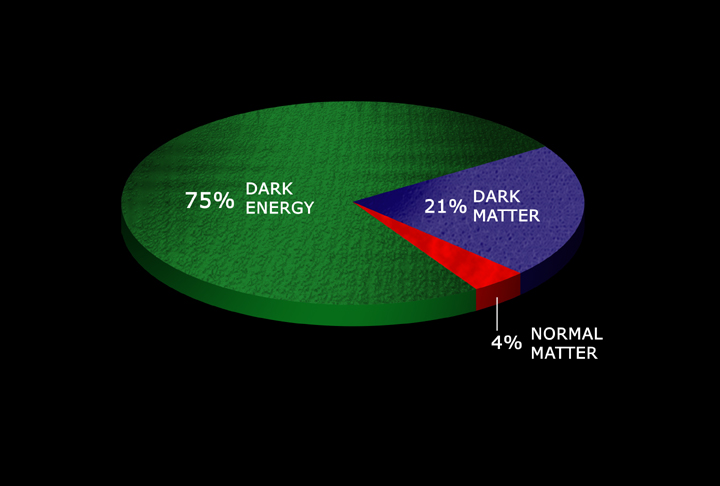
Based on detailed observations of exploding stars, astrophysicists have been able to estimate that dark energy makes up about 70 % of "stuff" in the universe. The rest is made of dark matter (25 %) and regular matter that makes up stars, planets and us (5 %).
In Caldwell's scenario, the universe will last about 20 billion more years. Sixty million years before the end, dark energy will cause the Milky Way galaxy to fly apart. Three months before the end solar systems will break down, flinging planets helter-skelter. Finally, at a tiny fraction of a second before the end of everything, dark energy will be so great that it will overcome the powerful forces that hold matter together, throwing apart atoms.
"It's as plausible as the other [scenarios]," said astrophysicist Professor Abraham Loeb of Harvard University. "And it's good to know what the possibilities are".
The other scenarios, the "Big Crunch" and "Big Chill" call on too much or too little gravity in the universe, respectively. If there is too much gravity, all matter will come back together in a tremendous "crunch." Too little gravity and the present expansion of the universe will continue forever - until every star burns out and the universe becomes a very cold and dead. In this scenario, entropy wins.
Only improved measurements of cosmic forces by astronomers will tell which scenario is likely to prevail, Caldwell said.
Researchers find evidence of dark energy in our galactic neighborhood, University of Washington, 16-Mar-2005
Astrophysicists in recent years have found evidence for a force they call dark energy in observations from the farthest reaches of the universe, billions of light years away.
Now an international team of researchers has used data from powerful computer models, supported by observations from the Hubble Space Telescope, to find evidence of dark energy right in our own cosmic neighborhood.
The data paint a picture of the universe as a virtual sea of dark energy, with billions of galaxies as islands emerging from the sea, said Fabio Governato, a University of Washington research associate professor of astronomy and a researcher with Italy's National Institute for Astrophysics.
In 1929 astronomer Edwin Hubble demonstrated that galaxies are moving away from each other, which supported the theory that the universe has been expanding since the big bang. In 1999 cosmologists reported evidence that an unusual force, called dark energy, was actually causing the expansion of the universe to accelerate.
However, the expansion is slower than it would be otherwise because of the tug of gravity among galaxies. As the battle between the attraction of gravity and the repellent force of dark energy plays out, cosmologists are left to ponder whether the expansion will continue forever or if the universe will collapse in a "big crunch."
In 1997, Governato designed a computer model to simulate evolution of the universe from the big bang until the present. His research group found the model could not duplicate the smooth expansion that had been observed among galaxies around the Milky Way, the galaxy in which Earth resides. In fact, the model produced deviations from a purely radial expansion that were three to seven times higher than astronomers had actually observed, Governato said.
"The observed motion was small, and we could not duplicate it without the presence of dark energy," he said. "When we added the dark energy, we got a perfect match."
Governato is one of three authors of a paper describing the work, scheduled for publication in the Monthly Notices of the Royal Astronomical Society, an astronomy journal in the United Kingdom. Co-authors are Andrea Maccio of the University of Zurich in Switzerland and Cathy Horellou of Chalmers University of Technology in Sweden. The work was supported by grants from the National Science Foundation and Vetenskapsrådet, the Swedish Research Council.
The authors, part of an international research collaboration called the N-Body Shop that originated at the UW, ran simulations of universe expansion on powerful supercomputers in Italy and Alaska. Their findings provide supporting evidence for a sea of dark energy surrounding galaxies.
"We studied the properties of galaxies close to the Milky Way instead of looking billions of light years away," Governato said. "It's like traveling from Seattle to Portland, Ore., rather than from Seattle to New York, to measure the Earth's curvature."


 Market Data
  Markets


 AI
AI