



 AI
AI








Saturday, January 05, 2013 10:52:18 PM
U.S. likely to keep thousands of troops in Afghanistan after NATO forces leave
By Mike Mount January 3rd, 2013 03:42 PM ET
[ http://www.youtube.com/watch?v=3NIg8m8QfG8 ]
The United States could keep between 6,000 and 15,000 troops in Afghanistan after the official 2014 NATO withdrawal, say officials familiar with plans submitted to the Pentagon by the current U.S. commander in that country, Gen. John Allen.
Allen was tasked with developing an overarching plan for how U.S. forces will leave Afghanistan over the next two years, as well as solidifying a post-international combat troop presence. Now he has offered three distinctive options for the president, according to senior defense officials.
The officials said Allen's plans - created with input from Defense Secretary Leon Panetta's office, the Joint Staff, the U.S. Central Command, and the White House - would give President Barack Obama options based on what he is looking to do in Afghanistan.
The plans are awaiting official approval from Panetta, the officials said.
According to the officials:
The low-end option calls for 6,000 to 6,500 troops that would be strictly for counterterrorism operations: hunting down Taliban and al Qaeda members and cells still operating around the country. This would require mostly Special Operations Forces, with a limited number of support troops and only a very small amount of training assistance for Afghan forces.
The mid-range option, involving around 10,000 troops, would still have the main focus on counterterrorism operations, but it would have a bigger training footprint for Afghan forces, with most of the focus on Special Operations troops and a limited amount of conventional troop training.
The 15,000-troop option would bring in a greater number of conventional troops for training Afghan Security Forces, as well as a bigger support element in addition to the counterterrorism forces.
The defense officials said planning for the post-2014 troop presence is still not complete, but it is very close. They said they expect next week's visit of Afghan President Hamid Karzai to involve conversations discussing these options. Officials said Karzai and Panetta are expected to meet at some point.
Last spring, NATO and the Afghan government agreed on a plan for the United States and international forces to end the NATO mission in Afghanistan and hand over full security responsibility of the country to the Afghan government. At the end of last September - as the final troops added during the "surge" that Obama ordered in December 2009 left Afghanistan - the president ordered Allen to assess the situation in the country and develop an exit strategy.
Defense officials said that Allen had to develop a post-2014 security plan before he could determine how fast troops could be withdrawn over the next two years, to ensure stability throughout the exit.
There are currently 66,000 U.S. troops in Afghanistan.
The capability of Afghan security forces has long been in question, with slow improvement in the military, and the Afghan police force lagging far behind. A December 2012 assessment of the security forces, which looked at a snapshot from between the spring and summer, showed that only one of the Afghan Army's 23 brigades was able to operate on its own, without U.S. military air or ground troop support.
Military analysts who closely watch Afghan operations say that while Allen has not yet made a recommendation for the pace of the force withdrawal, he is expected to suggest pulling troops out at a slower rate than the president would want.
One senior Defense official told CNN the United States is expecting the Afghan government to allow legal protections for U.S. troops who remain in Afghanistan after the NATO mission ends in 2014.
The refusal by the Iraq government to extend legal protections for U.S. troops after the end of the war in Iraq was a major reason the United States left the country with no residual military training force.
The Afghan plans come as Allen prepares to leave Afghanistan in early February in a regular command rotation. Taking over for him will be Marine Gen. Joseph Dunford.
Allen was nominated to take over as head of the U.S. European Command, becoming the top military commander for NATO forces. In that role, he was expected to be a key adviser on Afghanistan through its NATO allies. But his nomination is on hold while he is being investigated for alleged improper e-mail communications with a Tampa, Florida socialite, Jill Kelley.
http://security.blogs.cnn.com/2013/01/03/u-s-likely-to-keep-thousands-of-troops-in-afghanistan-after-nato-forces-leave/
======
Afghan census dodges questions of ethnicity and language
Door-to-door interviewers embark on controversial project to count population of country for first time since 1979
Emma Graham-Harrison in Chaghcharan
The Guardian, Thursday 3 January 2013 17.47 GMT
Jump to comments (16)
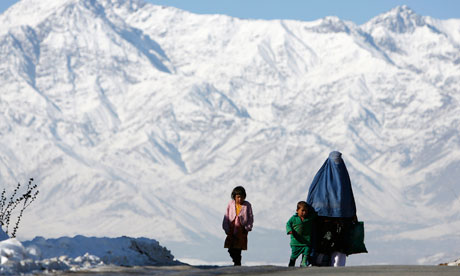
Afghan population data may prove a vital tool for cutting waste
of development resources. Photograph: Mohammad Ismail/Reuters
There are two questions Hajera Bashir does not ask as she goes door to door gathering census data in Ghor province in Afghanistan's .. http://www.guardian.co.uk/world/afghanistan .. freezing central highlands: which ethnic group residents belong to, and what language they speak at home.
With these taboo topics set aside, she quizzes families about everything else: their income and how many wives each man has, whether they can read and if their sons and daughters are in school, domestic details such as how they heat their homes, whether they have a toilet and if they keep chickens.
The shy 18-year-old is part of a critical but controversial effort to count the Afghan population .. http://www.guardian.co.uk/world/population .. for the first time since 1979. Expected to take at least six years on a slow, province-by-province basis, it is possible only because it sidesteps tangled questions about the country's ethnic balance. Asking about language is avoided because it can be used as a proxy marker for ethnicity.
"We don't ask for ethnicity or language spoken, this is on purpose," said Laurent Zessler, head in Afghanistan of the UN Population Fund, which is supporting the project. "This country has so many issues to address between the political process, the economy and security, why complicate it?"
Still, the complexity of Afghanistan's ethnic politics means any kind of counting is controversial. The first results, from normally calm central Bamiyan province, showed an actual population barely half official estimates. The area is mostly home to Hazaras, a Shia minority who have often been persecuted in Sunni-dominated Afghanistan, and many took the findings as another form of attack.
"Death to the enemies of Bamiyan! The statistics are wrong!" shouted more than 1,000 demonstrators as they marched on UN offices in the small town this summer, the Pajhwok news agency reported.
A previous attempt to end the decades-long wait for a count of the Afghan people, in 2008, was scrapped, with the government citing security problems. In December officials even dropped plans to unveil a new estimate of the population.
Although war has often put swaths of the country off-limits to statisticians, bitter ethnic politics have also played a role in slow progress, because of the risks that a population count might reduce the official size of some constituencies or expand those of rivals.
"If a politician sees that the ethnic group to which he or she belongs is less than expected, they will sometimes reject the data," said Abdul Rahman Ghafoori, head of the Central Statistics Office, who has the delicate job of balancing his country's need for decent data against the influence of groups who would rather details remain opaque or unchanged.
"We are not looking to reduce or increase population," he said, in an ornately carved office that survived years of violence better than the institution he heads. He is trying to capture his country in numbers with a staff of just 800, and an ambivalent population. "Statistics is a new thing for most people in Afghanistan," he said, "they don't feel it's a need, a necessity."
It is hard to overstate how few reliable numbers there are about population or anything else in Afghanistan, or what a problem this is for those trying to bolster the economy, distribute aid, decide where clinics should be built or how many teachers recruited, or do any other kind of long-term planning.
"The first step is to admit just how bad and conflicting many of the data now being used really are," wrote Anthony Cordesman, in a recent paper for the Centre for Strategic and International Studies .. http://csis.org/files/publication/120918_Afghan_Failing_Econ.pdf .. (pdf) on the economic impact of the departure of western troops.
The lack of reliable figures create "real world uncertainty levels that can easily reach 20-30%", he said, citing population figures from sources including the World Bank and Afghan and US governments that vary from 26 million to 32 million. The estimates are muddied by years of violence, death and exodus, to Pakistan, Iran or further afield; there are only educated guesses about how many people survived, how many returned and how many have since been born.
"For us this is historical because it's the first time since 1979 that we have a survey at the district level, from house to house," said the UN's Zessler. "We are convinced that if we continue to carry these out, province by province, that will give us the same result as a national census."
So far only three provinces have been counted, and they are among the most secure in the country. Security problems are likely to be added to political tensions as teams spread out in more restive areas. But the slow timetable, with the final provinces not due to be surveyed until 2016, may help limit political opposition to the project.
The government could not even consider using the data to change polling districts or the makeup of parliament until the whole country has been counted, UN and Afghan officials say, and that will be long after Afghanistan has chosen its next president and parliament.
The data that is stored up in the meantime may prove a vital tool for cutting corruption and waste, as the resources for development drop off in tandem with foreign troop numbers, supporters of the project say.
"If this survey had been done earlier, it could have changed the whole course of development here," said 28-year-old Abdul Sanjar, head of the provincial union of journalists in Ghor. "So much of the aid and money sent here was wasted as no one knew where or how to spend it. I hope this will be a step towards change." [ my emphasis ]
http://www.guardian.co.uk/world/2013/jan/03/afghan-census-questions-of-ethnicity
See also:
Pakistani protesters clash with police

http://investorshub.advfn.com/boards/read_msg.aspx?message_id=36332049 .. wild ..
By Mike Mount January 3rd, 2013 03:42 PM ET
[ http://www.youtube.com/watch?v=3NIg8m8QfG8 ]
The United States could keep between 6,000 and 15,000 troops in Afghanistan after the official 2014 NATO withdrawal, say officials familiar with plans submitted to the Pentagon by the current U.S. commander in that country, Gen. John Allen.
Allen was tasked with developing an overarching plan for how U.S. forces will leave Afghanistan over the next two years, as well as solidifying a post-international combat troop presence. Now he has offered three distinctive options for the president, according to senior defense officials.
The officials said Allen's plans - created with input from Defense Secretary Leon Panetta's office, the Joint Staff, the U.S. Central Command, and the White House - would give President Barack Obama options based on what he is looking to do in Afghanistan.
The plans are awaiting official approval from Panetta, the officials said.
According to the officials:
The low-end option calls for 6,000 to 6,500 troops that would be strictly for counterterrorism operations: hunting down Taliban and al Qaeda members and cells still operating around the country. This would require mostly Special Operations Forces, with a limited number of support troops and only a very small amount of training assistance for Afghan forces.
The mid-range option, involving around 10,000 troops, would still have the main focus on counterterrorism operations, but it would have a bigger training footprint for Afghan forces, with most of the focus on Special Operations troops and a limited amount of conventional troop training.
The 15,000-troop option would bring in a greater number of conventional troops for training Afghan Security Forces, as well as a bigger support element in addition to the counterterrorism forces.
The defense officials said planning for the post-2014 troop presence is still not complete, but it is very close. They said they expect next week's visit of Afghan President Hamid Karzai to involve conversations discussing these options. Officials said Karzai and Panetta are expected to meet at some point.
Last spring, NATO and the Afghan government agreed on a plan for the United States and international forces to end the NATO mission in Afghanistan and hand over full security responsibility of the country to the Afghan government. At the end of last September - as the final troops added during the "surge" that Obama ordered in December 2009 left Afghanistan - the president ordered Allen to assess the situation in the country and develop an exit strategy.
Defense officials said that Allen had to develop a post-2014 security plan before he could determine how fast troops could be withdrawn over the next two years, to ensure stability throughout the exit.
There are currently 66,000 U.S. troops in Afghanistan.
The capability of Afghan security forces has long been in question, with slow improvement in the military, and the Afghan police force lagging far behind. A December 2012 assessment of the security forces, which looked at a snapshot from between the spring and summer, showed that only one of the Afghan Army's 23 brigades was able to operate on its own, without U.S. military air or ground troop support.
Military analysts who closely watch Afghan operations say that while Allen has not yet made a recommendation for the pace of the force withdrawal, he is expected to suggest pulling troops out at a slower rate than the president would want.
One senior Defense official told CNN the United States is expecting the Afghan government to allow legal protections for U.S. troops who remain in Afghanistan after the NATO mission ends in 2014.
The refusal by the Iraq government to extend legal protections for U.S. troops after the end of the war in Iraq was a major reason the United States left the country with no residual military training force.
The Afghan plans come as Allen prepares to leave Afghanistan in early February in a regular command rotation. Taking over for him will be Marine Gen. Joseph Dunford.
Allen was nominated to take over as head of the U.S. European Command, becoming the top military commander for NATO forces. In that role, he was expected to be a key adviser on Afghanistan through its NATO allies. But his nomination is on hold while he is being investigated for alleged improper e-mail communications with a Tampa, Florida socialite, Jill Kelley.
http://security.blogs.cnn.com/2013/01/03/u-s-likely-to-keep-thousands-of-troops-in-afghanistan-after-nato-forces-leave/
======
Afghan census dodges questions of ethnicity and language
Door-to-door interviewers embark on controversial project to count population of country for first time since 1979
Emma Graham-Harrison in Chaghcharan
The Guardian, Thursday 3 January 2013 17.47 GMT
Jump to comments (16)
Afghan population data may prove a vital tool for cutting waste
of development resources. Photograph: Mohammad Ismail/Reuters
There are two questions Hajera Bashir does not ask as she goes door to door gathering census data in Ghor province in Afghanistan's .. http://www.guardian.co.uk/world/afghanistan .. freezing central highlands: which ethnic group residents belong to, and what language they speak at home.
With these taboo topics set aside, she quizzes families about everything else: their income and how many wives each man has, whether they can read and if their sons and daughters are in school, domestic details such as how they heat their homes, whether they have a toilet and if they keep chickens.
The shy 18-year-old is part of a critical but controversial effort to count the Afghan population .. http://www.guardian.co.uk/world/population .. for the first time since 1979. Expected to take at least six years on a slow, province-by-province basis, it is possible only because it sidesteps tangled questions about the country's ethnic balance. Asking about language is avoided because it can be used as a proxy marker for ethnicity.
"We don't ask for ethnicity or language spoken, this is on purpose," said Laurent Zessler, head in Afghanistan of the UN Population Fund, which is supporting the project. "This country has so many issues to address between the political process, the economy and security, why complicate it?"
Still, the complexity of Afghanistan's ethnic politics means any kind of counting is controversial. The first results, from normally calm central Bamiyan province, showed an actual population barely half official estimates. The area is mostly home to Hazaras, a Shia minority who have often been persecuted in Sunni-dominated Afghanistan, and many took the findings as another form of attack.
"Death to the enemies of Bamiyan! The statistics are wrong!" shouted more than 1,000 demonstrators as they marched on UN offices in the small town this summer, the Pajhwok news agency reported.
A previous attempt to end the decades-long wait for a count of the Afghan people, in 2008, was scrapped, with the government citing security problems. In December officials even dropped plans to unveil a new estimate of the population.
Although war has often put swaths of the country off-limits to statisticians, bitter ethnic politics have also played a role in slow progress, because of the risks that a population count might reduce the official size of some constituencies or expand those of rivals.
"If a politician sees that the ethnic group to which he or she belongs is less than expected, they will sometimes reject the data," said Abdul Rahman Ghafoori, head of the Central Statistics Office, who has the delicate job of balancing his country's need for decent data against the influence of groups who would rather details remain opaque or unchanged.
"We are not looking to reduce or increase population," he said, in an ornately carved office that survived years of violence better than the institution he heads. He is trying to capture his country in numbers with a staff of just 800, and an ambivalent population. "Statistics is a new thing for most people in Afghanistan," he said, "they don't feel it's a need, a necessity."
It is hard to overstate how few reliable numbers there are about population or anything else in Afghanistan, or what a problem this is for those trying to bolster the economy, distribute aid, decide where clinics should be built or how many teachers recruited, or do any other kind of long-term planning.
"The first step is to admit just how bad and conflicting many of the data now being used really are," wrote Anthony Cordesman, in a recent paper for the Centre for Strategic and International Studies .. http://csis.org/files/publication/120918_Afghan_Failing_Econ.pdf .. (pdf) on the economic impact of the departure of western troops.
The lack of reliable figures create "real world uncertainty levels that can easily reach 20-30%", he said, citing population figures from sources including the World Bank and Afghan and US governments that vary from 26 million to 32 million. The estimates are muddied by years of violence, death and exodus, to Pakistan, Iran or further afield; there are only educated guesses about how many people survived, how many returned and how many have since been born.
"For us this is historical because it's the first time since 1979 that we have a survey at the district level, from house to house," said the UN's Zessler. "We are convinced that if we continue to carry these out, province by province, that will give us the same result as a national census."
So far only three provinces have been counted, and they are among the most secure in the country. Security problems are likely to be added to political tensions as teams spread out in more restive areas. But the slow timetable, with the final provinces not due to be surveyed until 2016, may help limit political opposition to the project.
The government could not even consider using the data to change polling districts or the makeup of parliament until the whole country has been counted, UN and Afghan officials say, and that will be long after Afghanistan has chosen its next president and parliament.
The data that is stored up in the meantime may prove a vital tool for cutting corruption and waste, as the resources for development drop off in tandem with foreign troop numbers, supporters of the project say.
"If this survey had been done earlier, it could have changed the whole course of development here," said 28-year-old Abdul Sanjar, head of the provincial union of journalists in Ghor. "So much of the aid and money sent here was wasted as no one knew where or how to spend it. I hope this will be a step towards change." [ my emphasis ]
http://www.guardian.co.uk/world/2013/jan/03/afghan-census-questions-of-ethnicity
See also:
Pakistani protesters clash with police

http://investorshub.advfn.com/boards/read_msg.aspx?message_id=36332049 .. wild ..
It was Plato who said, “He, O men, is the wisest, who like Socrates, knows that his wisdom is in truth worth nothing”
Discover What Traders Are Watching
Explore small cap ideas before they hit the headlines.



