



 AI
AI






| Followers | 148 |
| Posts | 34814 |
| Boards Moderated | 3 |
| Alias Born | 06/16/2004 |

Sunday, October 30, 2005 1:07:26 AM
Suddenly, area's housing market favors the buyers
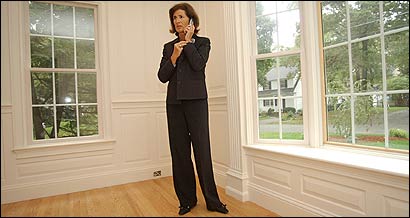
Dwindling turnouts: Real estate broker Sand Evellone called into her office while waiting for prospective buyers during a Sunday open house in Wellesley earlier this month. (Boston Globe Photo)
Suddenly, area's housing market favors the buyers
Cooling of sales to crimp economy
By Robert Gavin, Globe Staff | October 28, 2005
Greater Boston's once-sizzling home sales have cooled so much this fall that realtors are reverting to a description not heard in a decade: ''Buyer's market."
From the South End to the South Shore to Cape Ann, the list of unsold properties is growing, and so are reductions in asking prices. Attractive houses in good locations with seemingly appropriate pricetags are getting scant interest. Real estate agents, who six months ago played host to streams of buyers, are now presiding over open houses that draw few if any lookers.
For the last two Sundays, John Ford, of Ford Realty Inc., held open houses at a two-bedroom South End condo on a strong residential block of Columbus Avenue with parking, patio, and hardly outrageous asking price of $570,000. Not a single person showed up. In Weymouth, a four-bedroom raised-ranch with a view of the Fore River, priced at $445,000, attracted just one couple in the first hour and 15 minutes of an open house last weekend, prompting realtor Bonnie Goodstein to exult, ''O yay! Customers!"
In Jamaica Plain, even a $70,000 price cut -- to $399,000 -- hasn't generated much interest in a two-bedroom, bi-level condo in a 19th century mansion that has been on the market for about a month. Sunday, only four people, including two curious neighbors, came to an open house.
''My seller is willing" to consider a lower price, said the broker, Anne Connolly, ''but there's no buyers to deal with."
The fall slowdown not only represents a sea change for sellers, who for years have enjoyed multiple offers and higher prices, but also indicates the region's bull housing market is at an end. Real estate agents say a long-predicted market correction appears underway as the gap between the price of housing and peoples' incomes -- now even wider than at peak of the 1980s housing boom -- has become too great to sustain the recent pace of sales and appreciation.
Certainly, few expect an '80s-style collapse, when home values plunged 25 percent or more.Today, the economy and lenders are far stronger, and mortgage rates, which topped 10 percent when the last boom went bust, are far lower -- currently about 6 percent. In the 1980s, overbuilding, unsound lending practices, and intense speculation by investors, along with higher interest rates, sparked a real-estate crash.
Still, real estate agents today increasingly are telling sellers to expect lower prices than comparable sellers received six months ago. Linda O'Koniewski, owner of Re/Max Heritage in Melrose, said her brokerage is still selling houses, but at prices 5-to-10 percent lower than what comparable homes sold for in spring.
''All trends point to a correction period," she said.
While this may be good news for buyers, a slowing housing market will add a drag to Massachusetts' already sluggish economy. Real estate has been one of the state's few bright spots, generating not only jobs when most other sectors declined, but also wealth, in the form of rapidly appreciating home equity.
Homeowners, by refinancing mortgages, can tap into equity gained through appreciation as a source of cash. In Massachusetts, cash taken from home equity rose to 14 percent of peoples' disposable income in 2004 from 4 percent in 2001, according to Economy.com, a West Chester, Pa. forecasting firm.
Real estate-related employment in Massachusetts has risen about 5 percent since 2001, compared to a decline of about 5 percent in overall employment.
''A weakening housing market will be a significant weight on economies that have benefited from the real estate boom," said Mark Zandi, Economy.com's chief economist. ''It means fewer jobs in sectors such as construction. It short circuits equity withdrawals that supported household spending on home improvements, restaurants and vacations."
Analysts said it likely will take until spring, the main home selling season, to gauge the extent of the correction.
Maggie Tomkiewicz, president of the Massachusetts Association of Realtors, agreed that the market has cooled recently, but rather than a correction, it represents a return to normalcy. She doesn't expect prices to decline year-over-year.
''The market was overheated," she said. ''A seller now needs to be more realistic" in pricing.
The realtors association reported this week that the number of Massachusetts home sales rose in September from a year ago. Median prices increased about 4 percent over the prior year but fell from August. That data, however, lags the market since it includes only sales that have closed. It can take two-to-three months from purchase-and-sale agreement to closing.
Data from listing services, which better capture current conditions, suggest a weaker market. In Boston, for example, the number of condominiums listed for sale is up 50 percent from a year ago, while the number of price cuts has more than doubled, according to Listing Information Service Inc., which tracks the Boston condo market.
Analysts say a number of factors are contributing to this weakness, including rising interest rates, slow job growth, and soaring energy costs. Widespread speculation that prices eventually could fall rapidly is exacerbating the slowdown. As these factors have depressed buying interest, they also may have pushed sellers, sensing that the market may be at the beginning of a decline, to put properties up for sale, brokers said.
The result: more supply, less demand, and sellers searching for buyers. Last Sunday, Globe reporters visited about a dozen open houses in different Boston neighborhoods and suburban communities.
In Rockport, only four potential buyers visited a three-bedroom
Cape, on the market since July despite three price reductions to $369,000 from $384,000.
''People are being very choosy," said the broker, Michelle Allison.
With growing choices, buyer psychology has changed, brokers said. In recent years, buyers raced to make offers, convinced prices would only go higher, or even bid against each other, pushing prices up. Now, many are prepared to wait, believing that prices are coming down.
At an open house in Braintree last Sunday, Jeff Brown, a 30-year-old health care professional, said he and his wife, Julie, have a price in their head, and they plan to stick to it as they shop. Last spring, Brown added, they were outbid on five homes, all sold above asking price.
Recently, after viewing a home in Norwell, listed at $645,000, Brown was told as he walked out, ''We'll take $535,000."
Robert Gavin can be reached at rgavin@globe.com.
LINK: http://www.boston.com/news/local/massachusetts/articles/2005/10/28/suddenly_areas_housing_market_fav...
LINK: http://www.boston.com/news/local/massachusetts/articles/2005/10/28/suddenly_areas_housing_market_fav...
Dwindling turnouts: Real estate broker Sand Evellone called into her office while waiting for prospective buyers during a Sunday open house in Wellesley earlier this month. (Boston Globe Photo)
Suddenly, area's housing market favors the buyers
Cooling of sales to crimp economy
By Robert Gavin, Globe Staff | October 28, 2005
Greater Boston's once-sizzling home sales have cooled so much this fall that realtors are reverting to a description not heard in a decade: ''Buyer's market."
From the South End to the South Shore to Cape Ann, the list of unsold properties is growing, and so are reductions in asking prices. Attractive houses in good locations with seemingly appropriate pricetags are getting scant interest. Real estate agents, who six months ago played host to streams of buyers, are now presiding over open houses that draw few if any lookers.
For the last two Sundays, John Ford, of Ford Realty Inc., held open houses at a two-bedroom South End condo on a strong residential block of Columbus Avenue with parking, patio, and hardly outrageous asking price of $570,000. Not a single person showed up. In Weymouth, a four-bedroom raised-ranch with a view of the Fore River, priced at $445,000, attracted just one couple in the first hour and 15 minutes of an open house last weekend, prompting realtor Bonnie Goodstein to exult, ''O yay! Customers!"
In Jamaica Plain, even a $70,000 price cut -- to $399,000 -- hasn't generated much interest in a two-bedroom, bi-level condo in a 19th century mansion that has been on the market for about a month. Sunday, only four people, including two curious neighbors, came to an open house.
''My seller is willing" to consider a lower price, said the broker, Anne Connolly, ''but there's no buyers to deal with."
The fall slowdown not only represents a sea change for sellers, who for years have enjoyed multiple offers and higher prices, but also indicates the region's bull housing market is at an end. Real estate agents say a long-predicted market correction appears underway as the gap between the price of housing and peoples' incomes -- now even wider than at peak of the 1980s housing boom -- has become too great to sustain the recent pace of sales and appreciation.
Certainly, few expect an '80s-style collapse, when home values plunged 25 percent or more.Today, the economy and lenders are far stronger, and mortgage rates, which topped 10 percent when the last boom went bust, are far lower -- currently about 6 percent. In the 1980s, overbuilding, unsound lending practices, and intense speculation by investors, along with higher interest rates, sparked a real-estate crash.
Still, real estate agents today increasingly are telling sellers to expect lower prices than comparable sellers received six months ago. Linda O'Koniewski, owner of Re/Max Heritage in Melrose, said her brokerage is still selling houses, but at prices 5-to-10 percent lower than what comparable homes sold for in spring.
''All trends point to a correction period," she said.
While this may be good news for buyers, a slowing housing market will add a drag to Massachusetts' already sluggish economy. Real estate has been one of the state's few bright spots, generating not only jobs when most other sectors declined, but also wealth, in the form of rapidly appreciating home equity.
Homeowners, by refinancing mortgages, can tap into equity gained through appreciation as a source of cash. In Massachusetts, cash taken from home equity rose to 14 percent of peoples' disposable income in 2004 from 4 percent in 2001, according to Economy.com, a West Chester, Pa. forecasting firm.
Real estate-related employment in Massachusetts has risen about 5 percent since 2001, compared to a decline of about 5 percent in overall employment.
''A weakening housing market will be a significant weight on economies that have benefited from the real estate boom," said Mark Zandi, Economy.com's chief economist. ''It means fewer jobs in sectors such as construction. It short circuits equity withdrawals that supported household spending on home improvements, restaurants and vacations."
Analysts said it likely will take until spring, the main home selling season, to gauge the extent of the correction.
Maggie Tomkiewicz, president of the Massachusetts Association of Realtors, agreed that the market has cooled recently, but rather than a correction, it represents a return to normalcy. She doesn't expect prices to decline year-over-year.
''The market was overheated," she said. ''A seller now needs to be more realistic" in pricing.
The realtors association reported this week that the number of Massachusetts home sales rose in September from a year ago. Median prices increased about 4 percent over the prior year but fell from August. That data, however, lags the market since it includes only sales that have closed. It can take two-to-three months from purchase-and-sale agreement to closing.
Data from listing services, which better capture current conditions, suggest a weaker market. In Boston, for example, the number of condominiums listed for sale is up 50 percent from a year ago, while the number of price cuts has more than doubled, according to Listing Information Service Inc., which tracks the Boston condo market.
Analysts say a number of factors are contributing to this weakness, including rising interest rates, slow job growth, and soaring energy costs. Widespread speculation that prices eventually could fall rapidly is exacerbating the slowdown. As these factors have depressed buying interest, they also may have pushed sellers, sensing that the market may be at the beginning of a decline, to put properties up for sale, brokers said.
The result: more supply, less demand, and sellers searching for buyers. Last Sunday, Globe reporters visited about a dozen open houses in different Boston neighborhoods and suburban communities.
In Rockport, only four potential buyers visited a three-bedroom
Cape, on the market since July despite three price reductions to $369,000 from $384,000.
''People are being very choosy," said the broker, Michelle Allison.
With growing choices, buyer psychology has changed, brokers said. In recent years, buyers raced to make offers, convinced prices would only go higher, or even bid against each other, pushing prices up. Now, many are prepared to wait, believing that prices are coming down.
At an open house in Braintree last Sunday, Jeff Brown, a 30-year-old health care professional, said he and his wife, Julie, have a price in their head, and they plan to stick to it as they shop. Last spring, Brown added, they were outbid on five homes, all sold above asking price.
Recently, after viewing a home in Norwell, listed at $645,000, Brown was told as he walked out, ''We'll take $535,000."
Robert Gavin can be reached at rgavin@globe.com.
LINK: http://www.boston.com/news/local/massachusetts/articles/2005/10/28/suddenly_areas_housing_market_fav...
LINK: http://www.boston.com/news/local/massachusetts/articles/2005/10/28/suddenly_areas_housing_market_fav...

HI-HO SILVER !!!
Discover What Traders Are Watching
Explore small cap ideas before they hit the headlines.



