



 AI
AI








Saturday, April 07, 2012 9:37:35 PM
Hi .. that's not easy .. Iran .. bits ..
Both "Persia" and "Iran" are used interchangeably in cultural contexts;
however, "Iran" is the name used officially in political contexts.
The 18th largest country in the world in terms of area at 1,648,195 km2
(636,372 sq mi), Iran has a population of around 79 million.
Demographics
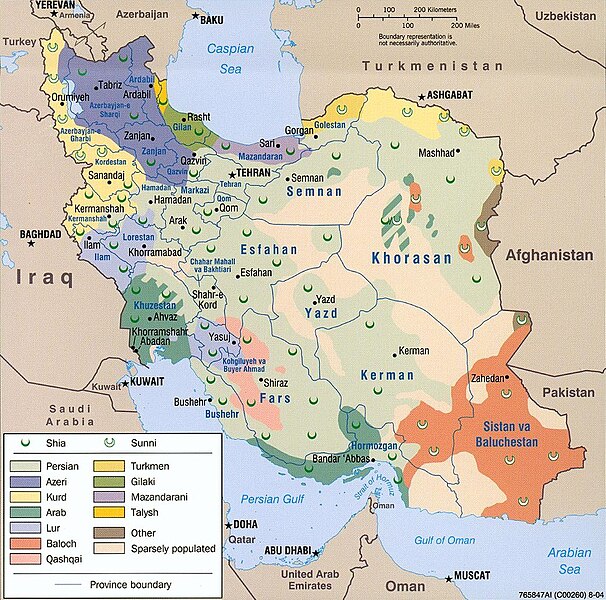
Iran ethnoreligious distribution
Iran is a diverse country consisting of people of many religions and ethnic backgrounds cemented by the Persian culture. The majority of the population speaks the Persian language, which is also the official language of the country, as well as other Iranian languages or dialects. Turkic languages and dialects, most importantly Azeri language, are spoken in different areas in Iran. Additionally, Arabic is spoken in the southwestern parts of the country.
The exact ethnic breakdown of Iran is unknown as there are no official numbers, however some organizations have made estimates. The World Factbook released the estimate: Persians (61%), Azerbaijanis (16%), Kurds (10%), Lurs (6%), Arabs (2%), Balochs (2%), Turkmens and Turkic tribes (2%), Laks, Qashqai, Armenians, Persian Jews, Georgians, Assyrians, Circassians, Tats, Mandaeans, Gypsies, Brahuis, Kazakhs and others (1%). However according to them Persian is spoken as first language by 53%, while Azeri and other Turkic dialects is spoken by 18%, Kurdish by 10%, Gilaki and Mazandarani by 7%, Luri by 6%, Balochi by 2%, Arabic by 2% and that some 2% have other languages as first language.
The Library of Congress estimates are as following: Persians (65%), Azerbaijanis (16%), Kurds (7%), Lurs (6%), Arabs (2%), Baluchi (2%), Turkmens (1%), Turkic tribal groups such as the Qashqai (1%), and non-Iranian, non-Turkic groups such as Armenians, Assyrians, and Georgians (less than 1%). According to them Persian is spoken as a mother tongue by at least 65% of the population and as a second language by a large proportion of the remaining 35%.
http://en.wikipedia.org/wiki/Iran#Demographics
Some seem to use Iranian and Persian almost synonymously, they include
other dialects in Iran as Persian whereas others don't seem to ..
Ethnicity
While a categorization of a "Persian" ethnic group persists in the West, Persians have generally been a pan-national group often comprising regional people who often refer to themselves as 'Persians' and have also often used the term "Iranian" (in the ethnic-cultural sense). As a pan-national group, defining Persians as an ethnic group, at least in terms used in the West, is not inclusive since the ethnonym "Persian" includes several Iranian people including the speakers of Modern Persian. Some scholars, classify the speakers of Persian language as a single ethnic unit (the ‘Persians’) and exclude those Iranians who speak dialects of Persian, or other Iranian dialects closely related to Persian; however this approach to ethnicity in Iran is erroneous, since the designation Iranian (Irani) as an ethnic term has been used by all these ethnic group in Iran, including the "Persians" irrespective of their origin, language and religion.
Sub-groups
Persians can be found in Iran, Georgia, Turkey, Armenia, the Caucasus, Azerbaijan, Afghanistan, Tajikistan, Uzbekistan and Northern Pakistan. Like the Persians of Iran (Western Persians), the Tajiks (Eastern Persians) are descendants of various Iranian peoples, including Persians from Iran, as well as numerous invaders. Tajiks and Farsiwan have a particular affinity with Persians in neighboring Khorasan due to historical interaction some stemming from the Islamic period. Scholars also include Iranian language speakers such as Talysh, Gilak, Lurs, Mazandaranis and speakers of Central Iranian languages in Iran under the term Persian. Specifically, the Lurs speak an Archaic Persian language.
Other smaller groups include the Qizilbash of Afghanistan and Pakistan who are related to the Farsiwan and Azerbaijanis. In the Caucasus, the Tats are concentrated in Azerbaijan, Armenia, and Russian Dagestan and their origins are traced to Sassanid merchants who settled in the region. Parsis, a Zoroastrian sect of western India centered around Gujarat and Mumbai and also found in southern Pakistan, while the Parsees, are also largely descended from Persian Zoroastrians. The Iranis, another small community in western South Asia, are descended from more recent Persian Zoroastrian immigrants. In addition, the Hazara and Aimaq of Afghanistan are ethnic groups of partial Persianized Mongol and Turkic origin. .. http://en.wikipedia.org/wiki/Persian_people#Modern_era
How many live outside Iran? 4+ million according to ..
The Persian Diaspora
Since the Iranian Revolution of 1979, millions of Persian Speaking peoples have migrated to other parts of
the Middle East, to the US, Europe, and other areas of the world. .. http://www.farsinet.com/pwo/diaspora.html
======== .. Surely the mullahs et al are Persian .. but .. ??? .. not sure ..
Iran’s Top 20
May 22, 2009 8:00 PM EDT
Power and public discourse in the Islamic Republic are dominated by fewer than
two dozen heavyweights, ranging from ayatollahs to entertainers (and one TV network).
1. Ayatollah Ali Khamenei - Supreme Leader
Watch his actions, not his words. Having made his name as a pragmatist before taking over as Iran's top holy man, he tries to reconcile the two roles: he tends to take the more popular side in every debate, while spouting radical rhetoric.
2. Mahmoud Ahmadinejad - President
Favored to win another four-year term as Iran’s second-most-powerful man. The Supreme Leader can always overrule him but until recently has tried to avoid direct confrontation. Khamenei is said to have particularly enjoyed his performance during nuclear negotiations.
3. Ayatollah Ali Akbar Hashemi Rafsanjani - Eminence Grise
As head of the Expediency Council the ex-president is in charge of settling disputes between Iran's Parliament and the Council of Guardians. A Khomeini confidant, he knows all the skeletons in the regime's closet and may play a quiet role in U.S.-Iran talks.
4. Mohammad Khatami - Ex-President
After 18 years of conservative rule, Iranians were stunned by the reformist's 1997 upset victory: their votes counted! Although he proved unable to keep his lofty promises, many young people still see him as the best hope for change. They took it hard when he quit this year's race.
5. Ayatollah Ahmad Jannati - Oversight Chief
The Council of Guardians of the Islamic Revolution is a panel of six clerics and six lawyers that oversees all legislative bills and decides who can run in parliamentary and presidential elections. Its 83-year-old chief is an enthusiastic Ahmadinejad supporter.
6. Ali Larijani - Majlis Speaker
The national legislature's pragmatic leader is the well-heeled son of an influential cleric, as well as Iran's former nuclear negotiator. He remains close to Khamenei. Ahmadinejad defeated Larijani in the 2005 presidential race, and their disputes since then have become a public spectacle.
7. Gen. Mohammad Ali Jafari - Revolutionary Guards Commander
Specialized in guerrilla missions and unconventional warfare during the war with Iraq. He's said to owe his current post to his popularity with young troops and his up-to-date plans for defense against possible threats from Israel and America.
8. Mohammad Baqer Qalibaf - Mayor of Tehran
A former Revolutionary Guards commander and security chief, he stepped into Ahmadinejad's old job as mayor after a failed bid for the presidency in 2005. Supporters praise him for fixing the mess they say Ahmadinejad left behind, and they hope he'll do the same for Iran in 2013.
9. Ayatollah Abbas Vaez-Tabasi - Holy Estate Director
Controls what is arguably the country's wealthiest single institution, the Holy Estate of Imam Reza, which owns hundreds of companies, mines and farms. Every year millions of pilgrims visit the shrine of the Shia saint, the only one buried in Iran.
10. Ayatollah Mohammad Taghi Mesbah Yazdi - Radical Scholar
The plugged-in director of the Imam Khomeini Education & Research Institute is one of the most hardline and influential interpreters of Islamic teachings in Qum. His students are among the city's brightest and most politicized.
11. Seyyed Javad Shahrestani - Sistani's Envoy
Despite 30 years of political Islam in Iran, many Shiites still see Iraq-based Grand Ayatollah Ali al-Sistani as their religious leader, or marja ("object of emulation"). The resolutely apolitical Shahrestani is Sistani's son-in-law, as well as his representative in the Islamic Republic.
12. Saeed Mortazavi - Prosecutor General of Tehran
Has been responsible for closing dozens of newspapers and sentencing journalists and activists to lengthy jail terms. Human-rights groups accuse him of harsh interrogation methods. He recently organized a group of lawyers to prosecute alleged Israeli crimes in Gaza.
13. Ayatollah Mahmoud Hashemi Shahroudi - Head of Judiciary
Born in Iraq, he was a leader in the fight against Saddam's dictatorship before fleeing the country in 1979. Has made impressive progress on court reform since Khamenei named him top judge in 1999, but many judges remain beyond his jurisdiction.
14. Mojtaba Samareh Hashemi - Campaign Manager
Friends with Ahmadinejad since childhood, and an architect of his political rise, Samareh has been called an Iranian Karl Rove. He recently resigned from his post as a senior presidential adviser in order to devote himself full time to Ahmadinejad's bid for reelection.
15. Mir Hossein Mousavi - Ex–Prime Minister
Dark-horse presidential candidate and an enigma to just about everyone. Older Iranians remember him as prime minister and a close Khomeini ally in the 1980s, but he's spent the past 20 years painting and designing buildings. Now he's wooing young voters as a reformist.
16. Mohsen Rezaei - Khamenei Adviser
The former Revolutionary Guards commander and secretary of the Expediency Council is a close and loyal adviser to the Supreme Leader. He's a devout traditionalist but more pragmatic than the current president, and is hoping to unseat him in the June 12 elections.
17. Hossein Shariatmadari - Newspaper Editor
Khamenei's top man at Kayhan, the leading conservative daily. His editorials, special reports and "Hidden Half" feature (devoted to the darker side of public figures he dislikes) read like a cross between intelligence reports and an Iranian version of Fox News.
18. BBC Persian Service - Illegal TV Network
The ban on satellite dishes is widely ignored: Iranians want news they can trust, not state TV. The Persian Voice of America is too pro-Washington for some. Since early this year, many have turned instead to the BBC and popular anchors like Farnaz Ghazizadeh (above).
19. Adel Ferdosipour - Sportscaster
Easily the country's most popular TV host. When angry sports officials tried to get him fired recently for criticizing them on his weekly show (Iranian soccer, a national passion, is in crisis, beset by scandal and poor play), more than 3 million loyal fans sent text messages to keep him on.
20. Mehran Modiri - Social Satirist
Has survived 20 years by choosing his battles. Today his television comedies rule Iran's airwaves, with audiences so big that broadcast executives don't balk at his lampoons of Iranian life. Reformist politicians crave his endorsement, but he wants to stay in business.
http://www.thedailybeast.com/newsweek/2009/05/22/iran-s-top-20.html
Who is Persian and who is not seems to differ among scholars .. many Iranians apparently refer to themselves as Persians ..
lost the post the first time, and am grrring so just click ..
Both "Persia" and "Iran" are used interchangeably in cultural contexts;
however, "Iran" is the name used officially in political contexts.
The 18th largest country in the world in terms of area at 1,648,195 km2
(636,372 sq mi), Iran has a population of around 79 million.
Demographics
Iran ethnoreligious distribution
Iran is a diverse country consisting of people of many religions and ethnic backgrounds cemented by the Persian culture. The majority of the population speaks the Persian language, which is also the official language of the country, as well as other Iranian languages or dialects. Turkic languages and dialects, most importantly Azeri language, are spoken in different areas in Iran. Additionally, Arabic is spoken in the southwestern parts of the country.
The exact ethnic breakdown of Iran is unknown as there are no official numbers, however some organizations have made estimates. The World Factbook released the estimate: Persians (61%), Azerbaijanis (16%), Kurds (10%), Lurs (6%), Arabs (2%), Balochs (2%), Turkmens and Turkic tribes (2%), Laks, Qashqai, Armenians, Persian Jews, Georgians, Assyrians, Circassians, Tats, Mandaeans, Gypsies, Brahuis, Kazakhs and others (1%). However according to them Persian is spoken as first language by 53%, while Azeri and other Turkic dialects is spoken by 18%, Kurdish by 10%, Gilaki and Mazandarani by 7%, Luri by 6%, Balochi by 2%, Arabic by 2% and that some 2% have other languages as first language.
The Library of Congress estimates are as following: Persians (65%), Azerbaijanis (16%), Kurds (7%), Lurs (6%), Arabs (2%), Baluchi (2%), Turkmens (1%), Turkic tribal groups such as the Qashqai (1%), and non-Iranian, non-Turkic groups such as Armenians, Assyrians, and Georgians (less than 1%). According to them Persian is spoken as a mother tongue by at least 65% of the population and as a second language by a large proportion of the remaining 35%.
http://en.wikipedia.org/wiki/Iran#Demographics
Some seem to use Iranian and Persian almost synonymously, they include
other dialects in Iran as Persian whereas others don't seem to ..
Ethnicity
While a categorization of a "Persian" ethnic group persists in the West, Persians have generally been a pan-national group often comprising regional people who often refer to themselves as 'Persians' and have also often used the term "Iranian" (in the ethnic-cultural sense). As a pan-national group, defining Persians as an ethnic group, at least in terms used in the West, is not inclusive since the ethnonym "Persian" includes several Iranian people including the speakers of Modern Persian. Some scholars, classify the speakers of Persian language as a single ethnic unit (the ‘Persians’) and exclude those Iranians who speak dialects of Persian, or other Iranian dialects closely related to Persian; however this approach to ethnicity in Iran is erroneous, since the designation Iranian (Irani) as an ethnic term has been used by all these ethnic group in Iran, including the "Persians" irrespective of their origin, language and religion.
Sub-groups
Persians can be found in Iran, Georgia, Turkey, Armenia, the Caucasus, Azerbaijan, Afghanistan, Tajikistan, Uzbekistan and Northern Pakistan. Like the Persians of Iran (Western Persians), the Tajiks (Eastern Persians) are descendants of various Iranian peoples, including Persians from Iran, as well as numerous invaders. Tajiks and Farsiwan have a particular affinity with Persians in neighboring Khorasan due to historical interaction some stemming from the Islamic period. Scholars also include Iranian language speakers such as Talysh, Gilak, Lurs, Mazandaranis and speakers of Central Iranian languages in Iran under the term Persian. Specifically, the Lurs speak an Archaic Persian language.
Other smaller groups include the Qizilbash of Afghanistan and Pakistan who are related to the Farsiwan and Azerbaijanis. In the Caucasus, the Tats are concentrated in Azerbaijan, Armenia, and Russian Dagestan and their origins are traced to Sassanid merchants who settled in the region. Parsis, a Zoroastrian sect of western India centered around Gujarat and Mumbai and also found in southern Pakistan, while the Parsees, are also largely descended from Persian Zoroastrians. The Iranis, another small community in western South Asia, are descended from more recent Persian Zoroastrian immigrants. In addition, the Hazara and Aimaq of Afghanistan are ethnic groups of partial Persianized Mongol and Turkic origin. .. http://en.wikipedia.org/wiki/Persian_people#Modern_era
How many live outside Iran? 4+ million according to ..
The Persian Diaspora
Since the Iranian Revolution of 1979, millions of Persian Speaking peoples have migrated to other parts of
the Middle East, to the US, Europe, and other areas of the world. .. http://www.farsinet.com/pwo/diaspora.html
======== .. Surely the mullahs et al are Persian .. but .. ??? .. not sure ..
Iran’s Top 20
May 22, 2009 8:00 PM EDT
Power and public discourse in the Islamic Republic are dominated by fewer than
two dozen heavyweights, ranging from ayatollahs to entertainers (and one TV network).
1. Ayatollah Ali Khamenei - Supreme Leader
Watch his actions, not his words. Having made his name as a pragmatist before taking over as Iran's top holy man, he tries to reconcile the two roles: he tends to take the more popular side in every debate, while spouting radical rhetoric.
2. Mahmoud Ahmadinejad - President
Favored to win another four-year term as Iran’s second-most-powerful man. The Supreme Leader can always overrule him but until recently has tried to avoid direct confrontation. Khamenei is said to have particularly enjoyed his performance during nuclear negotiations.
3. Ayatollah Ali Akbar Hashemi Rafsanjani - Eminence Grise
As head of the Expediency Council the ex-president is in charge of settling disputes between Iran's Parliament and the Council of Guardians. A Khomeini confidant, he knows all the skeletons in the regime's closet and may play a quiet role in U.S.-Iran talks.
4. Mohammad Khatami - Ex-President
After 18 years of conservative rule, Iranians were stunned by the reformist's 1997 upset victory: their votes counted! Although he proved unable to keep his lofty promises, many young people still see him as the best hope for change. They took it hard when he quit this year's race.
5. Ayatollah Ahmad Jannati - Oversight Chief
The Council of Guardians of the Islamic Revolution is a panel of six clerics and six lawyers that oversees all legislative bills and decides who can run in parliamentary and presidential elections. Its 83-year-old chief is an enthusiastic Ahmadinejad supporter.
6. Ali Larijani - Majlis Speaker
The national legislature's pragmatic leader is the well-heeled son of an influential cleric, as well as Iran's former nuclear negotiator. He remains close to Khamenei. Ahmadinejad defeated Larijani in the 2005 presidential race, and their disputes since then have become a public spectacle.
7. Gen. Mohammad Ali Jafari - Revolutionary Guards Commander
Specialized in guerrilla missions and unconventional warfare during the war with Iraq. He's said to owe his current post to his popularity with young troops and his up-to-date plans for defense against possible threats from Israel and America.
8. Mohammad Baqer Qalibaf - Mayor of Tehran
A former Revolutionary Guards commander and security chief, he stepped into Ahmadinejad's old job as mayor after a failed bid for the presidency in 2005. Supporters praise him for fixing the mess they say Ahmadinejad left behind, and they hope he'll do the same for Iran in 2013.
9. Ayatollah Abbas Vaez-Tabasi - Holy Estate Director
Controls what is arguably the country's wealthiest single institution, the Holy Estate of Imam Reza, which owns hundreds of companies, mines and farms. Every year millions of pilgrims visit the shrine of the Shia saint, the only one buried in Iran.
10. Ayatollah Mohammad Taghi Mesbah Yazdi - Radical Scholar
The plugged-in director of the Imam Khomeini Education & Research Institute is one of the most hardline and influential interpreters of Islamic teachings in Qum. His students are among the city's brightest and most politicized.
11. Seyyed Javad Shahrestani - Sistani's Envoy
Despite 30 years of political Islam in Iran, many Shiites still see Iraq-based Grand Ayatollah Ali al-Sistani as their religious leader, or marja ("object of emulation"). The resolutely apolitical Shahrestani is Sistani's son-in-law, as well as his representative in the Islamic Republic.
12. Saeed Mortazavi - Prosecutor General of Tehran
Has been responsible for closing dozens of newspapers and sentencing journalists and activists to lengthy jail terms. Human-rights groups accuse him of harsh interrogation methods. He recently organized a group of lawyers to prosecute alleged Israeli crimes in Gaza.
13. Ayatollah Mahmoud Hashemi Shahroudi - Head of Judiciary
Born in Iraq, he was a leader in the fight against Saddam's dictatorship before fleeing the country in 1979. Has made impressive progress on court reform since Khamenei named him top judge in 1999, but many judges remain beyond his jurisdiction.
14. Mojtaba Samareh Hashemi - Campaign Manager
Friends with Ahmadinejad since childhood, and an architect of his political rise, Samareh has been called an Iranian Karl Rove. He recently resigned from his post as a senior presidential adviser in order to devote himself full time to Ahmadinejad's bid for reelection.
15. Mir Hossein Mousavi - Ex–Prime Minister
Dark-horse presidential candidate and an enigma to just about everyone. Older Iranians remember him as prime minister and a close Khomeini ally in the 1980s, but he's spent the past 20 years painting and designing buildings. Now he's wooing young voters as a reformist.
16. Mohsen Rezaei - Khamenei Adviser
The former Revolutionary Guards commander and secretary of the Expediency Council is a close and loyal adviser to the Supreme Leader. He's a devout traditionalist but more pragmatic than the current president, and is hoping to unseat him in the June 12 elections.
17. Hossein Shariatmadari - Newspaper Editor
Khamenei's top man at Kayhan, the leading conservative daily. His editorials, special reports and "Hidden Half" feature (devoted to the darker side of public figures he dislikes) read like a cross between intelligence reports and an Iranian version of Fox News.
18. BBC Persian Service - Illegal TV Network
The ban on satellite dishes is widely ignored: Iranians want news they can trust, not state TV. The Persian Voice of America is too pro-Washington for some. Since early this year, many have turned instead to the BBC and popular anchors like Farnaz Ghazizadeh (above).
19. Adel Ferdosipour - Sportscaster
Easily the country's most popular TV host. When angry sports officials tried to get him fired recently for criticizing them on his weekly show (Iranian soccer, a national passion, is in crisis, beset by scandal and poor play), more than 3 million loyal fans sent text messages to keep him on.
20. Mehran Modiri - Social Satirist
Has survived 20 years by choosing his battles. Today his television comedies rule Iran's airwaves, with audiences so big that broadcast executives don't balk at his lampoons of Iranian life. Reformist politicians crave his endorsement, but he wants to stay in business.
http://www.thedailybeast.com/newsweek/2009/05/22/iran-s-top-20.html
Who is Persian and who is not seems to differ among scholars .. many Iranians apparently refer to themselves as Persians ..
lost the post the first time, and am grrring so just click ..
It was Plato who said, “He, O men, is the wisest, who like Socrates, knows that his wisdom is in truth worth nothing”
Discover What Traders Are Watching
Explore small cap ideas before they hit the headlines.



