



 AI
AI








Sunday, February 19, 2012 1:08:17 AM
Iran's nuclear ambitions could lead to 'Middle East cold war', says Hague
Foreign secretary said the world would face most serious
round of nuclear proliferation since invention of atomic bomb
Chris McGreal in Washington, Conal Urquhart and agencies
guardian.co.uk, Saturday 18 February 2012 10.51 GMT
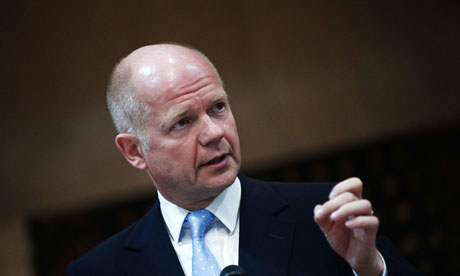
Foreign secretary William Hague has warned of the dangers
facing the world if Iran acquires nuclear weapons.
Photograph: Gianluigi Guercia/AFP/Getty Images
The Middle East could be the battleground for a new cold war, if Iran succeeds in acquiring nuclear weapons, Britain's foreign secretary has warned.
William Hague said the world would face the most serious round of nuclear proliferation since the invention of the atomic bomb, which would be a "disaster in world affairs".
Hague's comments come as officials in Washington expressed fears that Iran is ignoring economic sanctions, increasing the likelihood of Israel and or the US attacking the Islamic Republic this year.
Hague insisted that the UK did not currently support military action against Iran but added "all options must remain on the table".
"[The Iranians] are clearly continuing their nuclear weapons programme," Hague told the Daily Telegraph. "If they obtain nuclear weapons capability, then I think other nations across the Middle East will want to develop nuclear weapons.
[GAWD! I HATE READING, OVER AND OVER AND OVER AGAIN EVIDENCE DEVOID WAR-MONGERING PROPAGANDA]
"And so, the most serious round of nuclear proliferation since nuclear weapons were invented would have begun with all the destabilising effects in the Middle East. And the threat of a new cold war in the Middle East without necessarily all the safety mechanisms. That would be a disaster in world affairs."
Hague's desire to give economic sanctions time to work is reflected in Washington. However, officials in key parts of the Obama administration are increasingly convinced that sanctions will not deter Tehran from pursuing its nuclear programme. They believe the US will be left with no option but to launch an attack on Iran or watch Israel do so.
The president has made clear in public, and in private to Israel, that he is determined to give sufficient time for recent measures to bite deeper into Iran's already battered economy before retreating from its principal strategy to pressure Tehran. These measures include the financial blockade and the looming European oil embargo.
But there is a strong current of opinion within the administration – including in the Pentagon and the state department – that believes sanctions are doomed to fail. They also believe their principal use now is in delaying Israeli military action, as well as reassuring Europe that an attack will only come after other means have been tested.
"The White House wants to see sanctions work. This is not the Bush White House. It does not need another conflict," said an official knowledgeable on Middle East policy. "Its problem is that the guys in Tehran are behaving like sanctions don't matter, like their economy isn't collapsing, like Israel isn't going to do anything.
"Sanctions are all we've got to throw at the problem. If they fail, then it's hard to see how we don't move to the 'in extremis' option."
The White House has said repeatedly that all options are on the table, including the use of force to stop Iran obtaining a nuclear weapon, but that for now the emphasis is firmly on diplomacy and sanctions.
But long-held doubts among US officials about whether the Iranians can be enticed or cajoled into serious negotiations have been reinforced by recent events.
"We don't see a way forward," said one official. "The record shows that there is nothing to work with."
President Mahmoud Ahmadinejad claimed this week that Iran had loaded its first domestically-made fuel rod into a nuclear reactor, and he also threatened to cut oil supplies to six European countries. This was read as further evidence that Tehran remains defiantly committed to its nuclear programme.
If Obama were to conclude that there is no choice but to attack Iran, he is unlikely to order it before the presidential election in November, unless there is an urgent reason to do so. The question is whether the Israelis will hold back that long.
On Friday, the US and EU expressed optimism at the possibility of a resumption of talks with Iran. US secretary of state Hillary Clinton said a letter from Iran to the US and its allies was "one we have been waiting for".
But other US officials complained that the latest Iranian offer to negotiate with the UN security council appeared to contain no significant new concessions. They believed that renewed talks would likely steer discussions away from the nuclear programme.
That view was strengthened by Iran's increasingly belligerent moves such as the botched attempts, which were laid at Tehran's door, to attack Israeli diplomats in Thailand, India and Georgia. Such moves are compounding the sense that Iran is far from ready to negotiate.
Feeding into the considerations are the timing of the US election, including its bearing on Israeli thinking, as well as the pace of Iranian advances in their nuclear programme.
Obama has publicly said that there are no differences with Israel on Iran, describing his administration as in "lock step" with the Jewish state.
But the US and Israel are at odds over the significance of Iran's claim to have begun enriching uranium at the underground facility at Fordow, near the holy city of Qom, and therefore the timing of any military action.
Israel's defence minister, Ehud Barak, has warned that Iran cannot be allowed to establish a "zone of immunity" at Fordow, where it is able to work on a nuclear weapon deep underground and protected from Israel's conventional weapons. Earlier this month, Barak said Israel must consider an attack before that happens.
http://www.guardian.co.uk/world/2012/feb/18/iran-nuclear-ambitions-middle-east
Hague was for the invasion of Iraq, too.
=============== .. WARMONGERS CONTINUE TO RATCHET THE TEMPERATURE UP ..
Israel joins Hague in raising temperature over Iran
As Tehran unveils the latest developments in its nuclear programme, the Israeli Defence Minister calls for 'crippling' sanctions
Sunday 19 February 2012

Israel joined the Foreign Secretary, William Hague, in ratcheting up the pressure on Iran last night, calling for "crippling" sanctions on Tehran to force it to give up its nuclear programme. Israel's Defence Minister, Ehud Barak, said a nuclear-armed Iran would trigger an arms race in the Middle East and ultimately pose a threat to the entire world.
The warning came hours after Mr Hague had claimed that Iran's nuclear ambitions could plunge the Middle East into "a new Cold War". Mr Hague told The Daily Telegraph: "If [the Iranians] obtain nuclear weapons capability, other nations across the Middle East will want to develop nuclear weapons," leading to "the most serious round of nuclear proliferation since nuclear weapons were invented".
Tensions in the Middle East are already running high, with Israel accusing Iran of masterminding attacks on its embassies. Iran denies the allegations and blames Israel and the United States for assassinating several Iranian nuclear scientists in recent years.
Mr Barak added to the tensions yesterday, when he expressed frustration that four rounds of UN sanctions had failed to halt Iran's uranium enrichment programme. On a visit to Tokyo, he said: "We have to [speed up] imposing sanctions and make them crippling to such an extent that the leadership ... will be compelled to sit down and ask themselves 'are we ready to pay the price of isolation from most, if not all, of the world?'"
On Wednesday, Iran unveiled new developments in its nuclear programme, declaring it had used domestically made nuclear fuel in a reactor for the first time. Yesterday, after extensive naval manoeuvres in the region, Iranian warships entered the Mediterranean for only the second time since the 1979 revolution.
But experts urged governments last night to allow the International Atomic Energy Agency (IAEA) to lead the investigations. Sir Richard Dalton, a former UK ambassador to Iran, said: "It is wrong to say that Iran is rushing towards having a nuclear weapon.
"But," he added, "it is right that the IAEA should press Iran on behalf of the international community to answer fully questions about what it has been up to in the past and what it may still be doing in the present." The shadow Foreign Secretary, Douglas Alexander, said: "Instead of raising the rhetoric, the Government should be focused on redoubling their efforts to increase the diplomatic pressure on Iran and find a peaceful solution to the issue."
On Friday, US and European Union leaders were optimistic about resuming talks with Iran. The US Secretary of State, Hillary Clinton, said a letter from Iran to the US and its allies was "one we have been waiting for".
Talks between Iran and six world powers – the US, UK, France, Germany, Russia and China – on Tehran's nuclear programme collapsed a year ago. In recent months, Western countries have stepped up pressure on Iran over the nuclear issue, with the EU and US both introducing wide-ranging sanctions on the country. The US President, Barack Obama, emphasised this month that Israel and the US were working in "unison" to counter Iran.
Mr Hague told the Telegraph that Britain has urged Israel not to strike. He said: "We support a twin-track strategy of sanctions... and negotiations," adding that a military attack would have "enormous downsides."
http://www.independent.co.uk/news/world/middle-east/israel-joins-hague-in-raising-temperature-over-iran-7179536.html
See also:
...there is no doubt that Iraq (after Afghanistan) was the next step in the PNAC plan which always had Iran as its ultimate objective, or that the Israeli Likudniks/Jewish neocons were central to and in the genesis and later implementation of that PNAC plan
http://investorshub.advfn.com/boards/read_msg.aspx?message_id=72019708
Flashback: Netanyahu discussed 1967 lines with Hillary — and there was no controversy
http://investorshub.advfn.com/boards/read_msg.aspx?message_id=63506681
Anti-Liberal Netanyahu Slams Arab Spring as Anti-Liberal
Posted on 11/25/2011 by Juan
Israeli Prime Minister Binyamin Netanyahu .. http://www.telegraph.co.uk/news/worldnews/middleeast/israel/8913577/Arab-Spring-anti-democratic-says-Benjamin-Netanyahu.html .. said yesterday that he had been right to oppose the forced resignation of Egyptian President Hosni Mubarak last February and categorized the uprisings in the Arab world as “anti-Western, anti-liberal, anti-Israeli and anti-democratic wave.” He gave the “uncertainty” in the region as yet another excuse for the Likud Party to continue to steal and squat on ever greater portions of the Palestinian West Bank. .. continued ..
http://investorshub.advfn.com/boards/replies.aspx?msg=68647201
Foreign secretary said the world would face most serious
round of nuclear proliferation since invention of atomic bomb
Chris McGreal in Washington, Conal Urquhart and agencies
guardian.co.uk, Saturday 18 February 2012 10.51 GMT
Foreign secretary William Hague has warned of the dangers
facing the world if Iran acquires nuclear weapons.
Photograph: Gianluigi Guercia/AFP/Getty Images
The Middle East could be the battleground for a new cold war, if Iran succeeds in acquiring nuclear weapons, Britain's foreign secretary has warned.
William Hague said the world would face the most serious round of nuclear proliferation since the invention of the atomic bomb, which would be a "disaster in world affairs".
Hague's comments come as officials in Washington expressed fears that Iran is ignoring economic sanctions, increasing the likelihood of Israel and or the US attacking the Islamic Republic this year.
Hague insisted that the UK did not currently support military action against Iran but added "all options must remain on the table".
"[The Iranians] are clearly continuing their nuclear weapons programme," Hague told the Daily Telegraph. "If they obtain nuclear weapons capability, then I think other nations across the Middle East will want to develop nuclear weapons.
[GAWD! I HATE READING, OVER AND OVER AND OVER AGAIN EVIDENCE DEVOID WAR-MONGERING PROPAGANDA]
"And so, the most serious round of nuclear proliferation since nuclear weapons were invented would have begun with all the destabilising effects in the Middle East. And the threat of a new cold war in the Middle East without necessarily all the safety mechanisms. That would be a disaster in world affairs."
Hague's desire to give economic sanctions time to work is reflected in Washington. However, officials in key parts of the Obama administration are increasingly convinced that sanctions will not deter Tehran from pursuing its nuclear programme. They believe the US will be left with no option but to launch an attack on Iran or watch Israel do so.
The president has made clear in public, and in private to Israel, that he is determined to give sufficient time for recent measures to bite deeper into Iran's already battered economy before retreating from its principal strategy to pressure Tehran. These measures include the financial blockade and the looming European oil embargo.
But there is a strong current of opinion within the administration – including in the Pentagon and the state department – that believes sanctions are doomed to fail. They also believe their principal use now is in delaying Israeli military action, as well as reassuring Europe that an attack will only come after other means have been tested.
"The White House wants to see sanctions work. This is not the Bush White House. It does not need another conflict," said an official knowledgeable on Middle East policy. "Its problem is that the guys in Tehran are behaving like sanctions don't matter, like their economy isn't collapsing, like Israel isn't going to do anything.
"Sanctions are all we've got to throw at the problem. If they fail, then it's hard to see how we don't move to the 'in extremis' option."
The White House has said repeatedly that all options are on the table, including the use of force to stop Iran obtaining a nuclear weapon, but that for now the emphasis is firmly on diplomacy and sanctions.
But long-held doubts among US officials about whether the Iranians can be enticed or cajoled into serious negotiations have been reinforced by recent events.
"We don't see a way forward," said one official. "The record shows that there is nothing to work with."
President Mahmoud Ahmadinejad claimed this week that Iran had loaded its first domestically-made fuel rod into a nuclear reactor, and he also threatened to cut oil supplies to six European countries. This was read as further evidence that Tehran remains defiantly committed to its nuclear programme.
If Obama were to conclude that there is no choice but to attack Iran, he is unlikely to order it before the presidential election in November, unless there is an urgent reason to do so. The question is whether the Israelis will hold back that long.
On Friday, the US and EU expressed optimism at the possibility of a resumption of talks with Iran. US secretary of state Hillary Clinton said a letter from Iran to the US and its allies was "one we have been waiting for".
But other US officials complained that the latest Iranian offer to negotiate with the UN security council appeared to contain no significant new concessions. They believed that renewed talks would likely steer discussions away from the nuclear programme.
That view was strengthened by Iran's increasingly belligerent moves such as the botched attempts, which were laid at Tehran's door, to attack Israeli diplomats in Thailand, India and Georgia. Such moves are compounding the sense that Iran is far from ready to negotiate.
Feeding into the considerations are the timing of the US election, including its bearing on Israeli thinking, as well as the pace of Iranian advances in their nuclear programme.
Obama has publicly said that there are no differences with Israel on Iran, describing his administration as in "lock step" with the Jewish state.
But the US and Israel are at odds over the significance of Iran's claim to have begun enriching uranium at the underground facility at Fordow, near the holy city of Qom, and therefore the timing of any military action.
Israel's defence minister, Ehud Barak, has warned that Iran cannot be allowed to establish a "zone of immunity" at Fordow, where it is able to work on a nuclear weapon deep underground and protected from Israel's conventional weapons. Earlier this month, Barak said Israel must consider an attack before that happens.
http://www.guardian.co.uk/world/2012/feb/18/iran-nuclear-ambitions-middle-east
Hague was for the invasion of Iraq, too.
=============== .. WARMONGERS CONTINUE TO RATCHET THE TEMPERATURE UP ..
Israel joins Hague in raising temperature over Iran
As Tehran unveils the latest developments in its nuclear programme, the Israeli Defence Minister calls for 'crippling' sanctions
Sunday 19 February 2012

Israel joined the Foreign Secretary, William Hague, in ratcheting up the pressure on Iran last night, calling for "crippling" sanctions on Tehran to force it to give up its nuclear programme. Israel's Defence Minister, Ehud Barak, said a nuclear-armed Iran would trigger an arms race in the Middle East and ultimately pose a threat to the entire world.
The warning came hours after Mr Hague had claimed that Iran's nuclear ambitions could plunge the Middle East into "a new Cold War". Mr Hague told The Daily Telegraph: "If [the Iranians] obtain nuclear weapons capability, other nations across the Middle East will want to develop nuclear weapons," leading to "the most serious round of nuclear proliferation since nuclear weapons were invented".
Tensions in the Middle East are already running high, with Israel accusing Iran of masterminding attacks on its embassies. Iran denies the allegations and blames Israel and the United States for assassinating several Iranian nuclear scientists in recent years.
Mr Barak added to the tensions yesterday, when he expressed frustration that four rounds of UN sanctions had failed to halt Iran's uranium enrichment programme. On a visit to Tokyo, he said: "We have to [speed up] imposing sanctions and make them crippling to such an extent that the leadership ... will be compelled to sit down and ask themselves 'are we ready to pay the price of isolation from most, if not all, of the world?'"
On Wednesday, Iran unveiled new developments in its nuclear programme, declaring it had used domestically made nuclear fuel in a reactor for the first time. Yesterday, after extensive naval manoeuvres in the region, Iranian warships entered the Mediterranean for only the second time since the 1979 revolution.
But experts urged governments last night to allow the International Atomic Energy Agency (IAEA) to lead the investigations. Sir Richard Dalton, a former UK ambassador to Iran, said: "It is wrong to say that Iran is rushing towards having a nuclear weapon.
"But," he added, "it is right that the IAEA should press Iran on behalf of the international community to answer fully questions about what it has been up to in the past and what it may still be doing in the present." The shadow Foreign Secretary, Douglas Alexander, said: "Instead of raising the rhetoric, the Government should be focused on redoubling their efforts to increase the diplomatic pressure on Iran and find a peaceful solution to the issue."
On Friday, US and European Union leaders were optimistic about resuming talks with Iran. The US Secretary of State, Hillary Clinton, said a letter from Iran to the US and its allies was "one we have been waiting for".
Talks between Iran and six world powers – the US, UK, France, Germany, Russia and China – on Tehran's nuclear programme collapsed a year ago. In recent months, Western countries have stepped up pressure on Iran over the nuclear issue, with the EU and US both introducing wide-ranging sanctions on the country. The US President, Barack Obama, emphasised this month that Israel and the US were working in "unison" to counter Iran.
Mr Hague told the Telegraph that Britain has urged Israel not to strike. He said: "We support a twin-track strategy of sanctions... and negotiations," adding that a military attack would have "enormous downsides."
http://www.independent.co.uk/news/world/middle-east/israel-joins-hague-in-raising-temperature-over-iran-7179536.html
See also:
...there is no doubt that Iraq (after Afghanistan) was the next step in the PNAC plan which always had Iran as its ultimate objective, or that the Israeli Likudniks/Jewish neocons were central to and in the genesis and later implementation of that PNAC plan
http://investorshub.advfn.com/boards/read_msg.aspx?message_id=72019708
Flashback: Netanyahu discussed 1967 lines with Hillary — and there was no controversy
http://investorshub.advfn.com/boards/read_msg.aspx?message_id=63506681
Anti-Liberal Netanyahu Slams Arab Spring as Anti-Liberal
Posted on 11/25/2011 by Juan
Israeli Prime Minister Binyamin Netanyahu .. http://www.telegraph.co.uk/news/worldnews/middleeast/israel/8913577/Arab-Spring-anti-democratic-says-Benjamin-Netanyahu.html .. said yesterday that he had been right to oppose the forced resignation of Egyptian President Hosni Mubarak last February and categorized the uprisings in the Arab world as “anti-Western, anti-liberal, anti-Israeli and anti-democratic wave.” He gave the “uncertainty” in the region as yet another excuse for the Likud Party to continue to steal and squat on ever greater portions of the Palestinian West Bank. .. continued ..
http://investorshub.advfn.com/boards/replies.aspx?msg=68647201
It was Plato who said, “He, O men, is the wisest, who like Socrates, knows that his wisdom is in truth worth nothing”
Discover What Traders Are Watching
Explore small cap ideas before they hit the headlines.



