



 AI
AI








Sunday, August 21, 2011 8:31:37 PM
Libyan rebels push into Tripoli as Gaddafi appeals for help
GREAT NEWS! Where is Gadaffi? Headed to Algeria? With heaps of cash?
National Transitional Council confirms capture of ruler's son and rebel convoy enters Green Square, the capital's symbolic heart
Martin Chulov, and Chris Stephen in Zlitan
guardian.co.uk, Monday 22 August 2011 01.12 BST
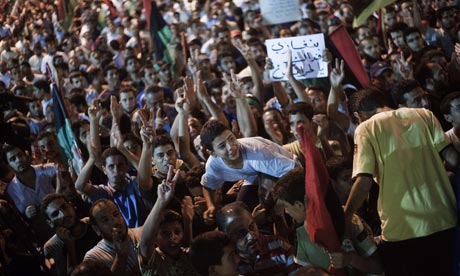
Libyans celebrating in the streets of Benghazi after rebel forces
surged into the capital, Tripoli, and the Gaddafi regime faced the
end of its reign. Photograph: Gianluigi Guercia/AFP/Getty Images
Hundreds of rebel fighters have pushed into the Libyan capital, Tripoli, as their struggle to overthrow the 42-year rule of Muammar Gaddafi moves closer to ending in victory.
As the rebel forces moved through the western suburbs of the city, there was little sign of resistance from pro-Gaddafi forces. Late on Sunday night, a rebel convoy entered the city's Green Square, its symbolic heart.
Jubilant residents were seen pouring into the streets to celebrate and greet the rebel fighters as they advanced. The head of the rebel National Transitional Council said that Gaddafi's son, Saif al-Islam had been captured. "We have confirmed information that our guys have captured Saif al-Islam," Mustapha Abd el-Jalil told al-Jazeera television on Sunday night.
"We have given instructions to treat him well so that he can face trial."
There were also reports that Gaddafi's eldest son, Mohammed, and the presidential guard had surrendered.
But as crowds cheered and let off volleys of gunfire in the air in Tripoli and the rebel-held city of Misrata, Gaddafi staged a dramatic late-night appeal for help.
Speaking on state television, which continued broadcasting, the dictator spoke via audiolink and sounded more measured than in previous, emotionally charged speeches. Addressing the Libyan people, he said: "There are criminals, they are coming to destroy Tripoli. They are coming to steal our oil.
"Now it [Tripoli] is in ruins. They are coming, they are destroying it. Come out of your houses and fight these betrayers. Hurry up, hurry up, families and tribes, go to Tripoli. Call the tribes to go to Tripoli."
Libyan information ministry spokesman Moussa Ibrahim also insisted that Gaddafi forces would stand and fight. He said: "We are still very strong. We have thousands and thousands of fighters who have nowhere to go but to fight.
"Nato has intensified its attacks on and around Tripoli, giving immediate and direct support for the rebels' forces to advance into a peaceful capital of this great nation and the death toll is beyond imagination."
In an attempt to try to avoid a heavy battle in the city centre, Abd el-Jalil said that the rebel fighters would halt their offensive if Gaddafi announced his departure, adding that they would give Gaddafi and his sons safe passage out of the country.
Nato said on Sunday night the situation was "very fluid", and that the rule of Muammar Gaddafi was crumbling. "It's a very fluid situation. We can see that the regime is crumbling, and the sooner Gaddafi realises he cannot win this war against his own people, the better," Nato spokeswoman Oana Lungescu said.
"He's the one who's responsible for starting the conflict and he should spare his people further bloodshed," she added.
Britain called on Gaddafi to stand down to save his people from further suffering. Downing Street said it was clear that the "end is near" for the Libyan leader.
"It is clear from the scenes we are witnessing in Tripoli that the end is near for Gaddafi," the No 10 statement said. "He has committed appalling crimes against the people of Libya and he must go now to avoid any further suffering for his own people."
Earlier Muammar Gaddafi called for supporters from across Libya to help him defend Tripoli, with rebel forces now in control of parts of the capital and massing on its western outskirts for a decisive assault.
As Libya's dictator vowed that he would not be forced into exile. "We will fight to the last drop of blood," he said. "We will never give up."
He warned of a furious fight ahead, with the remnants of the Libyan army and well-armed vigilantes bracing for urban warfare. As government forces went into full retreat towards the capital from the road west to Zawiya and from al-Aziziya, 30 miles (45km) to the south, Gaddafi again called the rebels "rats".
"All the patriots of Libya, come to defend the capital," he said, adding that he feared "Tripoli would burn".
The rebels had advanced rapidly during the day on Tripoli, seizing the town of Jadda'im and an outpost called Bridge 27, 17 miles from the centre of the capital, as they pushed east from the captured city of Zawiya.
Gaddafi had maintained a strong base of support in Tripoli, but neither its size nor resilience has been tested during the six months of civil war, in which government forces there have successfully crushed dissent and retained control.
In Tripoli on Sunday afternoon, one of the largest military bases was overrun by rebel forces, who freed up to 5,000 people imprisoned by the regime and then swung open the doors of the armoury, allowing thousands of rebel supporters to seize weapons. Reports from the scene at the Mais base revealed residents were celebrating wildly.
Observers inside the capital said barricades had been erected in some suburbs and soldiers had taken up defensive positions. Weapons and ammunition were distributed to loyalists earlier in the uprising, raising the prospect of prolonged guerrilla warfare within the city.
Gaddafi's heavily fortified compound in the centre of Tripoli was bombed again by Nato jets early on Sunday, and only several miles away uprisings were reported to be underway in the suburbs of Tajoura and Fashloum. Sustained gunfire from both areas on Saturday night appeared to mark the first time that rebel movements in either area had been able to gain momentum since anti-regime protests erupted on 17 February.
Opposition troops were attempting to consolidate gains in the capital by trying to seize control of a disused airfield on the city's eastern edges in a bid to establish a supply line. Their rapid advances of the past week have already shut off a government supply line to the Tunisian border and tightening a stranglehold on an already weakened regime.
Tripoli residents are reported to be fleeing, with most being allowed to pass through rebel-held Zawiya to the Ras Jdir crossing into Tunisia.
Gaddafi has spent much of the past five months sleeping in Tripoli hospitals, or in rooms in the city's largely empty five-star hotels. His other military forces have been severely weakened during months of fighting and more than 1,000 bombing raids by Nato jets, which have focused heavily on weapons stockpiles and command and control centres.
Even if Gaddafi backed down, he has few options inside or out of Libya. The international criminal court has issued warrants for him and key regime officials, which means he is at risk if he travels to any country that recognises the jurisdiction of the ICC.
"We remember our dead now," said Zaynab Shawaid, of the Shaheed (Martys) women, a self-help group of women in Misrata who have lost relatives in the war. "We are proud of our dead. There are celebrations yes, and the memory of the dead will be with us as we build a new Libya."
Rebel units around Misrata had orders to be on alert, after a day of fighting with government forces south of the neighboring town of Zlitan that left two rebel dead and 14 wounded.
"I feel good but I can't believe it yet," said rebel fighter Abdullah Maiteeg, 24, of Misrata's Shaheed brigade, standing watching the celebrations in Misrata's ruined Tripoli Street. "Right now I don't want to celebrate, I'm thinking of my friends, Mohammed Algajiji and Alaa Khsheem, they died for this. I don't want to celebrate until I see the G-dog [Gaddafi] his head separated from his body."
http://www.guardian.co.uk/world/2011/aug/22/libyan-rebels-push-into-tripoli
GREAT NEWS! Where is Gadaffi? Headed to Algeria? With heaps of cash?
National Transitional Council confirms capture of ruler's son and rebel convoy enters Green Square, the capital's symbolic heart
Martin Chulov, and Chris Stephen in Zlitan
guardian.co.uk, Monday 22 August 2011 01.12 BST
Libyans celebrating in the streets of Benghazi after rebel forces
surged into the capital, Tripoli, and the Gaddafi regime faced the
end of its reign. Photograph: Gianluigi Guercia/AFP/Getty Images
Hundreds of rebel fighters have pushed into the Libyan capital, Tripoli, as their struggle to overthrow the 42-year rule of Muammar Gaddafi moves closer to ending in victory.
As the rebel forces moved through the western suburbs of the city, there was little sign of resistance from pro-Gaddafi forces. Late on Sunday night, a rebel convoy entered the city's Green Square, its symbolic heart.
Jubilant residents were seen pouring into the streets to celebrate and greet the rebel fighters as they advanced. The head of the rebel National Transitional Council said that Gaddafi's son, Saif al-Islam had been captured. "We have confirmed information that our guys have captured Saif al-Islam," Mustapha Abd el-Jalil told al-Jazeera television on Sunday night.
"We have given instructions to treat him well so that he can face trial."
There were also reports that Gaddafi's eldest son, Mohammed, and the presidential guard had surrendered.
But as crowds cheered and let off volleys of gunfire in the air in Tripoli and the rebel-held city of Misrata, Gaddafi staged a dramatic late-night appeal for help.
Speaking on state television, which continued broadcasting, the dictator spoke via audiolink and sounded more measured than in previous, emotionally charged speeches. Addressing the Libyan people, he said: "There are criminals, they are coming to destroy Tripoli. They are coming to steal our oil.
"Now it [Tripoli] is in ruins. They are coming, they are destroying it. Come out of your houses and fight these betrayers. Hurry up, hurry up, families and tribes, go to Tripoli. Call the tribes to go to Tripoli."
Libyan information ministry spokesman Moussa Ibrahim also insisted that Gaddafi forces would stand and fight. He said: "We are still very strong. We have thousands and thousands of fighters who have nowhere to go but to fight.
"Nato has intensified its attacks on and around Tripoli, giving immediate and direct support for the rebels' forces to advance into a peaceful capital of this great nation and the death toll is beyond imagination."
In an attempt to try to avoid a heavy battle in the city centre, Abd el-Jalil said that the rebel fighters would halt their offensive if Gaddafi announced his departure, adding that they would give Gaddafi and his sons safe passage out of the country.
Nato said on Sunday night the situation was "very fluid", and that the rule of Muammar Gaddafi was crumbling. "It's a very fluid situation. We can see that the regime is crumbling, and the sooner Gaddafi realises he cannot win this war against his own people, the better," Nato spokeswoman Oana Lungescu said.
"He's the one who's responsible for starting the conflict and he should spare his people further bloodshed," she added.
Britain called on Gaddafi to stand down to save his people from further suffering. Downing Street said it was clear that the "end is near" for the Libyan leader.
"It is clear from the scenes we are witnessing in Tripoli that the end is near for Gaddafi," the No 10 statement said. "He has committed appalling crimes against the people of Libya and he must go now to avoid any further suffering for his own people."
Earlier Muammar Gaddafi called for supporters from across Libya to help him defend Tripoli, with rebel forces now in control of parts of the capital and massing on its western outskirts for a decisive assault.
As Libya's dictator vowed that he would not be forced into exile. "We will fight to the last drop of blood," he said. "We will never give up."
He warned of a furious fight ahead, with the remnants of the Libyan army and well-armed vigilantes bracing for urban warfare. As government forces went into full retreat towards the capital from the road west to Zawiya and from al-Aziziya, 30 miles (45km) to the south, Gaddafi again called the rebels "rats".
"All the patriots of Libya, come to defend the capital," he said, adding that he feared "Tripoli would burn".
The rebels had advanced rapidly during the day on Tripoli, seizing the town of Jadda'im and an outpost called Bridge 27, 17 miles from the centre of the capital, as they pushed east from the captured city of Zawiya.
Gaddafi had maintained a strong base of support in Tripoli, but neither its size nor resilience has been tested during the six months of civil war, in which government forces there have successfully crushed dissent and retained control.
In Tripoli on Sunday afternoon, one of the largest military bases was overrun by rebel forces, who freed up to 5,000 people imprisoned by the regime and then swung open the doors of the armoury, allowing thousands of rebel supporters to seize weapons. Reports from the scene at the Mais base revealed residents were celebrating wildly.
Observers inside the capital said barricades had been erected in some suburbs and soldiers had taken up defensive positions. Weapons and ammunition were distributed to loyalists earlier in the uprising, raising the prospect of prolonged guerrilla warfare within the city.
Gaddafi's heavily fortified compound in the centre of Tripoli was bombed again by Nato jets early on Sunday, and only several miles away uprisings were reported to be underway in the suburbs of Tajoura and Fashloum. Sustained gunfire from both areas on Saturday night appeared to mark the first time that rebel movements in either area had been able to gain momentum since anti-regime protests erupted on 17 February.
Opposition troops were attempting to consolidate gains in the capital by trying to seize control of a disused airfield on the city's eastern edges in a bid to establish a supply line. Their rapid advances of the past week have already shut off a government supply line to the Tunisian border and tightening a stranglehold on an already weakened regime.
Tripoli residents are reported to be fleeing, with most being allowed to pass through rebel-held Zawiya to the Ras Jdir crossing into Tunisia.
Gaddafi has spent much of the past five months sleeping in Tripoli hospitals, or in rooms in the city's largely empty five-star hotels. His other military forces have been severely weakened during months of fighting and more than 1,000 bombing raids by Nato jets, which have focused heavily on weapons stockpiles and command and control centres.
Even if Gaddafi backed down, he has few options inside or out of Libya. The international criminal court has issued warrants for him and key regime officials, which means he is at risk if he travels to any country that recognises the jurisdiction of the ICC.
"We remember our dead now," said Zaynab Shawaid, of the Shaheed (Martys) women, a self-help group of women in Misrata who have lost relatives in the war. "We are proud of our dead. There are celebrations yes, and the memory of the dead will be with us as we build a new Libya."
Rebel units around Misrata had orders to be on alert, after a day of fighting with government forces south of the neighboring town of Zlitan that left two rebel dead and 14 wounded.
"I feel good but I can't believe it yet," said rebel fighter Abdullah Maiteeg, 24, of Misrata's Shaheed brigade, standing watching the celebrations in Misrata's ruined Tripoli Street. "Right now I don't want to celebrate, I'm thinking of my friends, Mohammed Algajiji and Alaa Khsheem, they died for this. I don't want to celebrate until I see the G-dog [Gaddafi] his head separated from his body."
http://www.guardian.co.uk/world/2011/aug/22/libyan-rebels-push-into-tripoli
Discover What Traders Are Watching
Explore small cap ideas before they hit the headlines.



