Yes, our children are growing up too soon. But blame capitalism, not sex
What really makes kids grow up 'too soon' may have nothing to do with sex and everything to do with poverty
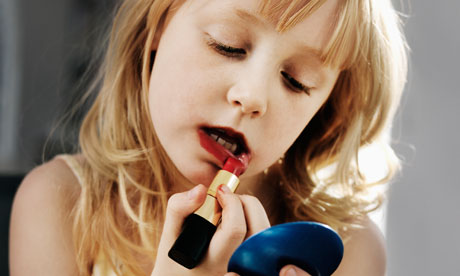
'Some kids learn the facts of life way too young because of deprivation' … Suzanne Moore
Suzanne Moore Saturday 11 June 2011
As if conducting some perverse sociological experiment, I managed to have a child in each decade, starting in the 80s. Don't worry, I've stopped now. Chatting this week, I asked them at what age they had become "sexualised". My middle child said: "Mum, when will you stop making up words?"
We then talked about who was going on the Slut Walk. The 10-year-old told me off about the word "slut", saying it was disgusting. This is the same 10-year-old who asked me what fisting was a few days ago. I may be fairly liberal, but I did not answer fully. We are all censors at heart. If I don't tell her the internet surely will. [ http://www.guardian.co.uk/world/2011/may/06/slutwalking-policeman-talk-clothing ]
So yes, as a parent, I understand feeling powerless. Often. Of course I can block sites, but I cannot monitor what my kids see and hear all the time: the sexual "wallpaper" that is said to surround them. This was how the Bailey review describes the sexual imagery with which our culture is saturated.
Our children are growing up too soon. They are encouraged to venture into territory that they are too emotionally immature to inhabit. These are the charges, repeated again and again, which presuppose an age of purity. I have made them myself at times.
How this imagery affects us all needs to be studied. Properly. The latest report is an example of how not to do it. The Bailey review set up by this government – at what cost, I wonder – was headed by Reg Bailey, who is head of the Mothers' Union, a Christian charity. Still, it is quite novel that something that was in both the Tory and Lib Dem manifesto has been acted upon. It must really push middle-class buttons. Never mind that we had reviews by Professor David Buckingham and Dr Linda Papadopoulos only recently. And two by Professor Tanya Byron on internet safety. What does Bailey bring to the party?
To be honest, little we don't already know, and zilch in terms of evidence to back up any of the claims made. And as we have come to know, there is not even a basic understanding that our view on sexuality may be culturally moulded rather than revealing some innate "truth". OK, so I will put away my Freud, but it is significant, as Dr Petra Boynton has said, that this is yet another report that does not include much about how young people themselves feel.
Actually, my daughter is right. There is a basic problem with the word "sexualisation". What does it really mean? It is used now to describe a kind of societal grooming of girls – and the entire discussion is focused around girls – into a premature sex life.
Our children know and see too much too soon. (Whatever happened when children did not have separate bedrooms from their parents, I wonder?) Still, left and right agree that the selling of padded bras to seven-year-olds is abhorrent. The display of naked breasts on the middle shelf thanks to Lad Mags is not nice. Don't worry – such mags are in decline anyway, and nothing in this report will challenge Page 3 or indeed the peculiar "sexualisation" of those poor Middleton sisters with their breasts, bottoms and legs now permanently on display as they lay back and think of England. Or Wales. Wherever.
Those who like posh totty are also those who don't want to see "raunch culture" acted out by their own offspring. Personally, I do not want to explain Rihanna's supposed excitement over whips and chains any more than to explain why a woman who has never supported herself is now a national "icon".
Here is where it gets a little difficult. The omnipresent sexual imagery long questioned by feminists precisely because it devalued women is now being questioned by the right, who in every other respect are pushing things back for women. The Tories are not the Taliban – of course not – but rightwingers are invariably fundamentalist in the attempt to control female sexuality.
The awkward encounter between the right and feminism is premised on this daft word, sexualisation. So let's call it as it is. We are talking really about commercialisation. Bodies do not exist without sex. Is there a difference between infantile and adult sexuality? Yes. At what age can that sexuality be commodified? At what age can it consume? At what age can it be regulated? These are the real but difficult questions.
And the hardest one of all, what really makes children grow up "too soon", may have nothing to do with sex and everything to do with poverty.
Watching the incredibly revealing BBC1 documentary Poor Kids this week, to see small children scratching their eczema while talking about parental debt and how things can never change, shows us some kids do learn the facts of life way too young because of deprivation. [ POOR KIDS, (not available for US to watch) BUT ..we have this - http://www.bbc.co.uk/blogs/tv/2011/06/poor-kids.shtml ]
This glimpse into gross inequality should shock us as much as porn downloaded on to mobiles in the playground. But we live with it. We cannot control what we are sold and not one of the Bailey recommendations suggests we can.
The hardcore shot is this one: this government will not act to regulate the market even when the market sells additive-filled food and thongs to little children. It will instead make sensitive noises at the outer edge and the middle class will dress its children in pretty polka-dot dresses while the useless underclass will dress its little girls as tarts.
Boys clothes, indeed their entire sexuality, are ignored. Generally they should not wear hoods or have their jeans hanging off their arses. Otherwise they can go hang.
The Bailey report is not only ineffective practically, as no one will do anything, but it is theoretically vacuous. There is indeed a body of research that seeks to understand how visual imagery affects us, and what harm it may cause. It is often done under the cover of the much-maligned media studies. But experiments and evidence appear to count for nothing against the moral panic of concerned parents. The viewing of porn, we are told, for instance, is addictive. What model of addiction are we using here?
If we want the state to intervene – ie censor more material – we need to think very carefully. I started off talking about my girls because I wonder if my youngest has been exposed to much worse stuff than my eldest. Certainly, in terms of technology she has more access to more imagery. But it seems to me that they have "grown up" at around the same time, though in a culture that has shifted from telling us ever more strongly that what we look like is much more important than how we think or feel.
What is needed then is not some weird repression of sexuality or of young people, but of a rapacious capitalism that commodifies every desire and yes, will sell sex to children.
No review that tells politicians this is what they need to regulate is ever acted on. Concerned parents, even that nice David Cameron, need to put out or shut up. Instead, they will protect their own children, knowing full well that the system they get down on their knees in front of means other people's children may get screwed. Because "other people's children", if no longer kept innocent, will in such a world inevitably be guilty.
The Dutch take sex very seriously – and their focus on education for young children pays off when they grow up
Let's talk about sex – to four-year-olds
Sex education starts younger in the Netherlands. Photograph: Peter Stringer
My son is three years old; he is learning to use the potty and brush his teeth at the moment. Next year, however, when he starts primary school, he will get his first lessons in sex education, during the so-called Lentekriebels week – the Dutch word for "spring itching" or "spring butterflies". This is not a joke, nor am I bringing up my offspring in a hippy commune. We live in a quiet middle-class neighbourhood in Amsterdam. Lentekriebels is a government-subsidised project for children aged four to 12. This year's Lentekriebels has just finished, with an exhibition about relationships and sexuality in hundreds of schools all over the Netherlands.
My son won't bring home the leaflet "Sex Yes, Worries No", about the use of contraceptives, until he is at least 10. He wouldn't be able to read it at the moment anyway. But his teachers will be talking about cuddling, friendship, newborn lambs in the fields and the differences between boys and girls. And his class might be visited by pregnant women and nursing mothers with their babies.
The Netherlands has a lurid reputation abroad when it comes to sex. Everyone knows about the red light district in Amsterdam and legalised prostitution. So it might come as a surprise to some to hear that deep down, the Dutch are very conservative people who take sex seriously. Very seriously, in fact.
Sex education has traditionally been an important part of the school curriculum here. Lentekriebels is in line with the Dutch tradition of assigning to schoolteachers responsibilities that might elsewhere be handled within the family. As my teacher in primary school in the 1970s told me: "If your parents don't bring you up properly, our school has to do the job for them." The issue then was not sex but prayer (we didn't pray at home), but the principle is the same. Parents are not to be trusted to do a good job and sex is a danger zone, like drugs or smoking. To discuss it at school from an early age will make young people aware of the many risks when they start to experiment with relationships and sexuality.
Dutch sex education doesn't stop at Lentekriebels. I remember vividly the little grey-haired lady with the large handbag who came to my high school to talk about "the first time", true love, the effects of alcohol and how to use a condom. I was 14 and we all found it great fun. And the lessons went on until my final exams: prostitution, reproduction, sexually transmitted diseases – we were spared nothing.
There is much to be said for the Dutch approach. Official figures show that the pregnancy rate here among teenage girls, 5.3 per thousand, is one of the lowest in Europe. The explanation is believed to be the open approach towards sexuality. And we see similarly low numbers when it comes to abortions and STDs.
The UK, by comparison, has a teen pregnancy rate that is nearly 400% higher and a much higher abortion rate.
In an attempt to make sense of these figures, we can turn to Nick Hornby's novel Slam, in which 16-year-old Sam gets his girlfriend, Alicia, pregnant. On the internet he finds government statistics about teenage parents:
And some of them were funny – like, one in 10 teenagers couldn't remember if they'd had sex the night before or not, which is pretty incredible if you think about it. I think this meant that one in 10 teenagers had got so blasted the night before that they didn't know what had gone on. I don't think it meant they were just forgetful, like when you can't remember whether you packed your games kit.
Dutch teenagers are probably just as sexually active as British ones and may even drink as much. But thanks to the priority given to sex education, Sam's Dutch equivalent can go skateboarding without worrying whether he has knocked up his girlfriend.
.... Interesting . . it's all most like you must compete with the internet to teach your children .. YES, I realize many people limit internet time.. .I wonder how effective that is . . when it's everywhere .. internet, that is .. at school at sports .. everywhere ....for younger parents ..questions, I guess it's going to be dependent on 'their' experiences .. ?




 AI
AI