



 AI
AI







Tuesday, March 29, 2011 5:52:57 PM
Japanese officials consider cell transplants for nuclear workers
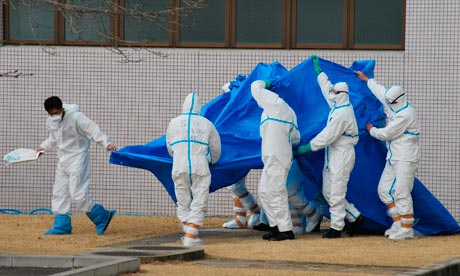
Workers at Japan's Fukushima nuclear plant are taken to hospital under a blue sheet after they were exposed to high levels of radiation.
Photograph: Jiji Press/AFP/Getty Images
Frozen blood stem cells could save workers' lives if they become ill after exposure to high levels of radiation
Ian Sample , science correspondent
guardian.co.uk, Tuesday 29 March 2011 21.52 BST
Japanese authorities are considering plans to collect and freeze cells from engineers and water cannon operators at the Fukushima nuclear power plant in case they are exposed to dangerous levels of radiation.
The proposal has been drawn up as a precautionary measure that could potentially save the lives of workers if they receive high doses of radiation while battling to bring the damaged nuclear reactors under control.
High levels of radiation can cause serious illness and death from bone marrow failure, but the condition can be treated if patients are seen quickly enough and given transplants of blood stem cells collected before they are exposed.
The procedure requires workers to take a drug for several days that causes their bone marrow to release stem cells into the blood. They are then hooked up to a machine through which their blood is passed and filtered to extract the stem cells.
The procedure is already used to treat cancer patients whose bone marrow is destroyed by chemo- or radiotherapy.
Alejandro Madrigal, scientific director at the Anthony Nolan transplant charity and president of the European group for blood and marrow transplantation, said the plan made sense given the risk to workers at Fukushima. He said more than 50 hospitals in Europe have agreed to help the Japanese if required.
But Robert Peter Gale, a US medical researcher advising the Japanese government, said the move might cause more problems than it solves. "It would be nifty if you could do it, but you are dealing with 800 workers and you might need these cells for only a small percentage of them."
Another downside is that workers who have had their bone marrow cells stored might become cavalier and take unnecessary risks, Gale said. "These cells can reconstitute bone marrow function; that is not the only target of high dose radiation, they would have damage elsewhere, to their lungs, gastrointenstinal tract and their skin. I, and a number of colleagues, feel it's not an appropriate thing to do."
guardian.co.uk © Guardian News and Media Limited 2011
http://www.guardian.co.uk/world/2011/mar/29/japan-cell-transplants-nuclear-workers
===
Some people may never see their land again
Latest Update: Wednesday March 30, 2011, 12:52 AM Doha Time
Tens of thousands of Japanese farmers and fishermen from areas closest to a stricken nuclear power plant are starting to face a dire possibility: they may never go home.
More than two weeks after a huge earthquake and tsunami triggered the world’s worst nuclear crisis since 1986, prospects for a speedy resolution at the Fukushima Daiichi nuclear plant look more distant by the day.
Plutonium has been found in the soil at the crippled plant 240km north of Tokyo, authorities said yesterday, the latest in a series of radioactive contamination revelations.
Radiation has been found in the sea off the plant, in vegetables and even in Tokyo tap water, though only briefly, the government said.
Each bit of bad news fans alarm in Japan and beyond but the anguish strikes much closer to home for the more than 200,000 people who live near the plant.
“These lands have come from their ancestors, and their affection for it is enormous,” said Tomo Honda, 36, a member of the Fukushima Assembly.
“The first step is to actually tell these refugees that they can’t go back but people are not facing that reality yet,” Honda said.
Honda has been doing relief work for the area’s people since the March 11 earthquake and tsunami, which left 28,000 people dead or missing.
More than 70,000 people have been evacuated from a 20km exclusion zone around the plant and another 130,000, who live in a 10km band beyond the exclusion zone, have been advised to leave, or, if they don’t, to stay indoors.
The government has not extended the mandatory evacuation zone but is coming under mounting criticism for not doing so.
Experts say an extension may be inevitable.
District governments in several of the towns within the 30 km zone have relocated and basic supplies are running short with many trucking firms reluctant to venture in to make deliveries.
And there’s going to be no quick fix, experts say.
“The amount of time it’s going to take to mitigate this accident is not measured in days or weeks, it’s measured in months or maybe even years,” said Robert Gale, visiting professor in the Hematology Division at Imperial College, London, after visiting Fukushima.
“It is not a practical solution,” he said of the government recommendation that people in the 20km to 30km zone stay inside.
After the 1986 nuclear accident at Chernobyl, thousands of people were ordered out of a 30km zone around the plant. Most have never gone home.
Today, the area is a weird, overgrown wilderness, teeming with wildlife but nearly empty of people and with its buildings decaying into ruin.
Some people fear that’s the fate that awaits Fukushima.
The area affected is a long, flat stretch of farmland and woods, sandwiched between the Pacific and a craggy range of central mountains.Its economy is based on fishing, farming -- particularly rice, but also fruit such as peaches -- and the production of energy, both nuclear and conventional, most of it for Tokyo.
A ban on the shipment of vegetables is already bringing despair. A 64-year-old farmer hanged himself last week after saying “our vegetables are no good anymore”, Japanese media reported.
“These nuclear plants produce energy consumed in Tokyo. That’s why people are angry now,” Honda said. “We have sold our land for those electric plants and now people in Tokyo aren’t buying our agricultural products. People feel betrayed.”
- Reuters
Gulf-Times.com © 2011
http://www.gulf-times.com/site/topics/article.asp?cu_no=2&item_no=425172&version=1
Workers at Japan's Fukushima nuclear plant are taken to hospital under a blue sheet after they were exposed to high levels of radiation.
Photograph: Jiji Press/AFP/Getty Images
Frozen blood stem cells could save workers' lives if they become ill after exposure to high levels of radiation
Ian Sample , science correspondent
guardian.co.uk, Tuesday 29 March 2011 21.52 BST
Japanese authorities are considering plans to collect and freeze cells from engineers and water cannon operators at the Fukushima nuclear power plant in case they are exposed to dangerous levels of radiation.
The proposal has been drawn up as a precautionary measure that could potentially save the lives of workers if they receive high doses of radiation while battling to bring the damaged nuclear reactors under control.
High levels of radiation can cause serious illness and death from bone marrow failure, but the condition can be treated if patients are seen quickly enough and given transplants of blood stem cells collected before they are exposed.
The procedure requires workers to take a drug for several days that causes their bone marrow to release stem cells into the blood. They are then hooked up to a machine through which their blood is passed and filtered to extract the stem cells.
The procedure is already used to treat cancer patients whose bone marrow is destroyed by chemo- or radiotherapy.
Alejandro Madrigal, scientific director at the Anthony Nolan transplant charity and president of the European group for blood and marrow transplantation, said the plan made sense given the risk to workers at Fukushima. He said more than 50 hospitals in Europe have agreed to help the Japanese if required.
But Robert Peter Gale, a US medical researcher advising the Japanese government, said the move might cause more problems than it solves. "It would be nifty if you could do it, but you are dealing with 800 workers and you might need these cells for only a small percentage of them."
Another downside is that workers who have had their bone marrow cells stored might become cavalier and take unnecessary risks, Gale said. "These cells can reconstitute bone marrow function; that is not the only target of high dose radiation, they would have damage elsewhere, to their lungs, gastrointenstinal tract and their skin. I, and a number of colleagues, feel it's not an appropriate thing to do."
guardian.co.uk © Guardian News and Media Limited 2011
http://www.guardian.co.uk/world/2011/mar/29/japan-cell-transplants-nuclear-workers
===
Some people may never see their land again
Latest Update: Wednesday March 30, 2011, 12:52 AM Doha Time
Tens of thousands of Japanese farmers and fishermen from areas closest to a stricken nuclear power plant are starting to face a dire possibility: they may never go home.
More than two weeks after a huge earthquake and tsunami triggered the world’s worst nuclear crisis since 1986, prospects for a speedy resolution at the Fukushima Daiichi nuclear plant look more distant by the day.
Plutonium has been found in the soil at the crippled plant 240km north of Tokyo, authorities said yesterday, the latest in a series of radioactive contamination revelations.
Radiation has been found in the sea off the plant, in vegetables and even in Tokyo tap water, though only briefly, the government said.
Each bit of bad news fans alarm in Japan and beyond but the anguish strikes much closer to home for the more than 200,000 people who live near the plant.
“These lands have come from their ancestors, and their affection for it is enormous,” said Tomo Honda, 36, a member of the Fukushima Assembly.
“The first step is to actually tell these refugees that they can’t go back but people are not facing that reality yet,” Honda said.
Honda has been doing relief work for the area’s people since the March 11 earthquake and tsunami, which left 28,000 people dead or missing.
More than 70,000 people have been evacuated from a 20km exclusion zone around the plant and another 130,000, who live in a 10km band beyond the exclusion zone, have been advised to leave, or, if they don’t, to stay indoors.
The government has not extended the mandatory evacuation zone but is coming under mounting criticism for not doing so.
Experts say an extension may be inevitable.
District governments in several of the towns within the 30 km zone have relocated and basic supplies are running short with many trucking firms reluctant to venture in to make deliveries.
And there’s going to be no quick fix, experts say.
“The amount of time it’s going to take to mitigate this accident is not measured in days or weeks, it’s measured in months or maybe even years,” said Robert Gale, visiting professor in the Hematology Division at Imperial College, London, after visiting Fukushima.
“It is not a practical solution,” he said of the government recommendation that people in the 20km to 30km zone stay inside.
After the 1986 nuclear accident at Chernobyl, thousands of people were ordered out of a 30km zone around the plant. Most have never gone home.
Today, the area is a weird, overgrown wilderness, teeming with wildlife but nearly empty of people and with its buildings decaying into ruin.
Some people fear that’s the fate that awaits Fukushima.
The area affected is a long, flat stretch of farmland and woods, sandwiched between the Pacific and a craggy range of central mountains.Its economy is based on fishing, farming -- particularly rice, but also fruit such as peaches -- and the production of energy, both nuclear and conventional, most of it for Tokyo.
A ban on the shipment of vegetables is already bringing despair. A 64-year-old farmer hanged himself last week after saying “our vegetables are no good anymore”, Japanese media reported.
“These nuclear plants produce energy consumed in Tokyo. That’s why people are angry now,” Honda said. “We have sold our land for those electric plants and now people in Tokyo aren’t buying our agricultural products. People feel betrayed.”
- Reuters
Gulf-Times.com © 2011
http://www.gulf-times.com/site/topics/article.asp?cu_no=2&item_no=425172&version=1

Greensburg, KS - 5/4/07
"Eternal vigilance is the price of Liberty."
from John Philpot Curran, Speech
upon the Right of Election, 1790
F6
Discover What Traders Are Watching
Explore small cap ideas before they hit the headlines.



