



 AI
AI






| Followers | 71 |
| Posts | 1651 |
| Boards Moderated | 0 |
| Alias Born | 02/18/2010 |

Thursday, August 26, 2010 1:53:25 AM
Read down and compare...I think we're very "good" (main point are highlighted for quick reading).
Drill rigs are not called “truth machines” for nothing. No amount of promotion or favorable press will prevent companies from being affected by negative assay results when good ones were anticipated. A selloff takes place immediately, with sophisticated players leading the way. That is why it is important for investors to understand the economic significance of drilling results, relative to the nature of the deposit being explored and where it is situated, You do not want to be the one buying when others are selling, and vice versa.
The first step to analyzing these results is to understand what grades will be economic in a typical mining operation. In general, large deposits capable of being mined by open pit will have lower cutoff grades than will deposits of the same metal that have to be mined by underground methods. For example, the Dome gold mine in northern Ontario operates an open pit with reserves grading 2.3 grams per tonne; its underground reserves grade 4.3 grams.
A 30 meter-drill intersection grading 1 gram gold per tonne, starting at 5 meters below surface, would be of economic interest if it originated from a road-accessible property in Nevada. The state has numerous low-grade deposits mined by less costly open-pit methods, whose gold is recovered by low-cost heap leaching. However, this same drill intersection would not attract much interest on a property in remote northwestern British Columbia owing to a lack of roads and other infrastructure.
A drill intersection showing 0.4% copper would be exciting in the porphyry-copper district of British Columbia, since it approaches the typical grade of the area’s large open-pit mines. In the volcanic belts of northern Ontario, where smaller, higher-grade base metal mines are the norm, the same result would merely merit more work.
Deposits with complex metallurgy will be more costly to mill, so cutoff grades rise accordingly. Off-site costs such as transportation are a major component of total production expenses. This is particularly true for gold and base metal deposits that produce concentrates, which must be shipped to a smelter for processing. Energy costs have a strong influence on a potential operation’s economics, especially when a mill must be built. As a general rule, a mineral deposit in an area where access is poor and costs are high will be less likely to make a mine than an equivalent deposit in a more developed region.
The length of drill intersections is also important, since these give an indication of the kind of mineralization present. Low-grade deposits must be large enough for bulk mining. That means low-grade drill intersections must be long — on the order of tens to hundreds of meters — to show economic potential.
Narrow intersections, on the other hand, must show high grades. A zone’s width is vital to the feasibility of mining operations, and narrow zones may simply not be economic to mine. A mineralized zone only a fraction of a meter wide could not be mined without also extracting large amounts of wall rock, thereby diluting the grade.
Core lengths quoted in press releases can also be misleading. Drill holes that cross a zone of mineralization at nearly a right angle give a better picture of the zone’s true width. Holes that are drilled at shallower angles to the mineralized zone will yield intersections with lengths much greater than the true width of the mineralization.
Keep in mind that a hole drilled to a great depth from surface will often be drilled at a very steep angle, such that if it intersects nearly vertical structures at depth, the true width will be much less than the length of the drill intersection.
There is always the possibility that the company has drilled down the dip or plunge of a mineralized zone rather than across it. This can happen, on occasion, in the early stages of an exploration project when the structure being explored is still poorly understood. A hole drilled in this way will provide no information about the width of the zone, yet the mineralized intersections may run to spectacular, but meaningless, lengths.
Lastly, it is important to consider that narrow zones of high-grade mineralization may carry an intersection. A zone only a meter wide may show a grade of 15% zinc, but a company may average that one-meter intersection with the nearly barren two meters to each side of it, reporting five meters grading 3% zinc.
http://www.miningbasics.com/why-wait-drill-results-junior-mining-company
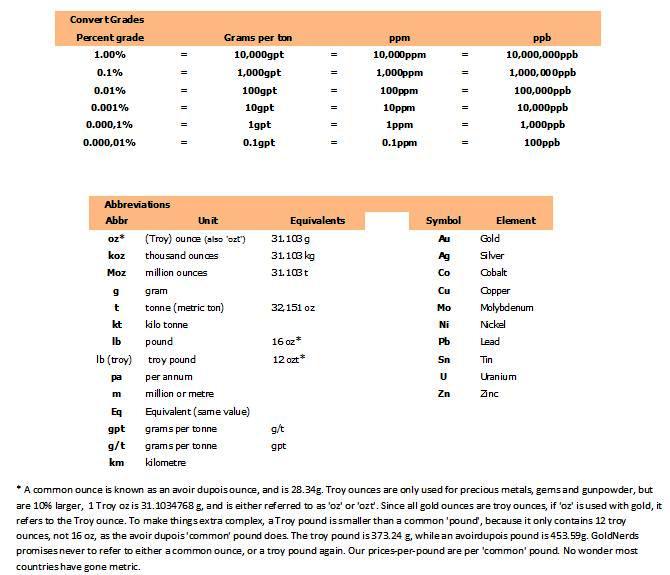
HOW TO READ AND CONVERT RESULTS TO UNDERSTANDABLE UNITS
KAT Exploration, Inc. and Bella Viaggio, Inc. Handcamp Drilling Intersects Very Encouraging Gold Mineralization at Shallow Depths
KAT Exploration, Inc. (PINKSHEETS: KATX) and Bella Viaggio, Inc. (OTCBB: BVIG) are pleased to announce that the drilling program at their Handcamp Project intersected very encouraging gold mineralization at shallow depths. Diamond drill hole DDH 004 intersected 6.3 g/t (0.18 oz./ton) gold and 111.6 g/t (3.3 oz./ton) silver over 1.9 m (1.4 m estimated true width) including 10.8 g/t (0.32 oz./ton) gold and 222.4 g/t (6.5 oz./ton) silver over 0.9 m (0.7 m estimated true width) within a wider interval grading 3.1 g/t gold and 42.6 g/t silver over 5.9 m (4.4 m estimated true width).
Diamond drill hole DDH 012 intersected 5.5 g/t (0.16 oz./ton) gold over 1.8 m (1.4 m estimated true width) within a wider interval grading 3.5 g/t gold (0.10 oz./ton) over 3.5 m (2.6 m estimated true width). Both intersections occur within an even broader mineralized zone defined by elevated gold that includes 1.2 g/t gold over 20.9 m (15.6 m estimated true width) in DDH 004 and 1.0 g/t gold over 17.8 m (13.3 m estimated true width). Three other holes (DDH-002, 003 and 005) also intersected strong gold mineralization over wide widths as shown in the summary table. The gold is typically accompanied by elevated silver, lead and zinc.
Results of the current exploration program indicate that the mineralized zone at Handcamp is outlined well by induced polarization geophysics. The current drilling program tested the mineralized zone for approximately 0.9 km along strike (trend) at 250m to 300m spaced intervals and to a maximum vertical depth of 200 m. DDH 012 is the southwestern most drill hole of the current program and is approximately 600m southwest of the main Handcamp showing. During the second phase of exploration, the mineralization in DDH 012 will be tested to depth and along strike to the northeast and southwest where the IP anomaly has been traced a further 500 m and remains open. Two other induced polarization anomalies subparallel to that delineating the Handcamp mineralized zone remain to be tested by diamond drilling. One, about 350 m to the northwest, has been traced for 1.2 km and remains open and the second is about 900m to the northwest, and has been traced for 700 m and remains open. The two anomalies are viable targets for testing in the second phase of exploration.
Trenching completed at four locations north and south of the Main Hand Camp prospect exposed disseminated sulphide mineralization in altered volcanic rock that contains anomalous gold, silver, lead and zinc concentrations over an approximate strike length of 600 m and over widths of up to 20 m in trenched rock exposures.
Ken Stead, President CEO, states, "The first phase of exploration, which included induced polarization geophysics, trenching and 1640m of diamond drilling in 12 drill holes, has now been completed on the Hand Camp Property. A second phase starting this fall is in planning and will include additional line cutting, induced polarization geophysics and diamond drilling. With data collected so far and the very encouraging results from this first phase, the company feels that this project warrants a full scale exploration program to determine the true significance of the deposit. With just four areas drilled at such wide intervals within such a large structure and the fact that we intersected gold in all 12 drill holes, we feel there is high potential for further encouraging results within this mineralized structure. Also the number of targets yet remaining to be tested outside this determined structure lends itself to a high degree of optimism that this project will be of great value to the company."
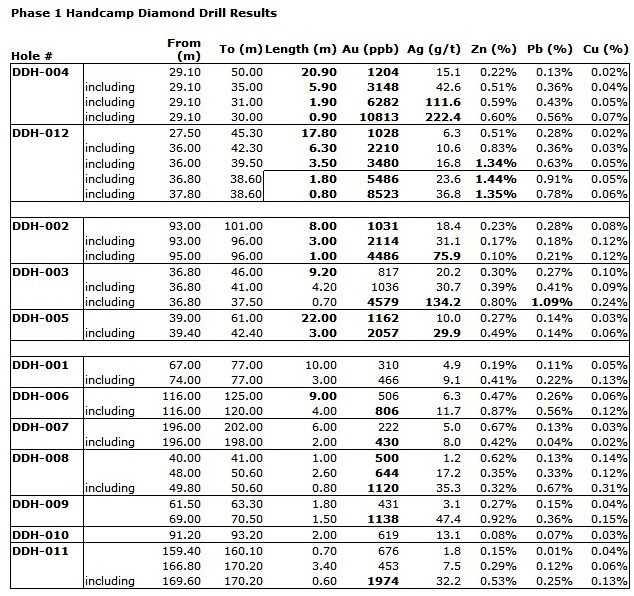
Geochemical analyses and assay data consistently and routinely return anomalous gold, silver, lead, zinc and copper values over considerable widths. As an added bonus the distribution of these elements is uniform in comparison to many gold deposits that are subject to the nugget effect enhancing the potential for the delineation of economic concentrations of polymetallic mineralization.
The Company's exploration work on the Handcamp Project is supervised by J. Wayne Pickett, M.Sc. P.Geo., a member of the Professional Engineers and Geoscientists of Newfoundland and Labrador and a Qualified Person as defined in NI 43-101. Mr. Pickett has verified that the results presented above have been accurately summarized from the official assay certificates provided to the Company.
http://www.marketwire.com/press-release/KAT-Exploration-Inc-Bella-Viaggio-Inc-Handcamp-Drilling-Intersects-Very-Encouraging-1309659.htm



