



 AI
AI








Tuesday, June 29, 2010 6:26:08 AM
Timeline: Fiji .. [below latest media crackdown[ .. updated Thursday, 11 March 2010 ..
http://news.bbc.co.uk/2/hi/asia-pacific/country_profiles/1300499.stm
IPI deplores Fiji crackdown on media
Thursday, April 16, 2009
Pacific Media Centre
Authorities in Fiji are removing articles from news websites under emergency rules imposed after a court declared the military-backed government illegal. These actions, combined with censorship of other news reports, represent a concerted effort by the government to block access to information in a time of political crisis, the International Press Institute said today.
The censorship and interference with media in Fiji follow an emergency decree imposed on April 10, a day after an appellate court declared the provisional government led by the army commander, Voreqe Bainimarama, to be illegal. In response to the ruling, President Ratu Josefa Iloilo, a Bainimarama ally, suspended the constitution and abolished the judiciary.
Journalists in Fiji told IPI that government censors have “cleaned up” newspaper websites to remove current as well as archived stories. IPI’s sources also said authorities from the Ministry of Information, backed by police officers, have gone into newsrooms and censored articles due to be published in newspapers.
Bainimarama, who took power in 2006 in a military-backed coup, told Radio New Zealand that the media are to blame for the current political turmoil. But IPI director David Dadge called the accusation a “deplorable attempt to hide the truth at a time of political uncertainty”, and called for an end to censorship and the intimidation of journalists. Dadge said:
The military regime is looking for a convenient excuse to mask its failure to restore order, stabilise the economy and allow Fijians to choose their leaders through the ballot box. Contrary to what the regime says, the media can contribute to better understanding and can ease tension in divided societies, and I fear Mr. Bainimarama’s desire for control will only exacerbate the problems in Fiji .
The Public Emergency Regulations imposed on April 10, along with other directives that impose severe restrictions on the news media, forbid journalists to report critically on politics or the government, or to publish stories perceived as inciting violence. Journalists said even stories about recent civil unrest in Thailand were pulled from newspapers for fear they may incite the local population.
Some newspapers in Fiji have run blank pages as an act of defiance after the authorities banned publication of certain articles. Several foreign journalists have been expelled or barred from entering the country.
Three foreign journalists -- Sia Aston and cameraman Matt Smith from New Zealand’s TV3, and Australian Broadcasting Corporation's Sean Dorney -- were expelled from Fiji on April 13. The government also ordered ABC to disconnect its FM transmitters in the capital Suva and in the tourist town of Nadi. This move also affects Radio New Zealand International, which rebroadcasts programmes via the ABC transmitters.
Fijian journalists have been warned not to speak to foreign media about the situation, and some have been taken into custody for questioning.
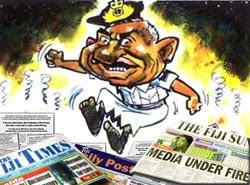
Graphic: A Malcolm Evans cartoon for PMC's Pacific Journalism Review adapted by Josephine Latu.
IPI statement .. Honduras .. http://www.freemedia.at/media/?ctxid=CH0055&docid=CMS1239883659267&year=2009
Other media reaction .. http://pacificmediacentre.blogspot.com/2009/04/fiji-regime-faces-fierce-condemnation.html
http://pacificmediacentre.blogspot.com/2009/04/ipi-deplores-fiji-crackdown-on-media.html
THAT WAS THEN .. NOW NOW ..
Fiji Media Crackdown To Hurt Economy, Foreign Investment - Australian Minister
By Neil Sands .. Of DOW JONES NEWSWIRES .. * JUNE 29, 2010
MELBOURNE (Dow Jones)--A crackdown on foreign media ownership in Fiji will damage the island
state's economy and deter foreign investment, Australian Foreign Minister Stephen Smith said Tuesday.
Smith condemned a Fijian decree imposed this week forcing all media outlets to be 90% locally owned
within three months, saying it damaged both free speech and the country's economic prospects.
In comments that drew a sharp rebuke from Fiji's Attorney-General Aiyaz Sayed-
Khaiyum, Smith said the foreign ownership cap could deter investment in Fiji.
"That will have very substantial and serious deleterious effects on Fiji's economy and
adversely affect the prosperity of their people," Smith told Australian Broadcasting Corp.
He described the action by Fiji Prime Minister Voreqe Bainimarama as
regrettable and said his regime "continues to take Fiji backwards."
Since Bainimarama came to power in a bloodless military coup in 2006 he has cracked down on press
freedoms, censoring reports and expelling foreign reporters and media executives, as well as
suspending the constitution and pushing back the deadline for promised elections to 2014.
Fiji's economy, heavily reliant on sugar exports and tourism, has experienced sluggish growth
in recent years due to political tensions and lack of progress implementing economic
reforms, according to a report released in December by the International Monetary Fund.
The report predicts a fall in foreign direct investment in Fiji to an estimated US$264 million in 2010 from US$415 million in 2006
Sayed-Khaiyum said Smith's remarks were inaccurate and Bainimarama's
government had worked to liberalize the economy to make Fiji more attractive to investors.
"The people who know Fiji, the people who are investors or would-be investors in Fiji, know that the
issue of the media is very, very separate to the private sector investment that takes place in other
sectors," he told Sky News Australia. "To draw some type of correlation is completely misplaced."
News Corp.'s (NWS) Australian subsidiary News Ltd.(NWS.AU), which says it will have to dispose of its only Fijian
newspaper The Fiji Times under the decree, has described the move as a blow to the country's fragile economy.
"This is an outrageous precedent that will make foreign investors in other industries very nervous about
their involvement and support there," News Ltd. Chief Executive John Hartigan said in a statement Monday.
News Corp. owns Dow Jones & Co., publisher of this newswire and The Wall Street Journal.
The Fiji Times is the largest newspaper in the country by circulation and has long had a tense relationship
with the Bainimarama regime. News Ltd. said Monday that reporters at the newspaper had faced physical intimidation
from the military-led regime and two managing directors have been deported in the past two years.
Sayed-Khaiyum said Fiji wanted to ensure its media wasn't run by foreigners who had no interest in the country's future.
"The media organization needs to have a stake within the country itself," he said.
"They need to be pro the country, I'm not saying pro-government, but pro the country."
New Zealand Prime Minister John Key said the way Fiji had set about controlling the media was heavy handed.
"We want to see democracy restored in Fiji because we want a full operating economic environment," he told reporters.
"When you start banning media and telling organizations to sell their newspapers, to me it sounds like a step too far."
-By Neil Sands, Dow Jones Newswires; 61-3-9292-2095; neil.sands@dowjones.com
http://online.wsj.com/article/BT-CO-20100629-701093.html
http://news.bbc.co.uk/2/hi/asia-pacific/country_profiles/1300499.stm
IPI deplores Fiji crackdown on media
Thursday, April 16, 2009
Pacific Media Centre
Authorities in Fiji are removing articles from news websites under emergency rules imposed after a court declared the military-backed government illegal. These actions, combined with censorship of other news reports, represent a concerted effort by the government to block access to information in a time of political crisis, the International Press Institute said today.
The censorship and interference with media in Fiji follow an emergency decree imposed on April 10, a day after an appellate court declared the provisional government led by the army commander, Voreqe Bainimarama, to be illegal. In response to the ruling, President Ratu Josefa Iloilo, a Bainimarama ally, suspended the constitution and abolished the judiciary.
Journalists in Fiji told IPI that government censors have “cleaned up” newspaper websites to remove current as well as archived stories. IPI’s sources also said authorities from the Ministry of Information, backed by police officers, have gone into newsrooms and censored articles due to be published in newspapers.
Bainimarama, who took power in 2006 in a military-backed coup, told Radio New Zealand that the media are to blame for the current political turmoil. But IPI director David Dadge called the accusation a “deplorable attempt to hide the truth at a time of political uncertainty”, and called for an end to censorship and the intimidation of journalists. Dadge said:
The military regime is looking for a convenient excuse to mask its failure to restore order, stabilise the economy and allow Fijians to choose their leaders through the ballot box. Contrary to what the regime says, the media can contribute to better understanding and can ease tension in divided societies, and I fear Mr. Bainimarama’s desire for control will only exacerbate the problems in Fiji .
The Public Emergency Regulations imposed on April 10, along with other directives that impose severe restrictions on the news media, forbid journalists to report critically on politics or the government, or to publish stories perceived as inciting violence. Journalists said even stories about recent civil unrest in Thailand were pulled from newspapers for fear they may incite the local population.
Some newspapers in Fiji have run blank pages as an act of defiance after the authorities banned publication of certain articles. Several foreign journalists have been expelled or barred from entering the country.
Three foreign journalists -- Sia Aston and cameraman Matt Smith from New Zealand’s TV3, and Australian Broadcasting Corporation's Sean Dorney -- were expelled from Fiji on April 13. The government also ordered ABC to disconnect its FM transmitters in the capital Suva and in the tourist town of Nadi. This move also affects Radio New Zealand International, which rebroadcasts programmes via the ABC transmitters.
Fijian journalists have been warned not to speak to foreign media about the situation, and some have been taken into custody for questioning.
Graphic: A Malcolm Evans cartoon for PMC's Pacific Journalism Review adapted by Josephine Latu.
IPI statement .. Honduras .. http://www.freemedia.at/media/?ctxid=CH0055&docid=CMS1239883659267&year=2009
Other media reaction .. http://pacificmediacentre.blogspot.com/2009/04/fiji-regime-faces-fierce-condemnation.html
http://pacificmediacentre.blogspot.com/2009/04/ipi-deplores-fiji-crackdown-on-media.html
THAT WAS THEN .. NOW NOW ..
Fiji Media Crackdown To Hurt Economy, Foreign Investment - Australian Minister
By Neil Sands .. Of DOW JONES NEWSWIRES .. * JUNE 29, 2010
MELBOURNE (Dow Jones)--A crackdown on foreign media ownership in Fiji will damage the island
state's economy and deter foreign investment, Australian Foreign Minister Stephen Smith said Tuesday.
Smith condemned a Fijian decree imposed this week forcing all media outlets to be 90% locally owned
within three months, saying it damaged both free speech and the country's economic prospects.
In comments that drew a sharp rebuke from Fiji's Attorney-General Aiyaz Sayed-
Khaiyum, Smith said the foreign ownership cap could deter investment in Fiji.
"That will have very substantial and serious deleterious effects on Fiji's economy and
adversely affect the prosperity of their people," Smith told Australian Broadcasting Corp.
He described the action by Fiji Prime Minister Voreqe Bainimarama as
regrettable and said his regime "continues to take Fiji backwards."
Since Bainimarama came to power in a bloodless military coup in 2006 he has cracked down on press
freedoms, censoring reports and expelling foreign reporters and media executives, as well as
suspending the constitution and pushing back the deadline for promised elections to 2014.
Fiji's economy, heavily reliant on sugar exports and tourism, has experienced sluggish growth
in recent years due to political tensions and lack of progress implementing economic
reforms, according to a report released in December by the International Monetary Fund.
The report predicts a fall in foreign direct investment in Fiji to an estimated US$264 million in 2010 from US$415 million in 2006
Sayed-Khaiyum said Smith's remarks were inaccurate and Bainimarama's
government had worked to liberalize the economy to make Fiji more attractive to investors.
"The people who know Fiji, the people who are investors or would-be investors in Fiji, know that the
issue of the media is very, very separate to the private sector investment that takes place in other
sectors," he told Sky News Australia. "To draw some type of correlation is completely misplaced."
News Corp.'s (NWS) Australian subsidiary News Ltd.(NWS.AU), which says it will have to dispose of its only Fijian
newspaper The Fiji Times under the decree, has described the move as a blow to the country's fragile economy.
"This is an outrageous precedent that will make foreign investors in other industries very nervous about
their involvement and support there," News Ltd. Chief Executive John Hartigan said in a statement Monday.
News Corp. owns Dow Jones & Co., publisher of this newswire and The Wall Street Journal.
The Fiji Times is the largest newspaper in the country by circulation and has long had a tense relationship
with the Bainimarama regime. News Ltd. said Monday that reporters at the newspaper had faced physical intimidation
from the military-led regime and two managing directors have been deported in the past two years.
Sayed-Khaiyum said Fiji wanted to ensure its media wasn't run by foreigners who had no interest in the country's future.
"The media organization needs to have a stake within the country itself," he said.
"They need to be pro the country, I'm not saying pro-government, but pro the country."
New Zealand Prime Minister John Key said the way Fiji had set about controlling the media was heavy handed.
"We want to see democracy restored in Fiji because we want a full operating economic environment," he told reporters.
"When you start banning media and telling organizations to sell their newspapers, to me it sounds like a step too far."
-By Neil Sands, Dow Jones Newswires; 61-3-9292-2095; neil.sands@dowjones.com
http://online.wsj.com/article/BT-CO-20100629-701093.html
Jonathan Swift said, "May you live all the days of your life!"
Discover What Traders Are Watching
Explore small cap ideas before they hit the headlines.



