










Monday, December 01, 2008 5:10:30 AM
Kirkuk dispute threatens to plunge Iraq into Kurdish-Arab war
Ministry for Extra Regional Affairs - 29 Oct. 2008

KIRKUK, IKurdistan region, — Iraq's relative calm is threatened by a festering Kurdish-Arab conflict over the oil-rich city of Kirkuk and other disputed territories, that could explode into the worst sectarian war the country has suffered since the 2003 invasion, a new report says today.
The report by the International Crisis Group (ICG) says the territorial dispute is blocking political progress in Iraq, contributing to the delay in passing a law on sharing oil revenue, and threatening to put off critical provincial elections.
Pointing out that the Arab-Kurdish dispute dates back to Britain's creation of modern Iraq after the first world http://www.ekurd.net/ the ICG report warns: "In its ethnically-driven intensity, ability to drag in regional players such as Turkey and Iran, and potentially devastating impact on efforts to rebuild a fragmented state, it matches and arguably exceeds the Sunni-Shia divide that spawned the 2005 - 2007 sectarian war."
At the heart of the dispute is the city of Kirkuk, home to 900,000 Kurds, Arabs and Turkmen, which sits on one of the country's biggest oil fields. It lies outside the northern zone run by the Kurdistan Regional Government, but is in practice run by Kurdish peshmerga fighters and a Kurdish intelligence service, the Asaysh, which works closely with US intelligence.
Arabs and Turkmen residents, who represent 40% of Kirkuk's population, claim they live in fear, particularly of the Asaysh.
The tensions in the city ignited in late July, when a suicide bomber blew himself up in the midst of a Kurdish demonstration. That triggered an attack by a Kurdish mob on the headquarters of a Turkmen party, where guards fired into the crowd. Over 25 people were killed in total and more than 200 injured.
Soon afterwards, Nuri al-Maliki's government in Baghdad sent troops into three areas that had been under informal Kurdish control, further escalating tensions and threatening a direct stand-off between Iraqi regular army and peshmerga forces.
The dispute over Kirkuk has derailed legislation in the national parliament to pave the way for provincial elections. Arab and Turkmen politicians demanded a guaranteed quota of seats in the Kirkuk assembly,www.ekurd.net but Kurdish parties refused.
Kurdish leaders argue Iraq's constitution gives them the right to absorb Kirkuk and other historically Kurdish-majority areas, in the name of "normalising" demographics skewed under Saddam Hussein by forced removals and a policy of Arabisation.
Today's ICG report recommends that the only solution to the seemingly intractable problem is an "oil-for-soil" trade-off, in which the Kurds are given the right to manage revenues from their own mineral wealth and receive security guarantees for the existing internal boundary between Kurdistan and the rest of Iraq, http://www.ekurd.net/ in exchange for deferring their claims on Kirkuk for 10 years.
The report warns: "The most likely alternative to an agreement is a new outbreak of violent strife over unsettled claims in a fragmented polity governed by chaos and fear."
Copyright, respective author or news agency, guardian co.uk
* Kirkuk city is historically a Kurdish city and it lies just south border of the Kurdistan autonomous region, the population is a mix of majority Kurds and minority of Arabs, Christians and Turkmen. lies 250 km northeast of Baghdad. Kurds have a strong cultural and emotional attachment to Kirkuk, which they call "the Kurdish Jerusalem."
Article 140 of the Iraqi constitution is related to the normalization of the situation in Kirkuk city and other disputed areas.
The article also calls for conducting a census to be followed by a referendum to let the inhabitants decide whether they would like Kirkuk to be annexed to the autonomous Iraqi Kurdistan region or having it as an independent province.
The former regime of Iraqi President Saddam Hussein had forced over 250,000 Kurdish residents to give up their homes to Arabs in the 1970s, to "Arabize" the city and the region's oil industry.
http://www.moera-krg.org/articles/detail.asp?rnr=138&lngnr=12&smap=01010000&anr=14957
NOTE: the extent of Saddam's 'Arabization' of Kirkuk .. the 250,000... is disputed below, as it has been
in many places before. Am guessing just part of the 'demonization' process, which you we do know.
The dispute over control of Kirkuk prevented Iraq's parliament from passing a law authorizing provincial elections. Although the law finally passed late last month, the issue of Kirkuk was not resolved, only postponed.
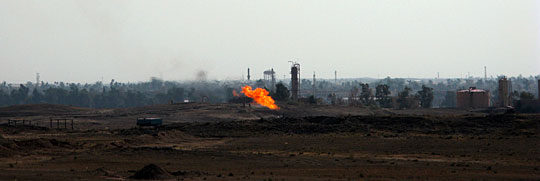
The first thing a visitor sees when approaching Kirkuk from the north is a tower of flame
.............
The potential wealth has made Kirkuk a tormented city ever since oil was discovered in 1927. Today, the city's three main ethnic groups, Kurds, Arabs and Turkmens, are vying for demographic and political control.
"If you look at history, you'll find that Kirkuk has always been part of Kurdistan," says Rebwar Falq al-Talabani, who serves as deputy chairman of the Kirkuk Provincial Council.
Talabani reflects the views of his fellow Kurds, who claim the city as their own, but he says he favors a temporary solution that the Iraqi parliament imposed on the city.
Demographic Disputes
Elections in Kirkuk will be delayed until a commission sorts out who is a legitimate resident and who is eligible to vote. That's not as easy as it sounds, because former dictator Saddam Hussein tried to change the demographics of the city by forcing Kurdish families out and replacing them with Arabs, who were thought to be more loyal to his regime.
Mohammed Khalil al-Jobouri, an Arab member of the provincial council, says the degree of Saddam's "Arabization" program in Kirkuk has been exaggerated.
"Saddam Hussein brought in no more than 50,000 Arabs over a period of more than 30 years," Jobouri says. "But since 2003, some 650,000 Kurds have been settled here."
Jobouri's numbers can't be confirmed, but he is repeating an often-heard charge made by the Arabs and Turkmens: They say that while Saddam expelled thousands of Kurds during his time, the Kurds are now using the same tactics, trying to change the political landscape by bringing in thousands of Kurds who never belonged there.
"The Kurdish political parties didn't learn any lesson from Saddam Hussein," says Ali Sadik, a Turkmen. "They accused him of being an oppressor, and here they are doing the same thing."
Good-Faith Cooperation Needed
Sadik is an official of the Turkmeneli Party, one of several that represents Turkmens in the city. Like the others, he asserts that his ethnic group has a historical claim to Kirkuk, and he says they won't get fair representation until the real population figures have been sorted out.
It is very difficult to assess what the real population numbers are, but Iraq's parliament has named a committee to try. Talabani, the Kurd, says there are ways to figure it out, including inspecting ID cards going back as far as 1957 and checking old voting lists and even ration cards.
The politicians from all three ethnic groups say this approach could work if — and only if — each group cooperates in good faith. The problem, all three agree, is that now, at least, no group trusts the others.
A senior official at the U.S. Embassy in Baghdad calls Kirkuk a "headline issue" — a symbol of fundamental problems facing all of Iraq. The official, who was not authorized to speak on the record, says that for Kurds, Kirkuk represents Kurdish autonomy; for the Arabs, Arab unity; and for the Turkmens, a place in Iraq's political system.
The U.S. official says he thinks the issue is not really about oil, since Kurdish leaders have said they would accept a revenue-sharing plan that would share Kirkuk's oil but also give them access to the revenues from Iraq's giant southern oil fields.
Kirkuk As An Example
The official noted that the U.N. is working on a series of options for solving the Kirkuk issue and is expected to deliver its suggestions soon. Meanwhile, he said he believes that at the local level in Kirkuk, there are politicians willing to work in good faith for a fair solution.
Arab representative Jobouri agrees, but he says time is running short.
"Kirkuk is the key to solving all Iraq's problems," he says, "and it's also the problem that could complicate everything else in Iraq."
Above it all, the giant gas flare outside Kirkuk burns night and day, a symbol of the riches that have been hidden beneath the city for millennia.
http://www.npr.org/templates/story/story.php?storyId=96217579
Ministry for Extra Regional Affairs - 29 Oct. 2008
KIRKUK, IKurdistan region, — Iraq's relative calm is threatened by a festering Kurdish-Arab conflict over the oil-rich city of Kirkuk and other disputed territories, that could explode into the worst sectarian war the country has suffered since the 2003 invasion, a new report says today.
The report by the International Crisis Group (ICG) says the territorial dispute is blocking political progress in Iraq, contributing to the delay in passing a law on sharing oil revenue, and threatening to put off critical provincial elections.
Pointing out that the Arab-Kurdish dispute dates back to Britain's creation of modern Iraq after the first world http://www.ekurd.net/ the ICG report warns: "In its ethnically-driven intensity, ability to drag in regional players such as Turkey and Iran, and potentially devastating impact on efforts to rebuild a fragmented state, it matches and arguably exceeds the Sunni-Shia divide that spawned the 2005 - 2007 sectarian war."
At the heart of the dispute is the city of Kirkuk, home to 900,000 Kurds, Arabs and Turkmen, which sits on one of the country's biggest oil fields. It lies outside the northern zone run by the Kurdistan Regional Government, but is in practice run by Kurdish peshmerga fighters and a Kurdish intelligence service, the Asaysh, which works closely with US intelligence.
Arabs and Turkmen residents, who represent 40% of Kirkuk's population, claim they live in fear, particularly of the Asaysh.
The tensions in the city ignited in late July, when a suicide bomber blew himself up in the midst of a Kurdish demonstration. That triggered an attack by a Kurdish mob on the headquarters of a Turkmen party, where guards fired into the crowd. Over 25 people were killed in total and more than 200 injured.
Soon afterwards, Nuri al-Maliki's government in Baghdad sent troops into three areas that had been under informal Kurdish control, further escalating tensions and threatening a direct stand-off between Iraqi regular army and peshmerga forces.
The dispute over Kirkuk has derailed legislation in the national parliament to pave the way for provincial elections. Arab and Turkmen politicians demanded a guaranteed quota of seats in the Kirkuk assembly,www.ekurd.net but Kurdish parties refused.
Kurdish leaders argue Iraq's constitution gives them the right to absorb Kirkuk and other historically Kurdish-majority areas, in the name of "normalising" demographics skewed under Saddam Hussein by forced removals and a policy of Arabisation.
Today's ICG report recommends that the only solution to the seemingly intractable problem is an "oil-for-soil" trade-off, in which the Kurds are given the right to manage revenues from their own mineral wealth and receive security guarantees for the existing internal boundary between Kurdistan and the rest of Iraq, http://www.ekurd.net/ in exchange for deferring their claims on Kirkuk for 10 years.
The report warns: "The most likely alternative to an agreement is a new outbreak of violent strife over unsettled claims in a fragmented polity governed by chaos and fear."
Copyright, respective author or news agency, guardian co.uk
* Kirkuk city is historically a Kurdish city and it lies just south border of the Kurdistan autonomous region, the population is a mix of majority Kurds and minority of Arabs, Christians and Turkmen. lies 250 km northeast of Baghdad. Kurds have a strong cultural and emotional attachment to Kirkuk, which they call "the Kurdish Jerusalem."
Article 140 of the Iraqi constitution is related to the normalization of the situation in Kirkuk city and other disputed areas.
The article also calls for conducting a census to be followed by a referendum to let the inhabitants decide whether they would like Kirkuk to be annexed to the autonomous Iraqi Kurdistan region or having it as an independent province.
The former regime of Iraqi President Saddam Hussein had forced over 250,000 Kurdish residents to give up their homes to Arabs in the 1970s, to "Arabize" the city and the region's oil industry.
http://www.moera-krg.org/articles/detail.asp?rnr=138&lngnr=12&smap=01010000&anr=14957
NOTE: the extent of Saddam's 'Arabization' of Kirkuk .. the 250,000... is disputed below, as it has been
in many places before. Am guessing just part of the 'demonization' process, which you we do know.
The dispute over control of Kirkuk prevented Iraq's parliament from passing a law authorizing provincial elections. Although the law finally passed late last month, the issue of Kirkuk was not resolved, only postponed.
The first thing a visitor sees when approaching Kirkuk from the north is a tower of flame
.............
The potential wealth has made Kirkuk a tormented city ever since oil was discovered in 1927. Today, the city's three main ethnic groups, Kurds, Arabs and Turkmens, are vying for demographic and political control.
"If you look at history, you'll find that Kirkuk has always been part of Kurdistan," says Rebwar Falq al-Talabani, who serves as deputy chairman of the Kirkuk Provincial Council.
Talabani reflects the views of his fellow Kurds, who claim the city as their own, but he says he favors a temporary solution that the Iraqi parliament imposed on the city.
Demographic Disputes
Elections in Kirkuk will be delayed until a commission sorts out who is a legitimate resident and who is eligible to vote. That's not as easy as it sounds, because former dictator Saddam Hussein tried to change the demographics of the city by forcing Kurdish families out and replacing them with Arabs, who were thought to be more loyal to his regime.
Mohammed Khalil al-Jobouri, an Arab member of the provincial council, says the degree of Saddam's "Arabization" program in Kirkuk has been exaggerated.
"Saddam Hussein brought in no more than 50,000 Arabs over a period of more than 30 years," Jobouri says. "But since 2003, some 650,000 Kurds have been settled here."
Jobouri's numbers can't be confirmed, but he is repeating an often-heard charge made by the Arabs and Turkmens: They say that while Saddam expelled thousands of Kurds during his time, the Kurds are now using the same tactics, trying to change the political landscape by bringing in thousands of Kurds who never belonged there.
"The Kurdish political parties didn't learn any lesson from Saddam Hussein," says Ali Sadik, a Turkmen. "They accused him of being an oppressor, and here they are doing the same thing."
Good-Faith Cooperation Needed
Sadik is an official of the Turkmeneli Party, one of several that represents Turkmens in the city. Like the others, he asserts that his ethnic group has a historical claim to Kirkuk, and he says they won't get fair representation until the real population figures have been sorted out.
It is very difficult to assess what the real population numbers are, but Iraq's parliament has named a committee to try. Talabani, the Kurd, says there are ways to figure it out, including inspecting ID cards going back as far as 1957 and checking old voting lists and even ration cards.
The politicians from all three ethnic groups say this approach could work if — and only if — each group cooperates in good faith. The problem, all three agree, is that now, at least, no group trusts the others.
A senior official at the U.S. Embassy in Baghdad calls Kirkuk a "headline issue" — a symbol of fundamental problems facing all of Iraq. The official, who was not authorized to speak on the record, says that for Kurds, Kirkuk represents Kurdish autonomy; for the Arabs, Arab unity; and for the Turkmens, a place in Iraq's political system.
The U.S. official says he thinks the issue is not really about oil, since Kurdish leaders have said they would accept a revenue-sharing plan that would share Kirkuk's oil but also give them access to the revenues from Iraq's giant southern oil fields.
Kirkuk As An Example
The official noted that the U.N. is working on a series of options for solving the Kirkuk issue and is expected to deliver its suggestions soon. Meanwhile, he said he believes that at the local level in Kirkuk, there are politicians willing to work in good faith for a fair solution.
Arab representative Jobouri agrees, but he says time is running short.
"Kirkuk is the key to solving all Iraq's problems," he says, "and it's also the problem that could complicate everything else in Iraq."
Above it all, the giant gas flare outside Kirkuk burns night and day, a symbol of the riches that have been hidden beneath the city for millennia.
http://www.npr.org/templates/story/story.php?storyId=96217579
Discover What Traders Are Watching
Explore small cap ideas before they hit the headlines.



