



 AI
AI








Friday, March 20, 2026 5:45:31 AM
How much damage has Iran done to Gulf oil and gas production?
"As expected Trump is beginning to back off: Iran War Live Updates: As Attacks Shake Markets, Trump Seeks to Reassure Americans
"How ignorance, misunderstanding and obfuscation ended Iran nuclear talks"
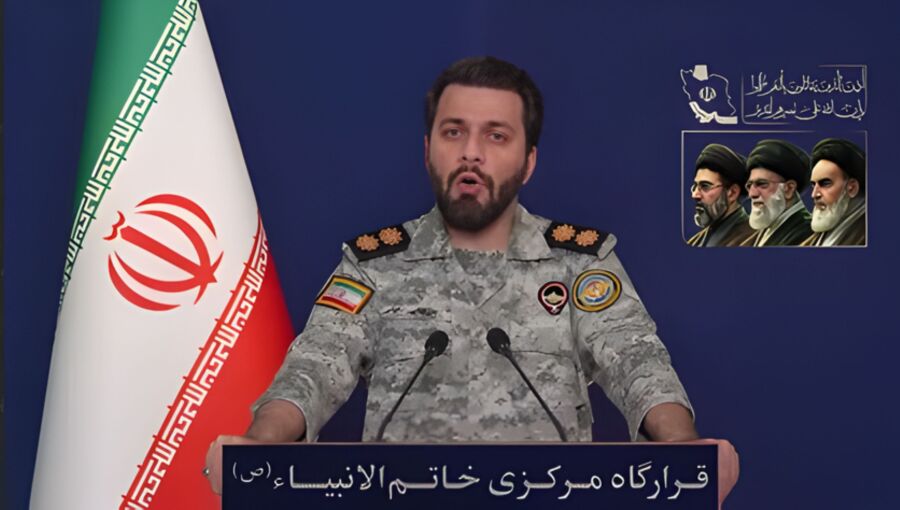
IRGC spokesman at the Iranian Khatam al-Anbiya HQ warning of more strikes on March 19. / bne IntelliNews
By Ben Aris in Berlin March 19, 2026
Iran struck back, targeting major oil and gas production facilities in the Gulf, after Israel attacked Iran’s Asaluyeh gas processing facility in Bushehr province, part of the South Pars gas fields on March 18.
In a joint statement issued on March 19, Qatar, Azerbaijan, Bahrain, Egypt, Jordan, Kuwait, Lebanon, Pakistan, Saudi Arabia, Syria, Turkey and the UAE called on Iran “to immediately halt its attacks” after holding a meeting in Riyadh.
The attack is a game-changer. It takes the unfolding Gulf war from the mere disruption of hydrocarbon flows to the destruction of vital production capacities that could have long-term global repercussions.
It is not yet clear how much physical damage the retaliation caused, but if extensive, it could change the shape of the global energy markets for months, and possibly years. According to preliminary reports, the damage appears to be mostly superficial - fires that have quickly been put out by first responders. But the stakes are high, and Tehran is demonstrating its power to seriously disrupt global energy markets, which is its main hold over the White House.
“I hate to be the bearer of bad news, but if infrastructure like this gets blown up, as of this moment it will take at least a decade to recover from this war - and the truth is that the world's energy picture is probably changed forever,” says bne IntelliNews contributor and political commentator Arnaud Bertrand.
There is also confusion over the US’ role in the strikes. Initially, it was reported that the attack was a joint effort by both Israel and the US. While the US was clearly informed of the attack ahead of time, by the end of the day US President Donald Trump was distancing himself, saying that the Pentagon did not have prior knowledge.
“The United States knew nothing about this particular attack, and the country of Qatar was in no way, shape, or form, involved with it, nor did it have any idea that it was going to happen,” Trump said in a social media post. “Unfortunately, Iran did not know this, or any of the pertinent facts pertaining to the South Pars attack, and unjustifiably and unfairly attacked a portion of Qatar’s LNG Gas facility.”
[Insert: As per, no one can take what Trump says literally. It's a sick state
of affairs when the president of the USA cannot be trusted by anbody.]
While the US has been overwhelmingly supportive of Israel, a row has already broken out between Tel Aviv and Washington over the extent of the strikes against Iranian production. The partners are fundamentally divergent on their strategy. While the US seeks to pressure the Islamic Republic into capitulation by striking its main cash cows, Israel’s goal is more extensive as it would like to see a complete economic collapse of the Iranian economy as part of its strategy to remove what Tel Aviv sees as an existential threat. That's a bridge too far for the Americans, who are afraid of the impact removing Iran's oil production completely from the market will have on energy prices.
Highlighting the growing divide between the White House and Tel Aviv, Trump promised that Israel would not be allowed to make similar attacks on production facilities going forward.
[So everything Netanyahu does from now he has been allowed
to do by you, Donald. Good to know.]
“NO MORE ATTACKS WILL BE MADE BY ISRAEL pertaining to this extremely important and valuable South Pars Field unless Iran unwisely decides to attack a very innocent, in this case, Qatar - In which instance the United States of America, with or without the help or consent of Israel, will massively blow up the entirety of the South Pars Gas Field at an amount of strength and power that Iran has never seen or witnessed before,” Trump posted.
[HEY DONALD, NONE OF THIS WOULD BE HAPPENING if you hadn't attacked Iran. Nobody
but Netanyahu, not sure about Putin, wanted you to. They were all against it, Donald.]
The differences in strategy have led many commentators to question how much control Trump has over Israeli Prime Minister Benjamin Netanyahu. In commentary, Trump is being increasingly accused of being dragged into this war that Netanyahu has been lobbying for, for years.
“I do not want to authorize this level of violence and destruction because of the long-term implications that it will have on the future of Iran, but if Qatar’s LNG is again attacked, I will not hesitate to do so,” Trump added.
South Pars damage
Fires were blazing at the Asaluyeh gas processing facility on March 18 that took the brunt of the strike, but emergency services responded quickly to put out the flames. Trump claimed that “a relatively small section of the whole [of the South Pars complex] has been hit.”
On the list of the 25 largest natural gas fields, South Pars by itself holds roughly 40% of their combined recoverable reserves and is nearly six times bigger than the second biggest field in the world. And it is a young field: unlike many of the other gas deposits on the list, South Pars is at 10% depletion.
The attack on South Pars is reminiscent of Ukraine’s strategy of striking Russian oil refineries in the last year with its new long-range drones. In the early stages, Ukraine’s drones only did superficial damage that was repaired in a few days but had a large symbolic effect on the conflict. However, as the campaign continued Ukraine has been using progressively more powerful drones that have done more extensive damage, although Kyiv lacks the missiles to actually destroy these facilities.
In the Ukrainian example, the White House also objected to Ukraine’s autonomous decision to attack Russia’s oil production facilities, for the same fears of what it would do to global energy prices.
Kuwait
Kuwait’s Mina Al-Ahmadi refinery was on fire after the Iranian missile strikes. Operations were suspended that account for roughly 346,000 barrels per day of refining capacity, Kuwait Petroleum Corporation (KPC) confirmed.
The Mina Al-Ahmadi refinery is Kuwait’s largest and most important refining complex, located about 40km from Kuwait City. Commissioned in 1949 and expanded multiple times, it has a total refining capacity of 466,000 barrels per day, making it a central pillar of Kuwait’s downstream sector and one of the largest refineries in the Middle East. The refinery processes Kuwait’s heavy crude into a wide range of products including diesel, kerosene, jet fuel and low-sulphur fuel oil, much of which is exported.
Qatar
QatarEnergy confirmed that Ras Laffan Industrial City was hit on March 18. At least one missile reportedly penetrated defences, causing “extensive damage” and fires.
“Emergency response teams were deployed immediately to contain the resulting fires, as extensive damage has been caused. All personnel have been accounted for and no casualties have been reported at this time,” Qatar said in a statement. In an update, QatarEnergy said most of the fires have now been extinguished.
A second wave of strikes on March 19 caused further damage, QatarEnergy said in a statement the same day.
“In addition to the previous attack on Ras Laffan Industrial City on Wednesday 18 March 2026 that resulted in extensive damage to the Pearl GTL (Gas-to-Liquids) facility, QatarEnergy confirms that in the early hours of Thursday 19 March 2026, several of its Liquefied Natural Gas (LNG) facilities were the subject of missile attacks, causing sizeable fires and extensive further damage,” QatarEnergy said in a statement. “Emergency response teams were deployed immediately to contain the resulting damage with no reported casualties.”
Ras Laffan is the backbone of Qatar’s LNG exports, the hub that produces 30% of global LNG. Qatar shares the same gas basin as Iran’s South Pars (which they call the North Dome), the world's largest by far or 9,700 km² - about the size of Qatar itself.
UAE
The UAE’s Habshan gas facility and Bab field were both hit by Iran on March 18.
Habshan is a key processing hub operated by ADNOC. It processes large volumes of sour gas from the Shah and other fields, removing sulphur and impurities before the gas is transported via pipeline to key industrial sites such as Ruwais and export terminals including Habshan–Fujairah port on the Gulf of Oman. The complex plays a central role in supplying domestic power generation, desalination plants and industrial demand, making it a cornerstone of the UAE’s energy security and downstream value chain.
The Bab oil fields are one of the UAE’s oldest and largest onshore oil fields, situated southwest of Abu Dhabi city and also operated by ADNOC. Discovered in the 1960s, it produces crude oil alongside associated gas, feeding into the UAE’s broader upstream production system. The field is part of the company’s long-term strategy to maintain output capacity through enhanced recovery techniques and infrastructure upgrades and remains a key contributor to the UAE’s overall oil production and export capacity.
While missiles were intercepted, debris sparked fires and forced a shutdown at Habshan. However, repairs are expected to be affected quickly and operations could be restarted soon. The UAE called it a “dangerous escalation” threatening global energy security.
Saudi Arabia
Iranian Ballistic missiles targeted Riyadh’s refineries supplying the capital’s fuel market, with capacity of about 130,000 barrels per day, according to the Wall Street Journal. Riyadh claims air defences intercepted the strikes, and debris caused limited damage. However, videos posted online showed massive fires at the site that emergency services are attempting to put out.
Saudi Foreign Minister Prince Faisal bin Farhan confirmed two refineries were “attacked,” without giving details of the extent of the damage. Unconfirmed reports online reported that the port of Yanbu, a the terminus for the Kingdom’s westward pipelines to the Red Sea that bypasses the Strait of Hormuz exit route, were also hit by Iranian missiles causing fires.
Unhit resources
If the strikes on energy assets continue, Iran has the option of causing massive damage to the global energy system.
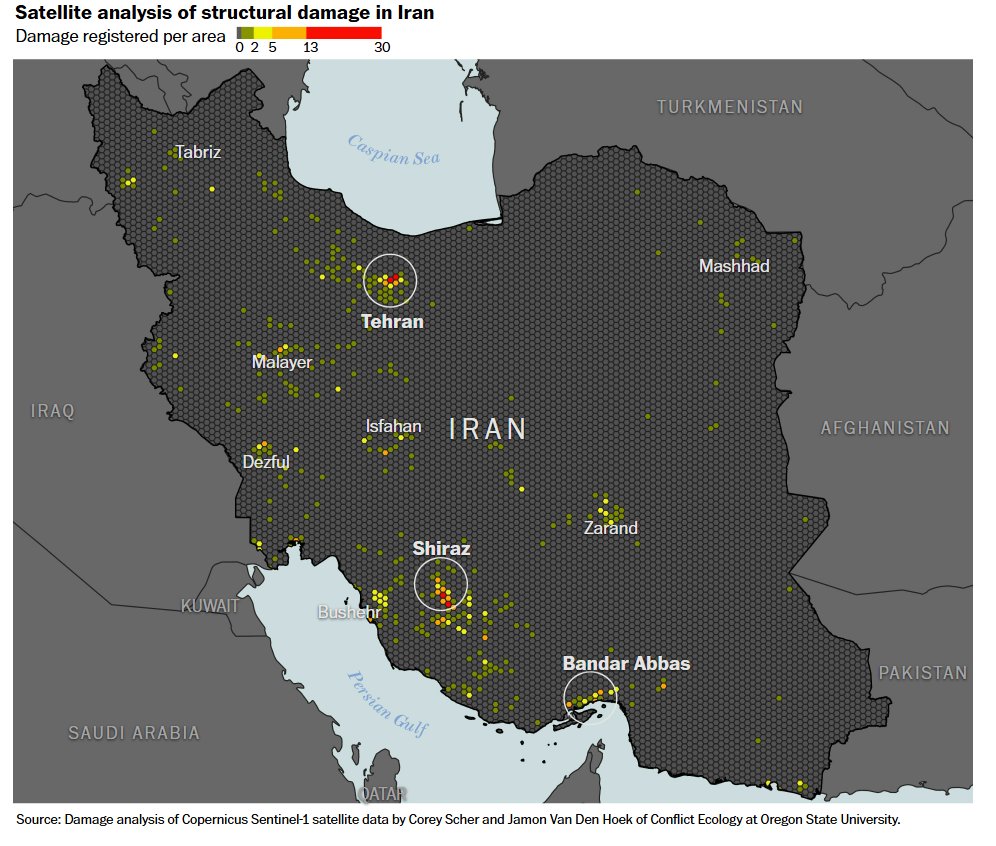
Prior to the attacks on South Pars, satellite analysis by Oregon State University shows that Iran had already inflicted widespread structural damage across Iran since the start of Operation Epic Fury.
There were major damage clusters in Tehran and Shiraz with more than 40 structures damaged in Bandar Abbas, home to a key naval base near the Strait of Hormuz. Researcher Jamon Van Den Hoek said: “There’s really no frontline at the moment — it’s simultaneous damage across different corners of Iran,” the Washington Post reported.
Trump doubling down
Following Trump’s failure to reopen the Strait of Hormuz, he is doubling down by deploying more air and naval forces to the Gulf theatre to give himself more options to end the conflict quickly. Marines are en route to the Gulf from US bases in Okinawa, due to arrive at the end of this month. There is the possibility of a land invasion to secure Qeshm Island in the Strait and possibly the approximately 45km of coastline in the narrow part of the Straits.
The Trump administration has also discussed options to send ground forces to Iran's Kharg island, the hub for 90% of Iran's oil exports, Reuters reports, citing Trump administration sources. The island was already struck by US missiles on March 13, but only military targets were hit and the oil infrastructure was deliberately spared. Trump administration officials have also discussed the possibility of deploying US forces to secure Iran's stocks of highly ?enriched uranium.
A White House official, speaking on condition of anonymity, said: "There has been no decision to send ground troops at this time, but President Trump wisely keeps all options at his disposal, Reuters reported. "The ?president is focused on achieving all of the defined objectives of Operation Epic Fury: destroy Iran's ballistic missile capacity, annihilate their navy, ensure their terrorist proxies cannot destabilise the region, and guarantee that Iran can never ?possess a nuclear weapon."
The US has carried out more than 7,800 strikes since launching the war on ?February 28 ?and damaged or destroyed more than 120 Iranian vessels so far, according to a factsheet released on Wednesday by the US Central Command, which oversees the roughly 50,000 US troops in the Middle East, Reuters reports.
A reported 13 US troops have been killed so far, and about 200 have been wounded. Deaths amongst the Iranians is reported to be over 1,100, but the real numbers is almost certainly much higher.
Trump is also reportedly toying with the idea of declaring victory and ending the conflict before getting pulled deeper in.
[Of course he is. When Trump does it shouldn't surprise anyone. See:
hap0206, Bullshit, Israel has never been in a safer situation. Peace deals galore, more land blah blah, and your wishful certainty
of an "unconditional surrender" by Iran maybe inside two weeks is as delusional as it was the first time you said it.
P - Trump declaring victory within two weeks is a real possibility, he has fucked up the world economy almost as badly as covid did already.
https://investorshub.advfn.com/boards/read_msg.aspx?message_id=177411671]
"I wonder what would happen if we 'finished off' what's left of the Iranian Terror State, and let the Countries ?that use it, we don't, be responsible for the so called 'Strait?,'" Trump posted on Truth Social.
https://www.intellinews.com/how-much-damage-has-iran-done-to-gulf-oil-and-gas-production-432563/
Imagine a president thinking that running the show from this own social media site
is the best way to do it. Could only happen from a fucked up head.
"As expected Trump is beginning to back off: Iran War Live Updates: As Attacks Shake Markets, Trump Seeks to Reassure Americans
"How ignorance, misunderstanding and obfuscation ended Iran nuclear talks"
IRGC spokesman at the Iranian Khatam al-Anbiya HQ warning of more strikes on March 19. / bne IntelliNews
By Ben Aris in Berlin March 19, 2026
Iran struck back, targeting major oil and gas production facilities in the Gulf, after Israel attacked Iran’s Asaluyeh gas processing facility in Bushehr province, part of the South Pars gas fields on March 18.
In a joint statement issued on March 19, Qatar, Azerbaijan, Bahrain, Egypt, Jordan, Kuwait, Lebanon, Pakistan, Saudi Arabia, Syria, Turkey and the UAE called on Iran “to immediately halt its attacks” after holding a meeting in Riyadh.
The attack is a game-changer. It takes the unfolding Gulf war from the mere disruption of hydrocarbon flows to the destruction of vital production capacities that could have long-term global repercussions.
It is not yet clear how much physical damage the retaliation caused, but if extensive, it could change the shape of the global energy markets for months, and possibly years. According to preliminary reports, the damage appears to be mostly superficial - fires that have quickly been put out by first responders. But the stakes are high, and Tehran is demonstrating its power to seriously disrupt global energy markets, which is its main hold over the White House.
“I hate to be the bearer of bad news, but if infrastructure like this gets blown up, as of this moment it will take at least a decade to recover from this war - and the truth is that the world's energy picture is probably changed forever,” says bne IntelliNews contributor and political commentator Arnaud Bertrand.
There is also confusion over the US’ role in the strikes. Initially, it was reported that the attack was a joint effort by both Israel and the US. While the US was clearly informed of the attack ahead of time, by the end of the day US President Donald Trump was distancing himself, saying that the Pentagon did not have prior knowledge.
“The United States knew nothing about this particular attack, and the country of Qatar was in no way, shape, or form, involved with it, nor did it have any idea that it was going to happen,” Trump said in a social media post. “Unfortunately, Iran did not know this, or any of the pertinent facts pertaining to the South Pars attack, and unjustifiably and unfairly attacked a portion of Qatar’s LNG Gas facility.”
[Insert: As per, no one can take what Trump says literally. It's a sick state
of affairs when the president of the USA cannot be trusted by anbody.]
While the US has been overwhelmingly supportive of Israel, a row has already broken out between Tel Aviv and Washington over the extent of the strikes against Iranian production. The partners are fundamentally divergent on their strategy. While the US seeks to pressure the Islamic Republic into capitulation by striking its main cash cows, Israel’s goal is more extensive as it would like to see a complete economic collapse of the Iranian economy as part of its strategy to remove what Tel Aviv sees as an existential threat. That's a bridge too far for the Americans, who are afraid of the impact removing Iran's oil production completely from the market will have on energy prices.
Highlighting the growing divide between the White House and Tel Aviv, Trump promised that Israel would not be allowed to make similar attacks on production facilities going forward.
[So everything Netanyahu does from now he has been allowed
to do by you, Donald. Good to know.]
“NO MORE ATTACKS WILL BE MADE BY ISRAEL pertaining to this extremely important and valuable South Pars Field unless Iran unwisely decides to attack a very innocent, in this case, Qatar - In which instance the United States of America, with or without the help or consent of Israel, will massively blow up the entirety of the South Pars Gas Field at an amount of strength and power that Iran has never seen or witnessed before,” Trump posted.
[HEY DONALD, NONE OF THIS WOULD BE HAPPENING if you hadn't attacked Iran. Nobody
but Netanyahu, not sure about Putin, wanted you to. They were all against it, Donald.]
The differences in strategy have led many commentators to question how much control Trump has over Israeli Prime Minister Benjamin Netanyahu. In commentary, Trump is being increasingly accused of being dragged into this war that Netanyahu has been lobbying for, for years.
“I do not want to authorize this level of violence and destruction because of the long-term implications that it will have on the future of Iran, but if Qatar’s LNG is again attacked, I will not hesitate to do so,” Trump added.
South Pars damage
Fires were blazing at the Asaluyeh gas processing facility on March 18 that took the brunt of the strike, but emergency services responded quickly to put out the flames. Trump claimed that “a relatively small section of the whole [of the South Pars complex] has been hit.”
On the list of the 25 largest natural gas fields, South Pars by itself holds roughly 40% of their combined recoverable reserves and is nearly six times bigger than the second biggest field in the world. And it is a young field: unlike many of the other gas deposits on the list, South Pars is at 10% depletion.
The attack on South Pars is reminiscent of Ukraine’s strategy of striking Russian oil refineries in the last year with its new long-range drones. In the early stages, Ukraine’s drones only did superficial damage that was repaired in a few days but had a large symbolic effect on the conflict. However, as the campaign continued Ukraine has been using progressively more powerful drones that have done more extensive damage, although Kyiv lacks the missiles to actually destroy these facilities.
In the Ukrainian example, the White House also objected to Ukraine’s autonomous decision to attack Russia’s oil production facilities, for the same fears of what it would do to global energy prices.
Kuwait
Kuwait’s Mina Al-Ahmadi refinery was on fire after the Iranian missile strikes. Operations were suspended that account for roughly 346,000 barrels per day of refining capacity, Kuwait Petroleum Corporation (KPC) confirmed.
The Mina Al-Ahmadi refinery is Kuwait’s largest and most important refining complex, located about 40km from Kuwait City. Commissioned in 1949 and expanded multiple times, it has a total refining capacity of 466,000 barrels per day, making it a central pillar of Kuwait’s downstream sector and one of the largest refineries in the Middle East. The refinery processes Kuwait’s heavy crude into a wide range of products including diesel, kerosene, jet fuel and low-sulphur fuel oil, much of which is exported.
Qatar
QatarEnergy confirmed that Ras Laffan Industrial City was hit on March 18. At least one missile reportedly penetrated defences, causing “extensive damage” and fires.
“Emergency response teams were deployed immediately to contain the resulting fires, as extensive damage has been caused. All personnel have been accounted for and no casualties have been reported at this time,” Qatar said in a statement. In an update, QatarEnergy said most of the fires have now been extinguished.
A second wave of strikes on March 19 caused further damage, QatarEnergy said in a statement the same day.
“In addition to the previous attack on Ras Laffan Industrial City on Wednesday 18 March 2026 that resulted in extensive damage to the Pearl GTL (Gas-to-Liquids) facility, QatarEnergy confirms that in the early hours of Thursday 19 March 2026, several of its Liquefied Natural Gas (LNG) facilities were the subject of missile attacks, causing sizeable fires and extensive further damage,” QatarEnergy said in a statement. “Emergency response teams were deployed immediately to contain the resulting damage with no reported casualties.”
Ras Laffan is the backbone of Qatar’s LNG exports, the hub that produces 30% of global LNG. Qatar shares the same gas basin as Iran’s South Pars (which they call the North Dome), the world's largest by far or 9,700 km² - about the size of Qatar itself.
UAE
The UAE’s Habshan gas facility and Bab field were both hit by Iran on March 18.
Habshan is a key processing hub operated by ADNOC. It processes large volumes of sour gas from the Shah and other fields, removing sulphur and impurities before the gas is transported via pipeline to key industrial sites such as Ruwais and export terminals including Habshan–Fujairah port on the Gulf of Oman. The complex plays a central role in supplying domestic power generation, desalination plants and industrial demand, making it a cornerstone of the UAE’s energy security and downstream value chain.
The Bab oil fields are one of the UAE’s oldest and largest onshore oil fields, situated southwest of Abu Dhabi city and also operated by ADNOC. Discovered in the 1960s, it produces crude oil alongside associated gas, feeding into the UAE’s broader upstream production system. The field is part of the company’s long-term strategy to maintain output capacity through enhanced recovery techniques and infrastructure upgrades and remains a key contributor to the UAE’s overall oil production and export capacity.
While missiles were intercepted, debris sparked fires and forced a shutdown at Habshan. However, repairs are expected to be affected quickly and operations could be restarted soon. The UAE called it a “dangerous escalation” threatening global energy security.
Saudi Arabia
Iranian Ballistic missiles targeted Riyadh’s refineries supplying the capital’s fuel market, with capacity of about 130,000 barrels per day, according to the Wall Street Journal. Riyadh claims air defences intercepted the strikes, and debris caused limited damage. However, videos posted online showed massive fires at the site that emergency services are attempting to put out.
Saudi Foreign Minister Prince Faisal bin Farhan confirmed two refineries were “attacked,” without giving details of the extent of the damage. Unconfirmed reports online reported that the port of Yanbu, a the terminus for the Kingdom’s westward pipelines to the Red Sea that bypasses the Strait of Hormuz exit route, were also hit by Iranian missiles causing fires.
Unhit resources
If the strikes on energy assets continue, Iran has the option of causing massive damage to the global energy system.
Prior to the attacks on South Pars, satellite analysis by Oregon State University shows that Iran had already inflicted widespread structural damage across Iran since the start of Operation Epic Fury.
There were major damage clusters in Tehran and Shiraz with more than 40 structures damaged in Bandar Abbas, home to a key naval base near the Strait of Hormuz. Researcher Jamon Van Den Hoek said: “There’s really no frontline at the moment — it’s simultaneous damage across different corners of Iran,” the Washington Post reported.
Trump doubling down
Following Trump’s failure to reopen the Strait of Hormuz, he is doubling down by deploying more air and naval forces to the Gulf theatre to give himself more options to end the conflict quickly. Marines are en route to the Gulf from US bases in Okinawa, due to arrive at the end of this month. There is the possibility of a land invasion to secure Qeshm Island in the Strait and possibly the approximately 45km of coastline in the narrow part of the Straits.
The Trump administration has also discussed options to send ground forces to Iran's Kharg island, the hub for 90% of Iran's oil exports, Reuters reports, citing Trump administration sources. The island was already struck by US missiles on March 13, but only military targets were hit and the oil infrastructure was deliberately spared. Trump administration officials have also discussed the possibility of deploying US forces to secure Iran's stocks of highly ?enriched uranium.
A White House official, speaking on condition of anonymity, said: "There has been no decision to send ground troops at this time, but President Trump wisely keeps all options at his disposal, Reuters reported. "The ?president is focused on achieving all of the defined objectives of Operation Epic Fury: destroy Iran's ballistic missile capacity, annihilate their navy, ensure their terrorist proxies cannot destabilise the region, and guarantee that Iran can never ?possess a nuclear weapon."
The US has carried out more than 7,800 strikes since launching the war on ?February 28 ?and damaged or destroyed more than 120 Iranian vessels so far, according to a factsheet released on Wednesday by the US Central Command, which oversees the roughly 50,000 US troops in the Middle East, Reuters reports.
A reported 13 US troops have been killed so far, and about 200 have been wounded. Deaths amongst the Iranians is reported to be over 1,100, but the real numbers is almost certainly much higher.
Trump is also reportedly toying with the idea of declaring victory and ending the conflict before getting pulled deeper in.
[Of course he is. When Trump does it shouldn't surprise anyone. See:
hap0206, Bullshit, Israel has never been in a safer situation. Peace deals galore, more land blah blah, and your wishful certainty
of an "unconditional surrender" by Iran maybe inside two weeks is as delusional as it was the first time you said it.
P - Trump declaring victory within two weeks is a real possibility, he has fucked up the world economy almost as badly as covid did already.
https://investorshub.advfn.com/boards/read_msg.aspx?message_id=177411671]
"I wonder what would happen if we 'finished off' what's left of the Iranian Terror State, and let the Countries ?that use it, we don't, be responsible for the so called 'Strait?,'" Trump posted on Truth Social.
https://www.intellinews.com/how-much-damage-has-iran-done-to-gulf-oil-and-gas-production-432563/
Imagine a president thinking that running the show from this own social media site
is the best way to do it. Could only happen from a fucked up head.
It was Plato who said, “He, O men, is the wisest, who like Socrates, knows that his wisdom is in truth worth nothing”
Discover What Traders Are Watching
Explore small cap ideas before they hit the headlines.



