



 AI
AI







Thursday, September 18, 2025 10:48:05 PM
iPSC-Derived Off-the-Shelf anti-CD19 CAR T cells Deliver Improved Clinical Outcomes in Lupus with Reduced or No Conditioning Chemotherapy
Background/Purpose: Anti-CD19 chimeric antigen receptor (CAR) T cell therapy shows promise in autoimmune disease. However, autologous CAR T-cell therapy is limited by prolonged pre- and post-apheresis timelines, access to authorized treatment centers, T cell product inconsistency, high costs, and production capacity to support a broad patient (pt) base. Derived from a clonal master induced pluripotent stem cell (iPSC) bank for mass production of CAR T cells for on-demand and broad utilization, FT819 is an off-the-shelf CD19-targeting CAR T cell product engineered with features designed to improve safety and efficacy via a 1XX CAR signaling domain that extends T cell effector function without exhaustion; integration of CAR transgene directly into the T cell receptor (TCR) alpha constant locus promotes uniform CAR expression and enhanced potency; and complete bi-allelic disruption of TCR expression for the prevention of graft-versus-host disease (GVHD).
Methods: A Phase 1 dose-escalation study evaluating the safety, pharmacokinetics, and anti-B-cell activity of FT819 in pts with B-cell mediated autoimmune diseases (NCT06308978) is ongoing. All pts enrolled to date have SLE (EULAR/ACR 2019 classification with at least one antibody: ANA 1:160, anti-dsDNA, or anti-smith), whose severity is defined by SLEDAI-2K = 8 + 1 BILAG A/2 BILAG B scores. FT819 was administered as a single dose under 2 regimens (Reg): Reg A, fludarabine-free conditioning chemotherapy (CCT) with single-dose cyclophosphamide or bendamustine daily for 2 days prior to FT819; and Reg B, no CCT with continued stable dose of maintenance therapy, including mycophenolate (MMF).
Results: As of the data cutoff date, pts treated in Reg A and Reg B had follow-up ranging from 1-12 months (mo). All pts tolerated FT819 without dose-limiting toxicity. Expected cytopenias after CCT were observed in Reg A. No Grade >2 CRS, ICANS, GvHD, or death was reported. Pts in Reg A experienced rapid and deep peripheral B cell depletion, with greater depletion observed at dose level 2 (DL; DL1 = 3.6 x 10⁸ viable cells (VC)/dose; DL2 = 9 x 10⁸ VC/dose). Reconstitution of the B cell compartment, predominantly naïve, was noted within 1-3 mo post-FT819. Pts from both Regimens experienced sustained improvements in SLEDAI-2K, PGA, and FACIT-fatigue scores and UPCr improved in pts with lupus nephritis (LN). Pts with LN achieved either a primary efficacy renal response or complete renal response (CRR) by last follow up.In the first pt in Reg A, steroids were discontinued at 3 mo, Definition of Remission in SLE (DORIS) achieved at 6 and 12 mo, and CRR at 9 mo. In the first pt in Reg B (BILAG A cardiorespiratory), MMF was continued without CCT, and Low Lupus Disease Activity State was achieved at 3 mo. Additional pt outcomes of current and additional pts will be highlighted at the time of presentation.
Conclusion: Preliminary patient data indicates a favorable safety profile, effective B cell depletion, and promising initial efficacy. These findings support the continued evaluation of FT819 in SLE as well as other B-cell mediated autoimmune diseases (ANCA-associated vasculitis, idiopathic inflammatory myositis, and systemic sclerosis) included in the FT819 protocol. https://acrabstracts.org/abstract/ipsc-derived-off-the-shelf-anti-cd19-car-t-cells-deliver-improved-clinical-outcomes-in-lupus-with-reduced-or-no-conditioning-chemotherapy/
Longitudinal Analysis of B cell Remodeling in Systemic Lupus Erythematosus Following iPSC-Derived CAR T-cell Therapy
Background/Purpose: Autologous chimeric antigen receptor (CAR) T-cell therapy is an exciting new potential therapy for autoimmune diseases but limited in scope of application by logistical complexity and cost of treatment. Furthermore, autoimmune patients will benefit from CAR T cell protocols that omit intensive conditioning chemotherapy (CCT) and integrate with their existing treatments. Here, we report 3-12 month follow-up data from our ongoing Phase I trial of FT819, an off-the-shelf iPSC-derived CD19-targeted CAR T-cell therapy, for the treatment of B-cell mediated autoimmune diseases (NCT06308978). FT819 is engineered to improve the safety and efficacy of CAR T cell therapy and incorporates a novel 1XX CAR signaling domain that extends T cell effector function without causing exhaustion. The CAR transgene is integrated into the T cell receptor (TCR) alpha constant locus to promote uniform CAR expression and enhance potency, with bi-allelic disruption of TCR expression to completely prevent graft-versus-host disease.
Methods: All patients enrolled to date were treated with FT819 for moderate to severe systemic lupus erythematosus (SLE) and either received fludarabine-free CCT (bendamustine or cyclophosphamide) or received no CCT and continued their standard-of-care therapy. Blood samples were collected at protocol-specified timepoints for B cell analysis.
Results: At baseline, patients had a mean SLEDAI score of 16 and reduced proportions of naïve B cells compared with healthy controls (HC, 60.2% vs 70.2%), increased proportions of pathogenically associated double-negative (DN) B cells (18.4% vs 8.7%), and circulating plasmablasts (PB, 8.2% vs 2.0%). Clonal architecture, as determined by sequencing of the BCR heavy chain, showed an increase in class-switched BCRs (73.1% vs 45.8%), larger clone sizes (12.3% vs 6.5% of total reads assigned to the top 10 clones), and a less diverse repertoire (Shannon index: 7.5 vs 8.7). Following treatment in patients receiving CCT, and concurrent with the overall resurgence in total B-cell numbers (6-12 mo), proportions of PB and DN B cells returned to the range observed in HC, while naïve B cells expanded to a proportion higher than that seen in HC. Moreover, the average proportion of large clones fell by 73.2%, with 87% of pre-treatment dominant clones absent by 6 months. Repertoire diversity increased from 6.2 to 9.2, and IgG/IgA fractions dropped by 42.6% while IgM rose 2.5-fold. Importantly, these measures paralleled the reduction in SLEDAI in these patients. In the patient treated with FT819 in the absence of CCT, we observed an overall minor reduction in PB (3.3% vs 2.9%) and DN B cells (33.3% vs 25.8%), but no change in naïve B cells at month 3 follow-up. Additionally, we observed a shift toward IgM positivity that, together with observed improvement in SLEDAI, may suggest ongoing rejuvenation of the B-cell compartment.
Conclusion: Collectively, these findings demonstrate that FT819 can remodel the B-cell compartment toward a naïve and more diverse repertoire, even without CCT, supporting immune reset as a mechanism of clinical remission. This trial is actively enrolling, and updated patient data will be included at the time of presentation. https://acrabstracts.org/abstract/longitudinal-analysis-of-b-cell-remodeling-in-systemic-lupus-erythematosus-following-ipsc-derived-car-t-cell-therapy/
Increasing Participation in the FT819 Cell Therapy Trial Amongst People Living with Lupus: A Focus Group Study
Background/Purpose: Clinical trials exploring the safety and efficacy of chimeric antigen receptor (CAR) T-cell therapy for lupus are growing. Challenges linked to recruitment for CAR T-cell clinical trials are likely multifactorial and may include barriers at the healthcare system, provider, and patient level. The aim of this study was to elicit qualitative feedback from people living with systemic lupus erythematosus (SLE) who have the greatest burden of disease to understand attitudes, perceptions, and behaviors related to CAR T-cell therapy clinical trials, specifically the Fate Therapeutics FT819 product.
Methods: A focus group was conducted among people with SLE recruited via the Lupus Foundation of America’s Research Accelerated by You (RAY) Registry. Researchers queried RAY for individuals thought to meet inclusion criteria and provided an online screener. Of 205 respondents, 23 were shortlisted based on response timing (5 business days) and alignment with a priori inclusion/exclusion criteria. Upon follow-up contact, 6 expressed interest and consented. Five attended a 2-hour virtual focus group in December 2025 via Zoom. Following a slide presentation describing FT819 therapy as an off-the-shelf (uniquely available on-demand) cell therapy with reduced patient burden such as hospitalization requirements, semi-structured questions covered: (1) background and journey to diagnosis and care, (2) general awareness and perceptions of cell therapy, (3) perceptions of FT819 therapy administration, (4) potential benefits and risks of receiving FT819 therapy within a clinical trial, and (5) perceptions and acceptability of follow-up and monitoring. The focus group was audio-video recorded, transcribed, and analyzed in Dedoose using content analysis methodology.
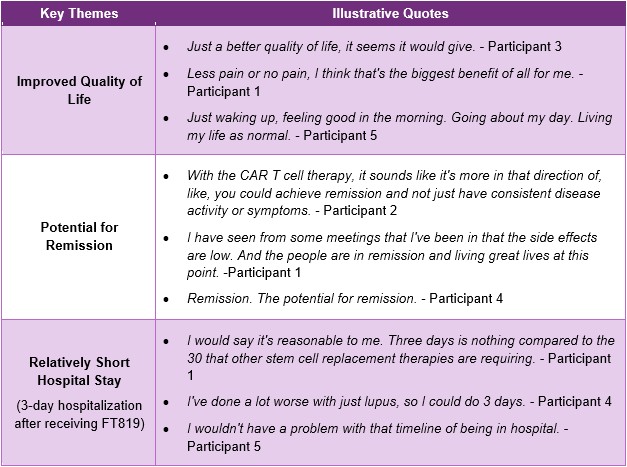
Results: Participants included 5 Black/African American female adults, one of whom also identified as Hispanic. All had active SLE affecting one or more major organ systems (Table 1). Results emerged across 3 categories: (1) Initial perceptions of cell therapy, (2) perceptions of FT819 therapy including benefits and concerns (Tables 2 and 3), and (3) willingness to participate in an FT819 trial and expected outcomes. Initial perceptions indicated participants were familiar with and optimistic about cell therapy but also had concerns. Regarding FT819 therapy, participants perceived benefits such as improved quality of life, potential for remission, and a relatively short hospital stay. Participants also expressed concerns about potential adverse reactions or side effects, chemotherapy or mycophenolate requirements, long-term effectiveness, time and travel, hospital care and quality, caregiver needs, and medication cost and coverage (upon FDA approval). Participants also commented on willingness to participate in an FT819 trial, definition of successful treatment, and required duration of clinical effect.
Conclusion: Clinical trials in the U.S. have often failed to include representative samples, leading to a lack of generalizability. This study identified barriers and facilitators to cell therapy trial participation among a purposive sample. The findings can guide activities such as patient engagement, recruitment, and site selection.
.jpg)
.jpg)
https://acrabstracts.org/abstract/increasing-participation-in-the-ft819-cell-therapy-trial-amongst-people-living-with-lupus-a-focus-group-study/
Background/Purpose: Anti-CD19 chimeric antigen receptor (CAR) T cell therapy shows promise in autoimmune disease. However, autologous CAR T-cell therapy is limited by prolonged pre- and post-apheresis timelines, access to authorized treatment centers, T cell product inconsistency, high costs, and production capacity to support a broad patient (pt) base. Derived from a clonal master induced pluripotent stem cell (iPSC) bank for mass production of CAR T cells for on-demand and broad utilization, FT819 is an off-the-shelf CD19-targeting CAR T cell product engineered with features designed to improve safety and efficacy via a 1XX CAR signaling domain that extends T cell effector function without exhaustion; integration of CAR transgene directly into the T cell receptor (TCR) alpha constant locus promotes uniform CAR expression and enhanced potency; and complete bi-allelic disruption of TCR expression for the prevention of graft-versus-host disease (GVHD).
Methods: A Phase 1 dose-escalation study evaluating the safety, pharmacokinetics, and anti-B-cell activity of FT819 in pts with B-cell mediated autoimmune diseases (NCT06308978) is ongoing. All pts enrolled to date have SLE (EULAR/ACR 2019 classification with at least one antibody: ANA 1:160, anti-dsDNA, or anti-smith), whose severity is defined by SLEDAI-2K = 8 + 1 BILAG A/2 BILAG B scores. FT819 was administered as a single dose under 2 regimens (Reg): Reg A, fludarabine-free conditioning chemotherapy (CCT) with single-dose cyclophosphamide or bendamustine daily for 2 days prior to FT819; and Reg B, no CCT with continued stable dose of maintenance therapy, including mycophenolate (MMF).
Results: As of the data cutoff date, pts treated in Reg A and Reg B had follow-up ranging from 1-12 months (mo). All pts tolerated FT819 without dose-limiting toxicity. Expected cytopenias after CCT were observed in Reg A. No Grade >2 CRS, ICANS, GvHD, or death was reported. Pts in Reg A experienced rapid and deep peripheral B cell depletion, with greater depletion observed at dose level 2 (DL; DL1 = 3.6 x 10⁸ viable cells (VC)/dose; DL2 = 9 x 10⁸ VC/dose). Reconstitution of the B cell compartment, predominantly naïve, was noted within 1-3 mo post-FT819. Pts from both Regimens experienced sustained improvements in SLEDAI-2K, PGA, and FACIT-fatigue scores and UPCr improved in pts with lupus nephritis (LN). Pts with LN achieved either a primary efficacy renal response or complete renal response (CRR) by last follow up.In the first pt in Reg A, steroids were discontinued at 3 mo, Definition of Remission in SLE (DORIS) achieved at 6 and 12 mo, and CRR at 9 mo. In the first pt in Reg B (BILAG A cardiorespiratory), MMF was continued without CCT, and Low Lupus Disease Activity State was achieved at 3 mo. Additional pt outcomes of current and additional pts will be highlighted at the time of presentation.
Conclusion: Preliminary patient data indicates a favorable safety profile, effective B cell depletion, and promising initial efficacy. These findings support the continued evaluation of FT819 in SLE as well as other B-cell mediated autoimmune diseases (ANCA-associated vasculitis, idiopathic inflammatory myositis, and systemic sclerosis) included in the FT819 protocol. https://acrabstracts.org/abstract/ipsc-derived-off-the-shelf-anti-cd19-car-t-cells-deliver-improved-clinical-outcomes-in-lupus-with-reduced-or-no-conditioning-chemotherapy/
Longitudinal Analysis of B cell Remodeling in Systemic Lupus Erythematosus Following iPSC-Derived CAR T-cell Therapy
Background/Purpose: Autologous chimeric antigen receptor (CAR) T-cell therapy is an exciting new potential therapy for autoimmune diseases but limited in scope of application by logistical complexity and cost of treatment. Furthermore, autoimmune patients will benefit from CAR T cell protocols that omit intensive conditioning chemotherapy (CCT) and integrate with their existing treatments. Here, we report 3-12 month follow-up data from our ongoing Phase I trial of FT819, an off-the-shelf iPSC-derived CD19-targeted CAR T-cell therapy, for the treatment of B-cell mediated autoimmune diseases (NCT06308978). FT819 is engineered to improve the safety and efficacy of CAR T cell therapy and incorporates a novel 1XX CAR signaling domain that extends T cell effector function without causing exhaustion. The CAR transgene is integrated into the T cell receptor (TCR) alpha constant locus to promote uniform CAR expression and enhance potency, with bi-allelic disruption of TCR expression to completely prevent graft-versus-host disease.
Methods: All patients enrolled to date were treated with FT819 for moderate to severe systemic lupus erythematosus (SLE) and either received fludarabine-free CCT (bendamustine or cyclophosphamide) or received no CCT and continued their standard-of-care therapy. Blood samples were collected at protocol-specified timepoints for B cell analysis.
Results: At baseline, patients had a mean SLEDAI score of 16 and reduced proportions of naïve B cells compared with healthy controls (HC, 60.2% vs 70.2%), increased proportions of pathogenically associated double-negative (DN) B cells (18.4% vs 8.7%), and circulating plasmablasts (PB, 8.2% vs 2.0%). Clonal architecture, as determined by sequencing of the BCR heavy chain, showed an increase in class-switched BCRs (73.1% vs 45.8%), larger clone sizes (12.3% vs 6.5% of total reads assigned to the top 10 clones), and a less diverse repertoire (Shannon index: 7.5 vs 8.7). Following treatment in patients receiving CCT, and concurrent with the overall resurgence in total B-cell numbers (6-12 mo), proportions of PB and DN B cells returned to the range observed in HC, while naïve B cells expanded to a proportion higher than that seen in HC. Moreover, the average proportion of large clones fell by 73.2%, with 87% of pre-treatment dominant clones absent by 6 months. Repertoire diversity increased from 6.2 to 9.2, and IgG/IgA fractions dropped by 42.6% while IgM rose 2.5-fold. Importantly, these measures paralleled the reduction in SLEDAI in these patients. In the patient treated with FT819 in the absence of CCT, we observed an overall minor reduction in PB (3.3% vs 2.9%) and DN B cells (33.3% vs 25.8%), but no change in naïve B cells at month 3 follow-up. Additionally, we observed a shift toward IgM positivity that, together with observed improvement in SLEDAI, may suggest ongoing rejuvenation of the B-cell compartment.
Conclusion: Collectively, these findings demonstrate that FT819 can remodel the B-cell compartment toward a naïve and more diverse repertoire, even without CCT, supporting immune reset as a mechanism of clinical remission. This trial is actively enrolling, and updated patient data will be included at the time of presentation. https://acrabstracts.org/abstract/longitudinal-analysis-of-b-cell-remodeling-in-systemic-lupus-erythematosus-following-ipsc-derived-car-t-cell-therapy/
Increasing Participation in the FT819 Cell Therapy Trial Amongst People Living with Lupus: A Focus Group Study
Background/Purpose: Clinical trials exploring the safety and efficacy of chimeric antigen receptor (CAR) T-cell therapy for lupus are growing. Challenges linked to recruitment for CAR T-cell clinical trials are likely multifactorial and may include barriers at the healthcare system, provider, and patient level. The aim of this study was to elicit qualitative feedback from people living with systemic lupus erythematosus (SLE) who have the greatest burden of disease to understand attitudes, perceptions, and behaviors related to CAR T-cell therapy clinical trials, specifically the Fate Therapeutics FT819 product.
Methods: A focus group was conducted among people with SLE recruited via the Lupus Foundation of America’s Research Accelerated by You (RAY) Registry. Researchers queried RAY for individuals thought to meet inclusion criteria and provided an online screener. Of 205 respondents, 23 were shortlisted based on response timing (5 business days) and alignment with a priori inclusion/exclusion criteria. Upon follow-up contact, 6 expressed interest and consented. Five attended a 2-hour virtual focus group in December 2025 via Zoom. Following a slide presentation describing FT819 therapy as an off-the-shelf (uniquely available on-demand) cell therapy with reduced patient burden such as hospitalization requirements, semi-structured questions covered: (1) background and journey to diagnosis and care, (2) general awareness and perceptions of cell therapy, (3) perceptions of FT819 therapy administration, (4) potential benefits and risks of receiving FT819 therapy within a clinical trial, and (5) perceptions and acceptability of follow-up and monitoring. The focus group was audio-video recorded, transcribed, and analyzed in Dedoose using content analysis methodology.
Results: Participants included 5 Black/African American female adults, one of whom also identified as Hispanic. All had active SLE affecting one or more major organ systems (Table 1). Results emerged across 3 categories: (1) Initial perceptions of cell therapy, (2) perceptions of FT819 therapy including benefits and concerns (Tables 2 and 3), and (3) willingness to participate in an FT819 trial and expected outcomes. Initial perceptions indicated participants were familiar with and optimistic about cell therapy but also had concerns. Regarding FT819 therapy, participants perceived benefits such as improved quality of life, potential for remission, and a relatively short hospital stay. Participants also expressed concerns about potential adverse reactions or side effects, chemotherapy or mycophenolate requirements, long-term effectiveness, time and travel, hospital care and quality, caregiver needs, and medication cost and coverage (upon FDA approval). Participants also commented on willingness to participate in an FT819 trial, definition of successful treatment, and required duration of clinical effect.
Conclusion: Clinical trials in the U.S. have often failed to include representative samples, leading to a lack of generalizability. This study identified barriers and facilitators to cell therapy trial participation among a purposive sample. The findings can guide activities such as patient engagement, recruitment, and site selection.
.jpg)
.jpg)
https://acrabstracts.org/abstract/increasing-participation-in-the-ft819-cell-therapy-trial-amongst-people-living-with-lupus-a-focus-group-study/
Recent FATE News
- Form 4 - Statement of changes in beneficial ownership of securities • Edgar (US Regulatory) • 05/21/2026 08:02:44 PM
- Form 4 - Statement of changes in beneficial ownership of securities • Edgar (US Regulatory) • 05/21/2026 08:01:08 PM
- Fate Therapeutics Announces Presentations at 2026 ASCO and EULAR Annual Meetings Highlighting Off-the-Shelf CAR T-cell Therapy Pipeline for Cancer and Autoimmune Diseases • GlobeNewswire Inc. • 05/21/2026 12:30:00 PM
- Form 144 - Report of proposed sale of securities • Edgar (US Regulatory) • 05/20/2026 07:41:34 PM
- Form 144 - Report of proposed sale of securities • Edgar (US Regulatory) • 05/20/2026 07:38:54 PM
- Three TriKE Candidates In Clinic As NK Cell Engager Field Reorganizes • PR Newswire (US) • 05/19/2026 01:00:00 PM
- Three TriKE Candidates In Clinic As NK Cell Engager Field Reorganizes • PR Newswire (Canada) • 05/19/2026 01:00:00 PM
- Form 10-Q - Quarterly report [Sections 13 or 15(d)] • Edgar (US Regulatory) • 05/13/2026 12:34:04 PM
- Form 8-K - Current report • Edgar (US Regulatory) • 05/13/2026 12:32:07 PM
- Fate Therapeutics Reports First Quarter 2026 Financial Results and Business Updates • GlobeNewswire Inc. • 05/13/2026 12:30:00 PM
- Fate Therapeutics Showcases FT819 Clinical Activity in SLE without the use of Conditioning Chemotherapy at the 2026 ASGCT Annual Meeting • GlobeNewswire Inc. • 05/11/2026 12:30:00 PM
- Form 4 - Statement of changes in beneficial ownership of securities • Edgar (US Regulatory) • 05/07/2026 08:00:36 PM
- Fate Therapeutics Selected for U.S. FDA Chemistry, Manufacturing, and Controls Development and Readiness Pilot Program to Support Manufacturing Readiness of FT819 • GlobeNewswire Inc. • 05/05/2026 12:30:00 PM
- Fate Therapeutics Announces Three Presentations at the 2026 ASGCT Annual Meeting Highlighting Off-the-Shelf CAR T-cell Therapy Pipeline for Cancer and Autoimmune Diseases • GlobeNewswire Inc. • 05/04/2026 01:00:00 PM
- Fate Therapeutics Reports New Employee Inducement Award Under Nasdaq Listing Rule 5635(c)(4) • GlobeNewswire Inc. • 05/01/2026 08:05:00 PM
- Fate Therapeutics Announces Data Presentation of FT819 Off-the-Shelf CAR T-Cell Product Candidate for Systemic Lupus Erythematosus (SLE) at the CCR – East 2026 Meeting • GlobeNewswire Inc. • 04/30/2026 01:00:00 PM
- Form ARS - Annual Report to Security Holders • Edgar (US Regulatory) • 04/24/2026 08:09:40 PM
- Form DEFA14A - Additional definitive proxy soliciting materials and Rule 14(a)(12) material • Edgar (US Regulatory) • 04/24/2026 08:08:03 PM
- Form DEF 14A - Other definitive proxy statements • Edgar (US Regulatory) • 04/24/2026 08:03:55 PM
- Fate Therapeutics Announces Data Presentation of FT839 Next-Generation Off-The-Shelf CAR T-Cell Product Candidate for the Broad Treatment of Hematological Malignancies and Autoimmune Diseases Without the Need for Conditioning Chemotherapy at the AACR Annua • GlobeNewswire Inc. • 04/16/2026 01:00:00 PM
- Fate Therapeutics to Participate in Upcoming Second Quarter 2026 Conferences • GlobeNewswire Inc. • 04/09/2026 01:00:00 PM
- Fate Therapeutics Reports New Employee Inducement Award Under Nasdaq Listing Rule 5635(c)(4) • GlobeNewswire Inc. • 04/02/2026 08:05:00 PM
- The $45 Billion Cell Therapy Boom Just Hit a Manufacturing Milestone Most Investors Haven’t Noticed • GlobeNewswire Inc. • 03/18/2026 03:30:00 PM
- Fate Therapeutics Reports New Employee Inducement Awards Under Nasdaq Listing Rule 5635(c)(4) • GlobeNewswire Inc. • 03/04/2026 09:05:00 PM
- Fate Therapeutics to Participate in Leerink Partners 2026 Global Healthcare Conference • GlobeNewswire Inc. • 03/03/2026 09:05:00 PM



