



 AI
AI








Friday, June 20, 2025 11:13:34 PM
Iranian opposition supporters grapple with US and Israeli regime change plans
Repeat: Iran, Israel and The Big War | Four Corners
‘We want freedom on our own terms,’ says one Tehran resident, while another writes, ‘Someone is helping us’
William Christou, Deepa Parent and Shah Meer Baloch
Thu 19 Jun 2025 04.08 AEST

Donald Trump and Benjamin Netanyahu. On Truth Social, Trump called for Iran’s ‘UNCONDITIONAL SURRENDER!’ Composite: Chip Somodevilla/Getty/Ronen Zvulun/AP
Despite a substantial internet blackout, news spread quickly in Iran on Tuesday night: the US was considering joining Israel in its war on Iran.
The US president, Donald Trump, wrote on Truth Social: “We know exactly where the so-called ‘Supreme Leader’ is hiding. We are not going to take him out (kill!), at least not for now … Our patience is wearing thin.” Three minutes later, in a second post, he added: “UNCONDITIONAL SURRENDER!”
When Mehnaz*, a 24-year-old student activist in east Tehran, heard the news, she did not think of Iran’s supreme leader, Ayatollah Khamenei. Instead, she thought of her fellow students who were detained, shot and executed by Iranian security forces during the “woman, life, liberty” .. https://www.theguardian.com/world/2022/oct/01/women-life-liberty-iranian-civil-rights-protests-spread-worldwide .. protests in 2022.
“After Mahsa [Amini]’s death .. https://www.theguardian.com/global-development/2022/sep/23/how-iran-erupted-after-mahsa-amini-death-protests , we tried to stand up. Teenagers were shot point blank, our compatriots were hanged. We could never get rid of the Islamic Republic on our own. Now, someone from outside is helping us,” Mehnaz told the Guardian via text on Wednesday after a sleepless night of Israeli bombing.
‘You worry what’s going to come next’: Iranians brace themselves as war looms
Read more > https://www.theguardian.com/world/2025/jun/14/you-worry-whats-going-to-come-next-iranians-brace-themselves-as-war-looms
The prospect of imminent US involvement in an Israeli bombing campaign, which is suggested to be in pursuit of regime change, has laid bare deep divides in Iran’s population, even among the opposition. Many are deeply suspicious of the US’s intentions in Iran, which has a bitter history of foreign adventurism gone awry. Others do not care who is the one to topple the government.
A large portion of Iran’s population is bitterly opposed to the government, which has only grown more repressive as the country slips deeper into economic crisis. Just two weeks ago, much of Iran was paralysed by a nationwide strike in protest at the dismal economic situation.
To some of the opposition, anything that could topple the Iranian government is welcome, whether it comes from street protests or US bunker busters.
Mehnaz said: “Yes, we’ll probably have massive destruction in Tehran and other cities, but this regime will fall – and then we can rebuild everything again.”
The toll of fighting – now in its sixth day – is growing. Israeli strikes have killed at least 585 people and wounded 1,326 others in Iran, according to Iranian media. At least 24 people have been killed and 600 injured by Iranian strikes in Israel.
Fighting started after Israel launched hundreds of pre-dawn strikes on Iran last Friday, which it said were aimed at preventing the country from obtaining a nuclear weapon. Iran quickly retaliated by firing a barrage of missiles and drones at Israel, kicking off a steadily escalating tit-for-tat war.
Israel’s assumption US would get drawn into Iran war is being put to the test
Read more > https://www.theguardian.com/world/2025/jun/18/israels-iran-war-us-join-trump
To Alborz*, an athlete from Tehran, the cost of Israeli bombing was already too high.
“I can’t explain how we pass each day, in fear. It feels like I am walking on a street of hot coal and having acid rain down on me,” Alborz said via text. “We want to get our freedom on our own terms, not through US bombs,” he added.
Iran has a long history of foreign intervention that has left the population suspicious of offers of help.
A 1953 coup that deposed the democratically elected prime minister, Mohammad Mosaddegh, was backed by the CIA and MI6 to protect western oil interests .. https://www.theguardian.com/world/2020/aug/17/british-spys-account-sheds-light-on-role-in-1953-iranian-coup . The intelligence plot features heavily in the national narrative of the current government, which overthrew the western-backed Shah of Iran in the country’s 1979 revolution.
-----
[INSERT: One other thing, the damage Iran closing the strait would do to themselves .. as i said it's the last thing
they would want .. also, why would they drone-dump on NYC when we haven't drone-dropped on Tehran?
.. if we bombed them as we bombed Iraq would they then? .. i doubt it .. and in all this don't forget
the Fatah [Fatwa] by Khamanei against the development of nuclear weapons .. if it was broken it
would be a real blow to his authority .. read it while wandering but have lost that post just now ..
http://investorshub.advfn.com/boards/read_msg.aspx?message_id=70346415
and the rest in that post, and others, outlining the aggression of the West toward Iran since 1953
.. they have a legal right to enrichment for peaceful means .. many others have programs toward
becoming a ""threshold country,"" as the link above mentions, are not bothered as Iran is now ..
This was has been going on for at lest 59 years ..
1953 Iranian coup d'état
The 1953 Iranian coup d'état (known in Iran as the 28 Mordad coup) was the overthrow of the democratically elected government of Iranian Prime Minister Mohammad Mosaddegh on 19 August 1953, orchestrated by the intelligence agencies of the United Kingdom and the United States under the name TPAJAX Project. The coup saw the transition of Mohammad-Reza Shah Pahlavi from a constitutional monarch to an authoritarian one who relied heavily on United States support to hold on to power until his own overthrow in February 1979.
January 2012 -- https://investorshub.advfn.com/boards/read_msg.aspx?message_id=70448357
-----
The more recent 21st-century history of US adventurism in the Middle East has inspired further scepticism among Iranians.
“Look at Libya, Afghanistan, Iraq – they destroyed the countries, then walked away. It’s funny how they call this ‘exporting democracy’ while they always have paralysed all the democratic institutions in those countries,” Abbas*, a 26-year-old artist from west Tehran, said.
The Israeli prime minister, Benjamin Netanyahu, has called for Iran’s opposition to rise up, suggesting in an interview on Monday that his military operation could help liberate Iranians from an oppressive regime.
Netanyahu told the London-based opposition news outlet Iran International: “A light has been lit, carry it to freedom. This is the time, your hour of freedom is near, it’s happening now.”
His calls rang hollow in Iran, which has seen nightly news broadcasts of starvation, displacement and mass killings in Gaza over the last 36 months.
Abbas said: “Now Trump wants to unite with Israel – and people here are scared. If they come here like they did in other places, we will be left with nothing but ruins and extremist groups.”
While Israeli bombings have battered Iran, its security services have intensified their crackdown on dissidents and political organisation.
“Activists and former political prisoners have been rearrested. They’re basically targeting anyone who’s talking about the war,” said Bahar Ghandehari, the director of advocacy and communications at the US-based Center for Human Rights in Iran.
Iranian authorities have restricted internet access, detained activists, and on Saturday arrested 16 people on charges of “spreading rumours” on social media.
The renewed wave of oppression has hardened the desire for regime change for some of the opposition, who now find themselves having to deal not only with Israeli bombings but also fear of arrest.
“Yes, 585 people were killed in this war till now, but in four days of demonstration after Mahsa Amini’s killing, almost 1,000 people were killed by the regime,” said Mohammad Reza, a resident of Tehran in his 50s who took part in the 2022 protests.
* Names have been changed
https://www.theguardian.com/world/2025/jun/18/iranian-opposition-supporters-grapple-with-us-and-israeli-regime-change-plans
**
Iran: Government continues systematic repression and escalates surveillance to crush dissent in the aftermath of protests, UN Fact-Finding Mission says
14 March 2025
GENEVA – Two and a half years after the “Woman, Life, Freedom” protests began in September 2022, the Government of Iran continues to ramp up efforts to restrict the rights of women and girls, and others demanding human rights as part of a concerted effort to crush dissent, the UN’s Independent International Fact-Finding Mission on the Islamic Republic of Iran warned in a new report today.
These repressive measures come despite pre-election assurances by the current President Masoud Pezeshkian to ease strict enforcement of mandatory hijab laws. They involve the increased use of technology and surveillance, including through State-sponsored vigilantism, that further infringe upon women and girls’ fundamental rights.
Since April 2024, the State increased policing of, and criminal prosecution against, women defying the mandatory hijab through the adoption of the so-called “Noor plan.” Women human rights defenders and activists have continued to face criminal sanctions, including fines, lengthy prison sentences, and in some cases the death penalty for peaceful activities in support of human rights.
The report, to be presented to the Human Rights Council in Geneva on 18 March 2025, found that these measures reflect the State’s ongoing persecutory conduct aimed at supressing women and girls’ human rights, and their right to equality.
Continued - https://www.ohchr.org/en/press-releases/2025/03/iran-government-continues-systematic-repression-and-escalates-surveillance
**
Human Rights Council hears alarming updates on executions in Iran and global civic space crackdown
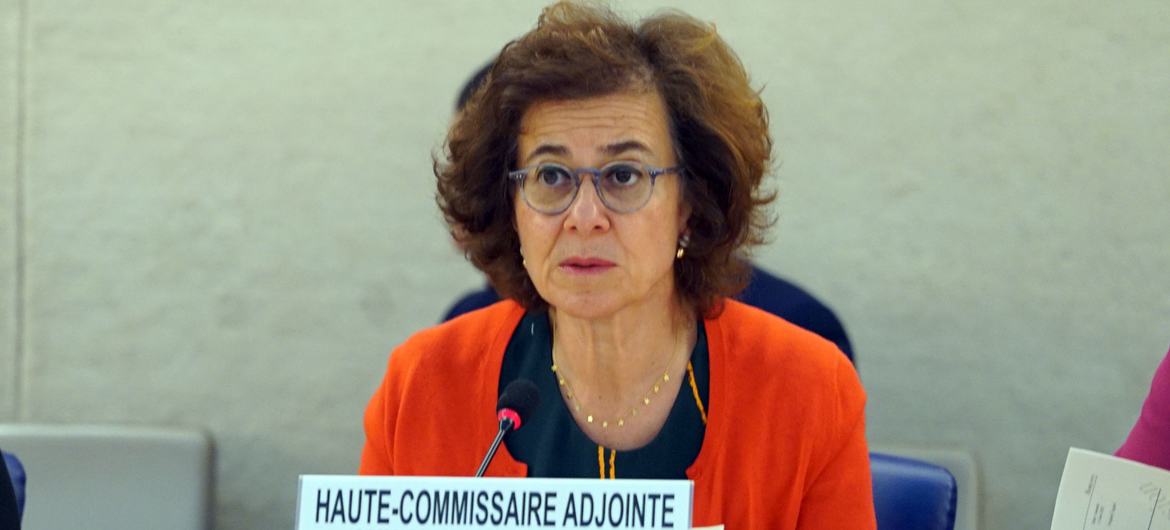
Nada Al Nashif, Deputy High Commissioner for Human Rights, addresses the Human Rights Council on Iran. UN Human Rights Council/Hongdao Yang
18 June 2025 Human Rights
On the third day of the 59th Session of the Human Rights Council (HRC), the spotlight turned to reports on rising executions in Iran and the increasing repression of civic space around the world amid a wave of elections.
At least 975 people were executed in Iran in 2024, the highest number reported since 2015, according to a report Deputy High Commissioner for Human Rights, Nada Al-Nashif, presented to the Geneva-based Council on Wednesday.
Of the total executions, just over half were for drug-related offenses, 43 per cent for murder, two per cent for sexual offenses, and three per cent for security-related charges. At least four executions were carried out publicly.
“These cases are marked by serious allegations of torture and due process violations, including lack of access to a lawyer,” said Ms. Al-Nashif.
Violence and discrimination against women
At least 31 women were reportedly executed in Iran last year, up from 22 in 2023. Of the 19 women executed for murder, nine had been convicted of killing their husbands in cases involving domestic violence or forced or child marriage, areas in which Iranian women have no legal protections.
Some executions were reportedly linked to protests that began in September 2022 under the banner “Women, Life, and Freedom.”
Beyond executions, femicide cases surged, with 179 reported in 2024 compared to 55 the year before. Many stemmed from so-called “honour” crimes or family disputes, often involving women and girls seeking divorce or rejecting marriage proposals.
Ms. Al-Nashif also warned that the suspended Chastity and Hijab Law, if enacted, would pose a serious threat to women’s rights. Penalties for violations such as improper dress could include heavy fines, travel bans, long-term imprisonment, or even the death penalty.
In addition, of the 125 journalists prosecuted in 2024, 40 were women, many reporting on human rights and women’s rights issues.
Religious and ethnic minorities
“In 2024, the death penalty continued to have a disproportionate impact on minority groups,” Ms. Al-Nashif told the Council.
At least 108 Baluchi and 84 Kurdish prisoners were executed in 2024, representing 11 and 9 per cent of the total, respectively.
The report also raised concerns over the lack of official data on the socioeconomic conditions of ethnic and ethno-religious minorities and non-citizens, which hampers efforts to assess their situation and measure the impact of targeted policies and programmes.
Looking ahead
While Iran continued engagement with the Office of the UN High Commissioner and other human rights mechanisms, it denied access to the Independent International Fact-Finding Mission on the Islamic Republic of Iran .. https://www.ohchr.org/en/hr-bodies/hrc/ffm-iran/index .
“Our Office remains ready to continue and build on its engagement with the Iranian authorities on the range of issues highlighted in the report of the Secretary-General for the promotion and protection of all human rights,” Ms. Al-Nashif concluded.
Global ‘Super Election’ cycle undermined democratic participation
In the Council’s afternoon session, Gina Romero, UN Special Rapporteur on the rights to freedom of peaceful assembly and association, presented her report on how the 2023–2025 “super election” cycle has affected civic space around the world.
In 2024, half of the world’s population elected their local, national and international representatives. While Ms. Romero’s report on this cycle does not assess the integrity of the elections, it identifies troubling global patterns of systematic repression of the exercise of peaceful assembly and association.
“The misuse of restrictive laws, smear campaigns, disinformation targeting civil society intensified globally in the super electoral cycle, undermining electoral participation and freedom of association,” she said.
Political repression and violence
As criminal justice systems are used to repress the opposition, leaders and members of political parties faced undue restrictions and political persecution. Civil society activists and election observers have also faced harassment, arbitrary detention, torture and murder.
“When political parties, civil society, and peaceful assemblies are suppressed, genuine political pluralism and competition cannot exist,” argued Ms. Romero. “I stress that these conditions are incompatible with free and genuine elections and risk legitimising undemocratic rule.”
Minority representation
Ms. Romero also underscored that women’s political leadership remains severely underrepresented, while LGBTIQ individuals and their organizations faced attacks during the super electoral cycle.
Both groups experienced physical and online political violence, restricting their electoral participation and accelerating the decline of their rights after the elections.
Calls to protect freedoms
Amid global crises and a rapid democratic decline, Ms. Romero emphasized the urgent need to protect the rights to peaceful assembly and association throughout the entire electoral cycle.
She outlined key recommendations, including strengthening legal protections before elections, ensuring accountability afterward, regulating digital technologies and promoting non-discriminatory participation throughout.
“Dissent is a fundamental element of democratic societies,” she concluded in Spanish. “Rather than being suppressed, it should be welcomed and permanently protected.”
https://news.un.org/en/story/2025/06/1164586
Repeat: Iran, Israel and The Big War | Four Corners
‘We want freedom on our own terms,’ says one Tehran resident, while another writes, ‘Someone is helping us’
William Christou, Deepa Parent and Shah Meer Baloch
Thu 19 Jun 2025 04.08 AEST

Donald Trump and Benjamin Netanyahu. On Truth Social, Trump called for Iran’s ‘UNCONDITIONAL SURRENDER!’ Composite: Chip Somodevilla/Getty/Ronen Zvulun/AP
Despite a substantial internet blackout, news spread quickly in Iran on Tuesday night: the US was considering joining Israel in its war on Iran.
The US president, Donald Trump, wrote on Truth Social: “We know exactly where the so-called ‘Supreme Leader’ is hiding. We are not going to take him out (kill!), at least not for now … Our patience is wearing thin.” Three minutes later, in a second post, he added: “UNCONDITIONAL SURRENDER!”
When Mehnaz*, a 24-year-old student activist in east Tehran, heard the news, she did not think of Iran’s supreme leader, Ayatollah Khamenei. Instead, she thought of her fellow students who were detained, shot and executed by Iranian security forces during the “woman, life, liberty” .. https://www.theguardian.com/world/2022/oct/01/women-life-liberty-iranian-civil-rights-protests-spread-worldwide .. protests in 2022.
“After Mahsa [Amini]’s death .. https://www.theguardian.com/global-development/2022/sep/23/how-iran-erupted-after-mahsa-amini-death-protests , we tried to stand up. Teenagers were shot point blank, our compatriots were hanged. We could never get rid of the Islamic Republic on our own. Now, someone from outside is helping us,” Mehnaz told the Guardian via text on Wednesday after a sleepless night of Israeli bombing.
‘You worry what’s going to come next’: Iranians brace themselves as war looms
Read more > https://www.theguardian.com/world/2025/jun/14/you-worry-whats-going-to-come-next-iranians-brace-themselves-as-war-looms
The prospect of imminent US involvement in an Israeli bombing campaign, which is suggested to be in pursuit of regime change, has laid bare deep divides in Iran’s population, even among the opposition. Many are deeply suspicious of the US’s intentions in Iran, which has a bitter history of foreign adventurism gone awry. Others do not care who is the one to topple the government.
A large portion of Iran’s population is bitterly opposed to the government, which has only grown more repressive as the country slips deeper into economic crisis. Just two weeks ago, much of Iran was paralysed by a nationwide strike in protest at the dismal economic situation.
To some of the opposition, anything that could topple the Iranian government is welcome, whether it comes from street protests or US bunker busters.
Mehnaz said: “Yes, we’ll probably have massive destruction in Tehran and other cities, but this regime will fall – and then we can rebuild everything again.”
The toll of fighting – now in its sixth day – is growing. Israeli strikes have killed at least 585 people and wounded 1,326 others in Iran, according to Iranian media. At least 24 people have been killed and 600 injured by Iranian strikes in Israel.
Fighting started after Israel launched hundreds of pre-dawn strikes on Iran last Friday, which it said were aimed at preventing the country from obtaining a nuclear weapon. Iran quickly retaliated by firing a barrage of missiles and drones at Israel, kicking off a steadily escalating tit-for-tat war.
Israel’s assumption US would get drawn into Iran war is being put to the test
Read more > https://www.theguardian.com/world/2025/jun/18/israels-iran-war-us-join-trump
To Alborz*, an athlete from Tehran, the cost of Israeli bombing was already too high.
“I can’t explain how we pass each day, in fear. It feels like I am walking on a street of hot coal and having acid rain down on me,” Alborz said via text. “We want to get our freedom on our own terms, not through US bombs,” he added.
Iran has a long history of foreign intervention that has left the population suspicious of offers of help.
A 1953 coup that deposed the democratically elected prime minister, Mohammad Mosaddegh, was backed by the CIA and MI6 to protect western oil interests .. https://www.theguardian.com/world/2020/aug/17/british-spys-account-sheds-light-on-role-in-1953-iranian-coup . The intelligence plot features heavily in the national narrative of the current government, which overthrew the western-backed Shah of Iran in the country’s 1979 revolution.
-----
[INSERT: One other thing, the damage Iran closing the strait would do to themselves .. as i said it's the last thing
they would want .. also, why would they drone-dump on NYC when we haven't drone-dropped on Tehran?
.. if we bombed them as we bombed Iraq would they then? .. i doubt it .. and in all this don't forget
the Fatah [Fatwa] by Khamanei against the development of nuclear weapons .. if it was broken it
would be a real blow to his authority .. read it while wandering but have lost that post just now ..
http://investorshub.advfn.com/boards/read_msg.aspx?message_id=70346415
and the rest in that post, and others, outlining the aggression of the West toward Iran since 1953
.. they have a legal right to enrichment for peaceful means .. many others have programs toward
becoming a ""threshold country,"" as the link above mentions, are not bothered as Iran is now ..
This was has been going on for at lest 59 years ..
1953 Iranian coup d'état
The 1953 Iranian coup d'état (known in Iran as the 28 Mordad coup) was the overthrow of the democratically elected government of Iranian Prime Minister Mohammad Mosaddegh on 19 August 1953, orchestrated by the intelligence agencies of the United Kingdom and the United States under the name TPAJAX Project. The coup saw the transition of Mohammad-Reza Shah Pahlavi from a constitutional monarch to an authoritarian one who relied heavily on United States support to hold on to power until his own overthrow in February 1979.
January 2012 -- https://investorshub.advfn.com/boards/read_msg.aspx?message_id=70448357
-----
The more recent 21st-century history of US adventurism in the Middle East has inspired further scepticism among Iranians.
“Look at Libya, Afghanistan, Iraq – they destroyed the countries, then walked away. It’s funny how they call this ‘exporting democracy’ while they always have paralysed all the democratic institutions in those countries,” Abbas*, a 26-year-old artist from west Tehran, said.
The Israeli prime minister, Benjamin Netanyahu, has called for Iran’s opposition to rise up, suggesting in an interview on Monday that his military operation could help liberate Iranians from an oppressive regime.
Netanyahu told the London-based opposition news outlet Iran International: “A light has been lit, carry it to freedom. This is the time, your hour of freedom is near, it’s happening now.”
His calls rang hollow in Iran, which has seen nightly news broadcasts of starvation, displacement and mass killings in Gaza over the last 36 months.
Abbas said: “Now Trump wants to unite with Israel – and people here are scared. If they come here like they did in other places, we will be left with nothing but ruins and extremist groups.”
While Israeli bombings have battered Iran, its security services have intensified their crackdown on dissidents and political organisation.
“Activists and former political prisoners have been rearrested. They’re basically targeting anyone who’s talking about the war,” said Bahar Ghandehari, the director of advocacy and communications at the US-based Center for Human Rights in Iran.
Iranian authorities have restricted internet access, detained activists, and on Saturday arrested 16 people on charges of “spreading rumours” on social media.
The renewed wave of oppression has hardened the desire for regime change for some of the opposition, who now find themselves having to deal not only with Israeli bombings but also fear of arrest.
“Yes, 585 people were killed in this war till now, but in four days of demonstration after Mahsa Amini’s killing, almost 1,000 people were killed by the regime,” said Mohammad Reza, a resident of Tehran in his 50s who took part in the 2022 protests.
* Names have been changed
https://www.theguardian.com/world/2025/jun/18/iranian-opposition-supporters-grapple-with-us-and-israeli-regime-change-plans
**
Iran: Government continues systematic repression and escalates surveillance to crush dissent in the aftermath of protests, UN Fact-Finding Mission says
14 March 2025
GENEVA – Two and a half years after the “Woman, Life, Freedom” protests began in September 2022, the Government of Iran continues to ramp up efforts to restrict the rights of women and girls, and others demanding human rights as part of a concerted effort to crush dissent, the UN’s Independent International Fact-Finding Mission on the Islamic Republic of Iran warned in a new report today.
These repressive measures come despite pre-election assurances by the current President Masoud Pezeshkian to ease strict enforcement of mandatory hijab laws. They involve the increased use of technology and surveillance, including through State-sponsored vigilantism, that further infringe upon women and girls’ fundamental rights.
Since April 2024, the State increased policing of, and criminal prosecution against, women defying the mandatory hijab through the adoption of the so-called “Noor plan.” Women human rights defenders and activists have continued to face criminal sanctions, including fines, lengthy prison sentences, and in some cases the death penalty for peaceful activities in support of human rights.
The report, to be presented to the Human Rights Council in Geneva on 18 March 2025, found that these measures reflect the State’s ongoing persecutory conduct aimed at supressing women and girls’ human rights, and their right to equality.
Continued - https://www.ohchr.org/en/press-releases/2025/03/iran-government-continues-systematic-repression-and-escalates-surveillance
**
Human Rights Council hears alarming updates on executions in Iran and global civic space crackdown
Nada Al Nashif, Deputy High Commissioner for Human Rights, addresses the Human Rights Council on Iran. UN Human Rights Council/Hongdao Yang
18 June 2025 Human Rights
On the third day of the 59th Session of the Human Rights Council (HRC), the spotlight turned to reports on rising executions in Iran and the increasing repression of civic space around the world amid a wave of elections.
At least 975 people were executed in Iran in 2024, the highest number reported since 2015, according to a report Deputy High Commissioner for Human Rights, Nada Al-Nashif, presented to the Geneva-based Council on Wednesday.
Of the total executions, just over half were for drug-related offenses, 43 per cent for murder, two per cent for sexual offenses, and three per cent for security-related charges. At least four executions were carried out publicly.
“These cases are marked by serious allegations of torture and due process violations, including lack of access to a lawyer,” said Ms. Al-Nashif.
Violence and discrimination against women
At least 31 women were reportedly executed in Iran last year, up from 22 in 2023. Of the 19 women executed for murder, nine had been convicted of killing their husbands in cases involving domestic violence or forced or child marriage, areas in which Iranian women have no legal protections.
Some executions were reportedly linked to protests that began in September 2022 under the banner “Women, Life, and Freedom.”
Beyond executions, femicide cases surged, with 179 reported in 2024 compared to 55 the year before. Many stemmed from so-called “honour” crimes or family disputes, often involving women and girls seeking divorce or rejecting marriage proposals.
Ms. Al-Nashif also warned that the suspended Chastity and Hijab Law, if enacted, would pose a serious threat to women’s rights. Penalties for violations such as improper dress could include heavy fines, travel bans, long-term imprisonment, or even the death penalty.
In addition, of the 125 journalists prosecuted in 2024, 40 were women, many reporting on human rights and women’s rights issues.
Religious and ethnic minorities
“In 2024, the death penalty continued to have a disproportionate impact on minority groups,” Ms. Al-Nashif told the Council.
At least 108 Baluchi and 84 Kurdish prisoners were executed in 2024, representing 11 and 9 per cent of the total, respectively.
The report also raised concerns over the lack of official data on the socioeconomic conditions of ethnic and ethno-religious minorities and non-citizens, which hampers efforts to assess their situation and measure the impact of targeted policies and programmes.
Looking ahead
While Iran continued engagement with the Office of the UN High Commissioner and other human rights mechanisms, it denied access to the Independent International Fact-Finding Mission on the Islamic Republic of Iran .. https://www.ohchr.org/en/hr-bodies/hrc/ffm-iran/index .
“Our Office remains ready to continue and build on its engagement with the Iranian authorities on the range of issues highlighted in the report of the Secretary-General for the promotion and protection of all human rights,” Ms. Al-Nashif concluded.
Global ‘Super Election’ cycle undermined democratic participation
In the Council’s afternoon session, Gina Romero, UN Special Rapporteur on the rights to freedom of peaceful assembly and association, presented her report on how the 2023–2025 “super election” cycle has affected civic space around the world.
In 2024, half of the world’s population elected their local, national and international representatives. While Ms. Romero’s report on this cycle does not assess the integrity of the elections, it identifies troubling global patterns of systematic repression of the exercise of peaceful assembly and association.
“The misuse of restrictive laws, smear campaigns, disinformation targeting civil society intensified globally in the super electoral cycle, undermining electoral participation and freedom of association,” she said.
Political repression and violence
As criminal justice systems are used to repress the opposition, leaders and members of political parties faced undue restrictions and political persecution. Civil society activists and election observers have also faced harassment, arbitrary detention, torture and murder.
“When political parties, civil society, and peaceful assemblies are suppressed, genuine political pluralism and competition cannot exist,” argued Ms. Romero. “I stress that these conditions are incompatible with free and genuine elections and risk legitimising undemocratic rule.”
Minority representation
Ms. Romero also underscored that women’s political leadership remains severely underrepresented, while LGBTIQ individuals and their organizations faced attacks during the super electoral cycle.
Both groups experienced physical and online political violence, restricting their electoral participation and accelerating the decline of their rights after the elections.
Calls to protect freedoms
Amid global crises and a rapid democratic decline, Ms. Romero emphasized the urgent need to protect the rights to peaceful assembly and association throughout the entire electoral cycle.
She outlined key recommendations, including strengthening legal protections before elections, ensuring accountability afterward, regulating digital technologies and promoting non-discriminatory participation throughout.
“Dissent is a fundamental element of democratic societies,” she concluded in Spanish. “Rather than being suppressed, it should be welcomed and permanently protected.”
https://news.un.org/en/story/2025/06/1164586
It was Plato who said, “He, O men, is the wisest, who like Socrates, knows that his wisdom is in truth worth nothing”
Discover What Traders Are Watching
Explore small cap ideas before they hit the headlines.



