



 AI
AI








Saturday, December 21, 2024 8:08:32 PM
Who are the Houthis, and why are we at war with them?
2019 - "Yemen war: Houthi withdrawal from Hudaydah met by mistrust'
Related:
The Houthis’ forgotten war goes global
https://investorshub.advfn.com/boards/read_msg.aspx?message_id=173612252
10 Conflicts to Watch in 2022
[...] 6. Yemen
Yemen’s war faded from headlines in 2021 but remains devastating and could be poised to get worse.
https://investorshub.advfn.com/boards/read_msg.aspx?message_id=168256643
The UAE in Yemen: From Surge to Recalibration
"Israel's $1.1 billion theft from Iran - UAE Deal Boosts Israeli Oil Pipeline Secretly Built With Iran
https://investorshub.advfn.com/boards/read_msg.aspx?message_id=158832044
The Saudi Regime’s Other Victims
Remember that resident Trump said that 'torture was ok', and followed that up
with .. Gina Haspel, Trump’s Choice for C.I.A., Played Role in Torture Program
https://investorshub.advfn.com/boards/read_msg.aspx?message_id=139299412
"Mohammed bin Salman's ill-advised ventures have weakened Saudi Arabia’s position in the world"
https://investorshub.advfn.com/boards/read_msg.aspx?message_id=146543608
brooklyn13, And how many not only international legal entities disagree with you on this one. Even Israeli peace groups.
https://investorshub.advfn.com/boards/read_msg.aspx?message_id=175526283&txt2find=sinwar
Bruce Riedel
December 18, 2017
[Insert: Trump prides himself with the claim he hasn't contributed to wars
when there was Yemen, and the war he fed immeasurably at home.]
Grrr...IMAGE won't work
[Houthi fighters attend the funeral of their fellow who were killed during the recent clashes in Sanaa, Yemen December 7, 2017. REUTERS /Mohammed Al-Sayaghi - RC1B26B1C800]
Read more from Markaz
https://www.brookings.edu/tags/markaz/
Read more from
The New Geopolitics of the Middle East
https://www.brookings.edu/tags/the-new-geopolitics-of-the-middle-east/
More On
International Affairs
https://www.brookings.edu/topics/international-affairs/
Sub-Topics
U.S. Foreign Policy
https://www.brookings.edu/topics/u-s-foreign-policy/
Middle East & North Africa
Sub-Topics
Gulf States Iran Saudi Arabia Yemen
Program
Foreign Policy
Center
Center for Middle East Policy Strobe Talbott Center for Security, Strategy, and Technology
For over two-and-a-half years, the United States has supported Saudi Arabia in a war against the Houthi movement in Yemen. The war has created the worst humanitarian catastrophe in the world and threatens to turn into the largest famine in decades.
Yet very few Americans know who the Houthis are, what they stand for, and why they are our de facto enemies. Two administrations have backed the war against the Houthis without a serious campaign to explain why Americans should see them as our enemies.
Yemeni politics are incredibly complex and volatile—rather than get drawn into a quagmire against an enemy they hardly know, the United States and its partners should get serious about finding a political solution.
What you need to know
First and foremost, the Houthis are Zaydi Shiites, or Zaydiyyah. Shiite Muslims are the minority community in the Islamic world and Zaydis are a minority of Shiites, significantly different in doctrine and beliefs from the Shiites who dominate in Iran, Iraq, and elsewhere (often called Twelvers for their belief in twelve Imams).
[ And there you have a simple reason why the Houthi's are "de facto" US enemies, because they are Shiites. And Iran are Shiites. And even though 15 of the 19 9/11 terrorists were Saudi .. https://www.911memorial.org/911-faqs .. Saudi's are Sunni and US friends, so Houthi's are de facto enemies of America. It's not about religion though is it. Let's say it's about religion, power and control, with religion the incidental. LOL Power, greed and religion, where would/could we be without them. Heaven? Haha.]
The Zadiyyah take their name from Zayd bin Ali, the great grandson of Ali, Muhammad’s cousin and son-in-law, whom all Shiites revere. Zayd bin Ali led an uprising against the Umayyad Empire in 740, the first dynastic empire in Islamic history, which ruled from Damascus. Zayd was martyred in his revolt, and his head is believed to be buried in a shrine to him in Kerak, Jordan. Zaydis believe he was a model of a pure caliph who should have ruled instead of the Umayyads.
The Houthis have made fighting corruption the
centerpiece of their political program, at least nominally.
The distinguishing feature of Zayd’s remembered biography is that he fought against a corrupt regime. Sunnis and Shiites agree that he was a righteous man. The Zaydi elevate him to be the epitome of a symbol of fighting corruption. The Houthis have made fighting corruption the centerpiece of their political program, at least nominally. The Zaydi do not believe in ayatollahs like the Twelver Shiites—who are the Shiite sect in Iran and most of the Muslim world—nor do they practice the other Twelver doctrine of taqqiyah (dissimulation), which permits one to disguise his or her faith for self-protection.
In short, they are a very different sect than the Iranian version of Shiism that Americans have come to know since the 1979 Iranian revolution.
Followers of Zayd established themselves in north Yemen’s rugged mountains in the ninth century. For the next thousand years, the Zaydis fought for control of Yemen with various degrees of success. A succession of Zaydi Imams ruled the community and Zaydis were the majority of the population in the mountains of the north. They fought against both the Ottomans and the Wahhabis in the 18th and 19th centuries.
With the collapse of the Ottoman Empire in 1918, a Zaydi monarchy took power in North Yemen called the Mutawakkilite Kingdom. The ruler, or imam, was both a secular ruler and a spiritual leader. Their kingdom fought and lost a border war with Saudi Arabia in the 1930s, losing territory to the Saudi state. They also enjoyed international recognition as the legitimate government of North Yemen. Their capital was in Taiz.

Source: CIA World Factbook.
In 1962, an Egyptian-backed revolutionary military cabal overthrew the Mutawakkilite king and established an Arab nationalist government with its capital in Sanaa. With Soviet assistance, Egypt sent tens of thousands of troops to back the republican coup. The Zaydi Royalists fled to the mountains along the Saudi border to fight a civil war for control of the country. Saudi Arabia supported the royalists against Egypt. Israel also clandestinely backed the Zaydi Royalists. The war ended in a republican victory after the Saudis and Egyptians resolved their regional rivalry after the 1967 war with Israel and lost interest in the Yemen civil war.
A Zaydi republican general named Ali Abdullah Saleh came to power after a succession of coups in 1978. Saleh ruled—or misruled—Yemen for the next 33 years. He united north and south Yemen in 1990, tilted toward Iraq during the 1991 Kuwait war, and survived a Saudi-backed southern civil war in 1994. He had complicated relations with both Riyadh and Washington, but by the late 1990s was generally aligned with both against al-Qaida. The al-Qaida attack on the USS Cole in late 2000 in Aden drew the Americans closer to Saleh, although his cooperation against al-Qaida was always incomplete.
The Houthis emerged as a Zaydi resistance to Saleh and his corruption in the 1990s led by a charismatic leader named Hussein al Houthi, from whom they are named. They charged Saleh with massive corruption to steal the wealth of the Arab world’s poorest country for his own family, much like other Arab dictators in Tunisia, Egypt, and Syria. They also criticized Saudi and American backing for the dictator.
2003: The tipping point
The American invasion of Iraq in 2003 deeply radicalized the Houthi movement, like it did many other Arabs. It was a pivotal moment. The Houthis adopted the slogan: “God is great, death to the U.S., death to Israel, curse the Jews, and victory for Islam,”
-----
[ Yay, the GWB 'God made me do it, Saddam has WMDs' Iraq invasion. Lies lies
lies, "deeply radicalized" much of the Arab community. Fuck, yeah!! Yahoo!!!
To the quote above, another's comment. This linked in previous post:
The rise of Yemen's Houthi rebels
Published28 February 2015
[...]
Al-Shabab al-Muminin (Believing Youth), the predecessor of Ansar Allah, was meanwhile founded by Hussein al-Houthi to revive Zaidi tradition in the face of effective proselytising among the young by Saudi-backed Wahhabis and local Salafists.
P - But it was the attack of the Saleh regime on al-Shabab al-Muminin that propelled the movement to the fore of Yemeni politics.
P - Hussein al-Houthi challenged President Saleh's legitimacy by claiming that he was weak and beholden to the United States and its "War on Terror".
P - In the context of the US-led invasion of Iraq, he chanted: "Death to America. Death to Israel. Curse the Jews. Long live Islam in the Grand Mosque of Sanaa." However, the target of the chant was Mr Saleh, not America or Israel.
https://www.bbc.com/news/world-middle-east-31645145 ]
-----
in the wake of the U.S.-led invasion of Iraq. The group also officially called itself Ansar Allah, or supporters of God. It was a turning point largely unrecognized outside Yemen, another unanticipated consequence of George Bush’s Iraq adventures.
-----
[ Unanticipated. Although it was easily anticipated by all those in opposition to the invasion.
And no this is not 'easy in hindsight', it was anticipated by millions of us then.
Back to Ansar Allah, more from the link above: The rise of Yemen's Houthi rebels
Published 28 February 2015
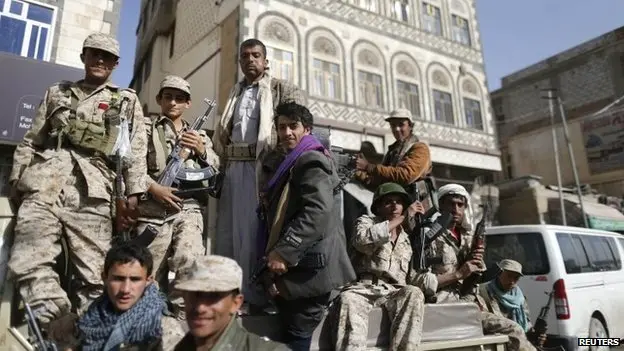
Reuters
By Charles Schmitz
Towson University
P - Ansar Allah (Partisans of God), which is also known as the Houthi movement, has experienced several major transformations in arriving at its current dominant position in Yemeni politics.
P - It began in the 1990s as a youth-orientated revivalist movement that wanted to defend the religious traditions of a branch of Shia Islam known as Zaidism.
P - By the 2000s, it was leading a stubborn military insurgency that enveloped tribal politics in the far northern governorate of Saada. Its objective was to defend itself and its allies against President Ali Abdullah Saleh's military.
P - When the Arab Spring began in 2011, Ansar Allah was a welcome supporter of the peaceful protests against Mr Saleh and actively participated in the National Dialogue that followed his fall. The group backed regional autonomy, respect for diversity, and the strengthening of a democratic state.
https://www.bbc.com/news/world-middle-east-31645145 ]
-----
Hezbollah, the Shiite movement in Lebanon which successfully expelled the Israeli army from the country, became a role model and mentor for the Houthis. Although different kinds of Shiites, the two groups have a natural attraction. Hezbollah provided inspiration and expertise for the Houthis. Iran was a secondary source of support, especially since the Houthis and Iranians share a common enemy in Saudi Arabia.
After 2003, Saleh launched a series of military campaigns to destroy the Houthis. In 2004, Saleh’s forces killed Hussein al Houthi. The Yemeni army and air force was used to suppress the rebellion in the far north of Yemen, especially in Saada province. The Saudis joined with Saleh in these campaigns. The Houthis won against both Saleh and the Saudi army, besting them both again and again. For the Saudis, who have spent tens of billions of dollars on their military, it was deeply humiliating.
The Houthis won against both Saleh and the Saudi army,
besting them both again and again.
The Arab Spring came to Yemen in 2011. The Houthi movement was one part of the wide national uprising against Saleh. It was primarily concerned with advancing the narrow interests of the Zaydi community, not surprisingly. When Saleh was replaced by a Sunni from the south—Abdrabbuh Mansour Hadi, who had been Saleh’s vice president at the behest of the Saudis—the Houthi response was predictable. They were critical of the process and of Hadi.
A national dialogue was instituted to address the future of Yemen after Saleh, with regional and international assistance. It proposed a federal solution with six provinces with some autonomy. The Zaydi-dominated north got two landlocked entities, which the Houthis argued was gerrymandered against them.
In 2014, they began colluding with Saleh against Hadi secretly. Even by the standards of Middle East politics, it was a remarkable and hypocritical reversal of alliances by both the Houthis and Saleh. Much of the army remained loyal to Saleh and his family, so together with the Houthis the two had a preponderance of force in the country. Hadi was deeply unpopular and seen as a Saudi stooge.
The war
After months of gradually moving into the capital Sanaa, it fell to the rebel alliance in January 2015, just as King Salman ascended to the throne in Riyadh. The Houthis opened direct civilian air traffic between Sanaa and Tehran, Iran promised cheap oil for Yemen, and rumors of more Iran-Houthi cooperation spread quickly. The main port at Hodeidah fell to the Houthi forces and they began marching to take Aden, the capital of the south and the largest port on the Indian Ocean.
For the Saudi king and his 29-year-old defense minister and son Prince Muhammad bin Salman (MBS), it was a nightmare. A traditional enemy with ties to their regional foe was taking over the country on their southern belly. The strategic straits at the Bab al Mandab could be in the Houthis’ hands. It was a very difficult challenge for an untried team in the royal palace.
-----
[Bit from a 2nd article linked in the previous post: Yemen: Why is the war there getting more violent?
Published14 April 2023
[...]
How did the war start?
In 2011, a popular uprising in Yemen forced its long-standing authoritarian president, Ali Abdullah Saleh, to hand over power to his deputy, Abdrabbuh Mansour Hadi.
P - However, the new president was overwhelmed with Yemen's economic problems, and security problems such as attacks by jihadists. Furthermore, most of Yemen's armed forces felt more loyalty to the ousted president than they did to Mr Hadi.
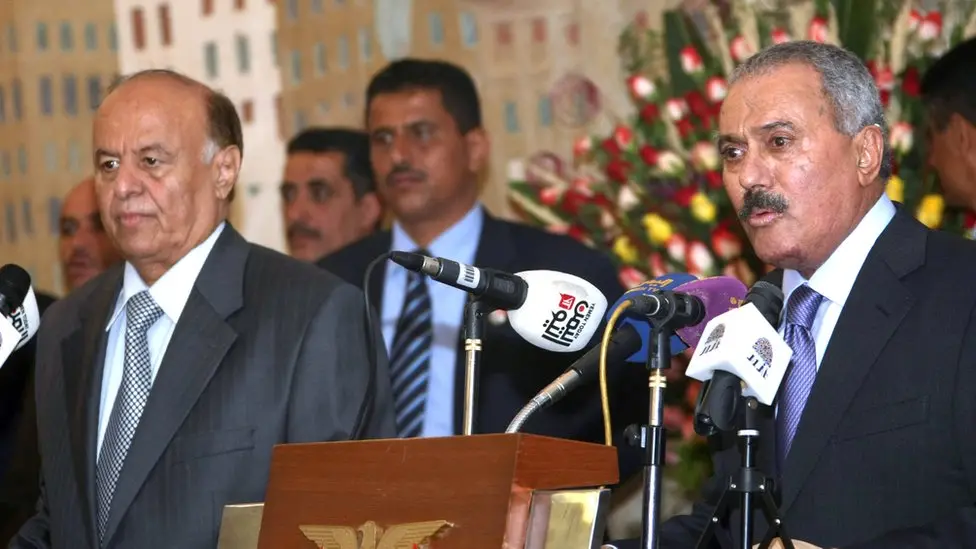
Ali Abdullah Saleh (R) was forced to hand over power to Abdrabbuh Mansour Hadi (L) AFP
The Houthis took advantage of his weakness.
P - Formally known as the Ansar Allah (Partisans of God), they champion Yemen's Zaidi Shia Muslim minority.
P - In early 2014, they seized control of Saada province, in the north of the country and then captured the nation's capital, Sanaa, forcing President Hadi to flee abroad in March 2015.
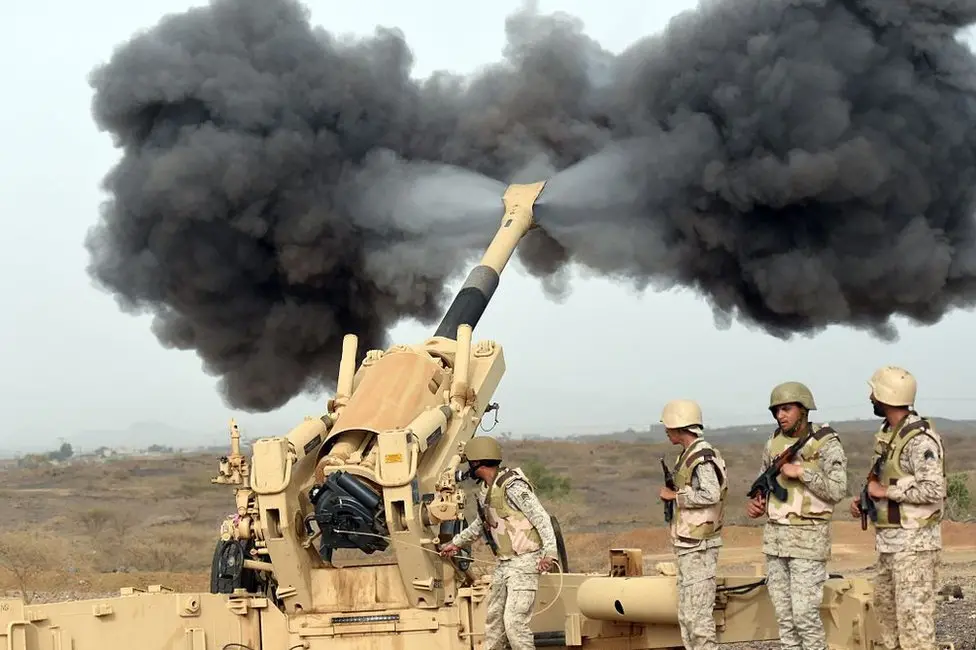
A Saudi-led multinational coalition intervened in the conflict in Yemen in March 2015
P - Yemen's neighbour Saudi Arabia was alarmed by the prospect of the Houthis taking
control of Yemen, fearing it would become a satellite of Saudi Arabia's rival, Iran.
P - In March 2015, it and other Arab states began an air campaign aimed at ousting the Houthis and restoring Mr Hadi's government.
P - The coalition received logistical and intelligence support from the US, UK and France.
https://www.bbc.com/news/world-middle-east-29319423 ]
-----
For the Obama administration, the picture was more complicated. American intelligence officials said that Iran .. https://www.al-monitor.com/pulse/en/originals/2015/01/yemen-houthis-obama-administration.html .. was actually trying to discourage the Houthis from seizing Sanaa and openly toppling Hadi. Iran preferred a less radical course, but the Houthi leadership was drunk with success. Moreover, Undersecretary of Defense Michael Vickers said on the record in January .. https://www.al-monitor.com/pulse/originals/2015/01/yemen-houthis-obama-administration.html .. that Washington had a productive informal intelligence relationship with the Houthis against al-Qaida. He suggested that the cooperation could continue.
The Saudis chose to go to war to support Hadi and prevent the Houthi-Saleh rebellion from consolidating control of the country. Operation Decisive Storm began in March 2015, MBS taking the public lead in promising early victory for the Saudis. They forged a coalition to back them including the United Arab Emirates, Bahrain, and other traditional Saudi allies. Two refused to join: Oman, Yemen’s neighbor, and Pakistan, whose parliament voted unanimously against the war.
Obama backed the Saudi war. In the choice between the Saudi ally and the Houthis, the president—not surprisingly—took the side of a 70-year old alliance. U.S. and U.K. support is essential to the Royal Saudi Air Force (RSAF), which is equipped with American and British aircraft. The RSAF has dropped tons of American and British munitions on Yemen since.

Almost three years later, the Saudi air and naval blockade of Houthi-controlled territory has created a humanitarian disaster, with millions of Yemenis at dire risk of starvation and disease. The Saudi-led coalition has tightened the blockade and gradually gained more territory, although Hadi has little if any control over the territory recovered from the rebels. He resides in Riyadh. All sides are credibly accused of war crimes.
Saleh broke with his putative ally this month, signaled to Riyadh that he was flipping sides again, and was killed days later .. https://www.brookings.edu/blog/markaz/2017/12/06/in-yemen-iran-outsmarts-saudi-arabia-again/ . The Houthis won the battle for Sanaa but are isolated from the rest of Yemeni politics and political parties. Riyadh portrays them as Iranian puppets, but many Yemenis see them as patriots fighting the country’s traditional enemy Saudi Arabia and America, Israel’s defender. Houthi propaganda plays to the line that Yemen is under attack by a Saudi-American-Israeli conspiracy.
A major consequence of the war is to push the Houthis and Iran and Hezbollah closer together. U.S. Ambassador to the U.N. Nikki Haley underscored that point, perhaps unintentionally, when she presented compelling evidence .. http://www.cnn.com/2017/12/14/politics/haley-us-evidence-iran-yemen-rebels/index.html .. of Iranian support for the Houthis missile attacks on Saudi and Emirati targets last week. With their own cities under constant aerial bombardment, the Houthis are firing missiles
[ brooklyn13, Gee, a missile. That said it's good no one was killed. Yeah, Yemen, another area in
which peace could have been negotiated and maintained if all actors were more fucking fairly minded.
https://investorshub.advfn.com/boards/read_msg.aspx?message_id=175565521]
at Riyadh and Abu Dhabi, with Tehran’s technological assistance. The war costs Tehran a few million dollars per month, while it costs Riyadh $6 billion per month.
Tehran and the Houthis are playing with fire, of course. If a missile hits Riyadh, Jeddah, or Abu Dhabi and kills dozens or more, the pressure for retaliation against Iran will be significant. The Trump administration is poorly designed to provide cooling counsel.
This brief and simplified account of the background of the Houthis should underscore how complex Yemeni politics are and how volatile they can be. Saleh called running Yemen to be akin to dancing on the heads of snakes. It is a foolish place for Americans to be drawn into a war and a quagmire against an enemy they hardly know. The administration has recently called for an easing of the blockade. It’s time to get serious about a political solution, not to wade deeper into quicksand.
Related Content
The Houthis have won in Yemen: What next?
Bruce Riedel February 1, 2022
https://www.brookings.edu/articles/the-houthis-have-won-in-yemen-what-next/
A pragmatic view on Yemen’s Houthis
Bruce Riedel January 11, 2021
https://www.brookings.edu/articles/a-pragmatic-view-on-yemens-houthis/
Saudi Arabia and the United Arab Emirates have a disastrous Yemen strategy
A man stands next to cars damaged by an air strike in Amran, Yemen June 25, 2018. REUTERS/Khaled Abdullah TPX IMAGES OF THE DAY - RC1FAE9C8CC0
Yemen
Saudi Arabia and the United Arab Emirates have a disastrous Yemen strategy
Daniel L. Byman July 17, 2018
https://www.brookings.edu/articles/saudi-arabia-and-the-united-arab-emirates-have-a-disastrous-yemen-strategy/
Author Bruce Riedel
Senior Fellow - Foreign Policy, Center for Middle East Policy, Strobe Talbott Center for Security, Strategy, and Technology
https://www.brookings.edu/articles/who-are-the-houthis-and-why-are-we-at-war-with-them/
2019 - "Yemen war: Houthi withdrawal from Hudaydah met by mistrust'
Related:
The Houthis’ forgotten war goes global
https://investorshub.advfn.com/boards/read_msg.aspx?message_id=173612252
10 Conflicts to Watch in 2022
[...] 6. Yemen
Yemen’s war faded from headlines in 2021 but remains devastating and could be poised to get worse.
https://investorshub.advfn.com/boards/read_msg.aspx?message_id=168256643
The UAE in Yemen: From Surge to Recalibration
"Israel's $1.1 billion theft from Iran - UAE Deal Boosts Israeli Oil Pipeline Secretly Built With Iran
https://investorshub.advfn.com/boards/read_msg.aspx?message_id=158832044
The Saudi Regime’s Other Victims
Remember that resident Trump said that 'torture was ok', and followed that up
with .. Gina Haspel, Trump’s Choice for C.I.A., Played Role in Torture Program
https://investorshub.advfn.com/boards/read_msg.aspx?message_id=139299412
"Mohammed bin Salman's ill-advised ventures have weakened Saudi Arabia’s position in the world"
https://investorshub.advfn.com/boards/read_msg.aspx?message_id=146543608
brooklyn13, And how many not only international legal entities disagree with you on this one. Even Israeli peace groups.
https://investorshub.advfn.com/boards/read_msg.aspx?message_id=175526283&txt2find=sinwar
Bruce Riedel
December 18, 2017
[Insert: Trump prides himself with the claim he hasn't contributed to wars
when there was Yemen, and the war he fed immeasurably at home.]
Grrr...IMAGE won't work
[Houthi fighters attend the funeral of their fellow who were killed during the recent clashes in Sanaa, Yemen December 7, 2017. REUTERS /Mohammed Al-Sayaghi - RC1B26B1C800]
Read more from Markaz
https://www.brookings.edu/tags/markaz/
Read more from
The New Geopolitics of the Middle East
https://www.brookings.edu/tags/the-new-geopolitics-of-the-middle-east/
More On
International Affairs
https://www.brookings.edu/topics/international-affairs/
Sub-Topics
U.S. Foreign Policy
https://www.brookings.edu/topics/u-s-foreign-policy/
Middle East & North Africa
Sub-Topics
Gulf States Iran Saudi Arabia Yemen
Program
Foreign Policy
Center
Center for Middle East Policy Strobe Talbott Center for Security, Strategy, and Technology
For over two-and-a-half years, the United States has supported Saudi Arabia in a war against the Houthi movement in Yemen. The war has created the worst humanitarian catastrophe in the world and threatens to turn into the largest famine in decades.
Yet very few Americans know who the Houthis are, what they stand for, and why they are our de facto enemies. Two administrations have backed the war against the Houthis without a serious campaign to explain why Americans should see them as our enemies.
Yemeni politics are incredibly complex and volatile—rather than get drawn into a quagmire against an enemy they hardly know, the United States and its partners should get serious about finding a political solution.
What you need to know
First and foremost, the Houthis are Zaydi Shiites, or Zaydiyyah. Shiite Muslims are the minority community in the Islamic world and Zaydis are a minority of Shiites, significantly different in doctrine and beliefs from the Shiites who dominate in Iran, Iraq, and elsewhere (often called Twelvers for their belief in twelve Imams).
[ And there you have a simple reason why the Houthi's are "de facto" US enemies, because they are Shiites. And Iran are Shiites. And even though 15 of the 19 9/11 terrorists were Saudi .. https://www.911memorial.org/911-faqs .. Saudi's are Sunni and US friends, so Houthi's are de facto enemies of America. It's not about religion though is it. Let's say it's about religion, power and control, with religion the incidental. LOL Power, greed and religion, where would/could we be without them. Heaven? Haha.]
The Zadiyyah take their name from Zayd bin Ali, the great grandson of Ali, Muhammad’s cousin and son-in-law, whom all Shiites revere. Zayd bin Ali led an uprising against the Umayyad Empire in 740, the first dynastic empire in Islamic history, which ruled from Damascus. Zayd was martyred in his revolt, and his head is believed to be buried in a shrine to him in Kerak, Jordan. Zaydis believe he was a model of a pure caliph who should have ruled instead of the Umayyads.
The Houthis have made fighting corruption the
centerpiece of their political program, at least nominally.
The distinguishing feature of Zayd’s remembered biography is that he fought against a corrupt regime. Sunnis and Shiites agree that he was a righteous man. The Zaydi elevate him to be the epitome of a symbol of fighting corruption. The Houthis have made fighting corruption the centerpiece of their political program, at least nominally. The Zaydi do not believe in ayatollahs like the Twelver Shiites—who are the Shiite sect in Iran and most of the Muslim world—nor do they practice the other Twelver doctrine of taqqiyah (dissimulation), which permits one to disguise his or her faith for self-protection.
In short, they are a very different sect than the Iranian version of Shiism that Americans have come to know since the 1979 Iranian revolution.
Followers of Zayd established themselves in north Yemen’s rugged mountains in the ninth century. For the next thousand years, the Zaydis fought for control of Yemen with various degrees of success. A succession of Zaydi Imams ruled the community and Zaydis were the majority of the population in the mountains of the north. They fought against both the Ottomans and the Wahhabis in the 18th and 19th centuries.
With the collapse of the Ottoman Empire in 1918, a Zaydi monarchy took power in North Yemen called the Mutawakkilite Kingdom. The ruler, or imam, was both a secular ruler and a spiritual leader. Their kingdom fought and lost a border war with Saudi Arabia in the 1930s, losing territory to the Saudi state. They also enjoyed international recognition as the legitimate government of North Yemen. Their capital was in Taiz.

Source: CIA World Factbook.
In 1962, an Egyptian-backed revolutionary military cabal overthrew the Mutawakkilite king and established an Arab nationalist government with its capital in Sanaa. With Soviet assistance, Egypt sent tens of thousands of troops to back the republican coup. The Zaydi Royalists fled to the mountains along the Saudi border to fight a civil war for control of the country. Saudi Arabia supported the royalists against Egypt. Israel also clandestinely backed the Zaydi Royalists. The war ended in a republican victory after the Saudis and Egyptians resolved their regional rivalry after the 1967 war with Israel and lost interest in the Yemen civil war.
A Zaydi republican general named Ali Abdullah Saleh came to power after a succession of coups in 1978. Saleh ruled—or misruled—Yemen for the next 33 years. He united north and south Yemen in 1990, tilted toward Iraq during the 1991 Kuwait war, and survived a Saudi-backed southern civil war in 1994. He had complicated relations with both Riyadh and Washington, but by the late 1990s was generally aligned with both against al-Qaida. The al-Qaida attack on the USS Cole in late 2000 in Aden drew the Americans closer to Saleh, although his cooperation against al-Qaida was always incomplete.
The Houthis emerged as a Zaydi resistance to Saleh and his corruption in the 1990s led by a charismatic leader named Hussein al Houthi, from whom they are named. They charged Saleh with massive corruption to steal the wealth of the Arab world’s poorest country for his own family, much like other Arab dictators in Tunisia, Egypt, and Syria. They also criticized Saudi and American backing for the dictator.
2003: The tipping point
The American invasion of Iraq in 2003 deeply radicalized the Houthi movement, like it did many other Arabs. It was a pivotal moment. The Houthis adopted the slogan: “God is great, death to the U.S., death to Israel, curse the Jews, and victory for Islam,”
-----
[ Yay, the GWB 'God made me do it, Saddam has WMDs' Iraq invasion. Lies lies
lies, "deeply radicalized" much of the Arab community. Fuck, yeah!! Yahoo!!!
To the quote above, another's comment. This linked in previous post:
The rise of Yemen's Houthi rebels
Published28 February 2015
[...]
Al-Shabab al-Muminin (Believing Youth), the predecessor of Ansar Allah, was meanwhile founded by Hussein al-Houthi to revive Zaidi tradition in the face of effective proselytising among the young by Saudi-backed Wahhabis and local Salafists.
P - But it was the attack of the Saleh regime on al-Shabab al-Muminin that propelled the movement to the fore of Yemeni politics.
P - Hussein al-Houthi challenged President Saleh's legitimacy by claiming that he was weak and beholden to the United States and its "War on Terror".
P - In the context of the US-led invasion of Iraq, he chanted: "Death to America. Death to Israel. Curse the Jews. Long live Islam in the Grand Mosque of Sanaa." However, the target of the chant was Mr Saleh, not America or Israel.
https://www.bbc.com/news/world-middle-east-31645145 ]
-----
in the wake of the U.S.-led invasion of Iraq. The group also officially called itself Ansar Allah, or supporters of God. It was a turning point largely unrecognized outside Yemen, another unanticipated consequence of George Bush’s Iraq adventures.
-----
[ Unanticipated. Although it was easily anticipated by all those in opposition to the invasion.
And no this is not 'easy in hindsight', it was anticipated by millions of us then.
Back to Ansar Allah, more from the link above: The rise of Yemen's Houthi rebels
Published 28 February 2015
Reuters
By Charles Schmitz
Towson University
P - Ansar Allah (Partisans of God), which is also known as the Houthi movement, has experienced several major transformations in arriving at its current dominant position in Yemeni politics.
P - It began in the 1990s as a youth-orientated revivalist movement that wanted to defend the religious traditions of a branch of Shia Islam known as Zaidism.
P - By the 2000s, it was leading a stubborn military insurgency that enveloped tribal politics in the far northern governorate of Saada. Its objective was to defend itself and its allies against President Ali Abdullah Saleh's military.
P - When the Arab Spring began in 2011, Ansar Allah was a welcome supporter of the peaceful protests against Mr Saleh and actively participated in the National Dialogue that followed his fall. The group backed regional autonomy, respect for diversity, and the strengthening of a democratic state.
https://www.bbc.com/news/world-middle-east-31645145 ]
-----
Hezbollah, the Shiite movement in Lebanon which successfully expelled the Israeli army from the country, became a role model and mentor for the Houthis. Although different kinds of Shiites, the two groups have a natural attraction. Hezbollah provided inspiration and expertise for the Houthis. Iran was a secondary source of support, especially since the Houthis and Iranians share a common enemy in Saudi Arabia.
After 2003, Saleh launched a series of military campaigns to destroy the Houthis. In 2004, Saleh’s forces killed Hussein al Houthi. The Yemeni army and air force was used to suppress the rebellion in the far north of Yemen, especially in Saada province. The Saudis joined with Saleh in these campaigns. The Houthis won against both Saleh and the Saudi army, besting them both again and again. For the Saudis, who have spent tens of billions of dollars on their military, it was deeply humiliating.
The Houthis won against both Saleh and the Saudi army,
besting them both again and again.
The Arab Spring came to Yemen in 2011. The Houthi movement was one part of the wide national uprising against Saleh. It was primarily concerned with advancing the narrow interests of the Zaydi community, not surprisingly. When Saleh was replaced by a Sunni from the south—Abdrabbuh Mansour Hadi, who had been Saleh’s vice president at the behest of the Saudis—the Houthi response was predictable. They were critical of the process and of Hadi.
A national dialogue was instituted to address the future of Yemen after Saleh, with regional and international assistance. It proposed a federal solution with six provinces with some autonomy. The Zaydi-dominated north got two landlocked entities, which the Houthis argued was gerrymandered against them.
In 2014, they began colluding with Saleh against Hadi secretly. Even by the standards of Middle East politics, it was a remarkable and hypocritical reversal of alliances by both the Houthis and Saleh. Much of the army remained loyal to Saleh and his family, so together with the Houthis the two had a preponderance of force in the country. Hadi was deeply unpopular and seen as a Saudi stooge.
The war
After months of gradually moving into the capital Sanaa, it fell to the rebel alliance in January 2015, just as King Salman ascended to the throne in Riyadh. The Houthis opened direct civilian air traffic between Sanaa and Tehran, Iran promised cheap oil for Yemen, and rumors of more Iran-Houthi cooperation spread quickly. The main port at Hodeidah fell to the Houthi forces and they began marching to take Aden, the capital of the south and the largest port on the Indian Ocean.
For the Saudi king and his 29-year-old defense minister and son Prince Muhammad bin Salman (MBS), it was a nightmare. A traditional enemy with ties to their regional foe was taking over the country on their southern belly. The strategic straits at the Bab al Mandab could be in the Houthis’ hands. It was a very difficult challenge for an untried team in the royal palace.
-----
[Bit from a 2nd article linked in the previous post: Yemen: Why is the war there getting more violent?
Published14 April 2023
[...]
How did the war start?
In 2011, a popular uprising in Yemen forced its long-standing authoritarian president, Ali Abdullah Saleh, to hand over power to his deputy, Abdrabbuh Mansour Hadi.
P - However, the new president was overwhelmed with Yemen's economic problems, and security problems such as attacks by jihadists. Furthermore, most of Yemen's armed forces felt more loyalty to the ousted president than they did to Mr Hadi.
Ali Abdullah Saleh (R) was forced to hand over power to Abdrabbuh Mansour Hadi (L) AFP
The Houthis took advantage of his weakness.
P - Formally known as the Ansar Allah (Partisans of God), they champion Yemen's Zaidi Shia Muslim minority.
P - In early 2014, they seized control of Saada province, in the north of the country and then captured the nation's capital, Sanaa, forcing President Hadi to flee abroad in March 2015.
A Saudi-led multinational coalition intervened in the conflict in Yemen in March 2015
P - Yemen's neighbour Saudi Arabia was alarmed by the prospect of the Houthis taking
control of Yemen, fearing it would become a satellite of Saudi Arabia's rival, Iran.
P - In March 2015, it and other Arab states began an air campaign aimed at ousting the Houthis and restoring Mr Hadi's government.
P - The coalition received logistical and intelligence support from the US, UK and France.
https://www.bbc.com/news/world-middle-east-29319423 ]
-----
For the Obama administration, the picture was more complicated. American intelligence officials said that Iran .. https://www.al-monitor.com/pulse/en/originals/2015/01/yemen-houthis-obama-administration.html .. was actually trying to discourage the Houthis from seizing Sanaa and openly toppling Hadi. Iran preferred a less radical course, but the Houthi leadership was drunk with success. Moreover, Undersecretary of Defense Michael Vickers said on the record in January .. https://www.al-monitor.com/pulse/originals/2015/01/yemen-houthis-obama-administration.html .. that Washington had a productive informal intelligence relationship with the Houthis against al-Qaida. He suggested that the cooperation could continue.
The Saudis chose to go to war to support Hadi and prevent the Houthi-Saleh rebellion from consolidating control of the country. Operation Decisive Storm began in March 2015, MBS taking the public lead in promising early victory for the Saudis. They forged a coalition to back them including the United Arab Emirates, Bahrain, and other traditional Saudi allies. Two refused to join: Oman, Yemen’s neighbor, and Pakistan, whose parliament voted unanimously against the war.
Obama backed the Saudi war. In the choice between the Saudi ally and the Houthis, the president—not surprisingly—took the side of a 70-year old alliance. U.S. and U.K. support is essential to the Royal Saudi Air Force (RSAF), which is equipped with American and British aircraft. The RSAF has dropped tons of American and British munitions on Yemen since.

Almost three years later, the Saudi air and naval blockade of Houthi-controlled territory has created a humanitarian disaster, with millions of Yemenis at dire risk of starvation and disease. The Saudi-led coalition has tightened the blockade and gradually gained more territory, although Hadi has little if any control over the territory recovered from the rebels. He resides in Riyadh. All sides are credibly accused of war crimes.
Saleh broke with his putative ally this month, signaled to Riyadh that he was flipping sides again, and was killed days later .. https://www.brookings.edu/blog/markaz/2017/12/06/in-yemen-iran-outsmarts-saudi-arabia-again/ . The Houthis won the battle for Sanaa but are isolated from the rest of Yemeni politics and political parties. Riyadh portrays them as Iranian puppets, but many Yemenis see them as patriots fighting the country’s traditional enemy Saudi Arabia and America, Israel’s defender. Houthi propaganda plays to the line that Yemen is under attack by a Saudi-American-Israeli conspiracy.
A major consequence of the war is to push the Houthis and Iran and Hezbollah closer together. U.S. Ambassador to the U.N. Nikki Haley underscored that point, perhaps unintentionally, when she presented compelling evidence .. http://www.cnn.com/2017/12/14/politics/haley-us-evidence-iran-yemen-rebels/index.html .. of Iranian support for the Houthis missile attacks on Saudi and Emirati targets last week. With their own cities under constant aerial bombardment, the Houthis are firing missiles
[ brooklyn13, Gee, a missile. That said it's good no one was killed. Yeah, Yemen, another area in
which peace could have been negotiated and maintained if all actors were more fucking fairly minded.
https://investorshub.advfn.com/boards/read_msg.aspx?message_id=175565521]
at Riyadh and Abu Dhabi, with Tehran’s technological assistance. The war costs Tehran a few million dollars per month, while it costs Riyadh $6 billion per month.
Tehran and the Houthis are playing with fire, of course. If a missile hits Riyadh, Jeddah, or Abu Dhabi and kills dozens or more, the pressure for retaliation against Iran will be significant. The Trump administration is poorly designed to provide cooling counsel.
This brief and simplified account of the background of the Houthis should underscore how complex Yemeni politics are and how volatile they can be. Saleh called running Yemen to be akin to dancing on the heads of snakes. It is a foolish place for Americans to be drawn into a war and a quagmire against an enemy they hardly know. The administration has recently called for an easing of the blockade. It’s time to get serious about a political solution, not to wade deeper into quicksand.
Related Content
The Houthis have won in Yemen: What next?
Bruce Riedel February 1, 2022
https://www.brookings.edu/articles/the-houthis-have-won-in-yemen-what-next/
A pragmatic view on Yemen’s Houthis
Bruce Riedel January 11, 2021
https://www.brookings.edu/articles/a-pragmatic-view-on-yemens-houthis/
Saudi Arabia and the United Arab Emirates have a disastrous Yemen strategy
A man stands next to cars damaged by an air strike in Amran, Yemen June 25, 2018. REUTERS/Khaled Abdullah TPX IMAGES OF THE DAY - RC1FAE9C8CC0
Yemen
Saudi Arabia and the United Arab Emirates have a disastrous Yemen strategy
Daniel L. Byman July 17, 2018
https://www.brookings.edu/articles/saudi-arabia-and-the-united-arab-emirates-have-a-disastrous-yemen-strategy/
Author Bruce Riedel
Senior Fellow - Foreign Policy, Center for Middle East Policy, Strobe Talbott Center for Security, Strategy, and Technology
https://www.brookings.edu/articles/who-are-the-houthis-and-why-are-we-at-war-with-them/
It was Plato who said, “He, O men, is the wisest, who like Socrates, knows that his wisdom is in truth worth nothing”
Discover What Traders Are Watching
Explore small cap ideas before they hit the headlines.



