



 AI
AI








Tuesday, November 19, 2024 8:08:03 PM
How disinformation defined the 2024 election narrative
Why Does No One Understand the Real Reason Trump Won?
"[...]It doesn't matter what the policies are or what the facts, numbers, and graphs say or show. It all just boils down to the perceptions gained from the traitors planned and orchestrated DISINFORMATION and Russian style Propaganda War. With their suppression of votes, billions$ of corruption, using lawfare against democracy, draining $$'s, resources, and time (using our citizens paid for court systems against us), and continuing culture wars of hate to divide and conquer are some of the forces we need to deal with." [my emphasis]
It wasn’t the economy. It wasn’t inflation, or anything else. It was how people perceive
those things, which points to one overpowering answer.
Darrell M. West
November 7, 2024
* In a situation where public confidence in news reporters is very low and new generative AI tools make it easy to create and disseminate fake pictures, videos, and narratives, the 2024 campaign was rife with organized efforts to sway voters, twist perceptions, and make people believe negative material about various candidates.
* One video featured a Haitian man (although he was not really Haitian) saying he had just gotten to the United States and had voted in two counties—Gwinnett and Fulton—in Georgia, but it turned out to be a fake video made in Russia.
* Polling data suggest that false claims affected how people saw the candidates, their views about leading issues such as the economy, immigration, and crime, and the way the news media covered the campaign.
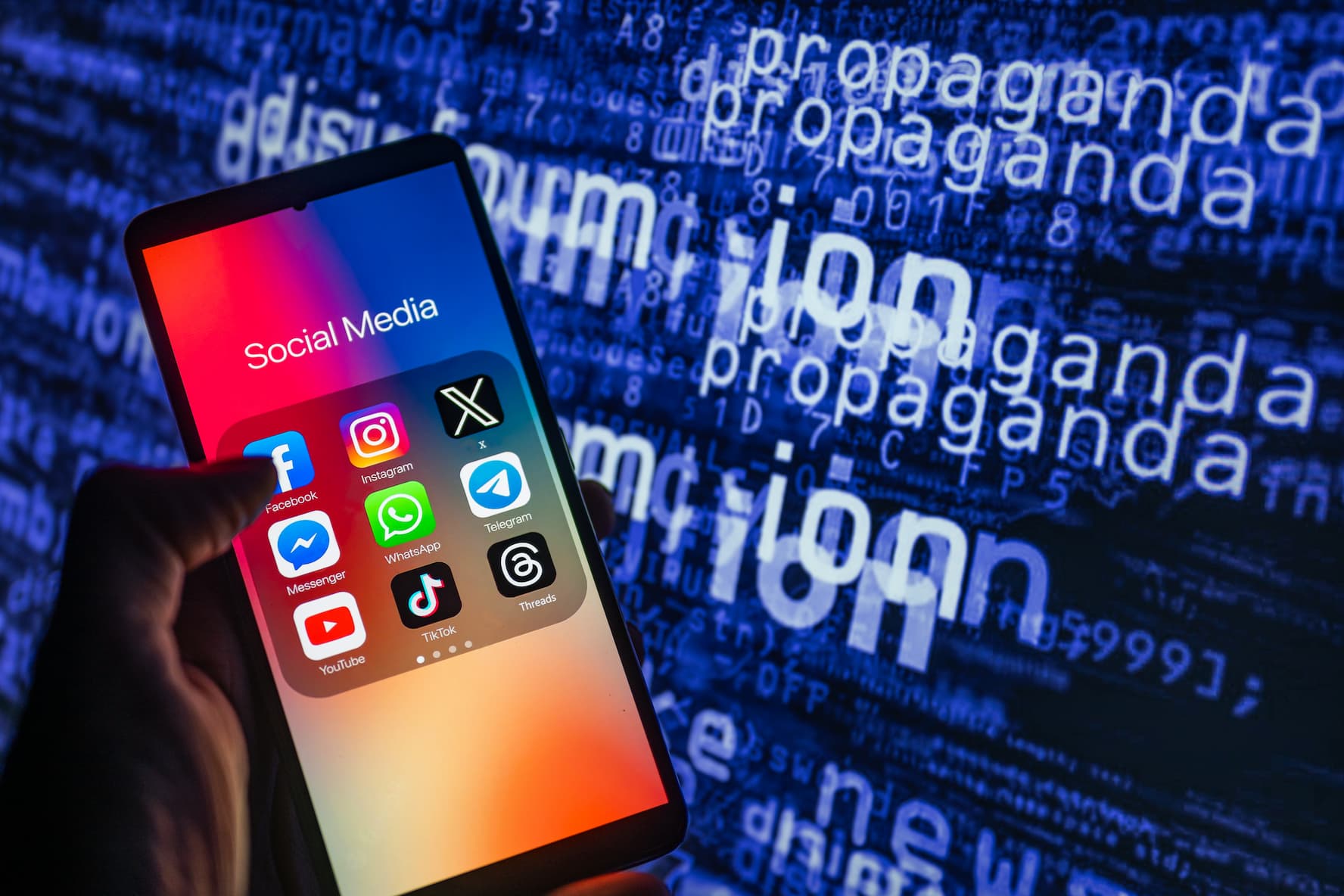
Social media icons logo displayed on a smartphone with disinformation on screen seen in the background of this photo illustration taken on October 15, 2023. Jonathan Raa/NurPhoto
Contact
Governance Studies Media Office
gsmedia@brookings.edu
202.540.7724
There are many reasons for the stunning election victories of Donald Trump and congressional Republicans: inflation fears, concerns about border security, worries about cultural issues related to race, gender, and sexuality, and feelings that President Joe Biden and the country as a whole were headed in the wrong direction. As my colleague Bill Galston persuasively has argued, people’s judgements .. https://www.brookings.edu/articles/why-donald-trump-won-and-kamala-harris-lost-an-early-analysis-of-the-results/?utm_campaign=Brookings%20Brief&utm_medium=email&utm_content=332763499&utm_source=hs_email .. about inflation and immigration were harsh during this election season, and these views harmed their assessments of Kamala Harris and strengthened the case for Trump.
But we can’t ignore the ways in which disinformation shaped views about the candidates, affected how voters saw leader performance, and generated widespread media attention. As Elaine Kamarck and I argue in our Brookings Press book “Lies That Kill: A Citizen’s Guide to Disinformation,” there are systematic and organized efforts to shape public opinion in many areas, from public health and climate change to race relations.
So, we shouldn’t be surprised that the same thing happened during the 2024 election. Campaign examples this fall include the infamous stories about immigrants eating cats and dogs, hurricane disaster relief funding going to undocumented immigrants, Kamala Harris in a swimsuit hugging convicted sex offender Jeffrey Epstein, and the supposed case of Tim Walz abusing a young man 30 years ago. Disinformation flowed into our info-ecosystem from other countries as well. One video featured a Haitian man (although he was not really Haitian) saying he had just gotten to the United States and had voted in two counties—Gwinnett and Fulton—in Georgia, but it turned out to be a fake video made in Russia.
These and other efforts were successful in shaping the campaign narrative because they were disseminated broadly on social media platforms, promoted through funny memes, picked up and publicized by mainstream media outlets, circulated by internet mega-influencers, and amplified by leading candidates during rallies, debates, and interviews. In a situation where public confidence in news reporters is very low and new generative AI tools make it easy to create and disseminate fake pictures, videos, and narratives, the 2024 campaign was rife with organized efforts to sway voters, twist perceptions, and make people believe negative material about various candidates.
Polling data suggest that false claims affected how people saw the candidates .. https://www.msn.com/en-us/news/politics/exit-poll-results-for-the-2024-election-show-democracy-economy-top-issues/ar-AA1tzcTS?ocid=BingNewsSerp , their views about leading issues such as the economy, immigration, and crime, and the way the news media covered the campaign. Take the case of immigration and border security. According to candidate Trump, there were hordes of migrants overrunning the country’s southern border, unfairly monopolizing scarce public resources and endangering public security through dangerous crime waves.
Actual border statistics consistently showed weak support for those claims, but that wasn’t enough to quell unfavorable views about Harris on border security. The idea that 10 million migrants had crossed the border and that many were released after capture was not true, according to independent fact-checkers. Apprehension and release numbers dropped during the Biden administration and were comparable to figures during the Trump administration.
In addition, crime statistics showed that native-born Americans actually committed crimes at levels three times higher than immigrants. According to the National Institute for Justice, native-born Americans committed around 1,100 crimes per 100,000 people, compared to 800 by legal immigrants and 400 for undocumented immigrants. But Trump’s false claims in this area made Harris look ineffective on crime and immigration.
On views about inflation and the overall economy, people in 2024 consistently reported very negative opinions compared to actual inflation, unemployment, and GDP figures. Europeans have been especially perplexed by American’s sour views of the economy. On the eve of the general election, the Economist magazine even had a cover story saying the U.S. economy was the envy of the world.
[Insert: I haven’t even gotten to the economy, about which there is so much to say. Yes—inflation is real. But the Biden economy has been great in many ways. The U.S. economy, wrote .. https://www.economist.com/special-report/2024-10-19 .. The Economist in mid-October, is "the envy of the world."
[Insert: Why Does No One Understand the Real Reason Trump Won?
[...]According to the economist our economy is the envy of the world... (Actually, Forbes and WSJ and others agree...)
https://investorshub.advfn.com/boards/read_msg.aspx?message_id=175358785
.. and ..
[...]The Historical Puzzle of US Economic Performance under Democrats vs. Republicans
https://www.belfercenter.org/publication/historical-puzzle-us-economic-performance-under-democrats-vs-republicans
We have heard much about the puzzle that US economic performance under President Joe Biden has been much stronger than voters perceive it to be. But the current episode is just one instance of a bigger historical puzzle: the US economy has since World War II consistently done better under Democratic presidents than under Republican presidents. This fact is even less widely known, including among Democratic voters, than the truth about Biden’s term. Indeed, some poll results suggest that more Americans believe the reverse, that Republican presidents are better stewards of the economy than Democrats.
https://investorshub.advfn.com/boards/read_msg.aspx?message_id=175397257]
But in the right-wing media, the horror stories were relentless. And mainstream economic reporting too often followed that lead. Allow me to make the world’s easiest prediction: After 12 noon next January 20, it won’t take Fox News and Fox Business even a full hour to start locating every positive economic indicator they can find and start touting those. Within weeks, the "roaring Trump economy" will be conventional wisdom. (Eventually, as some of the fruits from the long tail of Bidenomics start growing on the vine, Trump may become the beneficiary of some real-world facts as well, taking credit for that which he opposed and regularly denounced.)
https://investorshub.advfn.com/boards/read_msg.aspx?message_id=175406309]
Yet voters had a dismal view of the economy and rated Harris negatively for the economic situation.
For coming political battles, people need to be aware of how the current information ecosystem regularly is promoting falsehoods and skewing views about important issues. But we do not need to stand back and accept widespread misperceptions as the new reality. There are several things people and organizations can do to protect themselves for what will be a continuing wave of misinformation, disinformation, and false narratives.
There needs to be meaningful content moderation by social media platforms. Right now, many leading platforms are cesspools of rumors, false information, and outright lies. They are widely disseminated and seen by millions of people. If that continues, it will become increasingly difficult to discern fact from fiction—endangering our country’s ability to address major problems. Companies need to get far more serious about content moderation.
The disinformation risks have grown stronger in recent months due to new tech tools such as generative AI. There are easy-to-use tools that can create false pictures, videos, audio, and narratives. People no longer need a technical background to use AI tools but can make requests through prompts and templates and become master propagandists. We need digital literacy programs that train people on how to evaluate online information and spot fakes and deceptions.
We have to understand how changes in the contemporary political environment make people want to believe negative information about the opposition. In a highly polarized world, where people are divided into competing political tribes, millions of Americans admit .. https://misinforeview.hks.harvard.edu/article/who-knowingly-shares-false-political-information-online/ .. they themselves have intentionally spread information they know to be false. If that continues, it will lead to disaster for our country’s politics and governance.
Finally, many individuals and organizations have financial incentives .. https://www.amazon.com/Lies-that-Kill-Citizens-Disinformation/dp/0815740727 .. to spread blatant lies. Through websites, newsletters, and digital platforms, they make money from subscriptions, advertising, and merchandise sales. As long as spreading lies is lucrative, it will be hard to get a serious handle on the flood of disinformation that plagues our current system.
https://www.brookings.edu/articles/how-disinformation-defined-the-2024-election-narrative/
Why Does No One Understand the Real Reason Trump Won?
"[...]It doesn't matter what the policies are or what the facts, numbers, and graphs say or show. It all just boils down to the perceptions gained from the traitors planned and orchestrated DISINFORMATION and Russian style Propaganda War. With their suppression of votes, billions$ of corruption, using lawfare against democracy, draining $$'s, resources, and time (using our citizens paid for court systems against us), and continuing culture wars of hate to divide and conquer are some of the forces we need to deal with." [my emphasis]
It wasn’t the economy. It wasn’t inflation, or anything else. It was how people perceive
those things, which points to one overpowering answer.
Darrell M. West
November 7, 2024
* In a situation where public confidence in news reporters is very low and new generative AI tools make it easy to create and disseminate fake pictures, videos, and narratives, the 2024 campaign was rife with organized efforts to sway voters, twist perceptions, and make people believe negative material about various candidates.
* One video featured a Haitian man (although he was not really Haitian) saying he had just gotten to the United States and had voted in two counties—Gwinnett and Fulton—in Georgia, but it turned out to be a fake video made in Russia.
* Polling data suggest that false claims affected how people saw the candidates, their views about leading issues such as the economy, immigration, and crime, and the way the news media covered the campaign.
Social media icons logo displayed on a smartphone with disinformation on screen seen in the background of this photo illustration taken on October 15, 2023. Jonathan Raa/NurPhoto
Contact
Governance Studies Media Office
gsmedia@brookings.edu
202.540.7724
There are many reasons for the stunning election victories of Donald Trump and congressional Republicans: inflation fears, concerns about border security, worries about cultural issues related to race, gender, and sexuality, and feelings that President Joe Biden and the country as a whole were headed in the wrong direction. As my colleague Bill Galston persuasively has argued, people’s judgements .. https://www.brookings.edu/articles/why-donald-trump-won-and-kamala-harris-lost-an-early-analysis-of-the-results/?utm_campaign=Brookings%20Brief&utm_medium=email&utm_content=332763499&utm_source=hs_email .. about inflation and immigration were harsh during this election season, and these views harmed their assessments of Kamala Harris and strengthened the case for Trump.
But we can’t ignore the ways in which disinformation shaped views about the candidates, affected how voters saw leader performance, and generated widespread media attention. As Elaine Kamarck and I argue in our Brookings Press book “Lies That Kill: A Citizen’s Guide to Disinformation,” there are systematic and organized efforts to shape public opinion in many areas, from public health and climate change to race relations.
So, we shouldn’t be surprised that the same thing happened during the 2024 election. Campaign examples this fall include the infamous stories about immigrants eating cats and dogs, hurricane disaster relief funding going to undocumented immigrants, Kamala Harris in a swimsuit hugging convicted sex offender Jeffrey Epstein, and the supposed case of Tim Walz abusing a young man 30 years ago. Disinformation flowed into our info-ecosystem from other countries as well. One video featured a Haitian man (although he was not really Haitian) saying he had just gotten to the United States and had voted in two counties—Gwinnett and Fulton—in Georgia, but it turned out to be a fake video made in Russia.
These and other efforts were successful in shaping the campaign narrative because they were disseminated broadly on social media platforms, promoted through funny memes, picked up and publicized by mainstream media outlets, circulated by internet mega-influencers, and amplified by leading candidates during rallies, debates, and interviews. In a situation where public confidence in news reporters is very low and new generative AI tools make it easy to create and disseminate fake pictures, videos, and narratives, the 2024 campaign was rife with organized efforts to sway voters, twist perceptions, and make people believe negative material about various candidates.
Polling data suggest that false claims affected how people saw the candidates .. https://www.msn.com/en-us/news/politics/exit-poll-results-for-the-2024-election-show-democracy-economy-top-issues/ar-AA1tzcTS?ocid=BingNewsSerp , their views about leading issues such as the economy, immigration, and crime, and the way the news media covered the campaign. Take the case of immigration and border security. According to candidate Trump, there were hordes of migrants overrunning the country’s southern border, unfairly monopolizing scarce public resources and endangering public security through dangerous crime waves.
Actual border statistics consistently showed weak support for those claims, but that wasn’t enough to quell unfavorable views about Harris on border security. The idea that 10 million migrants had crossed the border and that many were released after capture was not true, according to independent fact-checkers. Apprehension and release numbers dropped during the Biden administration and were comparable to figures during the Trump administration.
In addition, crime statistics showed that native-born Americans actually committed crimes at levels three times higher than immigrants. According to the National Institute for Justice, native-born Americans committed around 1,100 crimes per 100,000 people, compared to 800 by legal immigrants and 400 for undocumented immigrants. But Trump’s false claims in this area made Harris look ineffective on crime and immigration.
On views about inflation and the overall economy, people in 2024 consistently reported very negative opinions compared to actual inflation, unemployment, and GDP figures. Europeans have been especially perplexed by American’s sour views of the economy. On the eve of the general election, the Economist magazine even had a cover story saying the U.S. economy was the envy of the world.
[Insert: I haven’t even gotten to the economy, about which there is so much to say. Yes—inflation is real. But the Biden economy has been great in many ways. The U.S. economy, wrote .. https://www.economist.com/special-report/2024-10-19 .. The Economist in mid-October, is "the envy of the world."
[Insert: Why Does No One Understand the Real Reason Trump Won?
[...]According to the economist our economy is the envy of the world... (Actually, Forbes and WSJ and others agree...)
https://investorshub.advfn.com/boards/read_msg.aspx?message_id=175358785
.. and ..
[...]The Historical Puzzle of US Economic Performance under Democrats vs. Republicans
https://www.belfercenter.org/publication/historical-puzzle-us-economic-performance-under-democrats-vs-republicans
We have heard much about the puzzle that US economic performance under President Joe Biden has been much stronger than voters perceive it to be. But the current episode is just one instance of a bigger historical puzzle: the US economy has since World War II consistently done better under Democratic presidents than under Republican presidents. This fact is even less widely known, including among Democratic voters, than the truth about Biden’s term. Indeed, some poll results suggest that more Americans believe the reverse, that Republican presidents are better stewards of the economy than Democrats.
https://investorshub.advfn.com/boards/read_msg.aspx?message_id=175397257]
But in the right-wing media, the horror stories were relentless. And mainstream economic reporting too often followed that lead. Allow me to make the world’s easiest prediction: After 12 noon next January 20, it won’t take Fox News and Fox Business even a full hour to start locating every positive economic indicator they can find and start touting those. Within weeks, the "roaring Trump economy" will be conventional wisdom. (Eventually, as some of the fruits from the long tail of Bidenomics start growing on the vine, Trump may become the beneficiary of some real-world facts as well, taking credit for that which he opposed and regularly denounced.)
https://investorshub.advfn.com/boards/read_msg.aspx?message_id=175406309]
Yet voters had a dismal view of the economy and rated Harris negatively for the economic situation.
For coming political battles, people need to be aware of how the current information ecosystem regularly is promoting falsehoods and skewing views about important issues. But we do not need to stand back and accept widespread misperceptions as the new reality. There are several things people and organizations can do to protect themselves for what will be a continuing wave of misinformation, disinformation, and false narratives.
There needs to be meaningful content moderation by social media platforms. Right now, many leading platforms are cesspools of rumors, false information, and outright lies. They are widely disseminated and seen by millions of people. If that continues, it will become increasingly difficult to discern fact from fiction—endangering our country’s ability to address major problems. Companies need to get far more serious about content moderation.
The disinformation risks have grown stronger in recent months due to new tech tools such as generative AI. There are easy-to-use tools that can create false pictures, videos, audio, and narratives. People no longer need a technical background to use AI tools but can make requests through prompts and templates and become master propagandists. We need digital literacy programs that train people on how to evaluate online information and spot fakes and deceptions.
We have to understand how changes in the contemporary political environment make people want to believe negative information about the opposition. In a highly polarized world, where people are divided into competing political tribes, millions of Americans admit .. https://misinforeview.hks.harvard.edu/article/who-knowingly-shares-false-political-information-online/ .. they themselves have intentionally spread information they know to be false. If that continues, it will lead to disaster for our country’s politics and governance.
Finally, many individuals and organizations have financial incentives .. https://www.amazon.com/Lies-that-Kill-Citizens-Disinformation/dp/0815740727 .. to spread blatant lies. Through websites, newsletters, and digital platforms, they make money from subscriptions, advertising, and merchandise sales. As long as spreading lies is lucrative, it will be hard to get a serious handle on the flood of disinformation that plagues our current system.
https://www.brookings.edu/articles/how-disinformation-defined-the-2024-election-narrative/
It was Plato who said, “He, O men, is the wisest, who like Socrates, knows that his wisdom is in truth worth nothing”
Discover What Traders Are Watching
Explore small cap ideas before they hit the headlines.



