



 AI
AI








Sunday, June 23, 2024 7:17:36 PM
Climate change is deadly. Exactly how deadly?
"Special Series - The Undercount: The invisible death toll from climate change"
In looking at the mess around inaccurate death counts from natural (with human boost now)
disasters how could i help resisting a drift to death caused by the action of one ex-president's
administration who put a president's own political interest above the interests of America
and it's citizens. I couldn't. So didn't. See below.
June 10, 20246:53 AM ET
Heard on Morning Edition
By Rebecca Hersher, Alejandra Borunda
[...]
The definitive federal accounting of climate change's impacts in the United States, the National Climate Assessment, estimates that upward of 1,300 people die in the U.S. each year due to heat alone and that extreme floods, hurricanes and wildfires routinely kill hundreds more. But those numbers are rough estimates.
That's a problem, the federal government has long acknowledged, because who dies as a result of extreme weather, as well as how they die, is important. That public health information can help protect people from increasingly frequent disasters and can even spur policies that address the reliance on fossil fuels at the root of global warming. And inconsistency over which disaster-related deaths get counted can lead to frustration and even financial losses for the families of those who died.
"The data collection needs to be better," says Samantha Montano, a disaster researcher at the Massachusetts Maritime Academy. "There needs to be a national, publicly available database that everybody has access to that is tracking every single death."
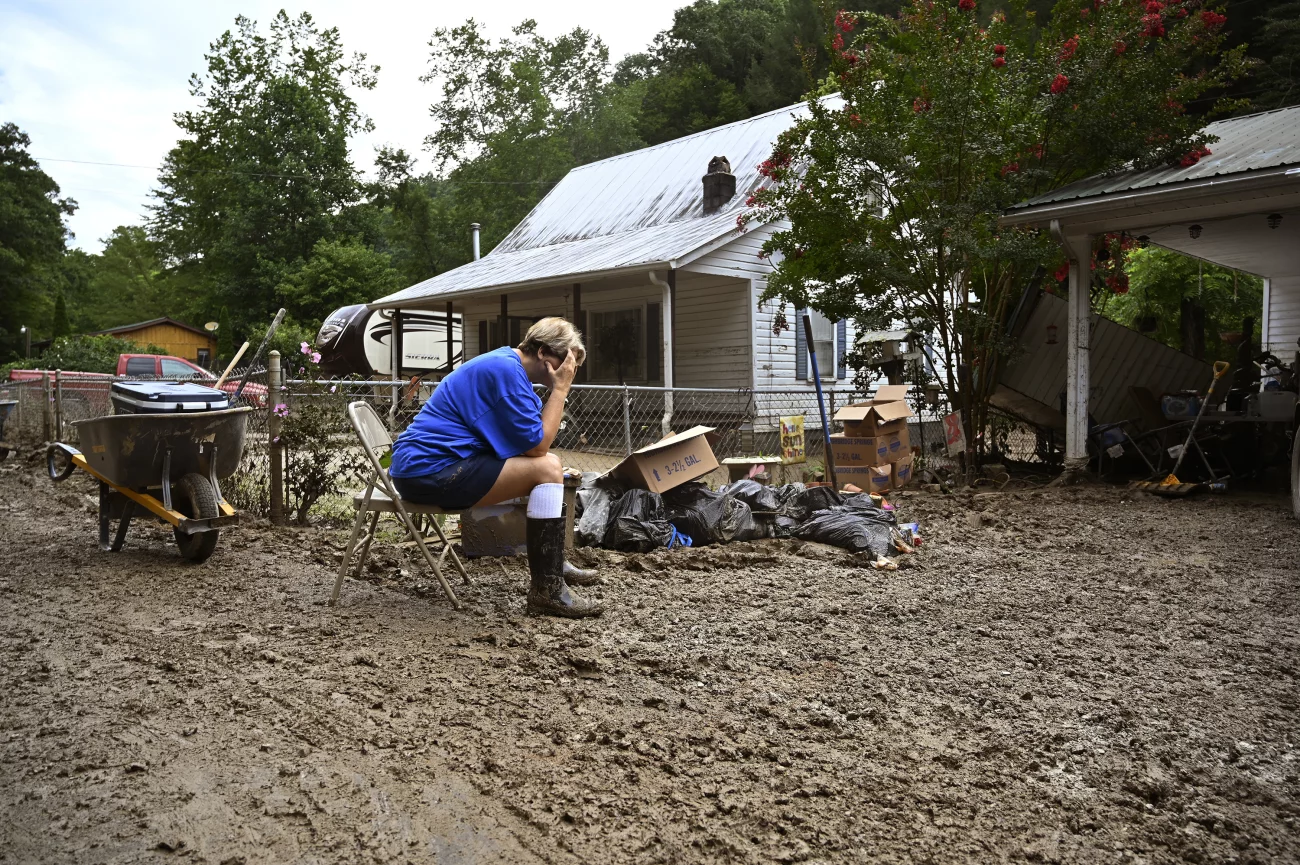
Teresa Reynolds sits exhausted as her neighbors remove debris from their flood-ravaged homes in Hindman, Ky., in July 2022. The deadly floods were caused by torrential rains. Climate change makes such record-breaking rainstorms more common in much of the United States. Timothy D. Easley/AP
One disaster, multiple death counts
It's unclear how many people in the U.S. officially died in some of the most high-profile and deadly climate-related weather disasters in recent years.
The issue burst into public view after Hurricane Maria hit Puerto Rico in 2017. The official death toll was in the dozens, but survivors and local officials on the ground questioned .. https://www.npr.org/2019/09/24/763958799/2-years-after-hurricane-maria-hit-puerto-rico-the-exact-death-toll-remains-unkno .. whether that was an accurate count, in part because reliable electricity wasn't restored on the island for months.
Epidemiologists stepped in .. https://www.npr.org/2018/05/29/615167556/official-death-toll-from-maria-in-puerto-rico-is-way-off-researchers-say .. and used statistics to compare the number of deaths in the months after the hurricane with the number of deaths during similar periods in previous years when there was no storm. They estimated that the actual death toll was likely much higher. "We went from the federal government saying 89 [people died] to another academic institution saying 2,000 and yet another saying 5,000," says Maureen Lichtveld, an epidemiologist at the University of Pittsburgh. Ultimately, the government of Puerto Rico reported an official death toll of just under 3,000 .. https://www.nhc.noaa.gov/data/tcr/AL152017_Maria.pdf .
[...]
The CDC is the federal agency officially responsible for mortality statistics for the U.S., including weather-related fatalities. The agency declined to make any of its experts on disaster-related mortality available for an interview, but acknowledged that deaths from weather disasters are potentially being undercounted because of inconsistent information on death certificates, according to a CDC spokesperson who answered NPR questions on background via email.
Start drift --------------------
[Insert: Remember Trump cuts to major agencies caring for the health of American citizens. One unarguable
point arising from the information around that is that Trump has never cared for the care or welfare
of one American more than he has cared for his own political interests. See again:
Trump's cult is a death cult. At least, on the best evidence available, it is accurate, fair and just to say Trump's
cult, energized by Fox News, was a death cult. And it has cost both American families and the GOP big time.
Excerpt: The states with the highest COVID death rates in 2021:
1. Oklahoma 2. Alabama 3. W. Virginia 4. Arizona 5. Kentucky
6. Mississippi 7. Wyoming 8. Florida 9. Georgia 10. S. Carolina
Source: Johns Hopkins; U.S. Census; CDC
Trump carried 8 out of 10 of these states. None of them are blue states.
https://investorshub.advfn.com/boards/read_msg.aspx?message_id=174375219
.. and ..
Inside the Fall of the CDC
This article in full is very, very long.
CDC-Trump-Mask-lead-3x2.jpg" rel="nofollow noopener noreferrer ugc">CDC-Trump-Mask-lead-3x2.jpg">
Leonardo Santamaria, special to ProPublica
How the world’s greatest public health organization was brought to its knees by a virus, the president and the capitulation of its own leaders, causing damage that could last much longer than the coronavirus.
by James Bandler, Patricia Callahan, Sebastian Rotella and Kirsten Berg Oct. 15, 2020, 1:12 p.m. EDT
[...]The week before, the CDC had published its investigation of an outbreak at an Arkansas church that had resulted in four deaths. The agency’s scientific journal recently had detailed a superspreader event in which 52 of the 61 singers at a 2½-hour choir practice developed COVID-19. Two died.
P - Butler, an infectious disease specialist with more than three decades of experience, seemed the ideal person to lead the effort. Trained as one of the CDC’s elite disease detectives, he’d helped the FBI investigate the anthrax attacks, and he’d led the distribution of vaccines during the H1N1 flu pandemic when demand far outstripped supply.
P - But days earlier, Butler and his team had suddenly found themselves on President Donald Trump’s front burner when the president began publicly agitating for churches to reopen. That Thursday, Trump had announced that the CDC would release safety guidelines for them “very soon.” He accused Democratic governors of disrespecting churches, and deemed houses of worship “essential services.”
P - Butler’s team rushed to finalize the guidance for churches, synagogues and mosques that Trump’s aides had shelved in April after battling the CDC over the language. In reviewing a raft of last-minute edits from the White House, Butler’s team rejected those that conflicted with CDC research, including a worrisome suggestion to delete a line that urged congregations to “consider suspending or at least decreasing” the use of choirs.
P - On Friday, Trump’s aides called the CDC repeatedly about the guidance, according to emails. “Why is it not up?” they demanded until it was posted on the CDC website that afternoon.
P - The next day, a furious call came from the office of the vice president: The White House suggestions were not optional. The CDC’s failure to use them was insubordinate, according to emails at the time.
P - Fifteen minutes later, one of Butler’s deputies had the agency’s text replaced with the White House version, the emails show. The danger of singing wasn’t mentioned.
P - Early that Sunday morning, as Americans across the country prepared excitedly to return to houses of worship, Butler, a churchgoer himself, poured his anguish and anger into an email to a few colleagues.
P - “I am very troubled on this Sunday morning that there will be people who will get sick and perhaps die because of what we were forced to do,” he wrote.
[...]
ProPublica obtained hundreds of emails and other internal government documents and interviewed more than 30 CDC employees, contractors and Trump administration officials who witnessed or were involved in key moments of the crisis. Although news organizations around the world have chronicled the CDC’s stumbles in real time, ProPublica’s reporting affords the most comprehensive inside look at the escalating tensions, paranoia and pained discussions that unfolded behind the walls of CDC’s Atlanta headquarters. And it sheds new light on the botched COVID-19 tests, the unprecedented political interference in public health policy, and the capitulations of some of the world’s top public health leaders.
[Insert: If the facts around this are not accepted as definitive proof that Trump and those close to him in his administration put Trump's personal political preferences in front of caring consideration for the public health then nothing could ever be printed to convince those who still believe Trump cares for the well being of American voters more than for his own political preferences.]
.. also ..
The inside story of how Trump’s denial, mismanagement and magical thinking led to the pandemic’s dark winter
https://investorshub.advfn.com/boards/read_msg.aspx?message_id=172346491
.. finally ..
Good man! Your comment on Trump cutting CDC during his term and overseas too reminded me that these two posts jigsaw into that long very, very long one. While on it it took all my focus and i didn't make the connection before reading yours just now. These two in post headed:
P - John Oliver gets it right again. Trump fucked up on three basic facets of virus fighting - preparation, communication and coordination. On the question, Bush and Obama were on the mark. Trump lowered the drawbridge, increasing the probability any deadly airborne virus could hit America hard:
P - How Trump let coronavirus take over America
[...]
2017-2020: Withdrew CDC staff from China
Between 2017 and 2020, the Trump administration reduced the number of CDC staff in China — the presumed epicenter of the outbreak — from 47 to just 14, Reuters reported on March 25.
P - "We had a large operation of experts in China who were brought back during this administration, some of them months before the outbreak," a person who witnessed the withdrawal of U.S. personnel said. "You have to consider the possibility that our drawdown made this catastrophe more likely or more difficult to respond to."
2018: Ignored warnings from CDC
https://investorshub.advfn.com/boards/read_msg.aspx?message_id=162580504
P - Trump's "drain the swamp" means 'drain the expertise'. Excerpt from yours ..
"In May 2018, Trump ordered the NSC’s entire global health security unit shut down, calling for reassignment of Rear Adm. Timothy Ziemer and dissolution of his team inside the agency. The month before, then-White House National Security Advisor John Bolton pressured Ziemer’s DHS counterpart, Tom Bossert, to resign along with his team. Neither the NSC nor DHS epidemic teams have been replaced. The global health section of the CDC was so drastically cut in 2018 that much of its staff was laid off and the number of countries it was working in was reduced from 49 to merely 10. Meanwhile, throughout 2018, the U.S. Agency for International Development and its director, Mark Green, came repeatedly under fire from both the White House and Secretary of State Mike Pompeo. And though Congress has so far managed to block Trump administration plans to cut the U.S. Public Health Service Commissioned Corps by 40 percent, the disease-fighting cadres have steadily eroded as retiring officers go unreplaced...."
March, 2023 - https://investorshub.advfn.com/boards/read_msg.aspx?message_id=171446036]
-------------------- end drift
[...]
The lack of reliable data is a problem, says Rep. Nydia Velázquez, D-N.Y., who sponsored the bill that led to the National Academies report, along with then-Sen. Kamala Harris. "Death tolls are important," Velázquez says. "They influence public perception about the scope of a disaster and often determine what federal resources are allocated in response."
Despite the congressional attention and the subsequent recommendations from the National Academies, little has changed. Disparities and confusion persist over official death tolls from climate-driven extreme weather.
[...]
The death count disparities from heat waves are particularly large. Heat waves are by far the deadliest type of climate-related extreme weather and are also the most closely linked to climate change. The most extreme heat waves today would be impossible .. https://www.npr.org/2022/07/07/1107814440/researchers-can-now-explain-how-climate-change-is-affecting-your-weather .. without human-caused warming.
But it's unclear how many people are dying in heat waves in the United States. In 2022, the Texas Department of State Health Services reported 279 heat-related deaths in the state, while the National Weather Service counted just 53 deaths in Texas. That discrepancy is likely because the National Weather Service counts only heat-related fatalities that occur on days hot enough to warrant an official heat advisory.
"You could still have heat-related deaths when the temperature is 95 degrees in Texas," says Gordon Strassberg, the storm data program manager for the National Weather Service. But such weather might not be hot enough to trigger an official heat advisory in a state where very hot weather is common. In that case, the National Weather Service wouldn't count the fatality, but the state government would.
A year earlier, in 2021, the Washington State Department of Health counted 100 deaths during the height of a record-shattering heat dome in the Pacific Northwest, while the National Weather Service reported just seven fatalities. The National Weather Service didn't have access to complete fatality data from the state of Washington, Strassberg says.
Amid concerns that many heat-related deaths might have been miscategorized on death certificates, Washington state epidemiologists used statistical methods to estimate how many extra deaths occurred compared with the same time period in previous years in the area. Those officials found that a more complete death toll for the heat dome is likely closer to 1,000 people.
Some wildfire-related deaths also go uncounted. Research shows that exposure to wildfire smoke .. https://www.npr.org/2024/04/18/1245068810/wildfire-smoke-contributes-to-thousands-of-deaths-each-year-in-the-u-s .. contributes to thousands of deaths in the U.S. each year, but there is no national system for counting such deaths. And while the official number of people killed in the 2018 wildfire that destroyed much of Paradise, Calif., is between 84 and 86, that doesn't include dozens of suicide deaths that have been linked to despair and displacement in the aftermath of the fire, none of which are counted by any state or federal agency.
"We know like after a lot of [extreme weather] events that there's an increase in suicide .. https://pubmed.ncbi.nlm.nih.gov/33034515/ .. , but there's not a good accounting of that and numbers that we can trust," Montano explains.
[...]
Unlike the CDC, which is responsible for publicly reporting official U.S. death data for all types of fatalities, the National Weather Service gathers weather fatality data primarily for internal use, Strassberg says. For example, information about how many people died in a flood can help inform future flood warnings issued by the local National Weather Service office in that area.
"The fatality data we have is the best information available to our knowledge," he explains, and the numbers are widely used by academic researchers, local emergency managers and even insurance companies. But, Strassberg stresses, "our numbers are not official."

People seek shelter from the heat at a church in Phoenix in July 2023. Data about heat-related fatalities has helped spur emergency managers across the U.S. to open cooling centers on hot days. More detailed data about such deaths could help officials decide where to open such centers and how to ensure vulnerable people can access them. Brandon Bell/Getty Images
Better disaster death data can save lives
Reliable data about how many people died in a flood, wildfire, hurricane or heat wave, as well as why those deaths occurred, can help save lives during future extreme weather.
"Many of the deaths are avoidable," says Wayne Blanchard, who worked at the Federal Emergency Management Agency (FEMA) for three decades and is now retired. "Particularly for the emergency management community, the more they know, the more enabled they'll be to try to develop mitigation measures" such as evacuation plans, shelters or weather warnings that are tailored to those who are most at risk.
For example, in the 1990s some cities began opening cooling centers during heat waves in response to large death tolls from prolonged heat exposure, Blanchard says. Such cooling centers are now a basic part of managing heat waves across the United States. Today, many city governments are hungry for more information about who is dying from heat exposure, because it can help inform where to place those cooling centers and how to help vulnerable people access them.
And data about drowning deaths in vehicles during flash floods helped spur a federal safety campaign warning drivers "Turn Around Don't Drown" if there is water in the road.
Accurate death counts after disasters can also be painfully personal and even financially important for the families of those who died. The Federal Emergency Management Agency helps pay for funerals .. https://www.npr.org/sections/health-shots/2022/05/09/1089788307/fema-covid-funerals .. for those whose deaths are officially linked to major disasters. But if a death isn't counted as disaster-related, families generally aren't eligible for those relief funds.
The vast majority of applications for FEMA funeral assistance after recent hurricanes were denied, according to a 2019 report by the Government Accountability Office, in part because of missing or incomplete death certificates.
The lack of concrete mortality numbers related to climate change is increasingly problematic at a national and global scale as well. Policymakers around the world rely on data about the human cost of climate change to justify policies that would help curb warming. The higher the death toll, the greater the economic and moral impetus to reduce greenhouse gas emissions that cause climate change.
https://www.npr.org/2024/06/10/nx-s1-4842299/climate-disasters-death-tolls
"Special Series - The Undercount: The invisible death toll from climate change"
In looking at the mess around inaccurate death counts from natural (with human boost now)
disasters how could i help resisting a drift to death caused by the action of one ex-president's
administration who put a president's own political interest above the interests of America
and it's citizens. I couldn't. So didn't. See below.
June 10, 20246:53 AM ET
Heard on Morning Edition
By Rebecca Hersher, Alejandra Borunda
[...]
The definitive federal accounting of climate change's impacts in the United States, the National Climate Assessment, estimates that upward of 1,300 people die in the U.S. each year due to heat alone and that extreme floods, hurricanes and wildfires routinely kill hundreds more. But those numbers are rough estimates.
That's a problem, the federal government has long acknowledged, because who dies as a result of extreme weather, as well as how they die, is important. That public health information can help protect people from increasingly frequent disasters and can even spur policies that address the reliance on fossil fuels at the root of global warming. And inconsistency over which disaster-related deaths get counted can lead to frustration and even financial losses for the families of those who died.
"The data collection needs to be better," says Samantha Montano, a disaster researcher at the Massachusetts Maritime Academy. "There needs to be a national, publicly available database that everybody has access to that is tracking every single death."
Teresa Reynolds sits exhausted as her neighbors remove debris from their flood-ravaged homes in Hindman, Ky., in July 2022. The deadly floods were caused by torrential rains. Climate change makes such record-breaking rainstorms more common in much of the United States. Timothy D. Easley/AP
One disaster, multiple death counts
It's unclear how many people in the U.S. officially died in some of the most high-profile and deadly climate-related weather disasters in recent years.
The issue burst into public view after Hurricane Maria hit Puerto Rico in 2017. The official death toll was in the dozens, but survivors and local officials on the ground questioned .. https://www.npr.org/2019/09/24/763958799/2-years-after-hurricane-maria-hit-puerto-rico-the-exact-death-toll-remains-unkno .. whether that was an accurate count, in part because reliable electricity wasn't restored on the island for months.
Epidemiologists stepped in .. https://www.npr.org/2018/05/29/615167556/official-death-toll-from-maria-in-puerto-rico-is-way-off-researchers-say .. and used statistics to compare the number of deaths in the months after the hurricane with the number of deaths during similar periods in previous years when there was no storm. They estimated that the actual death toll was likely much higher. "We went from the federal government saying 89 [people died] to another academic institution saying 2,000 and yet another saying 5,000," says Maureen Lichtveld, an epidemiologist at the University of Pittsburgh. Ultimately, the government of Puerto Rico reported an official death toll of just under 3,000 .. https://www.nhc.noaa.gov/data/tcr/AL152017_Maria.pdf .
[...]
The CDC is the federal agency officially responsible for mortality statistics for the U.S., including weather-related fatalities. The agency declined to make any of its experts on disaster-related mortality available for an interview, but acknowledged that deaths from weather disasters are potentially being undercounted because of inconsistent information on death certificates, according to a CDC spokesperson who answered NPR questions on background via email.
Start drift --------------------
[Insert: Remember Trump cuts to major agencies caring for the health of American citizens. One unarguable
point arising from the information around that is that Trump has never cared for the care or welfare
of one American more than he has cared for his own political interests. See again:
Trump's cult is a death cult. At least, on the best evidence available, it is accurate, fair and just to say Trump's
cult, energized by Fox News, was a death cult. And it has cost both American families and the GOP big time.
Excerpt: The states with the highest COVID death rates in 2021:
1. Oklahoma 2. Alabama 3. W. Virginia 4. Arizona 5. Kentucky
6. Mississippi 7. Wyoming 8. Florida 9. Georgia 10. S. Carolina
Source: Johns Hopkins; U.S. Census; CDC
Trump carried 8 out of 10 of these states. None of them are blue states.
https://investorshub.advfn.com/boards/read_msg.aspx?message_id=174375219
.. and ..
Inside the Fall of the CDC
This article in full is very, very long.
CDC-Trump-Mask-lead-3x2.jpg" rel="nofollow noopener noreferrer ugc">CDC-Trump-Mask-lead-3x2.jpg">
Leonardo Santamaria, special to ProPublica
How the world’s greatest public health organization was brought to its knees by a virus, the president and the capitulation of its own leaders, causing damage that could last much longer than the coronavirus.
by James Bandler, Patricia Callahan, Sebastian Rotella and Kirsten Berg Oct. 15, 2020, 1:12 p.m. EDT
[...]The week before, the CDC had published its investigation of an outbreak at an Arkansas church that had resulted in four deaths. The agency’s scientific journal recently had detailed a superspreader event in which 52 of the 61 singers at a 2½-hour choir practice developed COVID-19. Two died.
P - Butler, an infectious disease specialist with more than three decades of experience, seemed the ideal person to lead the effort. Trained as one of the CDC’s elite disease detectives, he’d helped the FBI investigate the anthrax attacks, and he’d led the distribution of vaccines during the H1N1 flu pandemic when demand far outstripped supply.
P - But days earlier, Butler and his team had suddenly found themselves on President Donald Trump’s front burner when the president began publicly agitating for churches to reopen. That Thursday, Trump had announced that the CDC would release safety guidelines for them “very soon.” He accused Democratic governors of disrespecting churches, and deemed houses of worship “essential services.”
P - Butler’s team rushed to finalize the guidance for churches, synagogues and mosques that Trump’s aides had shelved in April after battling the CDC over the language. In reviewing a raft of last-minute edits from the White House, Butler’s team rejected those that conflicted with CDC research, including a worrisome suggestion to delete a line that urged congregations to “consider suspending or at least decreasing” the use of choirs.
P - On Friday, Trump’s aides called the CDC repeatedly about the guidance, according to emails. “Why is it not up?” they demanded until it was posted on the CDC website that afternoon.
P - The next day, a furious call came from the office of the vice president: The White House suggestions were not optional. The CDC’s failure to use them was insubordinate, according to emails at the time.
P - Fifteen minutes later, one of Butler’s deputies had the agency’s text replaced with the White House version, the emails show. The danger of singing wasn’t mentioned.
P - Early that Sunday morning, as Americans across the country prepared excitedly to return to houses of worship, Butler, a churchgoer himself, poured his anguish and anger into an email to a few colleagues.
P - “I am very troubled on this Sunday morning that there will be people who will get sick and perhaps die because of what we were forced to do,” he wrote.
[...]
ProPublica obtained hundreds of emails and other internal government documents and interviewed more than 30 CDC employees, contractors and Trump administration officials who witnessed or were involved in key moments of the crisis. Although news organizations around the world have chronicled the CDC’s stumbles in real time, ProPublica’s reporting affords the most comprehensive inside look at the escalating tensions, paranoia and pained discussions that unfolded behind the walls of CDC’s Atlanta headquarters. And it sheds new light on the botched COVID-19 tests, the unprecedented political interference in public health policy, and the capitulations of some of the world’s top public health leaders.
[Insert: If the facts around this are not accepted as definitive proof that Trump and those close to him in his administration put Trump's personal political preferences in front of caring consideration for the public health then nothing could ever be printed to convince those who still believe Trump cares for the well being of American voters more than for his own political preferences.]
.. also ..
The inside story of how Trump’s denial, mismanagement and magical thinking led to the pandemic’s dark winter
https://investorshub.advfn.com/boards/read_msg.aspx?message_id=172346491
.. finally ..
Good man! Your comment on Trump cutting CDC during his term and overseas too reminded me that these two posts jigsaw into that long very, very long one. While on it it took all my focus and i didn't make the connection before reading yours just now. These two in post headed:
P - John Oliver gets it right again. Trump fucked up on three basic facets of virus fighting - preparation, communication and coordination. On the question, Bush and Obama were on the mark. Trump lowered the drawbridge, increasing the probability any deadly airborne virus could hit America hard:
P - How Trump let coronavirus take over America
[...]
2017-2020: Withdrew CDC staff from China
Between 2017 and 2020, the Trump administration reduced the number of CDC staff in China — the presumed epicenter of the outbreak — from 47 to just 14, Reuters reported on March 25.
P - "We had a large operation of experts in China who were brought back during this administration, some of them months before the outbreak," a person who witnessed the withdrawal of U.S. personnel said. "You have to consider the possibility that our drawdown made this catastrophe more likely or more difficult to respond to."
2018: Ignored warnings from CDC
https://investorshub.advfn.com/boards/read_msg.aspx?message_id=162580504
P - Trump's "drain the swamp" means 'drain the expertise'. Excerpt from yours ..
"In May 2018, Trump ordered the NSC’s entire global health security unit shut down, calling for reassignment of Rear Adm. Timothy Ziemer and dissolution of his team inside the agency. The month before, then-White House National Security Advisor John Bolton pressured Ziemer’s DHS counterpart, Tom Bossert, to resign along with his team. Neither the NSC nor DHS epidemic teams have been replaced. The global health section of the CDC was so drastically cut in 2018 that much of its staff was laid off and the number of countries it was working in was reduced from 49 to merely 10. Meanwhile, throughout 2018, the U.S. Agency for International Development and its director, Mark Green, came repeatedly under fire from both the White House and Secretary of State Mike Pompeo. And though Congress has so far managed to block Trump administration plans to cut the U.S. Public Health Service Commissioned Corps by 40 percent, the disease-fighting cadres have steadily eroded as retiring officers go unreplaced...."
March, 2023 - https://investorshub.advfn.com/boards/read_msg.aspx?message_id=171446036]
-------------------- end drift
[...]
The lack of reliable data is a problem, says Rep. Nydia Velázquez, D-N.Y., who sponsored the bill that led to the National Academies report, along with then-Sen. Kamala Harris. "Death tolls are important," Velázquez says. "They influence public perception about the scope of a disaster and often determine what federal resources are allocated in response."
Despite the congressional attention and the subsequent recommendations from the National Academies, little has changed. Disparities and confusion persist over official death tolls from climate-driven extreme weather.
[...]
The death count disparities from heat waves are particularly large. Heat waves are by far the deadliest type of climate-related extreme weather and are also the most closely linked to climate change. The most extreme heat waves today would be impossible .. https://www.npr.org/2022/07/07/1107814440/researchers-can-now-explain-how-climate-change-is-affecting-your-weather .. without human-caused warming.
But it's unclear how many people are dying in heat waves in the United States. In 2022, the Texas Department of State Health Services reported 279 heat-related deaths in the state, while the National Weather Service counted just 53 deaths in Texas. That discrepancy is likely because the National Weather Service counts only heat-related fatalities that occur on days hot enough to warrant an official heat advisory.
"You could still have heat-related deaths when the temperature is 95 degrees in Texas," says Gordon Strassberg, the storm data program manager for the National Weather Service. But such weather might not be hot enough to trigger an official heat advisory in a state where very hot weather is common. In that case, the National Weather Service wouldn't count the fatality, but the state government would.
A year earlier, in 2021, the Washington State Department of Health counted 100 deaths during the height of a record-shattering heat dome in the Pacific Northwest, while the National Weather Service reported just seven fatalities. The National Weather Service didn't have access to complete fatality data from the state of Washington, Strassberg says.
Amid concerns that many heat-related deaths might have been miscategorized on death certificates, Washington state epidemiologists used statistical methods to estimate how many extra deaths occurred compared with the same time period in previous years in the area. Those officials found that a more complete death toll for the heat dome is likely closer to 1,000 people.
Some wildfire-related deaths also go uncounted. Research shows that exposure to wildfire smoke .. https://www.npr.org/2024/04/18/1245068810/wildfire-smoke-contributes-to-thousands-of-deaths-each-year-in-the-u-s .. contributes to thousands of deaths in the U.S. each year, but there is no national system for counting such deaths. And while the official number of people killed in the 2018 wildfire that destroyed much of Paradise, Calif., is between 84 and 86, that doesn't include dozens of suicide deaths that have been linked to despair and displacement in the aftermath of the fire, none of which are counted by any state or federal agency.
"We know like after a lot of [extreme weather] events that there's an increase in suicide .. https://pubmed.ncbi.nlm.nih.gov/33034515/ .. , but there's not a good accounting of that and numbers that we can trust," Montano explains.
[...]
Unlike the CDC, which is responsible for publicly reporting official U.S. death data for all types of fatalities, the National Weather Service gathers weather fatality data primarily for internal use, Strassberg says. For example, information about how many people died in a flood can help inform future flood warnings issued by the local National Weather Service office in that area.
"The fatality data we have is the best information available to our knowledge," he explains, and the numbers are widely used by academic researchers, local emergency managers and even insurance companies. But, Strassberg stresses, "our numbers are not official."

People seek shelter from the heat at a church in Phoenix in July 2023. Data about heat-related fatalities has helped spur emergency managers across the U.S. to open cooling centers on hot days. More detailed data about such deaths could help officials decide where to open such centers and how to ensure vulnerable people can access them. Brandon Bell/Getty Images
Better disaster death data can save lives
Reliable data about how many people died in a flood, wildfire, hurricane or heat wave, as well as why those deaths occurred, can help save lives during future extreme weather.
"Many of the deaths are avoidable," says Wayne Blanchard, who worked at the Federal Emergency Management Agency (FEMA) for three decades and is now retired. "Particularly for the emergency management community, the more they know, the more enabled they'll be to try to develop mitigation measures" such as evacuation plans, shelters or weather warnings that are tailored to those who are most at risk.
For example, in the 1990s some cities began opening cooling centers during heat waves in response to large death tolls from prolonged heat exposure, Blanchard says. Such cooling centers are now a basic part of managing heat waves across the United States. Today, many city governments are hungry for more information about who is dying from heat exposure, because it can help inform where to place those cooling centers and how to help vulnerable people access them.
And data about drowning deaths in vehicles during flash floods helped spur a federal safety campaign warning drivers "Turn Around Don't Drown" if there is water in the road.
Accurate death counts after disasters can also be painfully personal and even financially important for the families of those who died. The Federal Emergency Management Agency helps pay for funerals .. https://www.npr.org/sections/health-shots/2022/05/09/1089788307/fema-covid-funerals .. for those whose deaths are officially linked to major disasters. But if a death isn't counted as disaster-related, families generally aren't eligible for those relief funds.
The vast majority of applications for FEMA funeral assistance after recent hurricanes were denied, according to a 2019 report by the Government Accountability Office, in part because of missing or incomplete death certificates.
The lack of concrete mortality numbers related to climate change is increasingly problematic at a national and global scale as well. Policymakers around the world rely on data about the human cost of climate change to justify policies that would help curb warming. The higher the death toll, the greater the economic and moral impetus to reduce greenhouse gas emissions that cause climate change.
https://www.npr.org/2024/06/10/nx-s1-4842299/climate-disasters-death-tolls
It was Plato who said, “He, O men, is the wisest, who like Socrates, knows that his wisdom is in truth worth nothing”
Discover What Traders Are Watching
Explore small cap ideas before they hit the headlines.



