



 AI
AI








Friday, April 26, 2024 5:46:29 PM
brooklyn13, Only a narrowly opinionated Israel supporter would label the late Shimon Peres and Ehud Barak as media sources. I assume many alternate sites would have similar quotes, used to support position. It is not a case of confirming biases, but a case of supporting arguments. What is your position on that? You remain comafied (don't know if that is an accepted word) when it comes to having an opinion on the quotes of Peres and Barak given you, yet you accuse me of being no good at considering different points of view.
"You’re an expert at finding media sources that confirm your biases. You are absolutely no good at considering that different points of view have any merit.
P - During the course of these discussions, I have conceded that Netanyahu belongs in jail as do the WB settlers. You’ve yet to concede there’s any validity in anyone else’s opinion.
P - Whatever. It’s not worth the effort. "
You have not validly argued against either of their comments. In fact you do nothing more than ignore them. Every one of your opinions have been dealt with here yet you accuse myself and others of ignoring your view, while you stolidly ignore all of ours. All while you ignore the different points of view of Peres and Barak. In other words you unarguably project. As a tangent see .. https://investorshub.advfn.com/boards/read_msg.aspx?message_id=174307924 . And there is nothing in this as suggesting you are a Trump supporter. The thought i just had was strictly on the fact that you also have projected here.
When did Peres make his critical comments i wonder (not sure if i missed it earlier), so searched "what year did Shimon Peres become critical of Israel anti-Palestinian state policy" . Note: there is nothing at all "expert at finding media sources that confirm your biases" in posing a question as that. You apparently have nothing left but to attack the messenger, and that's perfectly understandable since you had no moral or ethical or humane base for your superficial positions from the start. Anyway the obviously inexpert search came up with this one, and i don't know yet if this one result of the FireFox search has gives me an answer to the question asked, to this point i've read only the first few paragraphs of:
Israel’s last founding father
Itamar Rabinovich
September 28, 2016
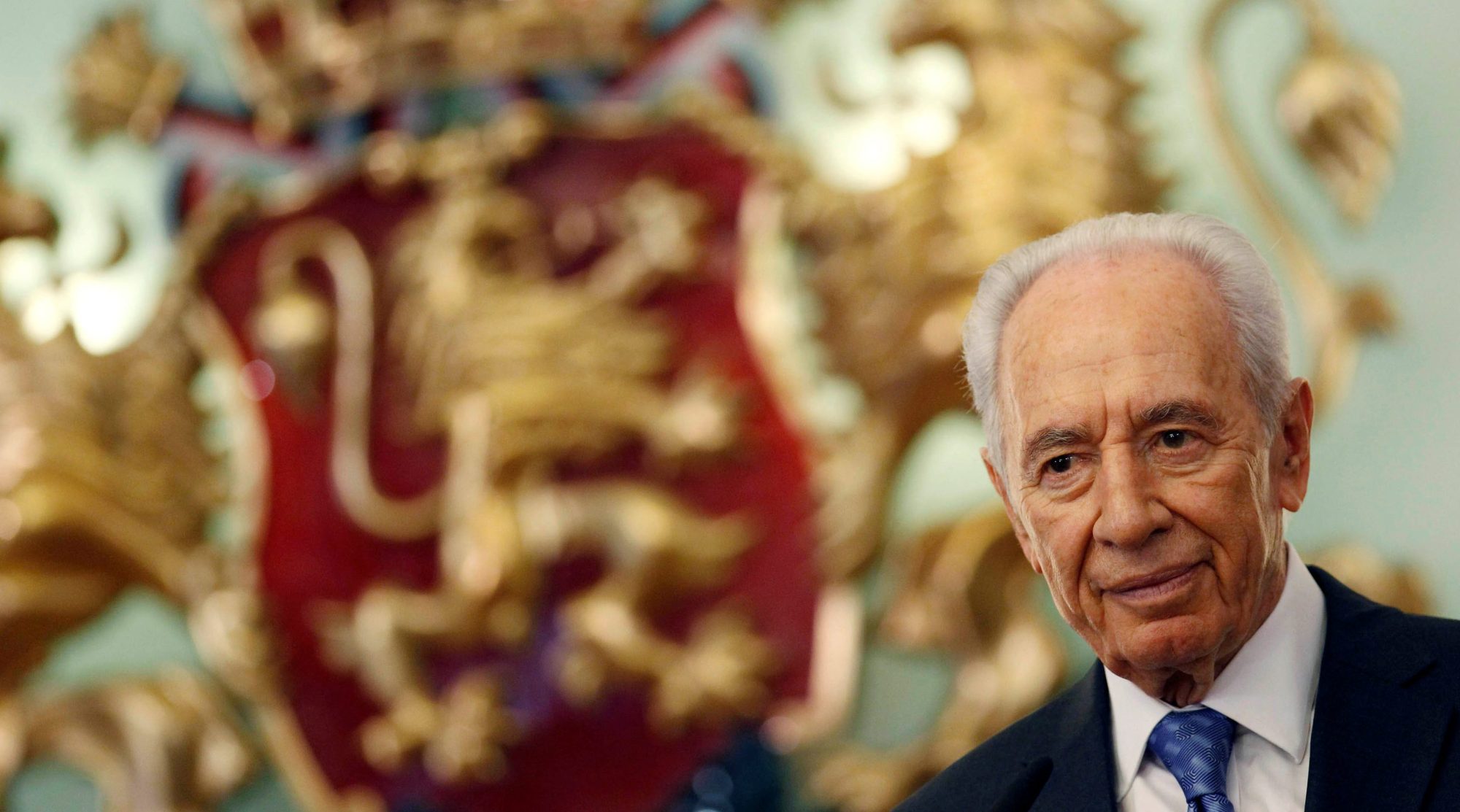
[Israeli President Shimon Peres attends a joint news conference with Bulgarian President Georgi Parvanov (not pictured) in Sofia, in this August 11, 2010 file photo. REUTERS/Oleg Popov/Files - RTSPRLD]
Read more from Markaz - https://www.brookings.edu/tags/markaz/
More On
Israel - https://www.brookings.edu/regions/middle-east-north-africa/israel/
Middle East & North Africa - https://www.brookings.edu/regions/middle-east-north-africa/
Program
Foreign Policy
Center
Center for Middle East Policy
Editor's note: Shimon Peres was pillar of Israel’s national security leadership and subsequently became an ardent peacemaker. Perhaps most important, writes Itamar Rabinovich, he was an Israeli leader who had a vision and a message. This piece originally appeared on Project Syndicate.
In 2006, a year before Shimon Peres was elected as Israel’s president, Michael Bar-Zohar published the Hebrew edition of his Peres biography. It was aptly titled Like a Phoenix: by then, Peres had been active in Israeli politics and public life for more than 60 years.
Peres’s career had its ups and downs. He reached lofty heights and suffered humiliating failures—and went through several incarnations. A pillar of Israel’s national security leadership, he subsequently became an ardent peacemaker, always maintaining a love-hate relationship with an Israeli public that consistently declined to elect him prime minister but admired him when he did not have or seek real power.
Undeterred by adversity, Peres kept pushing forward, driven by ambition and a sense of mission, and aided by his talents and creativity. He was a self-taught man, a voracious reader, and a prolific writer, a man moved and inspired every few years by a new idea: nanoscience, the human brain, Middle Eastern economic development.
Undeterred by adversity, Peres kept pushing
forward.
He was also a visionary and sly politician, who never fully shook off his East European origins. When his quest for power and participation in policymaking ended in 2007, he reached the pinnacle of his public career, serving as President until 2014. He rehabilitated the institution after succeeding an unworthy predecessor and became popular at home and admired abroad as an informal global Elder on the international stage, a sought-after speaker in international fora, and a symbol of a peace-seeking Israel, in sharp contrast to its pugnacious prime minister, Benjamin Netanyahu.
Peres’s rich and complex political career passed through five main phases. He began as an activist in the Labor Party and its youth movement in the early 1940s.
[Insert: Fun fact which only now allows me to relate some more to Shimon
Peres. I was born in 1942. Cool. '46, chuckle, would have me all of four.]
By 1946, he was considered senior enough to be sent to Europe as part of the pre-state delegation to the first post-war Zionist Congress. He then began to work closely with Israel’s leading founder, David Ben-Gurion, at the Ministry of Defense, mostly in procurement, during Israel’s Independence War, eventually rising to become the ministry’s director-general.
In that capacity, Peres became the architect of the young state’s defense doctrine. Running a sort of parallel foreign ministry, his main achievement was the creation of a close alliance and strong security cooperation—including with respect to nuclear technology—with France.
In 1959, Peres moved to full-time politics, supporting Ben-Gurion in his conflict with Labor’s old guard. Later, he was elected to the Knesset, Israel’s parliament, and became Deputy Minister of Defense and subsequently a full member of the cabinet.
His career entered a new phase in 1974, when Prime Minister Golda Meir was forced to resign after the October 1973 debacle, in which Anwar Sadat’s Egyptian forces successfully crossed the Suez Canal. Peres presented his candidacy, but narrowly lost to Yitzhak Rabin. As compensation, Rabin gave Peres the position of defense minister in his government. Nonetheless, their contest in 1974 marked the start of 21 years of fierce rivalry, mitigated by cooperation.
Twice, in 1977,] after Rabin was forced to resign, and in 1995-1996, after Rabin was assassinated, Peres succeeded his rival. He was also prime minister (a very good one) in a national unity government in 1984-1986; but, despite trying for nearly 30 years, he never won his own mandate from Israeli voters for the post he coveted the most.
In 1979, Peres transformed himself into the leader of Israel’s peace camp, focusing his efforts in the 1980s on Jordan. But, though he came tantalizingly close to a peace deal in 1987, when he signed the London Agreement with King Hussein, the agreement was stillborn. In 1992, the Labor Party’s rank and file concluded that Peres could not win an election, and that only a centrist like Rabin stood a chance.
Rabin won and returned, after 15 years, to the premiership. This time, he kept the defense portfolio for himself and gave Peres the foreign ministry. Rabin was determined to manage the peace process and assigned to Peres a marginal role. But Peres was offered by Rabin’s deputy an opportunity to champion a track two negotiation with the PLO in Oslo, and, with Rabin’s consent, took charge of the talks, bringing them to a successful conclusion in August 1993.
Here was the prime example of competition and collaboration that typified the Rabin-Peres relationship. It took Peres’s boldness and creativity to conclude the Oslo Accords; but without Rabin’s credibility and stature as a military man and security hawk, the Israeli public and political establishment would not have accepted it.
The grudging cooperation between Rabin and Peres continued until November 4, 1995, when Rabin was murdered by a right-wing extremist.[color=red] The assassin could have killed Peres, but decided that targeting Rabin was the more effective way to derail the peace process.[/color] Succeeding Rabin, Peres tried to negotiate a peace deal with Syria on the heels of Oslo. He failed, called an early election, ran a bad campaign, and lost narrowly to Netanyahu in May 1996.
The next ten years were not a happy period for Peres. He lost the leadership of Labor to Ehud Barak, joined Ariel Sharon’s new Kadima party and his government, and was the object of criticism and attacks by the Israeli right, who blamed him for the Oslo Accords. Peres began to play down the Nobel Peace Prize that he had shared with Yasser Arafat and Rabin after Oslo. The discrepancy between his stature on the international stage and his position in Israeli politics became glaringly apparent during these years—disappearing, however, when he became President in 2007.
Peres was an experienced, gifted leader, an eloquent speaker, and a source of ideas. But perhaps most important, he was an Israeli leader who had a vision and a message. This was the secret of his international stature: people expect the leader of Israel, the man from Jerusalem, to be just that type of visionary figure. When the country’s political leadership does not meet that expectation, a leader like Peres assumes the role—and gains the glory.
Related Content
Shimon Peres: Eternal optimist, 1923-2016
Natan Sachs September 28, 2016
[Excerpts outed here
Already at the age of 24—before the state was even declared in 1948—he was an aide to Israel’s founding prime minister, David Ben Gurion, and by 30 he was director general of the powerful ministry of defense. First elected to the Israeli Knesset in 1959 and first appointed to the cabinet in 1969, he also held a host of other ministerial positions, some created especially for him. He was a man who procured propeller airplanes for the fledgling state battling for its life as a young man, and who extolled the virtues of nano-technology six decades later, still at the apex of Israeli political life.
P - n this long career, Peres became a fixture of Israeli public life, part and parcel of the Israeli establishment. He died a widely respected and beloved patrician and recent former president, a largely apolitical and grandfatherly role. He departs as the very last of the major leaders who were active at the founding of the state and as a symbol of that generation.
[...]
He was born Shimon Perski, in Poland (now Belarus), and had the Polish accent to prove it.
[...]
While he became an essential part of the Israeli leadership for decades, Peres’s outsider origins, ever the immigrant, would follow him throughout his career.
[...]
Peres also embodied a dramatic transformation from ideological hawk to dove, common among several Israeli leaders.
[...]
In the 1970s, as minister of defense under Rabin (in his first term as prime minister), Peres was instrumental in helping the Gush Emunim movement establish its first settlements in the northern West Bank (Samaria, as Israelis often refer to it). Yet after assuming the party leadership and interacting with other social-democratic leaders around the world, Peres began a steady move to the left. By the late 1980s he had become Israel’s most senior dove.]
https://www.brookings.edu/articles/shimon-peres-eternal-optimist-1923-2016/
Former Israeli Prime Minister Yitzhak Shamir, A Stalwart of Israeli Conservatism
Natan Sachs July 5, 2012
https://www.brookings.edu/articles/former-israeli-prime-minister-yitzhak-shamir-a-stalwart-of-israeli-conservatism/
Israeli Elections: Labor’s Challenge
Natan Sachs January 1
https://www.brookings.edu/articles/israeli-elections-labors-challenge/
https://www.brookings.edu/articles/israels-last-founding-father/
Well well. I'm sure others here will find all that as interesting and as helpful as i just have.
Note again: There was no desire to confirm bias in posing the question. And there was no expertise in making the search.
Repeat:
"You’re an expert at finding media sources that confirm your biases. You are absolutely no good at considering that different points of view have any merit.
P - During the course of these discussions, I have conceded that Netanyahu belongs in jail as do the WB settlers. You’ve yet to concede there’s any validity in anyone else’s opinion.
P - Whatever. It’s not worth the effort."
"You’re an expert at finding media sources that confirm your biases. You are absolutely no good at considering that different points of view have any merit.
P - During the course of these discussions, I have conceded that Netanyahu belongs in jail as do the WB settlers. You’ve yet to concede there’s any validity in anyone else’s opinion.
P - Whatever. It’s not worth the effort. "
You have not validly argued against either of their comments. In fact you do nothing more than ignore them. Every one of your opinions have been dealt with here yet you accuse myself and others of ignoring your view, while you stolidly ignore all of ours. All while you ignore the different points of view of Peres and Barak. In other words you unarguably project. As a tangent see .. https://investorshub.advfn.com/boards/read_msg.aspx?message_id=174307924 . And there is nothing in this as suggesting you are a Trump supporter. The thought i just had was strictly on the fact that you also have projected here.
When did Peres make his critical comments i wonder (not sure if i missed it earlier), so searched "what year did Shimon Peres become critical of Israel anti-Palestinian state policy" . Note: there is nothing at all "expert at finding media sources that confirm your biases" in posing a question as that. You apparently have nothing left but to attack the messenger, and that's perfectly understandable since you had no moral or ethical or humane base for your superficial positions from the start. Anyway the obviously inexpert search came up with this one, and i don't know yet if this one result of the FireFox search has gives me an answer to the question asked, to this point i've read only the first few paragraphs of:
Israel’s last founding father
Itamar Rabinovich
September 28, 2016
[Israeli President Shimon Peres attends a joint news conference with Bulgarian President Georgi Parvanov (not pictured) in Sofia, in this August 11, 2010 file photo. REUTERS/Oleg Popov/Files - RTSPRLD]
Read more from Markaz - https://www.brookings.edu/tags/markaz/
More On
Israel - https://www.brookings.edu/regions/middle-east-north-africa/israel/
Middle East & North Africa - https://www.brookings.edu/regions/middle-east-north-africa/
Program
Foreign Policy
Center
Center for Middle East Policy
Editor's note: Shimon Peres was pillar of Israel’s national security leadership and subsequently became an ardent peacemaker. Perhaps most important, writes Itamar Rabinovich, he was an Israeli leader who had a vision and a message. This piece originally appeared on Project Syndicate.
In 2006, a year before Shimon Peres was elected as Israel’s president, Michael Bar-Zohar published the Hebrew edition of his Peres biography. It was aptly titled Like a Phoenix: by then, Peres had been active in Israeli politics and public life for more than 60 years.
Peres’s career had its ups and downs. He reached lofty heights and suffered humiliating failures—and went through several incarnations. A pillar of Israel’s national security leadership, he subsequently became an ardent peacemaker, always maintaining a love-hate relationship with an Israeli public that consistently declined to elect him prime minister but admired him when he did not have or seek real power.
Undeterred by adversity, Peres kept pushing forward, driven by ambition and a sense of mission, and aided by his talents and creativity. He was a self-taught man, a voracious reader, and a prolific writer, a man moved and inspired every few years by a new idea: nanoscience, the human brain, Middle Eastern economic development.
Undeterred by adversity, Peres kept pushing
forward.
He was also a visionary and sly politician, who never fully shook off his East European origins. When his quest for power and participation in policymaking ended in 2007, he reached the pinnacle of his public career, serving as President until 2014. He rehabilitated the institution after succeeding an unworthy predecessor and became popular at home and admired abroad as an informal global Elder on the international stage, a sought-after speaker in international fora, and a symbol of a peace-seeking Israel, in sharp contrast to its pugnacious prime minister, Benjamin Netanyahu.
Peres’s rich and complex political career passed through five main phases. He began as an activist in the Labor Party and its youth movement in the early 1940s.
[Insert: Fun fact which only now allows me to relate some more to Shimon
Peres. I was born in 1942. Cool. '46, chuckle, would have me all of four.]
By 1946, he was considered senior enough to be sent to Europe as part of the pre-state delegation to the first post-war Zionist Congress. He then began to work closely with Israel’s leading founder, David Ben-Gurion, at the Ministry of Defense, mostly in procurement, during Israel’s Independence War, eventually rising to become the ministry’s director-general.
In that capacity, Peres became the architect of the young state’s defense doctrine. Running a sort of parallel foreign ministry, his main achievement was the creation of a close alliance and strong security cooperation—including with respect to nuclear technology—with France.
In 1959, Peres moved to full-time politics, supporting Ben-Gurion in his conflict with Labor’s old guard. Later, he was elected to the Knesset, Israel’s parliament, and became Deputy Minister of Defense and subsequently a full member of the cabinet.
His career entered a new phase in 1974, when Prime Minister Golda Meir was forced to resign after the October 1973 debacle, in which Anwar Sadat’s Egyptian forces successfully crossed the Suez Canal. Peres presented his candidacy, but narrowly lost to Yitzhak Rabin. As compensation, Rabin gave Peres the position of defense minister in his government. Nonetheless, their contest in 1974 marked the start of 21 years of fierce rivalry, mitigated by cooperation.
Twice, in 1977,] after Rabin was forced to resign, and in 1995-1996, after Rabin was assassinated, Peres succeeded his rival. He was also prime minister (a very good one) in a national unity government in 1984-1986; but, despite trying for nearly 30 years, he never won his own mandate from Israeli voters for the post he coveted the most.
In 1979, Peres transformed himself into the leader of Israel’s peace camp, focusing his efforts in the 1980s on Jordan. But, though he came tantalizingly close to a peace deal in 1987, when he signed the London Agreement with King Hussein, the agreement was stillborn. In 1992, the Labor Party’s rank and file concluded that Peres could not win an election, and that only a centrist like Rabin stood a chance.
Rabin won and returned, after 15 years, to the premiership. This time, he kept the defense portfolio for himself and gave Peres the foreign ministry. Rabin was determined to manage the peace process and assigned to Peres a marginal role. But Peres was offered by Rabin’s deputy an opportunity to champion a track two negotiation with the PLO in Oslo, and, with Rabin’s consent, took charge of the talks, bringing them to a successful conclusion in August 1993.
Here was the prime example of competition and collaboration that typified the Rabin-Peres relationship. It took Peres’s boldness and creativity to conclude the Oslo Accords; but without Rabin’s credibility and stature as a military man and security hawk, the Israeli public and political establishment would not have accepted it.
The grudging cooperation between Rabin and Peres continued until November 4, 1995, when Rabin was murdered by a right-wing extremist.[color=red] The assassin could have killed Peres, but decided that targeting Rabin was the more effective way to derail the peace process.[/color] Succeeding Rabin, Peres tried to negotiate a peace deal with Syria on the heels of Oslo. He failed, called an early election, ran a bad campaign, and lost narrowly to Netanyahu in May 1996.
The next ten years were not a happy period for Peres. He lost the leadership of Labor to Ehud Barak, joined Ariel Sharon’s new Kadima party and his government, and was the object of criticism and attacks by the Israeli right, who blamed him for the Oslo Accords. Peres began to play down the Nobel Peace Prize that he had shared with Yasser Arafat and Rabin after Oslo. The discrepancy between his stature on the international stage and his position in Israeli politics became glaringly apparent during these years—disappearing, however, when he became President in 2007.
Peres was an experienced, gifted leader, an eloquent speaker, and a source of ideas. But perhaps most important, he was an Israeli leader who had a vision and a message. This was the secret of his international stature: people expect the leader of Israel, the man from Jerusalem, to be just that type of visionary figure. When the country’s political leadership does not meet that expectation, a leader like Peres assumes the role—and gains the glory.
Related Content
Shimon Peres: Eternal optimist, 1923-2016
Natan Sachs September 28, 2016
[Excerpts outed here
Already at the age of 24—before the state was even declared in 1948—he was an aide to Israel’s founding prime minister, David Ben Gurion, and by 30 he was director general of the powerful ministry of defense. First elected to the Israeli Knesset in 1959 and first appointed to the cabinet in 1969, he also held a host of other ministerial positions, some created especially for him. He was a man who procured propeller airplanes for the fledgling state battling for its life as a young man, and who extolled the virtues of nano-technology six decades later, still at the apex of Israeli political life.
P - n this long career, Peres became a fixture of Israeli public life, part and parcel of the Israeli establishment. He died a widely respected and beloved patrician and recent former president, a largely apolitical and grandfatherly role. He departs as the very last of the major leaders who were active at the founding of the state and as a symbol of that generation.
[...]
He was born Shimon Perski, in Poland (now Belarus), and had the Polish accent to prove it.
[...]
While he became an essential part of the Israeli leadership for decades, Peres’s outsider origins, ever the immigrant, would follow him throughout his career.
[...]
Peres also embodied a dramatic transformation from ideological hawk to dove, common among several Israeli leaders.
[...]
In the 1970s, as minister of defense under Rabin (in his first term as prime minister), Peres was instrumental in helping the Gush Emunim movement establish its first settlements in the northern West Bank (Samaria, as Israelis often refer to it). Yet after assuming the party leadership and interacting with other social-democratic leaders around the world, Peres began a steady move to the left. By the late 1980s he had become Israel’s most senior dove.]
https://www.brookings.edu/articles/shimon-peres-eternal-optimist-1923-2016/
Former Israeli Prime Minister Yitzhak Shamir, A Stalwart of Israeli Conservatism
Natan Sachs July 5, 2012
https://www.brookings.edu/articles/former-israeli-prime-minister-yitzhak-shamir-a-stalwart-of-israeli-conservatism/
Israeli Elections: Labor’s Challenge
Natan Sachs January 1
https://www.brookings.edu/articles/israeli-elections-labors-challenge/
https://www.brookings.edu/articles/israels-last-founding-father/
Well well. I'm sure others here will find all that as interesting and as helpful as i just have.
Note again: There was no desire to confirm bias in posing the question. And there was no expertise in making the search.
Repeat:
"You’re an expert at finding media sources that confirm your biases. You are absolutely no good at considering that different points of view have any merit.
P - During the course of these discussions, I have conceded that Netanyahu belongs in jail as do the WB settlers. You’ve yet to concede there’s any validity in anyone else’s opinion.
P - Whatever. It’s not worth the effort."
It was Plato who said, “He, O men, is the wisest, who like Socrates, knows that his wisdom is in truth worth nothing”
Discover What Traders Are Watching
Explore small cap ideas before they hit the headlines.



