Today’s reactor designs also have far more safety features than older installations. These range from duplicate emergency cooling systems to prevent overheating even if some systems fail, through to so-called “core catchers” that would contain the reactor core in a worst-case meltdown event.
Some designs will cool passively in the event of a loss of power to the cooling circuit (as happened at Fukushima). The heat from the core will gradually dissipate from the walls of the pressure vessel and through the cooling circuit by convection. The reactors that are being constructed today benefit from 60 years of experience gained in the design and operation of nuclear power plants around the world.
But future reactor technologies –- so-called “Gen IV” designs – offer even better inherent safety. One of their key features are fully passive cooling systems so the reactor is never dependent on external power for safety. The reactor is carefully designed so that overheating actually reduces, rather than increases, the power output of the core. The core and cooling systems are not pressurised, and using liquids other than water for cooling prevents the risk of creating hydrogen: both of which drastically reduce the risk of explosions as occurred at Fukushima. Power plant of the future. Idaho National Laboratory/Wikimedia Commons, CC BY
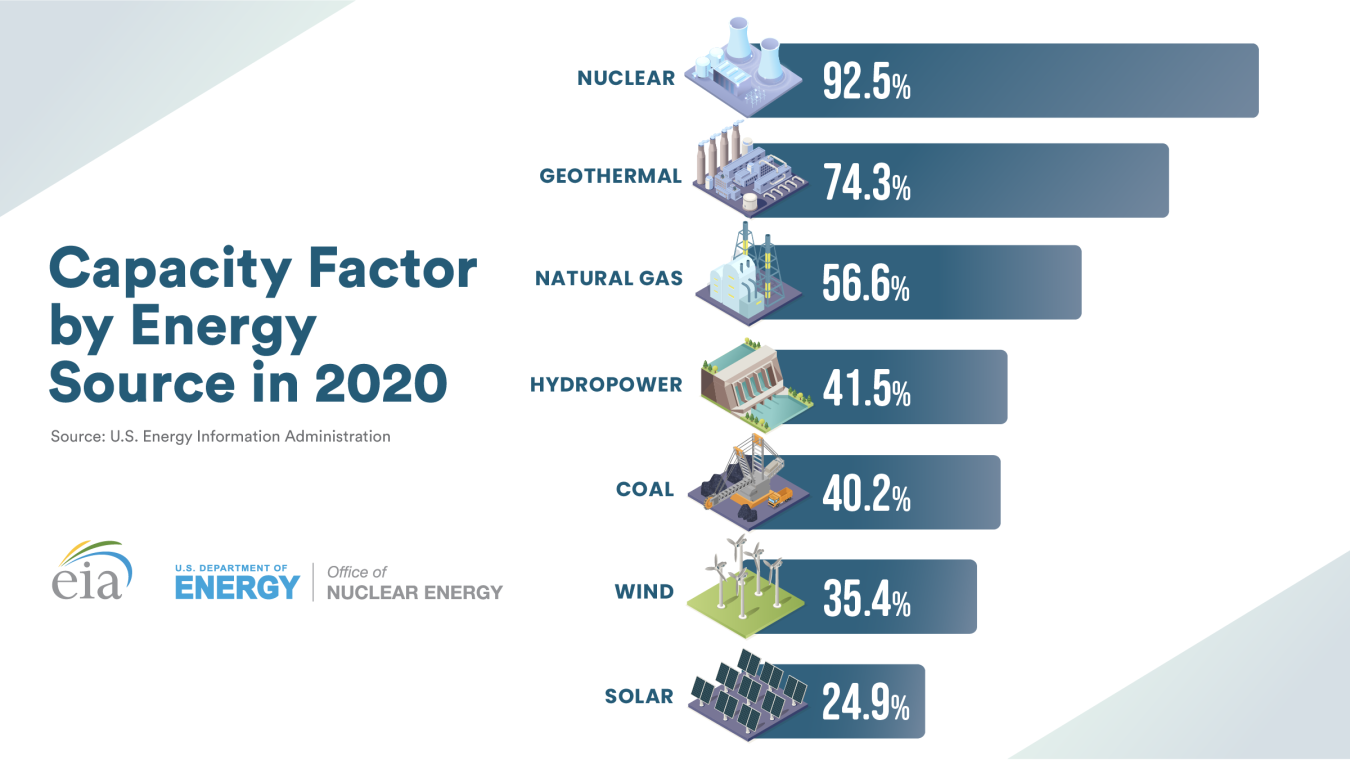
Nuclear Power is the Most Reliable Energy Source and It's Not Even Close March 24, 2021 Nuclear energy is America’s work horse. It’s been rolling up its sleeves for six decades now to provide constant, reliable, carbon-free power to millions of Americans. Just how reliable has nuclear energy been? It has roughly supplied a fifth of America’s power each year since 1990. To better understand what makes nuclear so reliable, take a look at the graph below.
As you can see, nuclear energy has by far the highest capacity factor of any other energy source. This basically means nuclear power plants are producing maximum power more than 93% of the time during the year. That’s about 1.5 to 2 times more as natural gas and coal units, and 2.5 to 3.5 times more reliable than wind and solar plants.


 Market Data
  Markets


 AI
AI