



 AI
AI








Friday, March 03, 2023 2:29:39 PM
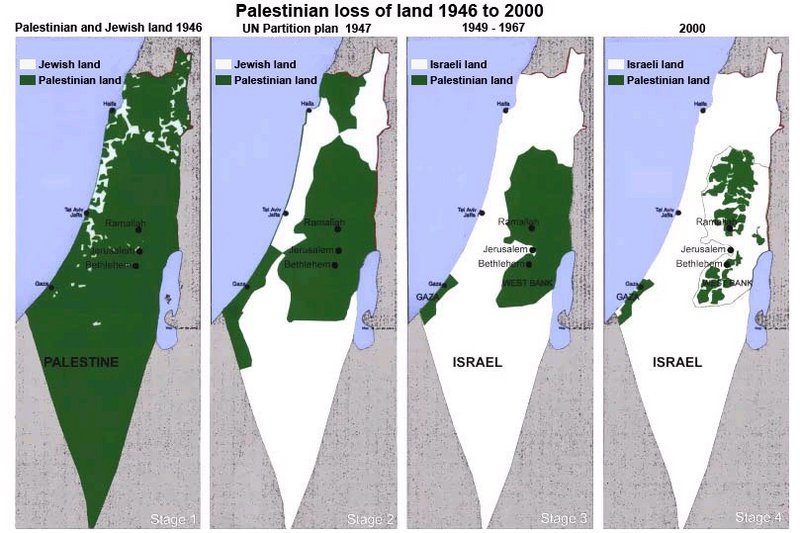
Agree with all of that. It's clear-cut. I think the hard right Israel fascists have had only one goal in mind from the beginning. Greater Israel.
"I've said this for years. Fascists do fascism. It ain't a mystery.
P - Israel claims the entire west bank and controls Gaza. That means half or more of their population has no political or civil rights. There's only one way to maintain such a system. Force. Ever more brutal force.
P - Gideon Levy said years ago that Israel had signed its own death warrant. That is certainly plain to see at this point."
Surely the Israel, as envisaged by the hard right fascists, cannot ever exist in peace. The article below was posted August 2014.
Israel’s target is not Hamas, but Palestinian statehood
[...]
Within three years of the 1993 Oslo declaration, for example, which promised self-governance for Palestinian areas, foreign minister Ariel Sharon was urging “everyone” to “grab as many hilltops as they can” in order to minimise the size and viability of the area to be administered by Palestinian Authority. The 1999 election of a Labour Prime Minister, Ehud Barak, made no difference, ushering in “a sustained commitment by Israel’s government to avoid full compliance with the Oslo agreement”, according to Jimmy Carter, most notably in the form of the greatest increase in illegal Israeli settlements that had yet taken place. The popular story that Barak had made a ‘generous offer’ on Palestinian statehood at negotiations in Taba in 2001, turned out to be a complete myth.
In the 2000s, the stakes were raised by the discovery of 1.4trillion cubic metres of natural gas in Gaza’s territorial waters, leading Israel to immediately strengthen its maritime blockade of Gaza ...
[...]
The Saudi peace plan, then, in 2002, turned out to be something of a problem for Israel. Accepted by 22 members of the Arab League, and offering complete normalisation of Israeli-Arab relations in exchange for a Palestinian state based on the 1967 borders (just 22% of historic Palestine), it was welcomed by the US, and followed up with a statement by George W Bush in support of a Palestinian state - the first such statement by any US president.
[...]
This problem – of a growing consensus in support of a Palestinian state – was compounded for Israel in 2003, when the so-called “Quartet” (US, the UN, Russia and the EU) produced their ‘roadmap’ for peace, based, like the Saudi plan, on the principle of a Palestinian state being a fundamental prerequisite for lasting peace. Whilst the Israelis publicly accepted the ‘roadmap’, behind the scenes they listed 14 ‘caveats’ and preconditions which rendered it meaningless and unworkable - effectively refusing to make any concessions whatsoever until the Palestinians were completely disarmed and their major organisations dissolved, whilst other caveats stripped any ‘state’ that might somehow emerge of all major attributes of statehood and sovereignty, just in case.
Since then, there have been various attempts by the US at restarting ‘negotiations’ on this roadmap, despite Israel’s obvious hostility to its declared aim of Palestinian statehood. In the latest round, beginning in July 2013, the Palestinians - who had already conceded the 78% of historic Palestine conquered before 1967 - even agreed to drop their demand that talks should be based on the 1967 borders. Yet none of this made any difference to Israel, who worked hard to scupper the negotiations as best they could. As historian Avi Shlaim put it, “During the nine months of Israeli-Palestinian peace talks orchestrated by secretary of state John Kerry, Netanyahu did not put forward a single constructive proposal and all the while kept expanding Israeli settlements on the West Bank.
[...]
Israel’s excuse for its reluctance to take negotiations seriously has always rested on two planks: a) Palestinian ‘terrorism’ and b) Palestinian ‘disunity’. Both of these, Israel claims, means it has no ‘partner for peace’; no one to negotiate with - either because they are terrorists, or because there is no single entity representing the Palestinian population who they can talk to. In 2006, following the election of Hamas, the US and EU effectively supported this line, and joined forces with Israel in refusing to recognise Hamas as the governing body of the Palestinian Authority. Likewise, when a unity government was formed with Fatah the following year (combining the two parties who together represented 86% of the popular vote), it was not recognised as legitimate by Israel’s international backers who instead supported a government led by Salam Fayyad, whose party had gained just 2% in the previous year’s election.
However, reaction to the recent unity government announced in April this year was very different. A government of ‘technocrats’ – comprising not a single Hamas member – was endorsed by both Fatah and Hamas in an attempt to end the isolation and strangulation of the Gaza strip. As noted in the Independent at the time, this “new government would “adhere to the conditions of the Middle East Quartet [the EU, UN Russia and US], recognise Israel, ratify all signed agreements and renounce violence” according to a “senior Palestinian official” quoted on the Times of Israel site. As such, it was welcomed by both the US and the EU. Israel no longer had ‘Palestinian disunity’ as an excuse for refusing to engage in peace talks.
Nor did they have ‘terrorism’ as an excuse, as Hamas had steadfastly stood by the terms of the 2012 ceasefire, not only ceasing their own rocket fire, but also successfully preventing rocket attacks by other Palestinian groups in Gaza. And all this despite continuous violations of the ceasefire by Israel beginning before the ink was even dry – from a refusal to lift the blockade (as required by the ceasefire terms), to continued attacks on Palestinians, killing 4 and maiming nearly 100 within the first three months of the ‘ceasefire’ alone. Even after Israeli attacks were stepped up over the past year, with four Palestinian children shot dead by Israeli forces between December 2013 and May 2014, including a 15 year old shot in the back from 100m, Hamas held their fire.
[...]
What Netanyahu really needed was a provocation against Hamas to which they would be forced to respond. Such as response would again allow him to paint them as the bloodthirsty terrorists with whom one can never negotiate, would provide the opportunity for another wave of devastation in Gaza, and would exacerbate tensions within the unity government between Fatah and Hamas.
Nine days after the swearing in of the unity government, on June 11th, the IDF made a raid on Gaza in which they killed a 10 year old boy on a bicycle. But still Hamas held their fire.
The following day, however, the apparent kidnapping of three Israeli settlers in the West Bank provided the opportunity for a provocation on an altogether larger scale. Having blamed the kidnapping on Hamas (without ever producing a scrap of evidence), Netanyahu used it as an excuse for an attack on the entire Hamas leadership in the West Bank,
[...]
Noam Chomsky notes: “The 18-day rampage....did succeed in undermining the feared unity government, and sharply increasing Israeli repression. According to Israeli military sources, Israeli soldiers arrested 419 Palestinians, including 335 affiliated with Hamas, and killed six Palestinians, also searching thousands of locations and confiscating $350,000. Israel also conducted dozens of attacks in Gaza, killing 5 Hamas members on July 7. Hamas finally reacted with its first rockets in 19 months, Israeli officials reported, providing Israel with the pretext for Operation Protective Edge on July 8.” Thus having killed eleven Palestinians in under a month, Israel then used retaliatory rocket attacks which killed no one as an excuse to launch the biggest slaughter of Palestinians in decades.
Operation Protective Edge went on to kill or maim over 12,000 Palestinians over the course of the month that followed. But for Israel, it allowed it to push forward its key aim - prevention the formation of a functioning Palestinian state – on a number of fronts. Firstly, ...
[...]
Trond Husby, head of the UN's development programme in Gaza, was non-committal when asked if he believed Israeli forces were deliberately targeting private businesses in Gaza.
But about the effects of the damage, he was unequivocal. "This is a humanitarian disaster," he said. "I was in Somalia for two years, Sierra Leone for five, and also South Sudan and Uganda, and this beats them all for the level of destruction."”
Finally, as many commentators have noted, even if Israel were successful in its stated aim of destroying or weakening Hamas, this would only result in even more militant groups emerging, perhaps even Al Qaeda type groups such as ISIS, gaining support from a traumatised population by promising revenge attacks and uncompromising armed jihad. Whilst many have argued that this would somehow be against Israel’s interests, the reverse is likely to be true. Groups such as ISIS have played a key role in facilitating US and British policies in the Middle East in recent years, by weakening independent regional powers (or potential regional powers) such as Libya, Syria and now Iraq.
[...]
See also:
Israelis plan new Colonies, Oil Drilling, on Palestinian Land during “Peace Talks”
http://investorshub.advfn.com/boards/read_msg.aspx?message_id=93921477
lolol, think it's about the Greater Israel, not sure if that is about religion .. oh, ok, yeah, of course...
http://investorshub.advfn.com/boards/read_msg.aspx?message_id=104696920
[...]
More -- https://investorshub.advfn.com/boards/read_msg.aspx?message_id=105152514
"I've said this for years. Fascists do fascism. It ain't a mystery.
P - Israel claims the entire west bank and controls Gaza. That means half or more of their population has no political or civil rights. There's only one way to maintain such a system. Force. Ever more brutal force.
P - Gideon Levy said years ago that Israel had signed its own death warrant. That is certainly plain to see at this point."
Surely the Israel, as envisaged by the hard right fascists, cannot ever exist in peace. The article below was posted August 2014.
Israel’s target is not Hamas, but Palestinian statehood
[...]
Within three years of the 1993 Oslo declaration, for example, which promised self-governance for Palestinian areas, foreign minister Ariel Sharon was urging “everyone” to “grab as many hilltops as they can” in order to minimise the size and viability of the area to be administered by Palestinian Authority. The 1999 election of a Labour Prime Minister, Ehud Barak, made no difference, ushering in “a sustained commitment by Israel’s government to avoid full compliance with the Oslo agreement”, according to Jimmy Carter, most notably in the form of the greatest increase in illegal Israeli settlements that had yet taken place. The popular story that Barak had made a ‘generous offer’ on Palestinian statehood at negotiations in Taba in 2001, turned out to be a complete myth.
In the 2000s, the stakes were raised by the discovery of 1.4trillion cubic metres of natural gas in Gaza’s territorial waters, leading Israel to immediately strengthen its maritime blockade of Gaza ...
[...]
The Saudi peace plan, then, in 2002, turned out to be something of a problem for Israel. Accepted by 22 members of the Arab League, and offering complete normalisation of Israeli-Arab relations in exchange for a Palestinian state based on the 1967 borders (just 22% of historic Palestine), it was welcomed by the US, and followed up with a statement by George W Bush in support of a Palestinian state - the first such statement by any US president.
[...]
This problem – of a growing consensus in support of a Palestinian state – was compounded for Israel in 2003, when the so-called “Quartet” (US, the UN, Russia and the EU) produced their ‘roadmap’ for peace, based, like the Saudi plan, on the principle of a Palestinian state being a fundamental prerequisite for lasting peace. Whilst the Israelis publicly accepted the ‘roadmap’, behind the scenes they listed 14 ‘caveats’ and preconditions which rendered it meaningless and unworkable - effectively refusing to make any concessions whatsoever until the Palestinians were completely disarmed and their major organisations dissolved, whilst other caveats stripped any ‘state’ that might somehow emerge of all major attributes of statehood and sovereignty, just in case.
Since then, there have been various attempts by the US at restarting ‘negotiations’ on this roadmap, despite Israel’s obvious hostility to its declared aim of Palestinian statehood. In the latest round, beginning in July 2013, the Palestinians - who had already conceded the 78% of historic Palestine conquered before 1967 - even agreed to drop their demand that talks should be based on the 1967 borders. Yet none of this made any difference to Israel, who worked hard to scupper the negotiations as best they could. As historian Avi Shlaim put it, “During the nine months of Israeli-Palestinian peace talks orchestrated by secretary of state John Kerry, Netanyahu did not put forward a single constructive proposal and all the while kept expanding Israeli settlements on the West Bank.
[...]
Israel’s excuse for its reluctance to take negotiations seriously has always rested on two planks: a) Palestinian ‘terrorism’ and b) Palestinian ‘disunity’. Both of these, Israel claims, means it has no ‘partner for peace’; no one to negotiate with - either because they are terrorists, or because there is no single entity representing the Palestinian population who they can talk to. In 2006, following the election of Hamas, the US and EU effectively supported this line, and joined forces with Israel in refusing to recognise Hamas as the governing body of the Palestinian Authority. Likewise, when a unity government was formed with Fatah the following year (combining the two parties who together represented 86% of the popular vote), it was not recognised as legitimate by Israel’s international backers who instead supported a government led by Salam Fayyad, whose party had gained just 2% in the previous year’s election.
However, reaction to the recent unity government announced in April this year was very different. A government of ‘technocrats’ – comprising not a single Hamas member – was endorsed by both Fatah and Hamas in an attempt to end the isolation and strangulation of the Gaza strip. As noted in the Independent at the time, this “new government would “adhere to the conditions of the Middle East Quartet [the EU, UN Russia and US], recognise Israel, ratify all signed agreements and renounce violence” according to a “senior Palestinian official” quoted on the Times of Israel site. As such, it was welcomed by both the US and the EU. Israel no longer had ‘Palestinian disunity’ as an excuse for refusing to engage in peace talks.
Nor did they have ‘terrorism’ as an excuse, as Hamas had steadfastly stood by the terms of the 2012 ceasefire, not only ceasing their own rocket fire, but also successfully preventing rocket attacks by other Palestinian groups in Gaza. And all this despite continuous violations of the ceasefire by Israel beginning before the ink was even dry – from a refusal to lift the blockade (as required by the ceasefire terms), to continued attacks on Palestinians, killing 4 and maiming nearly 100 within the first three months of the ‘ceasefire’ alone. Even after Israeli attacks were stepped up over the past year, with four Palestinian children shot dead by Israeli forces between December 2013 and May 2014, including a 15 year old shot in the back from 100m, Hamas held their fire.
[...]
What Netanyahu really needed was a provocation against Hamas to which they would be forced to respond. Such as response would again allow him to paint them as the bloodthirsty terrorists with whom one can never negotiate, would provide the opportunity for another wave of devastation in Gaza, and would exacerbate tensions within the unity government between Fatah and Hamas.
Nine days after the swearing in of the unity government, on June 11th, the IDF made a raid on Gaza in which they killed a 10 year old boy on a bicycle. But still Hamas held their fire.
The following day, however, the apparent kidnapping of three Israeli settlers in the West Bank provided the opportunity for a provocation on an altogether larger scale. Having blamed the kidnapping on Hamas (without ever producing a scrap of evidence), Netanyahu used it as an excuse for an attack on the entire Hamas leadership in the West Bank,
[...]
Noam Chomsky notes: “The 18-day rampage....did succeed in undermining the feared unity government, and sharply increasing Israeli repression. According to Israeli military sources, Israeli soldiers arrested 419 Palestinians, including 335 affiliated with Hamas, and killed six Palestinians, also searching thousands of locations and confiscating $350,000. Israel also conducted dozens of attacks in Gaza, killing 5 Hamas members on July 7. Hamas finally reacted with its first rockets in 19 months, Israeli officials reported, providing Israel with the pretext for Operation Protective Edge on July 8.” Thus having killed eleven Palestinians in under a month, Israel then used retaliatory rocket attacks which killed no one as an excuse to launch the biggest slaughter of Palestinians in decades.
Operation Protective Edge went on to kill or maim over 12,000 Palestinians over the course of the month that followed. But for Israel, it allowed it to push forward its key aim - prevention the formation of a functioning Palestinian state – on a number of fronts. Firstly, ...
[...]
Trond Husby, head of the UN's development programme in Gaza, was non-committal when asked if he believed Israeli forces were deliberately targeting private businesses in Gaza.
But about the effects of the damage, he was unequivocal. "This is a humanitarian disaster," he said. "I was in Somalia for two years, Sierra Leone for five, and also South Sudan and Uganda, and this beats them all for the level of destruction."”
Finally, as many commentators have noted, even if Israel were successful in its stated aim of destroying or weakening Hamas, this would only result in even more militant groups emerging, perhaps even Al Qaeda type groups such as ISIS, gaining support from a traumatised population by promising revenge attacks and uncompromising armed jihad. Whilst many have argued that this would somehow be against Israel’s interests, the reverse is likely to be true. Groups such as ISIS have played a key role in facilitating US and British policies in the Middle East in recent years, by weakening independent regional powers (or potential regional powers) such as Libya, Syria and now Iraq.
[...]
See also:
Israelis plan new Colonies, Oil Drilling, on Palestinian Land during “Peace Talks”
http://investorshub.advfn.com/boards/read_msg.aspx?message_id=93921477
lolol, think it's about the Greater Israel, not sure if that is about religion .. oh, ok, yeah, of course...
http://investorshub.advfn.com/boards/read_msg.aspx?message_id=104696920
[...]
More -- https://investorshub.advfn.com/boards/read_msg.aspx?message_id=105152514
It was Plato who said, “He, O men, is the wisest, who like Socrates, knows that his wisdom is in truth worth nothing”
Discover What Traders Are Watching
Explore small cap ideas before they hit the headlines.



