



 AI
AI








Wednesday, March 01, 2023 10:57:28 PM
The real role of pro-Russian Chechens in Ukraine
"We've read many in Russian intelligence are not enamored with Kadyrov, so the suggestion some are working against
him is thoroughly believable. Also, i'd guess many in the FSB would be unhappy with Putin going to war so recklessly.
Is Chechnya Taking Over Russia?"
Known as Kadyrovtsy after their leader Ramzan Kadyrov, the fighters are said to be brutal but delusional about their abilities.
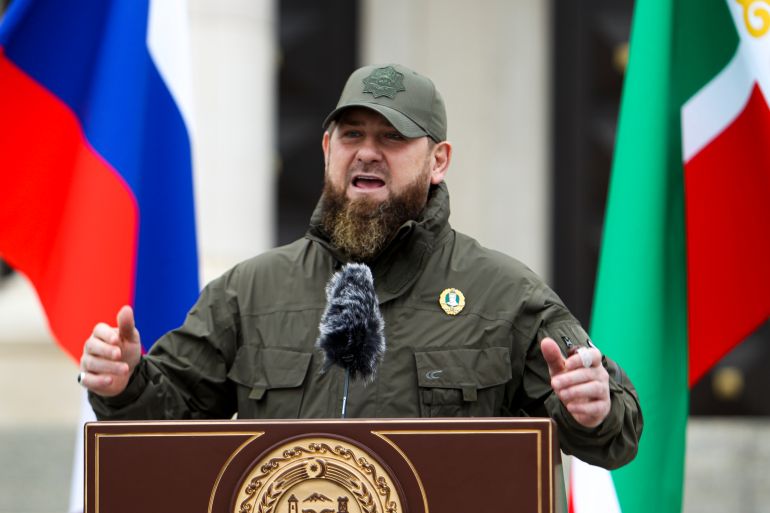
Chechnya's regional leader Ramzan Kadyrov addresses servicemen in Grozny, the capital of the Chechen
Republic, Russia, on February 25, 2022, the day after Moscow's troops invaded Ukraine
[Musa Sadulayev/AP]
By Mansur Mirovalev
Published On 18 Aug 202218 Aug 2022
Bucha, Ukraine – Most of the Russian servicemen sitting in and atop 34 armed personnel carriers that rolled into Bucha on February 27 were ethnic Chechens, according to Ukrainian military leaders and government officials.
[Insert: ‘Look, these are our boys’: Ukrainian troops drive Russian tanks on new front line
[...]While evacuating with her mother, Udovik was asked if she knew about the atrocities Russian soldiers committed against civilians in Bucha, including torture and killings – what had been major international news in April. Udovik shook her head.
P - “Bucha?” Udovik said. “I think I heard something about it, but I’m not sure.” The Russian channels she sometimes watched focused instead on how Europe might be facing an energy crisis this winter with Russian natural gas flows cut, she said.
https://investorshub.advfn.com/boards/read_msg.aspx?message_id=170163868]
Bearded and burly, clad in brand new, perfectly fitting uniforms and toting assault rifles, they hoped to whiz through the leafy suburb northwest of Kyiv to enter the Ukrainian capital on the war’s third day.
Keep reading
* Crimea ‘sabotage’ highlights Russia’s woes in Ukraine war
https://www.aljazeera.com/news/2022/8/17/crimea-sabotage-highlights-russias-woes-in-ukraine-war?traffic_source=KeepReading
* The Ukrainian Muslims fighting against Russia
https://www.aljazeera.com/features/2022/8/4/the-ukrainian-muslims-fighting-against-russia?traffic_source=KeepReading
* What role is Chechnya’s Ramzan Kadyrov playing in Ukraine war?
[Chechen forces deployed in Ukraine appear to be more of a ‘PR initiative’
than military utility, analysts say.]
https://www.aljazeera.com/news/2022/3/24/what-role-is-chechnyas-ramzan-kadyrov-playing-in-ukraine?traffic_source=KeepReading
* Chechen leader Kadyrov claims he travelled to Ukraine
https://www.aljazeera.com/news/2022/3/14/chechen-leader-kadyrov-says-he-travelled-to-ukraine?traffic_source=KeepReading
They are known as “Kadyrovtsy” or “Kadyrovites” after their leader, Ramzan Kadyrov, Chechnya’s pro-Kremlin strongman, and their reputation preceded them.
Human rights groups, witnesses and survivors have for decades accused them of extrajudicial killings, kidnappings and the torture of Kadyrov’s rivals and critics, as well as targeting religious hardliners and LGBTQ Chechens.
And in the month before the war, Kadyrov underwent a public relations disaster.
In January, during a campaign to silence his critics through intimidation of their relatives, these Kadyrov loyalists abducted Zarema Musaeva, the mother of a judge who lambasted Kadyrov, forcibly taking her from the western Russian city of Nizhny Novgorod to Chechnya.
[The War in Ukraine Is the End of a World
A shroud is settling over the dreams many of us had at the end of the 20th century
https://investorshub.advfn.com/boards/read_msg.aspx?message_id=171284882.]
An online petition to dismiss Kadyrov, posted in September by the now-jailed opposition leader Ilya Yashin, was signed by hundreds of thousands of people – a rare thing in President Vladimir Putin’s increasingly authoritarian Russia.
The ruler of Chechnya desperately needed to mend his tarnished image.
He deployed his troops, who are officially part of the National Guard of Russia, to spearhead a blitzkrieg of Ukraine, hoping to boast of their triumph in the Kremlin and on national television.
“Active participation in the assault in the first days of war was a public-relations need” for Kadyrov, Mykhailo Savva of Euromaidan-SOS, a Ukrainian rights group documenting Russian servicemen’s alleged atrocities, told Al Jazeera.
“Kadyrov wanted his people to seize Kyiv,” said Savva, who spent the first weeks of the war in the occupied suburbs along the strategic Zhytomyr highway that links Kyiv with central Ukraine.

A Russian armored vehicle outside Bucha Mansur [Mansur Mirovalev/Al Jazeera]
Two days before the column entered Bucha, Kadyrov addressed 12,000 servicemen in Chechnya’s administrative capital, Grozny, ordering them to storm Kyiv. He also issued a vaguely worded warning to anyone else opposed to Putin.
“Now Kyiv, and then whoever is going to mess with our side,” he said.
At least 1,200 Kadyrovtsy entered Ukraine in late February, according to Ukrainian intelligence, and hundreds more are believed to have joined them later.
Defending Bucha
The Kadyrovtsy – and a few ethnic Russian servicemen, according to the identity cards retrieved from their bodies later – started moving towards Bucha in the morning of February 27.
They hoped to join a bigger column on the Zhytomyr highway and advance on Kyiv. Sitting on the vehicles, the Kadyrovtsy were so carefree that they were singing Sufi religious chants.
But their easy ride came to a screeching halt.
“I heard them. And I was killing them,” Bogdan Yavorsky told Al Jazeera.
The lanky 39-year-old, who has two degrees and owns a small transportation company, was one of 22 Ukrainian volunteers from Bucha, aided by war veterans from central Ukraine, who ambushed the column at an intersection in the suburb.
Eight volunteers had nothing but Molotov cocktails. The rest had AK-74 assault rifles, a grenade launcher and 10 smaller, disposable anti-tank grenade launchers they had just learned how to use.

The bridge from Kyiv to Irpin was destroyed by Russian forces in early March [Mansur Mirovalev/Al Jazeera]
They fired the rifles to distract the Kadyrovtsy, hit two armoured personnel carriers APCs with grenades immobilising the column – and showered them with Molotov cocktails.
The Chechens returned fire with their APCs’ cannons, machine guns and assault rifles making the air thick with bullets, Yavorsky recalled.
They killed one of the Ukrainians, a disabled war veteran who had lost two feet while fighting separatists in the southeastern Donbas region, and wounded several more.
But the Ukrainians, who almost ran out of bullets, managed to drag the wounded to their cars and sped away from the Kadyrovtsy, who pursued them on foot and in the APCs.
During the chase, Yavorsky called an air raid on the column, and two Ukrainian fighter jets bombed it, destroying 12 APCs.

Bogdan Yavorsky, a Ukrainian businessman who battled Russian forces, shows a spot in Bucha where
he fought ‘Kadyrovtsy’ fighters on February 27 [Mansur Mirovalev/Al Jazeera]
“We showed this TikTok army who they are,” said Yavorsky, referring to the dozens of slick videos the Kadyrovtsy have posted on social media on their role in the war.
Observers say the videos are staged and aimed at a domestic audience and portray Kadyrov as a politician to be dreaded.
“He needs advertising to maintain his horrifying image, the image of ‘Putin’s foot soldier’ who is especially close [to Putin],” Pavel Luzin, a Russia-based defence analyst with the Jamestown Foundation, a think-tank in Washington, DC, told Al Jazeera.
Ukrainian media ridiculed the footage for months.
“Kadyrov’s TikTok forces posted a video of their real fight with a traffic light and an empty building,” one headline read.
Russian media, meanwhile, readily used the videos in their reporting, helping Kadyrov create the illusion that his troops played a key role in the invasion.
According to a former Russian mercenary who fought next to Chechen fighters in Syria, none of the videos shows any well-calculated military action and are mostly set up.
“Their success is definitely inflated, I think that they added very little to the military potential of invading forces,” said Marat Gabidullin, who commanded a squad of the Wagner private army that fought for President Bashar al-Assad’s government.
“They never were an active, formidable military force. They have never been used as assault groups,” Gabidullin, who has written .. https://www.amazon.com/Moi-Marat-ex-commandant-larm%C3%A9e-Wagner/dp/2749950287/ref=sr_1_1?keywords=moi+marat%2C+ex-commandant+de+l%27armee+wagner&qid=1660658183&sprefix=moi+marat%2Caps%2C174&sr=8-1 .. about his experiences, told Al Jazeera.
He claimed that a squad of Kadyrovtsy joined the Wagner group in Syria at Kadyrov’s request, but was disbanded after they panicked during their first encounter with anti-Assad rebels.
Gabidullin said that while some ethnic Chechens were “excellent warriors”, Kadyrovtsy are not that brave and battle-ready.
[----------
The First Chechen War, also known as the First Chechen Campaign,[22][23][24] or the First Russian-Chechen war, was a war of independence which the Chechen Republic of Ichkeria waged against the Russian Federation from December 1994 to August 1996. The first war was preceded by the Russian Intervention in Ichkeria, in which Russia tried covertly to overthrow the Ichkerian government. After the initial campaign of 1994–1995, culminating in the devastating Battle of Grozny, Russian federal forces attempted to seize control of the mountainous area of Chechnya, but they faced heavy resistance from Chechen guerrillas and raids on the flatlands. Despite Russia's overwhelming advantages in firepower, manpower, weaponry, artillery, combat vehicles, airstrikes and air support, the resulting widespread demoralization of federal forces and the almost universal opposition to the conflict by the Russian public led Boris Yeltsin's government to declare a ceasefire with the Chechens in 1996, and finally, it signed a peace treaty in 1997.
https://en.wikipedia.org/wiki/First_Chechen_War - 1.5 years
----------]
“There are no normal warriors next to [Kadyrov], only sycophants who calculated the strong side. Strong ones won’t follow a man of this kind,” he said.

A bullet-riddled glass wall of a McDonald’s restaurant in Bucha
[Mansur Mirovalev/Al Jazeera]
The Kremlin has reportedly been far from enthusiastic about the way they fight.
“They didn’t coordinate their action with anybody, they moved chaotically citing orders from Kadyrov or his coterie,” a Kremlin official told the Kit online publication.
A separatist strongman fighting in the then-besieged southeastern city of Mariupol, lambasted the Kadyrovtsy as a “motley crew.”
“They are not prepared and not equipped in accordance with the [military] goals,” Alexander Khodakovsky wrote on the social messaging app Telegram in mid-March.
But after one of Kadyrov’s allies paid a visit to Khodakovsky, he apologised for his words and said on camera that the Kadyrovtsy “know what they’re doing.”
In the days after the war began, Kadyrov realised that seizing Kyiv was impossible – and did a U-turn on his troops’ strategy.
“They guarded the rear, purged occupied territories and played the role of ‘blocking detachments’” like the Soviet secret police that shot at the retreating infantry during World War II, Euromaidan-SOS’s Savva said.
“Our task is to chase back those lousy soldiers, when they start running away from artillery strikes,” a Chechen fighter told his wife, referring to Russian troops, according to a phone conversation intercepted by Ukrainian intelligence in late March.
They were also ordered to help evacuate wounded Russian soldiers – and, on at least one occasion, did the opposite, a Ukrainian intelligence official said.
On March 12, instead of evacuating 12 ethnic Russian servicemen, Kadyrovtsy reportedly shot them dead.
“This is the attitude of Chechens who treat Russians like second- or third-rate people,” Ukraine’s National Security Council chief Oleksiy Danilov said in televised remarks. “That’s all you need to know about Russia.”
War crimes and torture
The Kadyrovtsy have contributed to the killings of hundreds of civilians in Bucha, other Kyiv suburbs and occupied areas, according to survivors, police, officials and rights groups.
“My neighbour had his bike taken and went to the Russians to ask for it back. A bearded Chechen killed him on the spot just for opening his mouth,” a resident of one of the villages near Kyiv told Al Jazeera,.
In early March, the Kadyrovtsy fighters shot dead Yuri Prilipko, a community leader in the occupied town of Hostomel, while he was delivering bread to town residents, Hostomel’s authorities said on Facebook.
The Slidstvo.info investigative journalism website reported that the Kadyrovtsy planted a booby trap on Prilipko’s body.
Sometimes, the fighters capture alleged war crimes on video.
Apti Alaudinov, a top security official in Chechnya, posted a video in mid-June showing a badly beaten and bruised Ukrainian serviceman.
The apparently harrowing, unprovoked and erratic violence committed by them and other Russian servicemen directly stems from the two wars between Chechen separatists and federal forces.
Both sides have committed war crimes such as summary executions, mutilation, torture and rape.

Remnants of a wooden hut built by Russian servicemen in a forest outside Bucha
[Mansur Mirovalev/Al Jazeera]
Even after the Kremlin declared the end of the second Chechen war in 2009, thousands of police officers and servicemen from across Russia were deployed to the war-scarred province for two-month tours.
They took part in arbitrary killings and the torture of alleged religious hardliners – and eagerly used their new skills at home.
“The Chechen wars were not only a traumatic experience both for Russians and Chechens, they also brutalised Russian society,” Ivar Dale, a senior policy adviser with the Norwegian Helsinki Committee, a rights watchdog, told Al Jazeera.
“Some of that violence and brutality that was normalised by this experience contributed to the horrific violence we are seeing in Ukraine today,” he said.
Kadyrovtsy transplanted the violence and brutality “in their most brutal form to the temporarily occupied areas of Ukraine,” the European Union’s Parliamentary Assembly said in a report in June.
Their role in the siege of Mariupol “is symptomatic for the brutalisation of the treatment of opponents that began in the two Chechen wars,” it said.
State within a state
Kadyrov calls himself Putin’s “foot soldier” and enjoys lavish funding from Moscow, which he reportedly spends with next-to-no control.
While one of the war’s most vocal proponents, he is sometimes shockingly ignorant about Ukraine’s history and current affairs.
In March, he ordered his men to kill Stepan Bandera, a fiercely anti-Russian nationalist leader and Nazi collaborator lionised in Ukraine.
Alas, Bandera had already been killed – by a KGB assassin, in Munich, in 1959.
Kadyrov’s Chechnya is a Kuwait-sized mountainous province with a population of less than 1.5 million.

A dugout built by Russian servicemen outside Bucha [Mansur Mirovalev/Al Jazeera]
But apart from ruling Chechnya like his personal fief, Kadyrov punches way above his political weight.
He boasts personal friendship with Putin, reprimands federal ministers and top officials – often forcing them to apologise on camera, and has an opinion about almost anything related to Islam in Russia.
The son of a Sufi Muslim cleric who sided with Chechen separatists in the 1990s and declared a “jihad” on Moscow, he reportedly boasted of killing his first Russian soldier at age 16.
But then his father, Akhmad Kadyrov, switched sides and allied with Russia during the second Chechen war that began in 1999 and propelled then-newly appointed Prime Minister Vladimir Putin to the presidency.
[----------
The Second Chechen War (Russian: ?????´? ????´????? ?????´, Chechen: ????I? ???????-??????? ????, lit.?'Second Russian-Chechen War'[24]) took place in Chechnya and the border regions of the North Caucasus between the Russian Federation and the Chechen Republic of Ichkeria, from August 1999 to April 2009. In August 1999, Islamist fighters from Chechnya infiltrated Russia's Dagestan region, violating Russia's borders. During the initial campaign, Russian military and pro-Russian Chechen paramilitary forces faced Chechen separatists in open combat and seized the Chechen capital Grozny after a winter siege that lasted from December 1999 until February 2000. Russia established direct rule over Chechnya in May 2000 although Chechen militant resistance throughout the North Caucasus region continued to inflict heavy Russian casualties and challenge Russian political control over Chechnya for several years. Both sides carried out attacks against civilians. These attacks drew international condemnation.
In mid-2000, the Russian government transferred certain military responsibilities to pro-Russian Chechen forces. The military phase of operations was terminated in April 2002, and the coordination of the field operations was given first to the Federal Security Service and then to the Ministry of Internal Affairs in the summer of 2003.
By 2009, Russia had severely disabled the Chechen separatist movement and large-scale fighting ceased. Russian army and Interior Ministry troops ceased patrolling. Grozny underwent reconstruction efforts and much of the city and surrounding areas were rebuilt quickly. Sporadic violence continued in the North Caucasus; occasional bombings and ambushes against federal troops and forces of the regional governments in the area still occur.
https://en.wikipedia.org/wiki/Second_Chechen_War -- 10 years
----------]
After an explosion killed Akhmad Kadyrov in 2004, Ramzan replaced him – and destroyed the traditional system of checks and balances among Chechen clans.
Human rights groups claimed Kadyrov’s paramilitary forces terrorised, abducted and killed innocent civilians, claiming they were Muslim rebels.
Almost a dozen of his political enemies and critics, including two women, have been brutally killed but Kadyrov denied any role in their death.
Under him, Chechnya became “a totalitarian part of Russia,” human rights advocate Lev Ponomaryov told Al Jazeera in 2015.
Kadyrov has praised so-called “honour” killings and polygamy, banned the sale of alcohol in Chechnya and enforced a dress code on Chechen women.
“All the human rights you can imagine are being violated, laws are not being enacted, and if some things run according to the Russian legislation it’s just because Kadyrov said so,” Ponomaryov said.
Third Chechen war?
Looking ahead, many in Ukraine believe that Kadyrov wants Chechnya to secede from Russia after Putin’s death – and therefore wants his troops to get first-hand battlefield experience.
“He wants to get his personal army ready for a war in Russia. He wants to fight after Putin is gone,” SOS-Maidan’s Savva said.
In 2008, during Russia’s war with Georgia, this reporter saw Chechen servicemen fighting.
[Note that was during the end of the Second Chechen War.]
They crossed the Greater Caucasus Range into the breakaway Georgian province of South Ossetia with dozens of APCs.
An ethnic Chechen photographer addressed one of the officers sitting on one of the APCs.
“Hey, child of Noah [a respectful sobriquet among Chechens], who are you fighting for?” the photographer asked.
“For Russians. For now,” the officer replied, and his subordinates started laughing.

A sign saying ‘Complete apartments’ on a damaged building in Irpin, in the Kyiv region
[Mansur Mirovalev/Al Jazeera]
Source: Al Jazeera
https://www.aljazeera.com/news/2022/8/18/the-real-role-of-pro-russian-chechens-in-ukraine
"We've read many in Russian intelligence are not enamored with Kadyrov, so the suggestion some are working against
him is thoroughly believable. Also, i'd guess many in the FSB would be unhappy with Putin going to war so recklessly.
Is Chechnya Taking Over Russia?"
Known as Kadyrovtsy after their leader Ramzan Kadyrov, the fighters are said to be brutal but delusional about their abilities.
Chechnya's regional leader Ramzan Kadyrov addresses servicemen in Grozny, the capital of the Chechen
Republic, Russia, on February 25, 2022, the day after Moscow's troops invaded Ukraine
[Musa Sadulayev/AP]
By Mansur Mirovalev
Published On 18 Aug 202218 Aug 2022
Bucha, Ukraine – Most of the Russian servicemen sitting in and atop 34 armed personnel carriers that rolled into Bucha on February 27 were ethnic Chechens, according to Ukrainian military leaders and government officials.
[Insert: ‘Look, these are our boys’: Ukrainian troops drive Russian tanks on new front line
[...]While evacuating with her mother, Udovik was asked if she knew about the atrocities Russian soldiers committed against civilians in Bucha, including torture and killings – what had been major international news in April. Udovik shook her head.
P - “Bucha?” Udovik said. “I think I heard something about it, but I’m not sure.” The Russian channels she sometimes watched focused instead on how Europe might be facing an energy crisis this winter with Russian natural gas flows cut, she said.
https://investorshub.advfn.com/boards/read_msg.aspx?message_id=170163868]
Bearded and burly, clad in brand new, perfectly fitting uniforms and toting assault rifles, they hoped to whiz through the leafy suburb northwest of Kyiv to enter the Ukrainian capital on the war’s third day.
Keep reading
* Crimea ‘sabotage’ highlights Russia’s woes in Ukraine war
https://www.aljazeera.com/news/2022/8/17/crimea-sabotage-highlights-russias-woes-in-ukraine-war?traffic_source=KeepReading
* The Ukrainian Muslims fighting against Russia
https://www.aljazeera.com/features/2022/8/4/the-ukrainian-muslims-fighting-against-russia?traffic_source=KeepReading
* What role is Chechnya’s Ramzan Kadyrov playing in Ukraine war?
[Chechen forces deployed in Ukraine appear to be more of a ‘PR initiative’
than military utility, analysts say.]
https://www.aljazeera.com/news/2022/3/24/what-role-is-chechnyas-ramzan-kadyrov-playing-in-ukraine?traffic_source=KeepReading
* Chechen leader Kadyrov claims he travelled to Ukraine
https://www.aljazeera.com/news/2022/3/14/chechen-leader-kadyrov-says-he-travelled-to-ukraine?traffic_source=KeepReading
They are known as “Kadyrovtsy” or “Kadyrovites” after their leader, Ramzan Kadyrov, Chechnya’s pro-Kremlin strongman, and their reputation preceded them.
Human rights groups, witnesses and survivors have for decades accused them of extrajudicial killings, kidnappings and the torture of Kadyrov’s rivals and critics, as well as targeting religious hardliners and LGBTQ Chechens.
And in the month before the war, Kadyrov underwent a public relations disaster.
In January, during a campaign to silence his critics through intimidation of their relatives, these Kadyrov loyalists abducted Zarema Musaeva, the mother of a judge who lambasted Kadyrov, forcibly taking her from the western Russian city of Nizhny Novgorod to Chechnya.
[The War in Ukraine Is the End of a World
A shroud is settling over the dreams many of us had at the end of the 20th century
https://investorshub.advfn.com/boards/read_msg.aspx?message_id=171284882.]
An online petition to dismiss Kadyrov, posted in September by the now-jailed opposition leader Ilya Yashin, was signed by hundreds of thousands of people – a rare thing in President Vladimir Putin’s increasingly authoritarian Russia.
The ruler of Chechnya desperately needed to mend his tarnished image.
He deployed his troops, who are officially part of the National Guard of Russia, to spearhead a blitzkrieg of Ukraine, hoping to boast of their triumph in the Kremlin and on national television.
“Active participation in the assault in the first days of war was a public-relations need” for Kadyrov, Mykhailo Savva of Euromaidan-SOS, a Ukrainian rights group documenting Russian servicemen’s alleged atrocities, told Al Jazeera.
“Kadyrov wanted his people to seize Kyiv,” said Savva, who spent the first weeks of the war in the occupied suburbs along the strategic Zhytomyr highway that links Kyiv with central Ukraine.

A Russian armored vehicle outside Bucha Mansur [Mansur Mirovalev/Al Jazeera]
Two days before the column entered Bucha, Kadyrov addressed 12,000 servicemen in Chechnya’s administrative capital, Grozny, ordering them to storm Kyiv. He also issued a vaguely worded warning to anyone else opposed to Putin.
“Now Kyiv, and then whoever is going to mess with our side,” he said.
At least 1,200 Kadyrovtsy entered Ukraine in late February, according to Ukrainian intelligence, and hundreds more are believed to have joined them later.
Defending Bucha
The Kadyrovtsy – and a few ethnic Russian servicemen, according to the identity cards retrieved from their bodies later – started moving towards Bucha in the morning of February 27.
They hoped to join a bigger column on the Zhytomyr highway and advance on Kyiv. Sitting on the vehicles, the Kadyrovtsy were so carefree that they were singing Sufi religious chants.
But their easy ride came to a screeching halt.
“I heard them. And I was killing them,” Bogdan Yavorsky told Al Jazeera.
The lanky 39-year-old, who has two degrees and owns a small transportation company, was one of 22 Ukrainian volunteers from Bucha, aided by war veterans from central Ukraine, who ambushed the column at an intersection in the suburb.
Eight volunteers had nothing but Molotov cocktails. The rest had AK-74 assault rifles, a grenade launcher and 10 smaller, disposable anti-tank grenade launchers they had just learned how to use.

The bridge from Kyiv to Irpin was destroyed by Russian forces in early March [Mansur Mirovalev/Al Jazeera]
They fired the rifles to distract the Kadyrovtsy, hit two armoured personnel carriers APCs with grenades immobilising the column – and showered them with Molotov cocktails.
The Chechens returned fire with their APCs’ cannons, machine guns and assault rifles making the air thick with bullets, Yavorsky recalled.
They killed one of the Ukrainians, a disabled war veteran who had lost two feet while fighting separatists in the southeastern Donbas region, and wounded several more.
But the Ukrainians, who almost ran out of bullets, managed to drag the wounded to their cars and sped away from the Kadyrovtsy, who pursued them on foot and in the APCs.
During the chase, Yavorsky called an air raid on the column, and two Ukrainian fighter jets bombed it, destroying 12 APCs.

Bogdan Yavorsky, a Ukrainian businessman who battled Russian forces, shows a spot in Bucha where
he fought ‘Kadyrovtsy’ fighters on February 27 [Mansur Mirovalev/Al Jazeera]
“We showed this TikTok army who they are,” said Yavorsky, referring to the dozens of slick videos the Kadyrovtsy have posted on social media on their role in the war.
Observers say the videos are staged and aimed at a domestic audience and portray Kadyrov as a politician to be dreaded.
“He needs advertising to maintain his horrifying image, the image of ‘Putin’s foot soldier’ who is especially close [to Putin],” Pavel Luzin, a Russia-based defence analyst with the Jamestown Foundation, a think-tank in Washington, DC, told Al Jazeera.
Ukrainian media ridiculed the footage for months.
“Kadyrov’s TikTok forces posted a video of their real fight with a traffic light and an empty building,” one headline read.
Russian media, meanwhile, readily used the videos in their reporting, helping Kadyrov create the illusion that his troops played a key role in the invasion.
According to a former Russian mercenary who fought next to Chechen fighters in Syria, none of the videos shows any well-calculated military action and are mostly set up.
“Their success is definitely inflated, I think that they added very little to the military potential of invading forces,” said Marat Gabidullin, who commanded a squad of the Wagner private army that fought for President Bashar al-Assad’s government.
“They never were an active, formidable military force. They have never been used as assault groups,” Gabidullin, who has written .. https://www.amazon.com/Moi-Marat-ex-commandant-larm%C3%A9e-Wagner/dp/2749950287/ref=sr_1_1?keywords=moi+marat%2C+ex-commandant+de+l%27armee+wagner&qid=1660658183&sprefix=moi+marat%2Caps%2C174&sr=8-1 .. about his experiences, told Al Jazeera.
He claimed that a squad of Kadyrovtsy joined the Wagner group in Syria at Kadyrov’s request, but was disbanded after they panicked during their first encounter with anti-Assad rebels.
Gabidullin said that while some ethnic Chechens were “excellent warriors”, Kadyrovtsy are not that brave and battle-ready.
[----------
The First Chechen War, also known as the First Chechen Campaign,[22][23][24] or the First Russian-Chechen war, was a war of independence which the Chechen Republic of Ichkeria waged against the Russian Federation from December 1994 to August 1996. The first war was preceded by the Russian Intervention in Ichkeria, in which Russia tried covertly to overthrow the Ichkerian government. After the initial campaign of 1994–1995, culminating in the devastating Battle of Grozny, Russian federal forces attempted to seize control of the mountainous area of Chechnya, but they faced heavy resistance from Chechen guerrillas and raids on the flatlands. Despite Russia's overwhelming advantages in firepower, manpower, weaponry, artillery, combat vehicles, airstrikes and air support, the resulting widespread demoralization of federal forces and the almost universal opposition to the conflict by the Russian public led Boris Yeltsin's government to declare a ceasefire with the Chechens in 1996, and finally, it signed a peace treaty in 1997.
https://en.wikipedia.org/wiki/First_Chechen_War - 1.5 years
----------]
“There are no normal warriors next to [Kadyrov], only sycophants who calculated the strong side. Strong ones won’t follow a man of this kind,” he said.

A bullet-riddled glass wall of a McDonald’s restaurant in Bucha
[Mansur Mirovalev/Al Jazeera]
The Kremlin has reportedly been far from enthusiastic about the way they fight.
“They didn’t coordinate their action with anybody, they moved chaotically citing orders from Kadyrov or his coterie,” a Kremlin official told the Kit online publication.
A separatist strongman fighting in the then-besieged southeastern city of Mariupol, lambasted the Kadyrovtsy as a “motley crew.”
“They are not prepared and not equipped in accordance with the [military] goals,” Alexander Khodakovsky wrote on the social messaging app Telegram in mid-March.
But after one of Kadyrov’s allies paid a visit to Khodakovsky, he apologised for his words and said on camera that the Kadyrovtsy “know what they’re doing.”
In the days after the war began, Kadyrov realised that seizing Kyiv was impossible – and did a U-turn on his troops’ strategy.
“They guarded the rear, purged occupied territories and played the role of ‘blocking detachments’” like the Soviet secret police that shot at the retreating infantry during World War II, Euromaidan-SOS’s Savva said.
“Our task is to chase back those lousy soldiers, when they start running away from artillery strikes,” a Chechen fighter told his wife, referring to Russian troops, according to a phone conversation intercepted by Ukrainian intelligence in late March.
They were also ordered to help evacuate wounded Russian soldiers – and, on at least one occasion, did the opposite, a Ukrainian intelligence official said.
On March 12, instead of evacuating 12 ethnic Russian servicemen, Kadyrovtsy reportedly shot them dead.
“This is the attitude of Chechens who treat Russians like second- or third-rate people,” Ukraine’s National Security Council chief Oleksiy Danilov said in televised remarks. “That’s all you need to know about Russia.”
War crimes and torture
The Kadyrovtsy have contributed to the killings of hundreds of civilians in Bucha, other Kyiv suburbs and occupied areas, according to survivors, police, officials and rights groups.
“My neighbour had his bike taken and went to the Russians to ask for it back. A bearded Chechen killed him on the spot just for opening his mouth,” a resident of one of the villages near Kyiv told Al Jazeera,.
In early March, the Kadyrovtsy fighters shot dead Yuri Prilipko, a community leader in the occupied town of Hostomel, while he was delivering bread to town residents, Hostomel’s authorities said on Facebook.
The Slidstvo.info investigative journalism website reported that the Kadyrovtsy planted a booby trap on Prilipko’s body.
Sometimes, the fighters capture alleged war crimes on video.
Apti Alaudinov, a top security official in Chechnya, posted a video in mid-June showing a badly beaten and bruised Ukrainian serviceman.
The apparently harrowing, unprovoked and erratic violence committed by them and other Russian servicemen directly stems from the two wars between Chechen separatists and federal forces.
Both sides have committed war crimes such as summary executions, mutilation, torture and rape.

Remnants of a wooden hut built by Russian servicemen in a forest outside Bucha
[Mansur Mirovalev/Al Jazeera]
Even after the Kremlin declared the end of the second Chechen war in 2009, thousands of police officers and servicemen from across Russia were deployed to the war-scarred province for two-month tours.
They took part in arbitrary killings and the torture of alleged religious hardliners – and eagerly used their new skills at home.
“The Chechen wars were not only a traumatic experience both for Russians and Chechens, they also brutalised Russian society,” Ivar Dale, a senior policy adviser with the Norwegian Helsinki Committee, a rights watchdog, told Al Jazeera.
“Some of that violence and brutality that was normalised by this experience contributed to the horrific violence we are seeing in Ukraine today,” he said.
Kadyrovtsy transplanted the violence and brutality “in their most brutal form to the temporarily occupied areas of Ukraine,” the European Union’s Parliamentary Assembly said in a report in June.
Their role in the siege of Mariupol “is symptomatic for the brutalisation of the treatment of opponents that began in the two Chechen wars,” it said.
State within a state
Kadyrov calls himself Putin’s “foot soldier” and enjoys lavish funding from Moscow, which he reportedly spends with next-to-no control.
While one of the war’s most vocal proponents, he is sometimes shockingly ignorant about Ukraine’s history and current affairs.
In March, he ordered his men to kill Stepan Bandera, a fiercely anti-Russian nationalist leader and Nazi collaborator lionised in Ukraine.
Alas, Bandera had already been killed – by a KGB assassin, in Munich, in 1959.
Kadyrov’s Chechnya is a Kuwait-sized mountainous province with a population of less than 1.5 million.

A dugout built by Russian servicemen outside Bucha [Mansur Mirovalev/Al Jazeera]
But apart from ruling Chechnya like his personal fief, Kadyrov punches way above his political weight.
He boasts personal friendship with Putin, reprimands federal ministers and top officials – often forcing them to apologise on camera, and has an opinion about almost anything related to Islam in Russia.
The son of a Sufi Muslim cleric who sided with Chechen separatists in the 1990s and declared a “jihad” on Moscow, he reportedly boasted of killing his first Russian soldier at age 16.
But then his father, Akhmad Kadyrov, switched sides and allied with Russia during the second Chechen war that began in 1999 and propelled then-newly appointed Prime Minister Vladimir Putin to the presidency.
[----------
The Second Chechen War (Russian: ?????´? ????´????? ?????´, Chechen: ????I? ???????-??????? ????, lit.?'Second Russian-Chechen War'[24]) took place in Chechnya and the border regions of the North Caucasus between the Russian Federation and the Chechen Republic of Ichkeria, from August 1999 to April 2009. In August 1999, Islamist fighters from Chechnya infiltrated Russia's Dagestan region, violating Russia's borders. During the initial campaign, Russian military and pro-Russian Chechen paramilitary forces faced Chechen separatists in open combat and seized the Chechen capital Grozny after a winter siege that lasted from December 1999 until February 2000. Russia established direct rule over Chechnya in May 2000 although Chechen militant resistance throughout the North Caucasus region continued to inflict heavy Russian casualties and challenge Russian political control over Chechnya for several years. Both sides carried out attacks against civilians. These attacks drew international condemnation.
In mid-2000, the Russian government transferred certain military responsibilities to pro-Russian Chechen forces. The military phase of operations was terminated in April 2002, and the coordination of the field operations was given first to the Federal Security Service and then to the Ministry of Internal Affairs in the summer of 2003.
By 2009, Russia had severely disabled the Chechen separatist movement and large-scale fighting ceased. Russian army and Interior Ministry troops ceased patrolling. Grozny underwent reconstruction efforts and much of the city and surrounding areas were rebuilt quickly. Sporadic violence continued in the North Caucasus; occasional bombings and ambushes against federal troops and forces of the regional governments in the area still occur.
https://en.wikipedia.org/wiki/Second_Chechen_War -- 10 years
----------]
After an explosion killed Akhmad Kadyrov in 2004, Ramzan replaced him – and destroyed the traditional system of checks and balances among Chechen clans.
Human rights groups claimed Kadyrov’s paramilitary forces terrorised, abducted and killed innocent civilians, claiming they were Muslim rebels.
Almost a dozen of his political enemies and critics, including two women, have been brutally killed but Kadyrov denied any role in their death.
Under him, Chechnya became “a totalitarian part of Russia,” human rights advocate Lev Ponomaryov told Al Jazeera in 2015.
Kadyrov has praised so-called “honour” killings and polygamy, banned the sale of alcohol in Chechnya and enforced a dress code on Chechen women.
“All the human rights you can imagine are being violated, laws are not being enacted, and if some things run according to the Russian legislation it’s just because Kadyrov said so,” Ponomaryov said.
Third Chechen war?
Looking ahead, many in Ukraine believe that Kadyrov wants Chechnya to secede from Russia after Putin’s death – and therefore wants his troops to get first-hand battlefield experience.
“He wants to get his personal army ready for a war in Russia. He wants to fight after Putin is gone,” SOS-Maidan’s Savva said.
In 2008, during Russia’s war with Georgia, this reporter saw Chechen servicemen fighting.
[Note that was during the end of the Second Chechen War.]
They crossed the Greater Caucasus Range into the breakaway Georgian province of South Ossetia with dozens of APCs.
An ethnic Chechen photographer addressed one of the officers sitting on one of the APCs.
“Hey, child of Noah [a respectful sobriquet among Chechens], who are you fighting for?” the photographer asked.
“For Russians. For now,” the officer replied, and his subordinates started laughing.

A sign saying ‘Complete apartments’ on a damaged building in Irpin, in the Kyiv region
[Mansur Mirovalev/Al Jazeera]
Source: Al Jazeera
https://www.aljazeera.com/news/2022/8/18/the-real-role-of-pro-russian-chechens-in-ukraine
It was Plato who said, “He, O men, is the wisest, who like Socrates, knows that his wisdom is in truth worth nothing”
Discover What Traders Are Watching
Explore small cap ideas before they hit the headlines.



