



 AI
AI








Wednesday, December 21, 2022 8:33:45 PM
January 6 hearing: Trump aide Cassidy Hutchinson full testimony
"Exclusive: Trump’s former White House ethics lawyer told Cassidy Hutchinson
to give misleading testimony to January 6 committee, sources say"
Good to know. I've included about half of the transcript today. Will cover the rest at another
time. Thanks for bringing Cassidy back. She deserves every honorable mention she can get.
Here's every word from the sixth Jan. 6 committee hearing on its investigation
June 28, 20226:23 PM ET
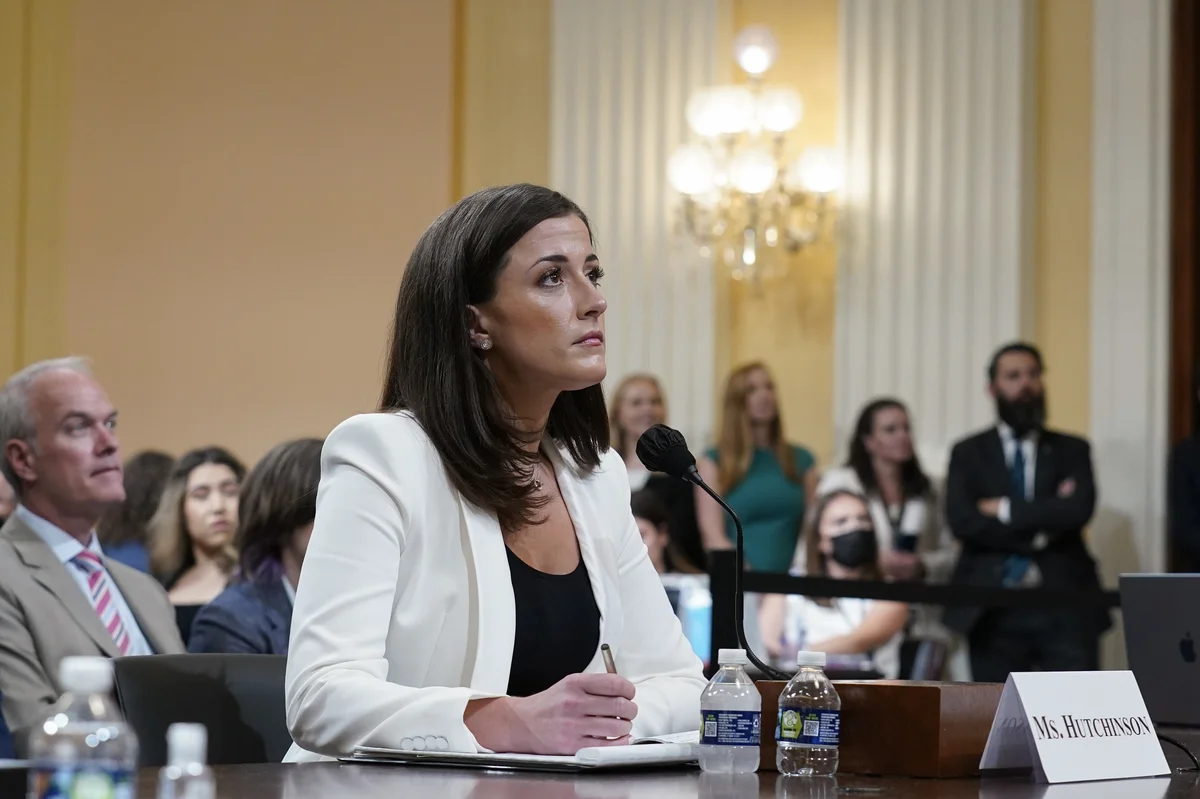
Cassidy Hutchinson, former aide to Trump White House chief of staff Mark Meadows, testifies as the House select committee investigating the Jan. 6 attack on the U.S. Capitol in Washington on Tuesday.
J. Scott Applewhite/AP
Below, read the full transcript from the June 28 hearing of the House select committee investigating the Jan. 6 Capitol attack. The transcript was produced by CQ.
BENNIE THOMPSON: The Select Committee to investigate the January 6th attack on the United States Capitol will be in order. Without objection, the chair is authorized to declare the committee in recess at any point. Pursuant to House Deposition Authority Regulation 10, the chair announces the committee's approval to release the deposition material presented during this hearing.
[...]
LIZ CHENEY: Thank you very much, Mr. Chairman. Mr. Chairman, we will begin today with an exchange that first provided Ms. Hutchinson a tangible sense of the ongoing planning for the events of January 6th. On January 2nd, four days before the attack on our Capitol, President Trump's lead lawyer Mr. Giuliani was meeting with White House Chief of Staff Mark Meadows and others.
Ms. Hutchinson, do you remember Mr. Giuliani meeting with Mr. Meadows on January 2, 2021?
CASSIDY HUTCHINSON: I do. He met with Mr. Meadows in the evening of January 2, 2021.
LIZ CHENEY: And we understand that you walked Mr. Giuliani out of the White House that night, and he talked to you about January 6th. What do you remember him saying?
CASSIDY HUTCHINSON: As Mr. Giuliani and I were walking to his vehicles that evening, he looked at me and said something to the effect of, Cass, are you excited for the 6th? It's going to be a great day. I remember looking at him saying, Rudy, could you explain what's happening on the 6th? He had responded something to the effect of, we're going to the Capitol.
It's going to be great. The President's going to be there. He's going to look powerful. He's — he's going to be with the members. He's going to be with the Senators. Talk to the chief about it, talk to the chief about it. He knows about it.
LIZ CHENEY: And did you go back then up to the West Wing and tell Mr. Meadows about your conversation with Mr. Giuliani?
CASSIDY HUTCHINSON: I did. After Mr. Giuliani had left the campus that evening, I went back up to our office and I found Mr. Meadows in his office on the couch. He was scrolling through his phone. I remember leaning against the doorway and saying, I just had an interesting conversation with Rudy, Mark. It sounds like we're going to go to the Capitol.
He didn't look up from his phone and said something to the effect of, there's a lot going on, Cass, but I don't know. Things might get real, real bad on January 6th.
LIZ CHENEY: Ms. Hutchinson. Mr. Meadows is engaged in litigation with the committee to try to avoid testifying here. What — what was your reaction when he said to you things might get real, real bad?
CASSIDY HUTCHINSON: In the days before January 2nd, I was apprehensive about the 6th. I had heard general plans for a rally. I had heard tentative movements to potentially go to the Capitol. But when hearing Rudy's take on
January 6th and then Marc's response, that was the first — that evening was the first moment that I remember feeling scared and nervous for what could happen on January 6th. And I had a deeper concern for what was happening with the planning aspects of it.
LIZ CHENEY: Thank you, Ms. Hutchinson. Today, we're going to be focusing primarily on the events of January 5th and 6th at the White House. But to begin and to frame the discussion, I want to talk about a conversation that you had with Mr. John Ratcliffe, the Director of National Intelligence. And you had this conversation in December of 2020. Mr. Ratcliffe was nominated by President Trump to oversee US intelligence — our US intelligence community.
And before his appointment, Mr. Ratcliffe was a Republican member of Congress. As you will see on this clip, Director Ratcliffe's comments in December of 2020 were prescient. [Begin videotape]
CASSIDY HUTCHINSON: My understanding was Mr. — Director Ratcliffe didn't want much to do with the post-election period. Director Ratcliffe felt that It wasn't something that the White House should be pursuing. It felt it was dangerous for the President's legacy. He had expressed to me that he was concerned that it could spiral out of control and potentially be dangerous, either for our democracy or the way that things were going for the 6th.
UNKNOWN: When you say it wasn't something the White House should be pursuing, what's the it?
CASSIDY HUTCHINSON: Trying to fight the results of the election, finding missing ballots, pressuring — filing lawsuits in certain states where there didn't seem to be significant evidence, and reaching out to state legislatures about that. So pretty much the way that the White House was handling the postelection period, he felt that there could be dangerous repercussions, in terms of precedent set for elections, for our democracy, for the 6th. You know, he was hoping that we would concede. [End videotape]
LIZ CHENEY: So, Ms. Hutchinson, now we're going to turn to certain information that was available before January 4th and what the Trump administration and the President knew about the potential for violence before January 6th. On the screen, you will see an email received by Acting Deputy Attorney General Donoghue on January 4th from the National Security Division of the Department of Justice.
Mr. Donoghue testified in our hearings last week. The email identifies apparent planning by those coming to Washington on January 6th to, quote, occupy federal buildings and discussions of, quote, invading the Capitol building. Here's what Mr. Donoghue said to us. [Begin videotape]
RICHARD DONOGHUE: And we knew that if you have tens of thousands of very obsessive people showing up in Washington DC that there was potential for violence. [End videotape]
LIZ CHENEY: The US Secret Service was looking at similar information and watching the planned demonstrations. In fact, their intelligence division sent several emails to White House personnel like Deputy Chief of Staff Tony Ornato and the head of the President's protective detail Robert Engel, including certain materials listing events like those on the screen.
The White House continued to receive updates about planned demonstrations, including information regarding the Proud Boys organizing and planning to attend events on January 6th. Although Ms. Hutchinson has no detailed knowledge of any planning involving the Proud Boys for January 6th, she did note this. [Begin videotape]
CASSIDY HUTCHINSON: I recall hearing the word Oath Keeper and hearing the word Proud Boys closer to the planning of the January 6th rally when Mr. Giuliani would be around. [End videotape]
LIZ CHENEY: On January 3rd, the Capitol Police issued a special event assessment. In that document, the Capitol Police noted that the Proud Boys and other groups planned to be in Washington, DC on January 6th and indicated that, quote, unlike previous post-election protests, the targets of the pro-Trump supporters are not necessarily the counter-protesters as they were previously, but rather Congress itself is the target on the 6th. Of course, we all know now that the Proud Boys showed up on January 6th, marched from the Washington Monument to the Capitol that day, and led the riotous mob to invade and occupy our Capitol.
Ms. Hutchinson, I want to play you a clip of one of our meetings when you described a call on January 4th that you received from National Security Advisor Robert O'Brien on the same topic, potential violence on January 6th. [Begin videotape]
CASSIDY HUTCHINSON: I received a call from Robert O'Brien, the National Security Advisor. He had asked if he could speak with Mr. Meadows about potential violent — words of violence that he was hearing that were potentially going to happen on the Hill on January 6th. I had asked if he had connected with Tony Ornato, because Tony Ornato had a conversation with him, with Mark, about that topic.
Robert had said, I'll talk to Tony, and then I don't know if Robert ever connected with Mark about the issue. [End videotape]
LIZ CHENEY: Ms. Hutchinson, can you describe for us Mr. Ornato's responsibilities as Deputy Chief of Staff?
CASSIDY HUTCHINSON: The Deputy Chief of Staff position at the White House for operations is arguably one of the most important positions that somebody can hold. They're in charge of all security protocol for the campus and all Presidential protectees, primarily the President and the first family. But anything that requires security for any individual that has presidential protection, so the Chief of Staff or the National Security Advisor, as well as the Vice President's team, too, Tony would oversee all of that.
And he was the conduit for security protocol between White House staff and the United States Secret Service.
LIZ CHENEY: Thank you. And you also described a brief meeting between Mr. Ornato and Mr. Meadows on the potential for violence. The meeting was on January 4th. They were talking about the potential for
violence on January 6th. Let's listen to a clip of that testimony. [Begin videotape]
CASSIDY HUTCHINSON: I remember Mr. Ornato had talked to him about intelligence reports. I just remember Mr. Ornato coming in and saying that we had intel reports saying that there could potentially be violence on the 6th. [End videotape]
LIZ CHENEY: You also told us about reports of violence and weapons that the Secret Service were receiving on the night of January 5th and throughout the day on January 6th. Is that correct?
CASSIDY HUTCHINSON: That's correct.
LIZ CHENEY: There are reports that police in Washington, DC had arrested several people with firearms or ammunition following a separate pro-Trump rally in Freedom Plaza on the evening of January 5th. Are those some of the reports that you recall hearing about?
CASSIDY HUTCHINSON: They are.
LIZ CHENEY: Of course, the world now knows that the people who attacked the Capitol on January 6th had many different types of weapons. When a President speaks, the Secret Service typically requires those attending to pass through metal detectors known as magnetometers, or mags for short. The Select Committee has learned that people who willingly entered the enclosed area for President Trump's speech were screened so they could attend the rally at the Ellipse.
They had weapons and other items that were confiscated: pepper spray, knives, brass knuckles, tasers, body armor, gas masks, batons, blunt weapons. And those were just from the people who chose to go through the security for the President's event on the Ellipse, not the several thousand
members of the crowd who refused to go through the mags and watched from the lawn near the Washington Monument.
The Select Committee has learned about reports from outside the magnetometers, and has obtained police radio transmissions identifying individuals with firearms, including AR-15s, near the Ellipse on the morning of January 6th. Let's listen. [Begin videotape]
UNKNOWN: There's an individual who is in a tree. It's gonna be a white male, about six feet tall, thin build, brown cowboy boots. He's got jeans and a blue jean jacket, and underneath the hoodie jacket the complainants both saw stock of an AR-15. He's going to be with a group of individuals, about 5 to 8 — 5 to 8 other individuals.
Two of the individuals in that group at the base of the tree near the porta-pottys were wearing green fatigues, green olive dress house fatigues. About 5'8", 5'9", skinny — skinny white males, brown cowboy boots.
UNKNOWN: They had Glock style pistols in their waistband. 8736-- That subject's weapon on his right hip. That's a negative, he's in the tree. Motor one, make sure PPD knows they have an elevated threat in the tree south side of Constitution Avenue. Look for the Don't Tread on Me flag, American flag facemask, cowboy boots, weapon on the right — right side hip. I got three men walking down the street in fatigues.
One's carrying a AR-15. Copy at 14th and Independence. [End Videotape]
LIZ CHENEY: AR-15s at 14th and Independence. As you saw in those emails, the first report that we showed we now know was sent in the 8:00 hour on January 6th. This talked about people in the crowd wearing ballistic helmets and body armor, carrying radio equipment and military grade backpacks. The second report we showed you on the screen was sent by the Secret Service in the 11 a.m. hour and it addressed reports of a man with a rifle near the ellipse.
Ms. Hutchinson, in prior testimony you described for us a meeting in the White House around 10 a.m. in the morning of January 6th involving Chief of Staff Meadows and Tony Ornato. Were you in that meeting?
CASSIDY HUTCHINSON: I was.
LIZ CHENEY: Let's listen to your testimony about that meeting and then we'll have some questions. [Begin Videotape]
UNKNOWN: I think the last time we talked you mentioned that some of the weapons that people had at the rally included flagpoles, oversized sticks or flagpoles, bear spray. Is there anything else that you recall hearing about that the — the people who had gathered on the ellipse had?
CASSIDY HUTCHINSON: I recall Tony and I having a conversation with Mark probably around 10 a.m., 10:15 a.m. where I remember Tony mentioning knives, guns in the form of pistols and rifles, bear spray, body armor, spears, and flagpoles. Spears were one item, flagpoles were one item. But then Tony had related to me something to the effect of and these effing people are fastening spears onto the ends of flagpoles. [End Videotape]
LIZ CHENEY: Ms. Hutchinson, here's a clip of your testimony regarding Mr. Meadows' response to learning that the rally attendees were armed that day. [Begin Videotape]
What was Mark's reaction — Mr. Meadows' reaction to this list of weapons that people had in the crowd?
CASSIDY HUTCHINSON: When Tony and I went in to talk to Mark that morning, Mark was sitting on his couch and on his phone which was something typical. And I remember Tony just got right into it. He was like, sorry, I just want to let you know and informed him, like, this is how many people we have outside the mags right now.
These are the weapons that we're going to have. It's possible he listed more weapons off that I just don't recall. And gave him a brief but — and concise explanation, but also fairly — fairly thorough. And I remember distinctly Mark not looking up from his phone, right? I remember Tony finishing his explanation and it taking a few seconds for Mark to say his name.
Because I almost said, Mark, did you hear him? And then Mark chimed in. It was like, Alright, anything else? Still looking down at his phone. And Tony looked at me and I looked at Tony and he — Tony said no, Sir. Do you have any questions? He's like, what are you hearing? And I looked at Tony and I was like, Sir he just told you about what was happening down at the rallies.
And he was like yeah, yeah. I know. And then he looked up and said have you talked to the President? And Tony said yes, Sir. He's aware. And he said Alright. Good.
LIZ CHENEY: He asked Tony if Tony had informed the President --
CASSIDY HUTCHINSON: — Yes --
LIZ CHENEY: — And Tony said yes, he had. [End Videotape] So Miss Hutchinson, is it your understanding that Mr. Ornato told the President about weapons at the rally on the morning of January 6th?
CASSIDY HUTCHINSON: That's what Mr. Ornato relayed to me.
LIZ CHENEY: And here's how you characterized Mr. Meadows' general response when people raised concerns about what could happen on January 6th. [Begin Videotape]
UNKNOWN: So at the time in the days leading up to the 6th, there were lots of public reports about how things might go bad on the 6th, even the potential for violence. If I'm hearing you correctly, what stands out to you is that Mr. Meadows did not share those concerns or at least did not act on those concerns.
CASSIDY HUTCHINSON: Did not act on those concerns would be accurate.
UNKNOWN: But other people raised them to — to him like in this exchange you mentioned that Mr. Ornato pulled him aside.
CASSIDY HUTCHINSON: That's correct. [End Videotape]
LIZ CHENEY: Ms. Hutchinson, we're going to show now an exchange of texts between you and Deputy Chief of Staff Ornato. And these text messages were exchanged while you were at the ellipse. In one text you write: But the crowd looks good from this vantage point. As long as we get the shot. He was effing furious.
And the text messages also stress that President Trump kept mentioning the OTR, an off the record movement. We're going to come back and ask you about that in a minute. But could you tell us, first of all, who it is in the text who was furious?
CASSIDY HUTCHINSON: The he in that text that I was referring to was the President.
LIZ CHENEY: And why was he furious, Miss Hutchinson?
CASSIDY HUTCHINSON: He was furious because he wanted the arena that we had on the ellipse to be maxed out at capacity for all attendees. The advanced team had relayed to him that the mags were free flowing. Everybody who wanted to come in had already come in. But he still was angry about the extra space and wanted more people to come in.
LIZ CHENEY: And did you go to the rally in the Presidential motorcade?
CASSIDY HUTCHINSON: I — I was there, yes, in the motorcade.
LIZ CHENEY: And were you backstage with the President and other members of his staff and family?
CASSIDY HUTCHINSON: I was.
LIZ CHENEY: And you told us, Ms. Hutchinson, about particular comments that you heard while you were in the tent area. [Begin Videotape]
CASSIDY HUTCHINSON: When we were in the offstage announce area tent behind the stage he was very concerned about the shot, meaning the photograph that we would get, because the rally space wasn't full. One of the reasons which I've previously stated was because he wanted it to be full and for people to not feel excluded because they had come far to watch him at the rally.
And he felt the mags were at fault for not letting everybody in. But another leading reason and likely the primary reason is because he wanted it full and he was angry that we weren't letting people through the mags with weapons, what the Secret Service deemed as weapons and are — are weapons.
But when we were in the offstage announce tent, I was part of a conversation — I was in — I was in the vicinity of a conversation where I overheard the President say something to the effect of, you know, I - - I don't effing care that they have weapons.
They're not here to hurt me. Take that effing mags away. Let my people in. They can march to the Capitol from here. Let the people in. Take the effing mags away. [End Videotape]
LIZ CHENEY: Just to be clear, Ms. Hutchinson, is it your understanding that the President wanted to take the mags away and said that the armed individuals were not there to hurt him?
CASSIDY HUTCHINSON: That's a fair assessment.
LIZ CHENEY: The issue wasn't with the amount of space available in the official rally area only, but instead that people did not want to have to go through the mags. Let's listen to a portion of what you told us about that. [Begin Videotape]
CASSIDY HUTCHINSON: In this particular instance, it wasn't the capacity of our space. It was the mags and the people that didn't want to come through. And that's what Tony had been trying to relay to him that morning. You know, it's not the issues that we encounter on the campaign. We have enough space, Sir. They don't want to come in right now.
They — they have weapons that they don't want confiscated by the Secret Service. And they're fine on the mall. They can see you on the mall and they're — they want to march straight to the Capitol from the mall. [End Videotape]
LIZ CHENEY: The President apparently wanted all attendees inside the official rally space and repeatedly said, quote, "They're not here to hurt me." [Begin Videotape] And — and just to — to be clear. So he was told again in — in that conversation — or was he told again in that conversation that people couldn't come through the mags because they had weapons?
CASSIDY HUTCHINSON: Correct.
LIZ CHENEY: And that people — and he — his response was to say they can march to the Capitol from — is it from the ellipse?
CASSIDY HUTCHINSON: Something to the effect of take the effing mags away. They're not here to hurt me. Let them in. Let my people in. They can march to the Capitol after the rallies are over. They can march from — they can march from the ellipse. Take the effing mags away. Then they can march to the Capitol. [End Videotape]
LIZ CHENEY: Ms. Hutchinson, what we saw when those clips were playing were photos provided by the National Archives showing the President in the offstage tent before his speech on the ellipse. You were in some of those photos as well. And I just want to confirm that that is when you heard the President say the people with weapons weren't there to hurt him and that he wanted the Secret Service to remove the magnetometers.
CASSIDY HUTCHINSON: That's correct. In the photos that you displayed we were standing towards the front of the tent with the TVs really close to where he would walk out to go on to the stage. The — these conversations happened two to three minutes before he took the stage that morning.
LIZ CHENEY: Let's reflect on that for a moment. President Trump was aware that a number of the individuals in the crowd had weapons and were wearing body armor.
And here's what President Trump instructed the crowd to do. [Begin Videotape]
DONALD TRUMP: We're going to walk down, and I'll be there with you. We're going to walk down — [Applause] — We're going to walk down any one you want. But I think right here. We're going to walk down to the Capitol. [Applause] [End Videotape]
LIZ CHENEY: And the crowd as we know did proceed to the Capitol. It soon became apparent to the Secret Service including the Secret Service teams in the crowd along with White House staff that security at the Capitol would not be sufficient. [Begin Videotape]
CASSIDY HUTCHINSON: I had two or three phone conversations with Mr. Ornato when we were at the ellipse. And then I had four men on Mr. Meadows' detail with me in between those individuals and a few other bodies on the ground just secret service doing advance. They're getting notifications through their radios and Mr. Ornato on one phone conversation had called me and said make sure the Chief knows that they're — they're getting close to the Capitol.
It's — they're having trouble stacking bodies. [End Videotape]
LIZ CHENEY: And Ms. Hutchinson, when you — you said they were having trouble stacking bodies, did you mean that law enforcement at the Capitol needed more people to defend the Capitol from the rioters?
CASSIDY HUTCHINSON: It was becoming clear to us and to the Secret Service that Capitol Police officers were getting overrun at the security barricades outside of the Capitol building. And they were having short — they were short people to defend the building against the rioters.
LIZ CHENEY: And you mentioned that Mr. Ornato was conveying this to you because he wanted you to tell Mr. Meadows.
So did you — did you tell Mr. Meadows that people were getting closer to the Capitol and that Capitol Police was having challen — difficulty?
CASSIDY HUTCHINSON: After I had the conversation with Mr. Meadows, Mr. — after I had the conversation with Mr. Ornato I went to have the discussion with Mr. Meadows. He was in a secure vehicle at the time making a call. So when I had gone over to the car, I went to open the door to let him know and he had immediately shut it. I don't know who he was speaking with.
It wasn't something that he regularly did, especially when I would go over to give him information. So I was a bit taken aback, but I didn't think much of it and thinking that I was — would be able to have the conversation with him a few moments later.
LIZ CHENEY: And were you able to have that conversation a few moments later?
CASSIDY HUTCHINSON: Probably about 20 to 25 minutes later. There was another period of between where he shut the door again and then when he finally got out of the vehicle we had the conversation. But at that point there was a backlog of information that he should have been made aware of.
LIZ CHENEY: And so you opened the door to the control car and Mr. Meadows pulled it shut?
CASSIDY HUTCHINSON: That's correct.
LIZ CHENEY: And he did that two times?
CASSIDY HUTCHINSON: That's correct.
LIZ CHENEY: And when you finally were able to give Mr. Meadows the information about the violence at the Capitol, what was his reaction?
CASSIDY HUTCHINSON: He almost had a lack of reaction. I remember him saying Alright, something to the effect of how much longer does the President have left in this speech?
LIZ CHENEY: Again, much of this information about the potential for violence was known or learned before the onset of the violence, early enough for President Trump to take steps to prevent it. He could, for example, have urged the crowd at the ellipse not to march to the Capitol. He could have condemned the violence immediately once it began.
Or he could have taken multiple other steps. But as we will see today and in later hearings, President Trump had something else in mind. One other question at this point Miss Hutchinson. Were you aware of concerns that White House counsel Pat Cipollone or Eric Herschmann had about the language President Trump used in his ellipse speech?
CASSIDY HUTCHINSON: There were many discussions the morning of the six about the rhetoric of the speech that day. In my conversations with Mr. Herschmann, he had relayed that we would be foolish to include language that had been included at the President's request, which had lines along — to the effect of fight for Trump. We're going to march the Capitol.
I'll be there with you. Fight for me. Fight for what we're doing. Fight for the movement. Things about the Vice President at the time too. Both Mr. Herschmann and White House counsel's office were urging the speechwriters to not include that language for legal concerns, and also for the optics of what it could portray the president wanting to do that day.
LIZ CHENEY: And we just heard the president say that he would be with his supporters as they marched to the Capitol. Even though he did not end up going, he certainly wanted to. Some have questioned whether President Trump genuinely planned to come here to the Capitol on January 6th. In his book, Mark Meadows falsely wrote that after President Trump gave his speech on January 6th, he told Mr. Meadows that he was, quote, speeding — speaking metaphorically about the walk to the Capitol.
As you will see, Donald Trump was not speaking metaphorically. As we heard earlier, Rudy Giuliani told Ms. Hutchinson that Mr. Trump planed to travel to the Capitol on January 6th. I want to pause for just a moment to ask you, Ms. Hutchinson, to explain some of the terminology you will hear today. We've heard you use two different terms to describe plans for the president's movement to the Capitol or anywhere else.
One of those is a scheduled movement and another one is OTR. Could you describe for us what each of those means?
CASSIDY HUTCHINSON: A scheduled presidential movement is on his official schedule. It's notified to the press and to a wide range of staff that will be traveling with him. It's known to the public, known as the Secret Service, and they're able to coordinate the movement days in advance. An off the record movement is confined to the knowledge of a very, very small group of advisers and staff.
Typically a very small group of staff would travel with him, mostly that are just included in the national security package. You can pull an off to — off the record movement together in less than an hour. It's a way to kind of circumvent having to release it to the press, if that's the goal of it, or to not have to have as many security parameters put in place ahead of time to make a movement happen.
LIZ CHENEY: Thank you. And let's turn back now to the president's plans to travel to the Capitol on January 6th. We know that White House Counsel Pat Cipollone was concerned about the legal implications of such a trip, and he agreed with the Secret Service that it shouldn't happen. Ms. Hutchinson, did you have any conversations with Pat Cipollone about his concerns about the president going to the Capitol on January 6th?
CASSIDY HUTCHINSON: On January 3rd, Mr. Cipollone had approached me knowing that Mark had raised the prospect of going up to the Capitol on January 6th. Mr. Cipollone and I had a brief private conversation where he said to me we need to make sure that this doesn't happen. This would be a legally a terrible idea for us. We're — we have serious legal concerns if we go up to the Capitol that day.
And he then urged me to continue relaying that to Mr. Meadows, because it's my understanding that Mr. Cipollone thought that Mr. Meadows was indeed pushing this, along with the president.
LIZ CHENEY: And we understand, Ms. Hutchinson, that you also spoke to Mr. Cipollone on the morning of the 6th as you were about to go to the rally on the Ellipse, and Mr. Cipollone said something to you like make sure the movement to the Capitol does not happen. Is that correct?
CASSIDY HUTCHINSON: That's correct. I saw Mr. Cipollone right before I walked out onto West Exec that morning, and Mr. Cipollone said something to the effect of please make sure we don't go up to the Capitol, Cassidy. Keep in touch with me. We're going to get charged with every crime imaginable if we make that movement happen.
LIZ CHENEY: And do you remember which crimes Mr. Cipollone was concerned with?
CASSIDY HUTCHINSON: In the days leading up to the 6th, we had conversations about potentially obstructing justice or defrauding the electoral count.
LIZ CHENEY: Let's hear about some of those concerns that you mentioned earlier in one of your interviews with us. [Begin videotape]
To be continued - https://www.npr.org/2022/06/28/1108396692/jan-6-committee-hearing-transcript
"Exclusive: Trump’s former White House ethics lawyer told Cassidy Hutchinson
to give misleading testimony to January 6 committee, sources say"
Good to know. I've included about half of the transcript today. Will cover the rest at another
time. Thanks for bringing Cassidy back. She deserves every honorable mention she can get.
Here's every word from the sixth Jan. 6 committee hearing on its investigation
June 28, 20226:23 PM ET
Cassidy Hutchinson, former aide to Trump White House chief of staff Mark Meadows, testifies as the House select committee investigating the Jan. 6 attack on the U.S. Capitol in Washington on Tuesday.
J. Scott Applewhite/AP
Below, read the full transcript from the June 28 hearing of the House select committee investigating the Jan. 6 Capitol attack. The transcript was produced by CQ.
BENNIE THOMPSON: The Select Committee to investigate the January 6th attack on the United States Capitol will be in order. Without objection, the chair is authorized to declare the committee in recess at any point. Pursuant to House Deposition Authority Regulation 10, the chair announces the committee's approval to release the deposition material presented during this hearing.
[...]
LIZ CHENEY: Thank you very much, Mr. Chairman. Mr. Chairman, we will begin today with an exchange that first provided Ms. Hutchinson a tangible sense of the ongoing planning for the events of January 6th. On January 2nd, four days before the attack on our Capitol, President Trump's lead lawyer Mr. Giuliani was meeting with White House Chief of Staff Mark Meadows and others.
Ms. Hutchinson, do you remember Mr. Giuliani meeting with Mr. Meadows on January 2, 2021?
CASSIDY HUTCHINSON: I do. He met with Mr. Meadows in the evening of January 2, 2021.
LIZ CHENEY: And we understand that you walked Mr. Giuliani out of the White House that night, and he talked to you about January 6th. What do you remember him saying?
CASSIDY HUTCHINSON: As Mr. Giuliani and I were walking to his vehicles that evening, he looked at me and said something to the effect of, Cass, are you excited for the 6th? It's going to be a great day. I remember looking at him saying, Rudy, could you explain what's happening on the 6th? He had responded something to the effect of, we're going to the Capitol.
It's going to be great. The President's going to be there. He's going to look powerful. He's — he's going to be with the members. He's going to be with the Senators. Talk to the chief about it, talk to the chief about it. He knows about it.
LIZ CHENEY: And did you go back then up to the West Wing and tell Mr. Meadows about your conversation with Mr. Giuliani?
CASSIDY HUTCHINSON: I did. After Mr. Giuliani had left the campus that evening, I went back up to our office and I found Mr. Meadows in his office on the couch. He was scrolling through his phone. I remember leaning against the doorway and saying, I just had an interesting conversation with Rudy, Mark. It sounds like we're going to go to the Capitol.
He didn't look up from his phone and said something to the effect of, there's a lot going on, Cass, but I don't know. Things might get real, real bad on January 6th.
LIZ CHENEY: Ms. Hutchinson. Mr. Meadows is engaged in litigation with the committee to try to avoid testifying here. What — what was your reaction when he said to you things might get real, real bad?
CASSIDY HUTCHINSON: In the days before January 2nd, I was apprehensive about the 6th. I had heard general plans for a rally. I had heard tentative movements to potentially go to the Capitol. But when hearing Rudy's take on
January 6th and then Marc's response, that was the first — that evening was the first moment that I remember feeling scared and nervous for what could happen on January 6th. And I had a deeper concern for what was happening with the planning aspects of it.
LIZ CHENEY: Thank you, Ms. Hutchinson. Today, we're going to be focusing primarily on the events of January 5th and 6th at the White House. But to begin and to frame the discussion, I want to talk about a conversation that you had with Mr. John Ratcliffe, the Director of National Intelligence. And you had this conversation in December of 2020. Mr. Ratcliffe was nominated by President Trump to oversee US intelligence — our US intelligence community.
And before his appointment, Mr. Ratcliffe was a Republican member of Congress. As you will see on this clip, Director Ratcliffe's comments in December of 2020 were prescient. [Begin videotape]
CASSIDY HUTCHINSON: My understanding was Mr. — Director Ratcliffe didn't want much to do with the post-election period. Director Ratcliffe felt that It wasn't something that the White House should be pursuing. It felt it was dangerous for the President's legacy. He had expressed to me that he was concerned that it could spiral out of control and potentially be dangerous, either for our democracy or the way that things were going for the 6th.
UNKNOWN: When you say it wasn't something the White House should be pursuing, what's the it?
CASSIDY HUTCHINSON: Trying to fight the results of the election, finding missing ballots, pressuring — filing lawsuits in certain states where there didn't seem to be significant evidence, and reaching out to state legislatures about that. So pretty much the way that the White House was handling the postelection period, he felt that there could be dangerous repercussions, in terms of precedent set for elections, for our democracy, for the 6th. You know, he was hoping that we would concede. [End videotape]
LIZ CHENEY: So, Ms. Hutchinson, now we're going to turn to certain information that was available before January 4th and what the Trump administration and the President knew about the potential for violence before January 6th. On the screen, you will see an email received by Acting Deputy Attorney General Donoghue on January 4th from the National Security Division of the Department of Justice.
Mr. Donoghue testified in our hearings last week. The email identifies apparent planning by those coming to Washington on January 6th to, quote, occupy federal buildings and discussions of, quote, invading the Capitol building. Here's what Mr. Donoghue said to us. [Begin videotape]
RICHARD DONOGHUE: And we knew that if you have tens of thousands of very obsessive people showing up in Washington DC that there was potential for violence. [End videotape]
LIZ CHENEY: The US Secret Service was looking at similar information and watching the planned demonstrations. In fact, their intelligence division sent several emails to White House personnel like Deputy Chief of Staff Tony Ornato and the head of the President's protective detail Robert Engel, including certain materials listing events like those on the screen.
The White House continued to receive updates about planned demonstrations, including information regarding the Proud Boys organizing and planning to attend events on January 6th. Although Ms. Hutchinson has no detailed knowledge of any planning involving the Proud Boys for January 6th, she did note this. [Begin videotape]
CASSIDY HUTCHINSON: I recall hearing the word Oath Keeper and hearing the word Proud Boys closer to the planning of the January 6th rally when Mr. Giuliani would be around. [End videotape]
LIZ CHENEY: On January 3rd, the Capitol Police issued a special event assessment. In that document, the Capitol Police noted that the Proud Boys and other groups planned to be in Washington, DC on January 6th and indicated that, quote, unlike previous post-election protests, the targets of the pro-Trump supporters are not necessarily the counter-protesters as they were previously, but rather Congress itself is the target on the 6th. Of course, we all know now that the Proud Boys showed up on January 6th, marched from the Washington Monument to the Capitol that day, and led the riotous mob to invade and occupy our Capitol.
Ms. Hutchinson, I want to play you a clip of one of our meetings when you described a call on January 4th that you received from National Security Advisor Robert O'Brien on the same topic, potential violence on January 6th. [Begin videotape]
CASSIDY HUTCHINSON: I received a call from Robert O'Brien, the National Security Advisor. He had asked if he could speak with Mr. Meadows about potential violent — words of violence that he was hearing that were potentially going to happen on the Hill on January 6th. I had asked if he had connected with Tony Ornato, because Tony Ornato had a conversation with him, with Mark, about that topic.
Robert had said, I'll talk to Tony, and then I don't know if Robert ever connected with Mark about the issue. [End videotape]
LIZ CHENEY: Ms. Hutchinson, can you describe for us Mr. Ornato's responsibilities as Deputy Chief of Staff?
CASSIDY HUTCHINSON: The Deputy Chief of Staff position at the White House for operations is arguably one of the most important positions that somebody can hold. They're in charge of all security protocol for the campus and all Presidential protectees, primarily the President and the first family. But anything that requires security for any individual that has presidential protection, so the Chief of Staff or the National Security Advisor, as well as the Vice President's team, too, Tony would oversee all of that.
And he was the conduit for security protocol between White House staff and the United States Secret Service.
LIZ CHENEY: Thank you. And you also described a brief meeting between Mr. Ornato and Mr. Meadows on the potential for violence. The meeting was on January 4th. They were talking about the potential for
violence on January 6th. Let's listen to a clip of that testimony. [Begin videotape]
CASSIDY HUTCHINSON: I remember Mr. Ornato had talked to him about intelligence reports. I just remember Mr. Ornato coming in and saying that we had intel reports saying that there could potentially be violence on the 6th. [End videotape]
LIZ CHENEY: You also told us about reports of violence and weapons that the Secret Service were receiving on the night of January 5th and throughout the day on January 6th. Is that correct?
CASSIDY HUTCHINSON: That's correct.
LIZ CHENEY: There are reports that police in Washington, DC had arrested several people with firearms or ammunition following a separate pro-Trump rally in Freedom Plaza on the evening of January 5th. Are those some of the reports that you recall hearing about?
CASSIDY HUTCHINSON: They are.
LIZ CHENEY: Of course, the world now knows that the people who attacked the Capitol on January 6th had many different types of weapons. When a President speaks, the Secret Service typically requires those attending to pass through metal detectors known as magnetometers, or mags for short. The Select Committee has learned that people who willingly entered the enclosed area for President Trump's speech were screened so they could attend the rally at the Ellipse.
They had weapons and other items that were confiscated: pepper spray, knives, brass knuckles, tasers, body armor, gas masks, batons, blunt weapons. And those were just from the people who chose to go through the security for the President's event on the Ellipse, not the several thousand
members of the crowd who refused to go through the mags and watched from the lawn near the Washington Monument.
The Select Committee has learned about reports from outside the magnetometers, and has obtained police radio transmissions identifying individuals with firearms, including AR-15s, near the Ellipse on the morning of January 6th. Let's listen. [Begin videotape]
UNKNOWN: There's an individual who is in a tree. It's gonna be a white male, about six feet tall, thin build, brown cowboy boots. He's got jeans and a blue jean jacket, and underneath the hoodie jacket the complainants both saw stock of an AR-15. He's going to be with a group of individuals, about 5 to 8 — 5 to 8 other individuals.
Two of the individuals in that group at the base of the tree near the porta-pottys were wearing green fatigues, green olive dress house fatigues. About 5'8", 5'9", skinny — skinny white males, brown cowboy boots.
UNKNOWN: They had Glock style pistols in their waistband. 8736-- That subject's weapon on his right hip. That's a negative, he's in the tree. Motor one, make sure PPD knows they have an elevated threat in the tree south side of Constitution Avenue. Look for the Don't Tread on Me flag, American flag facemask, cowboy boots, weapon on the right — right side hip. I got three men walking down the street in fatigues.
One's carrying a AR-15. Copy at 14th and Independence. [End Videotape]
LIZ CHENEY: AR-15s at 14th and Independence. As you saw in those emails, the first report that we showed we now know was sent in the 8:00 hour on January 6th. This talked about people in the crowd wearing ballistic helmets and body armor, carrying radio equipment and military grade backpacks. The second report we showed you on the screen was sent by the Secret Service in the 11 a.m. hour and it addressed reports of a man with a rifle near the ellipse.
Ms. Hutchinson, in prior testimony you described for us a meeting in the White House around 10 a.m. in the morning of January 6th involving Chief of Staff Meadows and Tony Ornato. Were you in that meeting?
CASSIDY HUTCHINSON: I was.
LIZ CHENEY: Let's listen to your testimony about that meeting and then we'll have some questions. [Begin Videotape]
UNKNOWN: I think the last time we talked you mentioned that some of the weapons that people had at the rally included flagpoles, oversized sticks or flagpoles, bear spray. Is there anything else that you recall hearing about that the — the people who had gathered on the ellipse had?
CASSIDY HUTCHINSON: I recall Tony and I having a conversation with Mark probably around 10 a.m., 10:15 a.m. where I remember Tony mentioning knives, guns in the form of pistols and rifles, bear spray, body armor, spears, and flagpoles. Spears were one item, flagpoles were one item. But then Tony had related to me something to the effect of and these effing people are fastening spears onto the ends of flagpoles. [End Videotape]
LIZ CHENEY: Ms. Hutchinson, here's a clip of your testimony regarding Mr. Meadows' response to learning that the rally attendees were armed that day. [Begin Videotape]
What was Mark's reaction — Mr. Meadows' reaction to this list of weapons that people had in the crowd?
CASSIDY HUTCHINSON: When Tony and I went in to talk to Mark that morning, Mark was sitting on his couch and on his phone which was something typical. And I remember Tony just got right into it. He was like, sorry, I just want to let you know and informed him, like, this is how many people we have outside the mags right now.
These are the weapons that we're going to have. It's possible he listed more weapons off that I just don't recall. And gave him a brief but — and concise explanation, but also fairly — fairly thorough. And I remember distinctly Mark not looking up from his phone, right? I remember Tony finishing his explanation and it taking a few seconds for Mark to say his name.
Because I almost said, Mark, did you hear him? And then Mark chimed in. It was like, Alright, anything else? Still looking down at his phone. And Tony looked at me and I looked at Tony and he — Tony said no, Sir. Do you have any questions? He's like, what are you hearing? And I looked at Tony and I was like, Sir he just told you about what was happening down at the rallies.
And he was like yeah, yeah. I know. And then he looked up and said have you talked to the President? And Tony said yes, Sir. He's aware. And he said Alright. Good.
LIZ CHENEY: He asked Tony if Tony had informed the President --
CASSIDY HUTCHINSON: — Yes --
LIZ CHENEY: — And Tony said yes, he had. [End Videotape] So Miss Hutchinson, is it your understanding that Mr. Ornato told the President about weapons at the rally on the morning of January 6th?
CASSIDY HUTCHINSON: That's what Mr. Ornato relayed to me.
LIZ CHENEY: And here's how you characterized Mr. Meadows' general response when people raised concerns about what could happen on January 6th. [Begin Videotape]
UNKNOWN: So at the time in the days leading up to the 6th, there were lots of public reports about how things might go bad on the 6th, even the potential for violence. If I'm hearing you correctly, what stands out to you is that Mr. Meadows did not share those concerns or at least did not act on those concerns.
CASSIDY HUTCHINSON: Did not act on those concerns would be accurate.
UNKNOWN: But other people raised them to — to him like in this exchange you mentioned that Mr. Ornato pulled him aside.
CASSIDY HUTCHINSON: That's correct. [End Videotape]
LIZ CHENEY: Ms. Hutchinson, we're going to show now an exchange of texts between you and Deputy Chief of Staff Ornato. And these text messages were exchanged while you were at the ellipse. In one text you write: But the crowd looks good from this vantage point. As long as we get the shot. He was effing furious.
And the text messages also stress that President Trump kept mentioning the OTR, an off the record movement. We're going to come back and ask you about that in a minute. But could you tell us, first of all, who it is in the text who was furious?
CASSIDY HUTCHINSON: The he in that text that I was referring to was the President.
LIZ CHENEY: And why was he furious, Miss Hutchinson?
CASSIDY HUTCHINSON: He was furious because he wanted the arena that we had on the ellipse to be maxed out at capacity for all attendees. The advanced team had relayed to him that the mags were free flowing. Everybody who wanted to come in had already come in. But he still was angry about the extra space and wanted more people to come in.
LIZ CHENEY: And did you go to the rally in the Presidential motorcade?
CASSIDY HUTCHINSON: I — I was there, yes, in the motorcade.
LIZ CHENEY: And were you backstage with the President and other members of his staff and family?
CASSIDY HUTCHINSON: I was.
LIZ CHENEY: And you told us, Ms. Hutchinson, about particular comments that you heard while you were in the tent area. [Begin Videotape]
CASSIDY HUTCHINSON: When we were in the offstage announce area tent behind the stage he was very concerned about the shot, meaning the photograph that we would get, because the rally space wasn't full. One of the reasons which I've previously stated was because he wanted it to be full and for people to not feel excluded because they had come far to watch him at the rally.
And he felt the mags were at fault for not letting everybody in. But another leading reason and likely the primary reason is because he wanted it full and he was angry that we weren't letting people through the mags with weapons, what the Secret Service deemed as weapons and are — are weapons.
But when we were in the offstage announce tent, I was part of a conversation — I was in — I was in the vicinity of a conversation where I overheard the President say something to the effect of, you know, I - - I don't effing care that they have weapons.
They're not here to hurt me. Take that effing mags away. Let my people in. They can march to the Capitol from here. Let the people in. Take the effing mags away. [End Videotape]
LIZ CHENEY: Just to be clear, Ms. Hutchinson, is it your understanding that the President wanted to take the mags away and said that the armed individuals were not there to hurt him?
CASSIDY HUTCHINSON: That's a fair assessment.
LIZ CHENEY: The issue wasn't with the amount of space available in the official rally area only, but instead that people did not want to have to go through the mags. Let's listen to a portion of what you told us about that. [Begin Videotape]
CASSIDY HUTCHINSON: In this particular instance, it wasn't the capacity of our space. It was the mags and the people that didn't want to come through. And that's what Tony had been trying to relay to him that morning. You know, it's not the issues that we encounter on the campaign. We have enough space, Sir. They don't want to come in right now.
They — they have weapons that they don't want confiscated by the Secret Service. And they're fine on the mall. They can see you on the mall and they're — they want to march straight to the Capitol from the mall. [End Videotape]
LIZ CHENEY: The President apparently wanted all attendees inside the official rally space and repeatedly said, quote, "They're not here to hurt me." [Begin Videotape] And — and just to — to be clear. So he was told again in — in that conversation — or was he told again in that conversation that people couldn't come through the mags because they had weapons?
CASSIDY HUTCHINSON: Correct.
LIZ CHENEY: And that people — and he — his response was to say they can march to the Capitol from — is it from the ellipse?
CASSIDY HUTCHINSON: Something to the effect of take the effing mags away. They're not here to hurt me. Let them in. Let my people in. They can march to the Capitol after the rallies are over. They can march from — they can march from the ellipse. Take the effing mags away. Then they can march to the Capitol. [End Videotape]
LIZ CHENEY: Ms. Hutchinson, what we saw when those clips were playing were photos provided by the National Archives showing the President in the offstage tent before his speech on the ellipse. You were in some of those photos as well. And I just want to confirm that that is when you heard the President say the people with weapons weren't there to hurt him and that he wanted the Secret Service to remove the magnetometers.
CASSIDY HUTCHINSON: That's correct. In the photos that you displayed we were standing towards the front of the tent with the TVs really close to where he would walk out to go on to the stage. The — these conversations happened two to three minutes before he took the stage that morning.
LIZ CHENEY: Let's reflect on that for a moment. President Trump was aware that a number of the individuals in the crowd had weapons and were wearing body armor.
And here's what President Trump instructed the crowd to do. [Begin Videotape]
DONALD TRUMP: We're going to walk down, and I'll be there with you. We're going to walk down — [Applause] — We're going to walk down any one you want. But I think right here. We're going to walk down to the Capitol. [Applause] [End Videotape]
LIZ CHENEY: And the crowd as we know did proceed to the Capitol. It soon became apparent to the Secret Service including the Secret Service teams in the crowd along with White House staff that security at the Capitol would not be sufficient. [Begin Videotape]
CASSIDY HUTCHINSON: I had two or three phone conversations with Mr. Ornato when we were at the ellipse. And then I had four men on Mr. Meadows' detail with me in between those individuals and a few other bodies on the ground just secret service doing advance. They're getting notifications through their radios and Mr. Ornato on one phone conversation had called me and said make sure the Chief knows that they're — they're getting close to the Capitol.
It's — they're having trouble stacking bodies. [End Videotape]
LIZ CHENEY: And Ms. Hutchinson, when you — you said they were having trouble stacking bodies, did you mean that law enforcement at the Capitol needed more people to defend the Capitol from the rioters?
CASSIDY HUTCHINSON: It was becoming clear to us and to the Secret Service that Capitol Police officers were getting overrun at the security barricades outside of the Capitol building. And they were having short — they were short people to defend the building against the rioters.
LIZ CHENEY: And you mentioned that Mr. Ornato was conveying this to you because he wanted you to tell Mr. Meadows.
So did you — did you tell Mr. Meadows that people were getting closer to the Capitol and that Capitol Police was having challen — difficulty?
CASSIDY HUTCHINSON: After I had the conversation with Mr. Meadows, Mr. — after I had the conversation with Mr. Ornato I went to have the discussion with Mr. Meadows. He was in a secure vehicle at the time making a call. So when I had gone over to the car, I went to open the door to let him know and he had immediately shut it. I don't know who he was speaking with.
It wasn't something that he regularly did, especially when I would go over to give him information. So I was a bit taken aback, but I didn't think much of it and thinking that I was — would be able to have the conversation with him a few moments later.
LIZ CHENEY: And were you able to have that conversation a few moments later?
CASSIDY HUTCHINSON: Probably about 20 to 25 minutes later. There was another period of between where he shut the door again and then when he finally got out of the vehicle we had the conversation. But at that point there was a backlog of information that he should have been made aware of.
LIZ CHENEY: And so you opened the door to the control car and Mr. Meadows pulled it shut?
CASSIDY HUTCHINSON: That's correct.
LIZ CHENEY: And he did that two times?
CASSIDY HUTCHINSON: That's correct.
LIZ CHENEY: And when you finally were able to give Mr. Meadows the information about the violence at the Capitol, what was his reaction?
CASSIDY HUTCHINSON: He almost had a lack of reaction. I remember him saying Alright, something to the effect of how much longer does the President have left in this speech?
LIZ CHENEY: Again, much of this information about the potential for violence was known or learned before the onset of the violence, early enough for President Trump to take steps to prevent it. He could, for example, have urged the crowd at the ellipse not to march to the Capitol. He could have condemned the violence immediately once it began.
Or he could have taken multiple other steps. But as we will see today and in later hearings, President Trump had something else in mind. One other question at this point Miss Hutchinson. Were you aware of concerns that White House counsel Pat Cipollone or Eric Herschmann had about the language President Trump used in his ellipse speech?
CASSIDY HUTCHINSON: There were many discussions the morning of the six about the rhetoric of the speech that day. In my conversations with Mr. Herschmann, he had relayed that we would be foolish to include language that had been included at the President's request, which had lines along — to the effect of fight for Trump. We're going to march the Capitol.
I'll be there with you. Fight for me. Fight for what we're doing. Fight for the movement. Things about the Vice President at the time too. Both Mr. Herschmann and White House counsel's office were urging the speechwriters to not include that language for legal concerns, and also for the optics of what it could portray the president wanting to do that day.
LIZ CHENEY: And we just heard the president say that he would be with his supporters as they marched to the Capitol. Even though he did not end up going, he certainly wanted to. Some have questioned whether President Trump genuinely planned to come here to the Capitol on January 6th. In his book, Mark Meadows falsely wrote that after President Trump gave his speech on January 6th, he told Mr. Meadows that he was, quote, speeding — speaking metaphorically about the walk to the Capitol.
As you will see, Donald Trump was not speaking metaphorically. As we heard earlier, Rudy Giuliani told Ms. Hutchinson that Mr. Trump planed to travel to the Capitol on January 6th. I want to pause for just a moment to ask you, Ms. Hutchinson, to explain some of the terminology you will hear today. We've heard you use two different terms to describe plans for the president's movement to the Capitol or anywhere else.
One of those is a scheduled movement and another one is OTR. Could you describe for us what each of those means?
CASSIDY HUTCHINSON: A scheduled presidential movement is on his official schedule. It's notified to the press and to a wide range of staff that will be traveling with him. It's known to the public, known as the Secret Service, and they're able to coordinate the movement days in advance. An off the record movement is confined to the knowledge of a very, very small group of advisers and staff.
Typically a very small group of staff would travel with him, mostly that are just included in the national security package. You can pull an off to — off the record movement together in less than an hour. It's a way to kind of circumvent having to release it to the press, if that's the goal of it, or to not have to have as many security parameters put in place ahead of time to make a movement happen.
LIZ CHENEY: Thank you. And let's turn back now to the president's plans to travel to the Capitol on January 6th. We know that White House Counsel Pat Cipollone was concerned about the legal implications of such a trip, and he agreed with the Secret Service that it shouldn't happen. Ms. Hutchinson, did you have any conversations with Pat Cipollone about his concerns about the president going to the Capitol on January 6th?
CASSIDY HUTCHINSON: On January 3rd, Mr. Cipollone had approached me knowing that Mark had raised the prospect of going up to the Capitol on January 6th. Mr. Cipollone and I had a brief private conversation where he said to me we need to make sure that this doesn't happen. This would be a legally a terrible idea for us. We're — we have serious legal concerns if we go up to the Capitol that day.
And he then urged me to continue relaying that to Mr. Meadows, because it's my understanding that Mr. Cipollone thought that Mr. Meadows was indeed pushing this, along with the president.
LIZ CHENEY: And we understand, Ms. Hutchinson, that you also spoke to Mr. Cipollone on the morning of the 6th as you were about to go to the rally on the Ellipse, and Mr. Cipollone said something to you like make sure the movement to the Capitol does not happen. Is that correct?
CASSIDY HUTCHINSON: That's correct. I saw Mr. Cipollone right before I walked out onto West Exec that morning, and Mr. Cipollone said something to the effect of please make sure we don't go up to the Capitol, Cassidy. Keep in touch with me. We're going to get charged with every crime imaginable if we make that movement happen.
LIZ CHENEY: And do you remember which crimes Mr. Cipollone was concerned with?
CASSIDY HUTCHINSON: In the days leading up to the 6th, we had conversations about potentially obstructing justice or defrauding the electoral count.
LIZ CHENEY: Let's hear about some of those concerns that you mentioned earlier in one of your interviews with us. [Begin videotape]
To be continued - https://www.npr.org/2022/06/28/1108396692/jan-6-committee-hearing-transcript
It was Plato who said, “He, O men, is the wisest, who like Socrates, knows that his wisdom is in truth worth nothing”
Discover What Traders Are Watching
Explore small cap ideas before they hit the headlines.



