



 AI
AI








Tuesday, October 11, 2022 6:17:51 PM
Repeat bit then continuing your excerpt from: "The Inevitable Indictment of Donald Trump
It’s clear to me that Merrick Garland will bring charges against Donald Trump. It’s just a matter of when.
By Franklin Foer
October 11, 2022, 6 AM ET
[...]
When Garland returned to the Court of Appeals after his nomination was blocked, he was greeted with an ovation from his colleagues. No doubt it was heartwarming, but the truth was that he was returning to an old routine after having been taunted with the job of his dreams. It would have only been human for his mind to ponder a fresh start."
In the fall of 2020, with polls showing Joe Biden primed to defeat Donald Trump, friends began asking, Would you ever want to be attorney general?
When Garland’s name showed up on the list of Biden’s potential AGs, it was fair to assume that he hoped the job would nudge the Supreme Court debacle out of the first paragraph of his obituary. But Garland told friends that he wanted to return to the Justice Department, where he’d worked as a young lawyer and first found his sense of professional purpose, to restore an institution that he revered. It had been damaged by a succession of Trump appointees, who carried out the policy of separating migrant children from their parents, distorted the findings of Robert Mueller’s investigation, and allegedly brought cases in order to settle the president’s political scores.
From the September 2022 issue: Caitlin Dickerson on the secret history of the U.S. government’s family-separation policy
https://www.theatlantic.com/magazine/archive/2022/09/trump-administration-family-separation-policy-immigration/670604/
As Garland prepared to take the job, he often sounded nostalgic for his first stint at DOJ, in the final years of the Carter administration, when he worked as a special assistant to Attorney General Benjamin Civiletti. Nobody thinks of the late ’70s as the height of idealism, but that’s how Garland remembers the time.
In the aftermath of Watergate, he sat by Civiletti’s side as he continued the work of reforming the Justice Department: writing new rules and procedures to prevent another president from ever abusing the institution. They were preserving the rule of law by bubble-wrapping it in norms, so that it would be thoroughly insulated from political pressure.
This June, I visited Garland in his wood-paneled office, one of the cozier rooms in DOJ’s cavernous building. He wore a navy suit that looked as if it had been purchased at Brooks Brothers in 1985. A tray of coffee with demitasses was laid out on a coffee table, but he sipped from a mug.
As Garland spoke about his approach to his job, he asked an aide to pass him a copy of a tattered blue book that was sitting on a side table, Principles of Federal Prosecution, published during his time with Civiletti. He kept extolling the neutrality of the department, how it should never favor friends or penalize foes, how it should only bring cases that persuade juries and survive appeals. “What I’m saying isn’t novel,” he said. “It’s all in here.”
Thumbing through the document, he seemed briefly distracted. I asked him if he’d had anything to do with its publication. “I helped edit it,” he said, and then wistfully recalled his mentors in the department who oversaw its production. It struck me that Garland isn’t just by-the-book. In some profound sense, he is the book.
This unbending fidelity to rules and norms has often looked impotent in the face of the democratic emergency that is Donald Trump. In his quest to avoid the taint of politics, Garland allowed certain Trump-era policies to remain in place. He ordered the DOJ to continue defending Trump against a defamation lawsuit filed by E. Jean Carroll, a writer who accused him of raping her. He has permitted the Special Prosecutor John Durham’s investigation of the origins of Russiagate to persist, despite a raft of Democrats clamoring for him to shut it down. (I should note here that Durham mentioned my reporting on Trump and Russia in court filings, and his lawyers asked witnesses about it in his prosecution of a Clinton campaign lawyer, whom a jury acquitted.) Those flash points created an impression of passivity; instead of rushing to confront the legacy of Trumpism, he seemed to be meekly deferring to it.
It is not difficult to see why anti-Trump partisans could grow frustrated with Garland’s obdurate commitment to the traditions of the department when Trump is so intent on trampling them. His faith in them feels antiquated—and detached from the Democratic Party’s broad reconsideration of norms that were once seen as pillars of the American system. Not so long ago, expanding the number of justices on the Supreme Court or eliminating the filibuster seemed like subversive thought experiments. Now they are touted as necessities for preserving majoritarian politics.
But the post-Watergate reforms that Garland wants to defend weren’t aimed at abstract threats. They emerged as responses to very real abuse committed within living memory. And they arguably did an effective job at blunting Donald Trump’s desire to turn the Justice Department into his plaything, even if they couldn’t prevent every transgression. Norms held and prevented nightmare scenarios from unfolding.
These norms may not hold the next time, but that doesn’t obviate their ethical power. No matter how much one fears Trump, the prosecution of a former president can’t be undertaken lightly. The expectation that political enemies will be treated fairly is the basis for the legitimacy of the entire legal system. That’s why Garland’s hand-wringing and fussiness matter. Any indictment he brings against Trump will have survived his scrutiny, which means that it will have cleared a high bar.
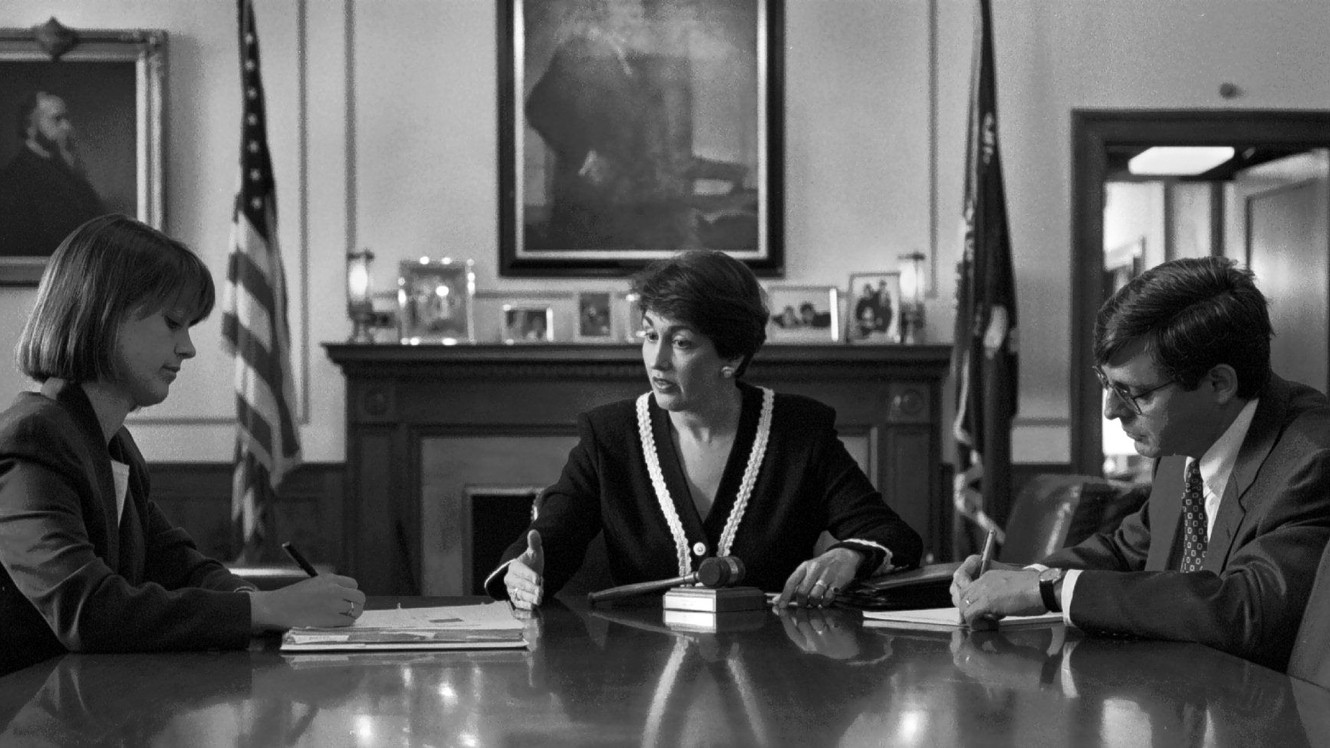
Deputy Attorney General Jamie Gorelick takes a meeting with Amy Jeffries (left), counsel to the DAG, and Merrick Garland (right), principal associate DAG, in her office at the Justice Department, in September 1995. (Bill O’Leary / The Washington Post / Getty)
When Garland talks about how he handles complex, emotionally fraught investigations, there’s a historical antecedent that he likes to cite as his formative experience. On the morning of April 19, 1995, the Department of Justice’s leadership learned that a bomb had destroyed much of a massive federal office building in Oklahoma City, ripping off its facade and killing 168 people, including 19 children in the building’s day-care center.
At the time, Garland held a job known as the PADAG, or the principal associate deputy attorney general. It’s a mystifying title, but one of the most prized offices in the department: It afforded him a seat in the attorney general’s morning meeting and access to DOJ’s most closely held secrets. Garland used his privileged position to ask if he could travel to Oklahoma City to oversee the investigation.
Before Garland left, Attorney General Janet Reno pulled him aside. Of all things, she wanted to talk about O. J. Simpson. The football star’s trial was going to be running on a split screen alongside the Oklahoma City investigation. Everything the public was about to witness in a Los Angeles courtroom would make the justice system look like a tawdry joke. She told Garland that his job was to show how the legal system could be the antithesis of that circus.
“I want you to be meticulous,” she told him. “I don’t want to have any chance of losing a conviction. I want this to be picture perfect, so that the public understands what justice is.”
The bombing case triggered a strong emotional reaction across America, particularly those who feared the emergence of right-wing militias. Although much more straightforward than the chaotic events of January 6, the crime ignited a similarly intense desire to quickly punish the perpetrators. But Garland vowed to Reno that he would take the long way around.
Paying strict attention to procedure came naturally to Garland, even when the FBI seemed inclined to take shortcuts. He ordered agents to obtain warrants and subpoenas from courts even when they weren’t unambiguously necessary. In his quest for immaculate justice, his investigators conducted 28,000 interviews.
These decisions arguably made the prosecution’s case harder and certainly delayed the gratification of a conviction. But they also guarded against humiliating slipups that might have provided the basis for an appeal. In the end, Timothy McVeigh’s attempt to overturn his conviction failed and he was executed in 2001. His co-conspirator Terry Nichols was sentenced to life, a sentence that an Appeals court affirmed.
David A. Graham: How did the Oklahoma City bombing shape Merrick Garland?
https://www.theatlantic.com/politics/archive/2016/03/merrick-garland-oklahoma-city-bombing-supreme-court/474090/
Garland has taken a similarly meticulous approach to Trump. Rather than starting with the offenses of the president himself, the department has devoted its resources to tediously building cases against every gym teacher and accountant who breached the Capitol on January 6, some 900 indictments in total. The volume of cases has risked overtaxing prosecutors—and pushing back the work of building more-complicated cases against Trump’s inner circle.
But what looks like donkeywork is a necessary step in a formulaic approach, a set of prescribed practices that have their own embedded wisdom. As Garland explains it, the department has no choice but to begin with the most “overt crimes,” and slowly build from there. To start with Trump would have reeked of politics—and it would have been bad practice, forgoing all the witnesses and cellphone data collected by starting at the bottom.
By focusing on Trump, Garland’s critics tend to underestimate the importance of the other arms of the January 6 prosecutions. The Justice Department has made an example of the foot soldiers of the insurrection, and has thus deflated attendance at every subsequent “Stop the Steal” rally. Evidence supplied by the minnows who invaded the Capitol helped the Justice Department indict leaders of the Oath Keepers (Elmer Stewart Rhodes) and Proud Boys (Henry “Enrique” Tarrio) on charges of seditious conspiracy, the most meaningful steps that the government has taken to dismantle the nation’s right-wing paramilitaries. (Both men have pleaded not guilty.)
From the November 2020 issue: Mike Giglio on the pro-Trump militant group that has recruited thousands of police, soldiers, and veterans
https://www.theatlantic.com/magazine/archive/2020/11/right-wing-militias-civil-war/616473/
Based on subpoenas and the witnesses seen exiting the grand jury, the department is clearly moving up the ladder, getting ever closer to Trump’s inner circle and to Trump himself. But there comes a moment when the rule book that Garland reveres ceases to provide such clear guidance. That’s the juncture that allows for prosecutorial discretion. In the case of Donald Trump, the prosecutor is Merrick Garland and discretion would allow him to decide that an indictment is simply not worth the social cost, or that the case is strong but not strong enough. Garland’s critics fret that when confronted with this moment, his penchant for caution will take hold.
Over the course of his career, institutions were good to Merrick Garland—and he was good to institutions. He was a true believer in the American system. That’s why he struggled to come to terms with the reality of Mitch McConnell.
For 293 days after Obama announced his selection to fill Scalia’s seat, Garland was trapped in limbo, waiting for Senate Republicans to provide him a fair hearing. The whole world knew that they never would; Garland remained patient. One of his old teachers from Harvard Law School, Laurence Tribe, told me, “What was heartbreaking was to see that the system really wasn’t as good as he hoped it was.”
The human response to McConnell’s brazen tactics was rage. Garland’s wife and daughters certainly channeled that emotion, as did his friends and former clerks. The people around Garland couldn’t contain their fury, but he did. When friends would call to vent, he would try to comfort them, to tamp down their ire. “Don’t feel too sorry for me,” he told them. “I’ve had a great run. Don’t worry.”
Such placidity wasn’t anomalous. He was always the calm one, his friend Jamie Gorelick told me. Ever since college, he had counseled her to not let emotions roil her. Back then, she was enraged that Harvard gave free football tickets to men, not women. After a contentious meeting where she railed against the injustice, he took her aside: “You’re right to be upset, but you shouldn’t be this upset. Over time, this will get fixed.” Gorelick valued his circumspection so highly that she hired him to serve as her deputy in the Clinton Justice Department. Even then, his advice was the same. He encouraged her to put angry letters she wrote in a drawer, until she restored her sense of equilibrium.
This tendency could be described as repression. The theologian Reinhold Niebuhr had another name for it. He called it the “spiritual discipline against resentment,” a phrase from his theory of political persuasion. He urged victims of injustice to resist the self-defeating instinct to righteously trumpet their own victimhood. That’s not a personal credo for Garland, or anything like it. But with his preternatural self-control and his sense of rectitude, he seems to regard anger, especially on his own behalf, as a dangerous emotion.
To be continued .. https://www.theatlantic.com/politics/archive/2022/10/merrick-garland-donald-trump-investigation-indictment/671683/
See also:
Agree all the "if Garland charges Trump' chat angst et al/is sickening. It's politics 'no person is above the law' bs politics-law and order intersection. Mostly all now waste of words. Just hoping Garland is man enough to ignore it all. And since he hasn't moved long before now would like him to hit Trump after the midterms.
https://investorshub.advfn.com/boards/read_msg.aspx?message_id=170107379
It’s clear to me that Merrick Garland will bring charges against Donald Trump. It’s just a matter of when.
By Franklin Foer
October 11, 2022, 6 AM ET
[...]
When Garland returned to the Court of Appeals after his nomination was blocked, he was greeted with an ovation from his colleagues. No doubt it was heartwarming, but the truth was that he was returning to an old routine after having been taunted with the job of his dreams. It would have only been human for his mind to ponder a fresh start."
In the fall of 2020, with polls showing Joe Biden primed to defeat Donald Trump, friends began asking, Would you ever want to be attorney general?
When Garland’s name showed up on the list of Biden’s potential AGs, it was fair to assume that he hoped the job would nudge the Supreme Court debacle out of the first paragraph of his obituary. But Garland told friends that he wanted to return to the Justice Department, where he’d worked as a young lawyer and first found his sense of professional purpose, to restore an institution that he revered. It had been damaged by a succession of Trump appointees, who carried out the policy of separating migrant children from their parents, distorted the findings of Robert Mueller’s investigation, and allegedly brought cases in order to settle the president’s political scores.
From the September 2022 issue: Caitlin Dickerson on the secret history of the U.S. government’s family-separation policy
https://www.theatlantic.com/magazine/archive/2022/09/trump-administration-family-separation-policy-immigration/670604/
As Garland prepared to take the job, he often sounded nostalgic for his first stint at DOJ, in the final years of the Carter administration, when he worked as a special assistant to Attorney General Benjamin Civiletti. Nobody thinks of the late ’70s as the height of idealism, but that’s how Garland remembers the time.
In the aftermath of Watergate, he sat by Civiletti’s side as he continued the work of reforming the Justice Department: writing new rules and procedures to prevent another president from ever abusing the institution. They were preserving the rule of law by bubble-wrapping it in norms, so that it would be thoroughly insulated from political pressure.
This June, I visited Garland in his wood-paneled office, one of the cozier rooms in DOJ’s cavernous building. He wore a navy suit that looked as if it had been purchased at Brooks Brothers in 1985. A tray of coffee with demitasses was laid out on a coffee table, but he sipped from a mug.
As Garland spoke about his approach to his job, he asked an aide to pass him a copy of a tattered blue book that was sitting on a side table, Principles of Federal Prosecution, published during his time with Civiletti. He kept extolling the neutrality of the department, how it should never favor friends or penalize foes, how it should only bring cases that persuade juries and survive appeals. “What I’m saying isn’t novel,” he said. “It’s all in here.”
Thumbing through the document, he seemed briefly distracted. I asked him if he’d had anything to do with its publication. “I helped edit it,” he said, and then wistfully recalled his mentors in the department who oversaw its production. It struck me that Garland isn’t just by-the-book. In some profound sense, he is the book.
This unbending fidelity to rules and norms has often looked impotent in the face of the democratic emergency that is Donald Trump. In his quest to avoid the taint of politics, Garland allowed certain Trump-era policies to remain in place. He ordered the DOJ to continue defending Trump against a defamation lawsuit filed by E. Jean Carroll, a writer who accused him of raping her. He has permitted the Special Prosecutor John Durham’s investigation of the origins of Russiagate to persist, despite a raft of Democrats clamoring for him to shut it down. (I should note here that Durham mentioned my reporting on Trump and Russia in court filings, and his lawyers asked witnesses about it in his prosecution of a Clinton campaign lawyer, whom a jury acquitted.) Those flash points created an impression of passivity; instead of rushing to confront the legacy of Trumpism, he seemed to be meekly deferring to it.
It is not difficult to see why anti-Trump partisans could grow frustrated with Garland’s obdurate commitment to the traditions of the department when Trump is so intent on trampling them. His faith in them feels antiquated—and detached from the Democratic Party’s broad reconsideration of norms that were once seen as pillars of the American system. Not so long ago, expanding the number of justices on the Supreme Court or eliminating the filibuster seemed like subversive thought experiments. Now they are touted as necessities for preserving majoritarian politics.
But the post-Watergate reforms that Garland wants to defend weren’t aimed at abstract threats. They emerged as responses to very real abuse committed within living memory. And they arguably did an effective job at blunting Donald Trump’s desire to turn the Justice Department into his plaything, even if they couldn’t prevent every transgression. Norms held and prevented nightmare scenarios from unfolding.
These norms may not hold the next time, but that doesn’t obviate their ethical power. No matter how much one fears Trump, the prosecution of a former president can’t be undertaken lightly. The expectation that political enemies will be treated fairly is the basis for the legitimacy of the entire legal system. That’s why Garland’s hand-wringing and fussiness matter. Any indictment he brings against Trump will have survived his scrutiny, which means that it will have cleared a high bar.
Deputy Attorney General Jamie Gorelick takes a meeting with Amy Jeffries (left), counsel to the DAG, and Merrick Garland (right), principal associate DAG, in her office at the Justice Department, in September 1995. (Bill O’Leary / The Washington Post / Getty)
When Garland talks about how he handles complex, emotionally fraught investigations, there’s a historical antecedent that he likes to cite as his formative experience. On the morning of April 19, 1995, the Department of Justice’s leadership learned that a bomb had destroyed much of a massive federal office building in Oklahoma City, ripping off its facade and killing 168 people, including 19 children in the building’s day-care center.
At the time, Garland held a job known as the PADAG, or the principal associate deputy attorney general. It’s a mystifying title, but one of the most prized offices in the department: It afforded him a seat in the attorney general’s morning meeting and access to DOJ’s most closely held secrets. Garland used his privileged position to ask if he could travel to Oklahoma City to oversee the investigation.
Before Garland left, Attorney General Janet Reno pulled him aside. Of all things, she wanted to talk about O. J. Simpson. The football star’s trial was going to be running on a split screen alongside the Oklahoma City investigation. Everything the public was about to witness in a Los Angeles courtroom would make the justice system look like a tawdry joke. She told Garland that his job was to show how the legal system could be the antithesis of that circus.
“I want you to be meticulous,” she told him. “I don’t want to have any chance of losing a conviction. I want this to be picture perfect, so that the public understands what justice is.”
The bombing case triggered a strong emotional reaction across America, particularly those who feared the emergence of right-wing militias. Although much more straightforward than the chaotic events of January 6, the crime ignited a similarly intense desire to quickly punish the perpetrators. But Garland vowed to Reno that he would take the long way around.
Paying strict attention to procedure came naturally to Garland, even when the FBI seemed inclined to take shortcuts. He ordered agents to obtain warrants and subpoenas from courts even when they weren’t unambiguously necessary. In his quest for immaculate justice, his investigators conducted 28,000 interviews.
These decisions arguably made the prosecution’s case harder and certainly delayed the gratification of a conviction. But they also guarded against humiliating slipups that might have provided the basis for an appeal. In the end, Timothy McVeigh’s attempt to overturn his conviction failed and he was executed in 2001. His co-conspirator Terry Nichols was sentenced to life, a sentence that an Appeals court affirmed.
David A. Graham: How did the Oklahoma City bombing shape Merrick Garland?
https://www.theatlantic.com/politics/archive/2016/03/merrick-garland-oklahoma-city-bombing-supreme-court/474090/
Garland has taken a similarly meticulous approach to Trump. Rather than starting with the offenses of the president himself, the department has devoted its resources to tediously building cases against every gym teacher and accountant who breached the Capitol on January 6, some 900 indictments in total. The volume of cases has risked overtaxing prosecutors—and pushing back the work of building more-complicated cases against Trump’s inner circle.
But what looks like donkeywork is a necessary step in a formulaic approach, a set of prescribed practices that have their own embedded wisdom. As Garland explains it, the department has no choice but to begin with the most “overt crimes,” and slowly build from there. To start with Trump would have reeked of politics—and it would have been bad practice, forgoing all the witnesses and cellphone data collected by starting at the bottom.
By focusing on Trump, Garland’s critics tend to underestimate the importance of the other arms of the January 6 prosecutions. The Justice Department has made an example of the foot soldiers of the insurrection, and has thus deflated attendance at every subsequent “Stop the Steal” rally. Evidence supplied by the minnows who invaded the Capitol helped the Justice Department indict leaders of the Oath Keepers (Elmer Stewart Rhodes) and Proud Boys (Henry “Enrique” Tarrio) on charges of seditious conspiracy, the most meaningful steps that the government has taken to dismantle the nation’s right-wing paramilitaries. (Both men have pleaded not guilty.)
From the November 2020 issue: Mike Giglio on the pro-Trump militant group that has recruited thousands of police, soldiers, and veterans
https://www.theatlantic.com/magazine/archive/2020/11/right-wing-militias-civil-war/616473/
Based on subpoenas and the witnesses seen exiting the grand jury, the department is clearly moving up the ladder, getting ever closer to Trump’s inner circle and to Trump himself. But there comes a moment when the rule book that Garland reveres ceases to provide such clear guidance. That’s the juncture that allows for prosecutorial discretion. In the case of Donald Trump, the prosecutor is Merrick Garland and discretion would allow him to decide that an indictment is simply not worth the social cost, or that the case is strong but not strong enough. Garland’s critics fret that when confronted with this moment, his penchant for caution will take hold.
Over the course of his career, institutions were good to Merrick Garland—and he was good to institutions. He was a true believer in the American system. That’s why he struggled to come to terms with the reality of Mitch McConnell.
For 293 days after Obama announced his selection to fill Scalia’s seat, Garland was trapped in limbo, waiting for Senate Republicans to provide him a fair hearing. The whole world knew that they never would; Garland remained patient. One of his old teachers from Harvard Law School, Laurence Tribe, told me, “What was heartbreaking was to see that the system really wasn’t as good as he hoped it was.”
The human response to McConnell’s brazen tactics was rage. Garland’s wife and daughters certainly channeled that emotion, as did his friends and former clerks. The people around Garland couldn’t contain their fury, but he did. When friends would call to vent, he would try to comfort them, to tamp down their ire. “Don’t feel too sorry for me,” he told them. “I’ve had a great run. Don’t worry.”
Such placidity wasn’t anomalous. He was always the calm one, his friend Jamie Gorelick told me. Ever since college, he had counseled her to not let emotions roil her. Back then, she was enraged that Harvard gave free football tickets to men, not women. After a contentious meeting where she railed against the injustice, he took her aside: “You’re right to be upset, but you shouldn’t be this upset. Over time, this will get fixed.” Gorelick valued his circumspection so highly that she hired him to serve as her deputy in the Clinton Justice Department. Even then, his advice was the same. He encouraged her to put angry letters she wrote in a drawer, until she restored her sense of equilibrium.
This tendency could be described as repression. The theologian Reinhold Niebuhr had another name for it. He called it the “spiritual discipline against resentment,” a phrase from his theory of political persuasion. He urged victims of injustice to resist the self-defeating instinct to righteously trumpet their own victimhood. That’s not a personal credo for Garland, or anything like it. But with his preternatural self-control and his sense of rectitude, he seems to regard anger, especially on his own behalf, as a dangerous emotion.
To be continued .. https://www.theatlantic.com/politics/archive/2022/10/merrick-garland-donald-trump-investigation-indictment/671683/
See also:
Agree all the "if Garland charges Trump' chat angst et al/is sickening. It's politics 'no person is above the law' bs politics-law and order intersection. Mostly all now waste of words. Just hoping Garland is man enough to ignore it all. And since he hasn't moved long before now would like him to hit Trump after the midterms.
https://investorshub.advfn.com/boards/read_msg.aspx?message_id=170107379
It was Plato who said, “He, O men, is the wisest, who like Socrates, knows that his wisdom is in truth worth nothing”
Discover What Traders Are Watching
Explore small cap ideas before they hit the headlines.



