



 AI
AI








Friday, March 11, 2022 5:56:51 PM
Biden, European allies move to strip Russia of trade status
"The edge of war: what, exactly, does Putin want in Ukraine?"
The president calls the actions a “crushing blow" to the Russian economy, which already has been pummeled by financial sanctions
By David J. Lynch
Today at 9:53 a.m. EST|Updated today at 4:25 p.m. EST
VIDEO - United States moves to suspend normal trade relations with Russia
President Biden announced on March 11 that the United States would suspend
"permanent normal trade relations" with Russia. (The Washington Post)
President Biden said the U.S. and its allies would strip Russia of trade benefits enjoyed by most nations, adding to financial pressure designed to punish Russian President Vladimir Putin for invading Ukraine.
The European Union and the other Group of 7 nations plan to implement similar measures, which would have a more dramatic impact.
Biden called the actions “another crushing blow to Russia’s economy,” which has been pummeled by comprehensive financial sanctions .. https://www.washingtonpost.com/business/2022/02/27/russia-ukraine-sanctions-swift-central-bank/?itid=lk_inline_manual_5 .. announced in the aftermath of Moscow’s invasion of its neighbor. The U.S. and Europe have cut off major Russian banks from global financial channels, blocked the country’s access to advanced technologies, and blacklisted wealthy business executives .. https://www.washingtonpost.com/us-policy/2022/03/02/russia-oligarchs-ukraine-america/?itid=lk_inline_manual_5 .. who back Putin’s rule and profit from it.
“The free world is coming together to confront Putin,” the president said in remarks from the White House.
[ Russia - Ukraine: Live updates
https://www.washingtonpost.com/world/2022/03/11/russia-ukraine-war-news-putin-live-updates/?itid=lk_interstitial_manual_8 ]
Amid Ukrainian President Volodymyr Zelensky’s pleas for military support, the coordinated allied initiatives were a fresh sign that Biden remains intent on using financial weapons to thwart what he called Putin’s “merciless assault” on Ukraine.
The battered Russian economy will shrink by at least 15 percent this year, according to the Institute of International Finance, an association of global banks. The White House said Friday that 30 years of Russian integration with the global economy .. https://www.washingtonpost.com/business/2022/03/05/global-economy-russia-ukraine/?itid=lk_inline_manual_11 .. have been erased in just weeks.
“It’s undeniable that allied sanctions have had a severe effect on the Russian economy and it’s important to remember, they would remain in place for some time to come even if the war in Ukraine ended today,” said Daniel Tannebaum, global head of sanctions for Oliver Wyman. “And there are still more levers yet to pull.”
[ Oil price shock jolts global recovery as impact of Russia's invasion of Ukraine spreads
https://www.washingtonpost.com/business/2022/03/11/oil-price-global-recovery-russia-ukraine/?itid=lk_interstitial_manual_13 ]
The president needs congressional approval to alter Russia’s trade status, ending what’s called “permanent and normal trade relations” and treating the country as a pariah along with nations like Cuba and North Korea. The European changes also must be approved by national legislatures.
House Speaker Nancy Pelosi said the House next week will take up legislation to formalize the policy shift.
The president said the allies also will seek to deny Russia the ability to borrow from the International Monetary Fund and the World Bank.
“Putin is the aggressor and he must pay the price,” the president said.
Friday’s actions will ratchet up the allies’ “maximum pressure campaign,” though they pale alongside measures already imposed, including a ban on U.S. purchases of Russian oil, according to Elina Ribakova, deputy chief economist for the Institute of International Finance.
In a largely symbolic move, the administration also plans to ban imports of Russian seafood and alcohol, which totaled $550 million last year. And Biden intends to prohibit U.S. exports of luxury goods favored by the Russian oligarchs who support Putin.
The U.S. already has halted purchases of Russian oil and energy products, which made up about 60 percent of the $26 billion in goods imported from Russia in 2021. Biden’s announcement will have a limited effect on future U.S. orders from Russian companies, according to Ed Gresser, who led the U.S. Trade Representative’s economic research unit until last year.
That’s because the policy change, if approved by Congress, would reinstate the import levies set in the Smoot-Hawley Tariff Act of 1930. The measure, which many economists say deepened the Great Depression, imposed high tariffs on foreign-made manufactured goods. But it left raw materials largely unscathed, to benefit American factory owners.
“Russia is quite unusual as a large complex economy that is a natural resources producer,” said Gresser.
For some critical Russian products — such as palladium — tariffs will remain at zero, Gresser said. The industrial metal is used to make catalytic converters for automobiles. Other imports such as plywood, which enter the U.S. on a duty-free basis, would be hit with a 30 percent import fee.
[Insert: Surely under the circumstances Pelosi, et al, could make some adjustments so that all of the impositions of the Smoot-Hawley Tariff Act are not reinstated. In the interests of minimizing inflationary measures driven by Putin's war and measures taken to oppose him, i mean.]
European policymakers could hurt Putin more.
Two-way trade between the E.U. and Russia amounts to about $281 billion a year, roughly 10 times U.S.-Russia trade. (Canada last week announced it would strip Russia and Belarus of their most-favored nation status, subjecting goods from those two countries to a new 35-percent tariff.)
The key question is what the E.U. does about tariffs on Russian energy products. Earlier this week, the European Commission, the union’s executive arm, announced a plan to cut European imports of Russian natural gas this year by two-thirds.
Russia provides roughly 40 percent of E.U. gas supplies, with Germany, Poland, Finland and Hungary especially dependent upon Russian sources. Austria and the Czech Republic get all of their gas from Russia, according to IIF.
[ Russian military pushes ahead seeing limited gains, huge losses
https://www.washingtonpost.com/national-security/2022/03/11/russia-military-ukraine-battlefield-progress/?itid=lk_interstitial_manual_36 ]
“Russia cannot grossly violate international law and, at the same time, expect to benefit from the privileges of being part of the international economic order,” EC President Ursula Von der Leyen .. https://ec.europa.eu/commission/presscorner/detail/en/STATEMENT_22_1724 .. said Friday in Versailles, France, previewing a fourth European sanctions package to be introduced on Saturday.
Allied sanctions imposed to date already have taken a toll on the Russian economy. The ruble has lost nearly half its value, the country’s stock market has been shut for more than a week, and foreign corporations are fleeing.
The war is taking a toll on the U.S. economy, too. Gasoline prices hit a record $4.23 per gallon this week, which will aggravate inflation that already is at a 40-year high. And on Friday the University of Michigan consumer confidence reading dropped to 59.7 from 62.8, as Americans grew increasingly gloomy about the outlook.
As the Russian economy crumbles, Putin has begun talking about retaliating. On Thursday, he endorsed a legislative proposal to nationalize the assets of foreign corporations that have quit the Russian market since the war began. At least 350 multinational corporations have abandoned or frozen their operations in Russia, according to a tally by Jeffrey Sonnenfeld, a professor at Yale University’s School of Management.
Even some who support the financial salvos against Russia worry they could accelerate an unraveling of global trade rules that generally prohibit punitive tariffs. President Trump in 2019 threatened to impose an escalating series of tariff increases .. https://www.washingtonpost.com/business/economy/trumps-threat-to-hit-mexico-with-tariffs-could-upend-his-trade-deal-and-undermine-the-economy/2019/05/30/876a1de0-8342-11e9-95a9-e2c830afe24f_story.html?itid=lk_inline_manual_46 .. on goods from Mexico to force its government to crack down on immigration, but subsequently dropped the idea.
Chad Bown, an economist with the Peterson Institute for International Economics, said Friday’s action could set an unfortunate precedent for handling routine commercial disputes.
“This thing today with Russia is unequivocally O.K.,” Bown said. “It’s just, does this make it too easy to resort to something like this in the future?”
https://www.washingtonpost.com/business/2022/03/11/biden-russia-trade-relations-eu/
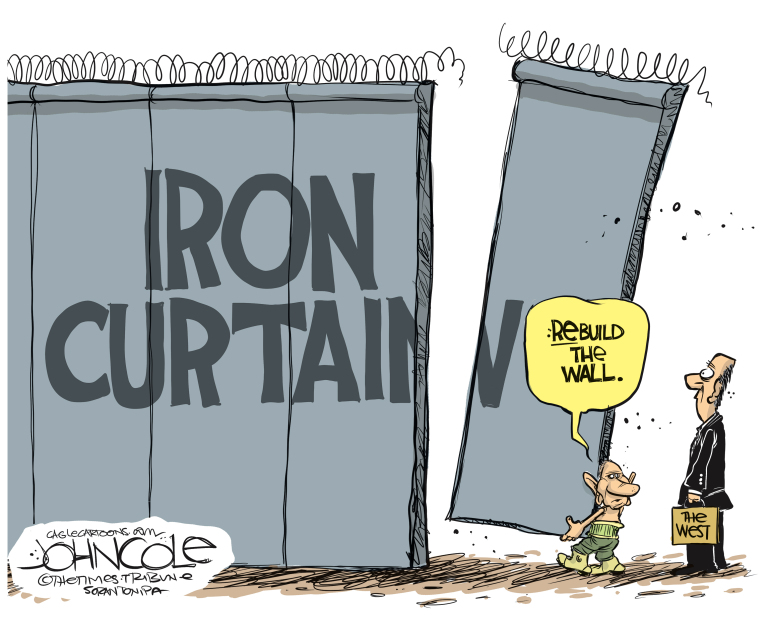
So Putin in his invasion of Ukraine has overstepped. Just as the West sees Xi
guilty of. Decades of coming together is smashed in a much shorter time. See
The Ugly End of Chimerica
[...]
Convinced of the seductive power of democracy and lulled by the promise of a seemingly ineluctable historical arc that bent toward greater openness, freedom, and justice, Americans tended to view the prospect of such convergence as almost inevitable. After all, if China wanted to participate fully in the global marketplace, it had no choice but to play by the existing rules—and after the end of the Cold War, that meant America’s rules. So certain did the likelihood of greater convergence seem that there was even talk of a so-called “Chimerica” or forming a “Group of Two.” These promises of a less contentious future allowed differences between China’s values and political systems and those of the democratic world to be downplayed. Proponents of engagement with China emphasized its future evolution under the tonic effects of its putative economic reforms and cautioned that a tougher U.S. policy would only harm the country’s reformers.
[...]
U.S. corporations and consumers both profited from these policies, even as the country was forced to compromise some of its democratic principles and tolerate a growing trade deficit. But China derived the largest benefit: Engagement neutralized the United States as an adversary at a time when it was most beneficial to Beijing. During those 30-plus years, China emerged out of its revolutionary cocoon, developed its fragile economy, laid down its modern infrastructure, and became an important part of global institutions. In a sheltered environment, one in which it was relieved of the threat of war with another big power or even serious hostility, China not only survived but thrived.
==========
With Xi’s 2012 enthronement, however, the chemistry of this critical bilateral relationship began to change. Xi replaced his predecessor’s slogan of “peaceful rise” with his more belligerent “China Dream” and “China rejuvenation.” These ideas laid out a grand vision of a far more assertive and influential Chinese government at home and abroad. But Xi’s implacable assertiveness in foreign policy and his expanding domestic authoritarianism soon began alienating the United States as well as many other lesser trade partners, which found themselves caught in increasingly unequal, and sometimes even abusive, relationships they could not afford to vacate.
https://investorshub.advfn.com/boards/read_msg.aspx?message_id=154817365
"The edge of war: what, exactly, does Putin want in Ukraine?"
The president calls the actions a “crushing blow" to the Russian economy, which already has been pummeled by financial sanctions
By David J. Lynch
Today at 9:53 a.m. EST|Updated today at 4:25 p.m. EST
VIDEO - United States moves to suspend normal trade relations with Russia
President Biden announced on March 11 that the United States would suspend
"permanent normal trade relations" with Russia. (The Washington Post)
President Biden said the U.S. and its allies would strip Russia of trade benefits enjoyed by most nations, adding to financial pressure designed to punish Russian President Vladimir Putin for invading Ukraine.
The European Union and the other Group of 7 nations plan to implement similar measures, which would have a more dramatic impact.
Biden called the actions “another crushing blow to Russia’s economy,” which has been pummeled by comprehensive financial sanctions .. https://www.washingtonpost.com/business/2022/02/27/russia-ukraine-sanctions-swift-central-bank/?itid=lk_inline_manual_5 .. announced in the aftermath of Moscow’s invasion of its neighbor. The U.S. and Europe have cut off major Russian banks from global financial channels, blocked the country’s access to advanced technologies, and blacklisted wealthy business executives .. https://www.washingtonpost.com/us-policy/2022/03/02/russia-oligarchs-ukraine-america/?itid=lk_inline_manual_5 .. who back Putin’s rule and profit from it.
“The free world is coming together to confront Putin,” the president said in remarks from the White House.
[ Russia - Ukraine: Live updates
https://www.washingtonpost.com/world/2022/03/11/russia-ukraine-war-news-putin-live-updates/?itid=lk_interstitial_manual_8 ]
Amid Ukrainian President Volodymyr Zelensky’s pleas for military support, the coordinated allied initiatives were a fresh sign that Biden remains intent on using financial weapons to thwart what he called Putin’s “merciless assault” on Ukraine.
The battered Russian economy will shrink by at least 15 percent this year, according to the Institute of International Finance, an association of global banks. The White House said Friday that 30 years of Russian integration with the global economy .. https://www.washingtonpost.com/business/2022/03/05/global-economy-russia-ukraine/?itid=lk_inline_manual_11 .. have been erased in just weeks.
“It’s undeniable that allied sanctions have had a severe effect on the Russian economy and it’s important to remember, they would remain in place for some time to come even if the war in Ukraine ended today,” said Daniel Tannebaum, global head of sanctions for Oliver Wyman. “And there are still more levers yet to pull.”
[ Oil price shock jolts global recovery as impact of Russia's invasion of Ukraine spreads
https://www.washingtonpost.com/business/2022/03/11/oil-price-global-recovery-russia-ukraine/?itid=lk_interstitial_manual_13 ]
The president needs congressional approval to alter Russia’s trade status, ending what’s called “permanent and normal trade relations” and treating the country as a pariah along with nations like Cuba and North Korea. The European changes also must be approved by national legislatures.
House Speaker Nancy Pelosi said the House next week will take up legislation to formalize the policy shift.
The president said the allies also will seek to deny Russia the ability to borrow from the International Monetary Fund and the World Bank.
“Putin is the aggressor and he must pay the price,” the president said.
Friday’s actions will ratchet up the allies’ “maximum pressure campaign,” though they pale alongside measures already imposed, including a ban on U.S. purchases of Russian oil, according to Elina Ribakova, deputy chief economist for the Institute of International Finance.
In a largely symbolic move, the administration also plans to ban imports of Russian seafood and alcohol, which totaled $550 million last year. And Biden intends to prohibit U.S. exports of luxury goods favored by the Russian oligarchs who support Putin.
The U.S. already has halted purchases of Russian oil and energy products, which made up about 60 percent of the $26 billion in goods imported from Russia in 2021. Biden’s announcement will have a limited effect on future U.S. orders from Russian companies, according to Ed Gresser, who led the U.S. Trade Representative’s economic research unit until last year.
That’s because the policy change, if approved by Congress, would reinstate the import levies set in the Smoot-Hawley Tariff Act of 1930. The measure, which many economists say deepened the Great Depression, imposed high tariffs on foreign-made manufactured goods. But it left raw materials largely unscathed, to benefit American factory owners.
“Russia is quite unusual as a large complex economy that is a natural resources producer,” said Gresser.
For some critical Russian products — such as palladium — tariffs will remain at zero, Gresser said. The industrial metal is used to make catalytic converters for automobiles. Other imports such as plywood, which enter the U.S. on a duty-free basis, would be hit with a 30 percent import fee.
[Insert: Surely under the circumstances Pelosi, et al, could make some adjustments so that all of the impositions of the Smoot-Hawley Tariff Act are not reinstated. In the interests of minimizing inflationary measures driven by Putin's war and measures taken to oppose him, i mean.]
European policymakers could hurt Putin more.
Two-way trade between the E.U. and Russia amounts to about $281 billion a year, roughly 10 times U.S.-Russia trade. (Canada last week announced it would strip Russia and Belarus of their most-favored nation status, subjecting goods from those two countries to a new 35-percent tariff.)
The key question is what the E.U. does about tariffs on Russian energy products. Earlier this week, the European Commission, the union’s executive arm, announced a plan to cut European imports of Russian natural gas this year by two-thirds.
Russia provides roughly 40 percent of E.U. gas supplies, with Germany, Poland, Finland and Hungary especially dependent upon Russian sources. Austria and the Czech Republic get all of their gas from Russia, according to IIF.
[ Russian military pushes ahead seeing limited gains, huge losses
https://www.washingtonpost.com/national-security/2022/03/11/russia-military-ukraine-battlefield-progress/?itid=lk_interstitial_manual_36 ]
“Russia cannot grossly violate international law and, at the same time, expect to benefit from the privileges of being part of the international economic order,” EC President Ursula Von der Leyen .. https://ec.europa.eu/commission/presscorner/detail/en/STATEMENT_22_1724 .. said Friday in Versailles, France, previewing a fourth European sanctions package to be introduced on Saturday.
Allied sanctions imposed to date already have taken a toll on the Russian economy. The ruble has lost nearly half its value, the country’s stock market has been shut for more than a week, and foreign corporations are fleeing.
The war is taking a toll on the U.S. economy, too. Gasoline prices hit a record $4.23 per gallon this week, which will aggravate inflation that already is at a 40-year high. And on Friday the University of Michigan consumer confidence reading dropped to 59.7 from 62.8, as Americans grew increasingly gloomy about the outlook.
As the Russian economy crumbles, Putin has begun talking about retaliating. On Thursday, he endorsed a legislative proposal to nationalize the assets of foreign corporations that have quit the Russian market since the war began. At least 350 multinational corporations have abandoned or frozen their operations in Russia, according to a tally by Jeffrey Sonnenfeld, a professor at Yale University’s School of Management.
Even some who support the financial salvos against Russia worry they could accelerate an unraveling of global trade rules that generally prohibit punitive tariffs. President Trump in 2019 threatened to impose an escalating series of tariff increases .. https://www.washingtonpost.com/business/economy/trumps-threat-to-hit-mexico-with-tariffs-could-upend-his-trade-deal-and-undermine-the-economy/2019/05/30/876a1de0-8342-11e9-95a9-e2c830afe24f_story.html?itid=lk_inline_manual_46 .. on goods from Mexico to force its government to crack down on immigration, but subsequently dropped the idea.
Chad Bown, an economist with the Peterson Institute for International Economics, said Friday’s action could set an unfortunate precedent for handling routine commercial disputes.
“This thing today with Russia is unequivocally O.K.,” Bown said. “It’s just, does this make it too easy to resort to something like this in the future?”
https://www.washingtonpost.com/business/2022/03/11/biden-russia-trade-relations-eu/
So Putin in his invasion of Ukraine has overstepped. Just as the West sees Xi
guilty of. Decades of coming together is smashed in a much shorter time. See
The Ugly End of Chimerica
[...]
Convinced of the seductive power of democracy and lulled by the promise of a seemingly ineluctable historical arc that bent toward greater openness, freedom, and justice, Americans tended to view the prospect of such convergence as almost inevitable. After all, if China wanted to participate fully in the global marketplace, it had no choice but to play by the existing rules—and after the end of the Cold War, that meant America’s rules. So certain did the likelihood of greater convergence seem that there was even talk of a so-called “Chimerica” or forming a “Group of Two.” These promises of a less contentious future allowed differences between China’s values and political systems and those of the democratic world to be downplayed. Proponents of engagement with China emphasized its future evolution under the tonic effects of its putative economic reforms and cautioned that a tougher U.S. policy would only harm the country’s reformers.
[...]
U.S. corporations and consumers both profited from these policies, even as the country was forced to compromise some of its democratic principles and tolerate a growing trade deficit. But China derived the largest benefit: Engagement neutralized the United States as an adversary at a time when it was most beneficial to Beijing. During those 30-plus years, China emerged out of its revolutionary cocoon, developed its fragile economy, laid down its modern infrastructure, and became an important part of global institutions. In a sheltered environment, one in which it was relieved of the threat of war with another big power or even serious hostility, China not only survived but thrived.
==========
With Xi’s 2012 enthronement, however, the chemistry of this critical bilateral relationship began to change. Xi replaced his predecessor’s slogan of “peaceful rise” with his more belligerent “China Dream” and “China rejuvenation.” These ideas laid out a grand vision of a far more assertive and influential Chinese government at home and abroad. But Xi’s implacable assertiveness in foreign policy and his expanding domestic authoritarianism soon began alienating the United States as well as many other lesser trade partners, which found themselves caught in increasingly unequal, and sometimes even abusive, relationships they could not afford to vacate.
https://investorshub.advfn.com/boards/read_msg.aspx?message_id=154817365
It was Plato who said, “He, O men, is the wisest, who like Socrates, knows that his wisdom is in truth worth nothing”
Discover What Traders Are Watching
Explore small cap ideas before they hit the headlines.



