



 AI
AI








Friday, June 25, 2021 7:44:42 PM
Yeah it's a sacrifice all of them are willing to make. All of the asshole non-mitigation nutters place children at risk of losing much. Putting children into danger doesn't appear to be a top worry for many religious adults.
If you were a religious man you wouldn't be talking the way you just did. You couldn't put those thoughts in a religious head.
No, ignore that as maybe you could. Many would have believed all Buddhists in Myanmar were peace-loving and gentle before the abuse and massacres of the Rohingya came into view.
The only comforting thought i've had for 50 years is that over the long run they are slowly losing ground. The Catholic Church has has to make adjustments after their abuse of children was exposed. Other churches have suffered knocks. At least the Christian church is losing some ground.
Demographic Study
June 13, 2018
The Age Gap in Religion Around the World
2. Young adults around the world are less religious by several measures
Adults under 40 are less likely to be religiously affiliated
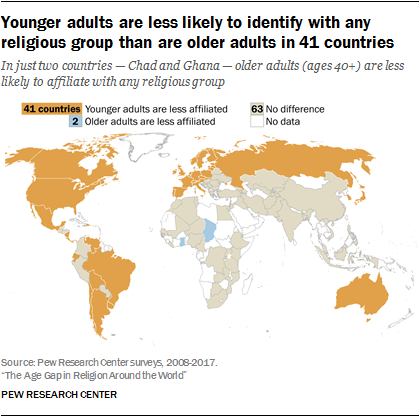
Perhaps the simplest way to measure attachment to religion among people of all ages is to look at the percentage of people who identify with a religious group. Pew Research Center surveys around the world routinely ask: “What is your present religion, if any?” Respondents are given a country-specific list of potential responses (which generally include several major world religions, as well as “atheist,” “agnostic” or “nothing in particular”).
The vast majority of people around the world claim a religious identity, such as Christian, Muslim or Hindu. But there is a clear age gap: Out of 106 countries surveyed, young adults are significantly less likely to be affiliated with a religious group in 41. In only two countries are young adults more likely to identify with a religion, while there is no significant difference in 63 countries.
Looked at another way, young adults are more likely to be religiously unaffiliated. This is especially true in North America, where in both the U.S. and Canada younger people are less likely to claim a religious identity. (These findings are in line with the rise of the religious “nones” in the U.S. .. https://www.pewresearch.org/fact-tank/2015/05/13/a-closer-look-at-americas-rapidly-growing-religious-nones/ , which is being driven largely by high levels of disaffiliation among young generations.) The gap is also prevalent in Europe – in 22 out of 35 countries – and in Latin America, where it applies in 14 out of 19 countries (including Mexico).
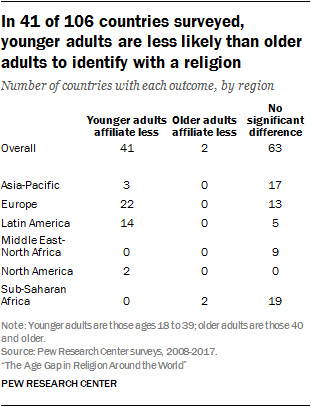
However, the pattern is not as pronounced in other parts of the world. In the Middle East-North Africa region and sub-Saharan Africa, where most people identify as either Muslim or Christian, there are no countries where young people are less affiliated. In fact, the only two countries out of a combined 30 in these regions with an affiliation gap are Chad and Ghana, where young adults are more likely than their elders to claim a religious affiliation – making these nations the only exceptions to the prevailing pattern around the world.
In the Asia-Pacific region, a religiously diverse area with a wide variety of religious practices, 17 out of 20 countries show no significant contrasts. However, the three nations in that region that do show differences – South Korea, Australia and Japan – have some of the world’s biggest gaps. In South Korea, 39% of younger adults are affiliated with a religious group, compared with 63% of their elders, a difference of 24 points. In Australia, the gap is 23 points (43% vs. 66%), and in Japan it is 18 points (31% vs. 49%). In many other countries in the region, such as Pakistan, India and Indonesia, affiliation is all but universal across both age groups.
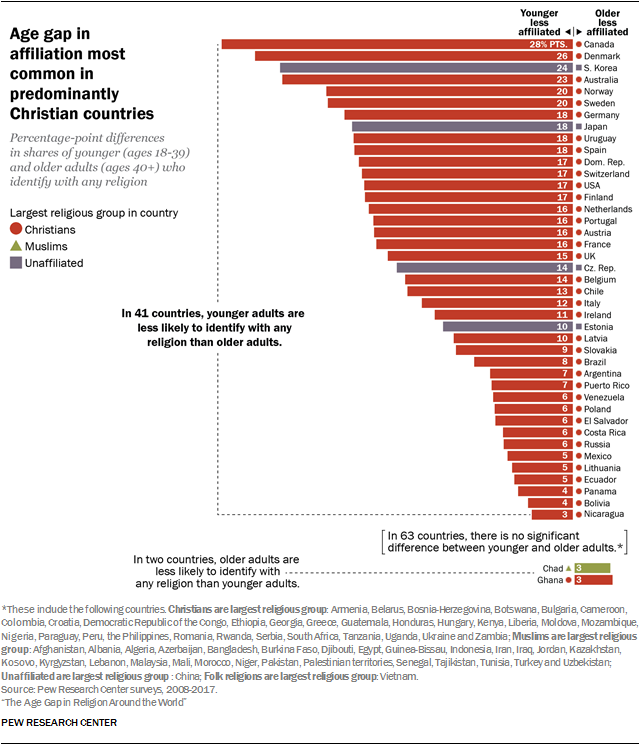
There is a particularly large gap in religious affiliation – 28 percentage points – in Canada (49% of adults under 40 and 77% of older adults are affiliated). The U.S. differential is smaller, though still considerable at 17 points (66% vs. 83%).
In the average country out of 35 in Europe, there is a 10-point difference between the share of younger adults who identify with a religion (75%) and the share of older adults who do (85%), with the Scandinavian countries of Denmark, Norway and Sweden each showing gaps of 20 points or more. In the Latin America-Caribbean region, the average country has a gap of 6 points (87% vs. 93%), with Uruguay and the Dominican Republic exhibiting large differences.
Averaging the national percentages in each of the 106 countries surveyed yields a global picture that clearly reinforces the regional patterns: The share of younger adults in the average country worldwide who claim a religion is 85%, compared with 90% among people ages 40 or older. 16
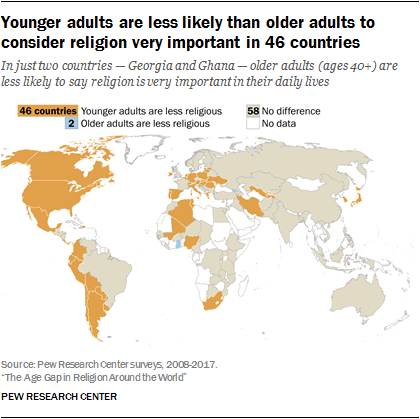
Importance of religion: Older adults regard religion as less important in only two countries
More - https://www.pewforum.org/2018/06/13/young-adults-around-the-world-are-less-religious-by-several-measures/
Then again religious brainwashing of the young is still unhappy and unhealthy in much of the world. It will be a very slow process, but Islam youngsters over time will shed the yolk evermore too. Still, the drift will occur.
If you were a religious man you wouldn't be talking the way you just did. You couldn't put those thoughts in a religious head.
No, ignore that as maybe you could. Many would have believed all Buddhists in Myanmar were peace-loving and gentle before the abuse and massacres of the Rohingya came into view.
The only comforting thought i've had for 50 years is that over the long run they are slowly losing ground. The Catholic Church has has to make adjustments after their abuse of children was exposed. Other churches have suffered knocks. At least the Christian church is losing some ground.
Demographic Study
June 13, 2018
The Age Gap in Religion Around the World
2. Young adults around the world are less religious by several measures
Adults under 40 are less likely to be religiously affiliated
Perhaps the simplest way to measure attachment to religion among people of all ages is to look at the percentage of people who identify with a religious group. Pew Research Center surveys around the world routinely ask: “What is your present religion, if any?” Respondents are given a country-specific list of potential responses (which generally include several major world religions, as well as “atheist,” “agnostic” or “nothing in particular”).
The vast majority of people around the world claim a religious identity, such as Christian, Muslim or Hindu. But there is a clear age gap: Out of 106 countries surveyed, young adults are significantly less likely to be affiliated with a religious group in 41. In only two countries are young adults more likely to identify with a religion, while there is no significant difference in 63 countries.
Looked at another way, young adults are more likely to be religiously unaffiliated. This is especially true in North America, where in both the U.S. and Canada younger people are less likely to claim a religious identity. (These findings are in line with the rise of the religious “nones” in the U.S. .. https://www.pewresearch.org/fact-tank/2015/05/13/a-closer-look-at-americas-rapidly-growing-religious-nones/ , which is being driven largely by high levels of disaffiliation among young generations.) The gap is also prevalent in Europe – in 22 out of 35 countries – and in Latin America, where it applies in 14 out of 19 countries (including Mexico).
However, the pattern is not as pronounced in other parts of the world. In the Middle East-North Africa region and sub-Saharan Africa, where most people identify as either Muslim or Christian, there are no countries where young people are less affiliated. In fact, the only two countries out of a combined 30 in these regions with an affiliation gap are Chad and Ghana, where young adults are more likely than their elders to claim a religious affiliation – making these nations the only exceptions to the prevailing pattern around the world.
In the Asia-Pacific region, a religiously diverse area with a wide variety of religious practices, 17 out of 20 countries show no significant contrasts. However, the three nations in that region that do show differences – South Korea, Australia and Japan – have some of the world’s biggest gaps. In South Korea, 39% of younger adults are affiliated with a religious group, compared with 63% of their elders, a difference of 24 points. In Australia, the gap is 23 points (43% vs. 66%), and in Japan it is 18 points (31% vs. 49%). In many other countries in the region, such as Pakistan, India and Indonesia, affiliation is all but universal across both age groups.
There is a particularly large gap in religious affiliation – 28 percentage points – in Canada (49% of adults under 40 and 77% of older adults are affiliated). The U.S. differential is smaller, though still considerable at 17 points (66% vs. 83%).
In the average country out of 35 in Europe, there is a 10-point difference between the share of younger adults who identify with a religion (75%) and the share of older adults who do (85%), with the Scandinavian countries of Denmark, Norway and Sweden each showing gaps of 20 points or more. In the Latin America-Caribbean region, the average country has a gap of 6 points (87% vs. 93%), with Uruguay and the Dominican Republic exhibiting large differences.
Averaging the national percentages in each of the 106 countries surveyed yields a global picture that clearly reinforces the regional patterns: The share of younger adults in the average country worldwide who claim a religion is 85%, compared with 90% among people ages 40 or older. 16
Importance of religion: Older adults regard religion as less important in only two countries
More - https://www.pewforum.org/2018/06/13/young-adults-around-the-world-are-less-religious-by-several-measures/
Then again religious brainwashing of the young is still unhappy and unhealthy in much of the world. It will be a very slow process, but Islam youngsters over time will shed the yolk evermore too. Still, the drift will occur.
It was Plato who said, “He, O men, is the wisest, who like Socrates, knows that his wisdom is in truth worth nothing”
Discover What Traders Are Watching
Explore small cap ideas before they hit the headlines.



