



 AI
AI








Thursday, September 10, 2020 2:27:08 PM
A Comprehensive History of 'Loose Change'—and the Seeds It Planted in Our Politics
AKA the origin story for the 'crazier than a shit house rat' conspiracy theory posts that we all read from time to time.
Fifteen years ago, three young men created a 9/11-conspiracy-theory film that laid the groundwork for our culture of outrageous misinformation.
By John McDermott
Sep 10, 2020
https://www.esquire.com/news-politics/a33971104/loose-change-9-11-conspiracy-documentary-history-interview/?source=nl&utm_source=nl_esq&utm_medium=email&date=091020&utm_campaign=nl21461648

The contemporary conspiracy-theory boom reached an astonishing new height (or nadir, depending on your perspective) this August when Marjorie Taylor Greene, an avowed believer of the QAnon conspiracy theory, won the Republican primary for Georgia’s 14th Congressional District, all but ensuring her election to Congress. (A Democrat hasn’t won the seat since the district was apportioned following the 2010 census.)
QAnon started in October 2017 on the infamously noxious message board 4chan, where an anonymous poster, “Q,” a self-proclaimed high-ranking intelligence officer, claimed to have intimate knowledge of President Trump’s crusade to rid Washington, D.C., of a cabal of satanist, pedophilic elitists and bring them to justice.
The alleged child-molesting ring includes the far right’s usual list of suspects—Hillary Clinton, George Soros, Barack Obama—as well as Hollywood figures Ellen DeGeneres, Tom Hanks, and Oprah Winfrey. Not only do theorists allege these people rape children; followers also claim they ritualistically kill and eat their victims in order to ingest adrenochrome, a chemical that supposedly has age-defying effects.
It’s almost a misnomer to call QAnon a conspiracy theory. QAnon is so sprawling and bonkers in scope that it’s something more akin to an all-encompassing political ideology. Adherents use QAnon to explain, justify, or dismiss virtually any political happening. Pizzagate, Black Lives Matter, the COVID-19 pandemic—they’re all products of the same shadowy cabal of elites. Insisting there’s a connection between these issues underscores how incoherent and obviously false QAnon is, but its supporters are legion. Comedian Tim Dillon likens QAnon to a religion because of the blind devotion it inspires.
Jason Campbell
@JasonSCampbell
Donald Trump says "people that are in the dark shadows" and "people you haven't heard of" are 'pulling the strings' for Joe Biden
Once relegated to the fringes of American society, conspiracy theories have achieved mainstream traction under the Trump administration, and Greene’s assured seat in Congress marks an inflection point—the moment when the most absurd of these conspiracy theories infiltrated the highest ranks of the U.S. federal government.
To truly understand how we’ve arrived at this place, we need to go back 15 years and revisit Loose Change, the first time a fringe Internet conspiracy theory percolated to the highest echelons of our cultural and political institutions.
Released on April 13, 2005, by Dylan Avery, a 21-year-old amateur filmmaker, Loose Change was a “documentary” that posited a radical thesis:
What if September 11th—the deadliest terrorist attack on U.S. soil, the tragedy that precipitated the wars in Afghanistan and Iraq, costing the world trillions of dollars in military spending and tens of thousands of innocent deaths—was not the work of 19 jihadi terrorists? What if the American government knew about the attacks ahead of time and allowed them to occur or, even worse, helped execute them?

Produced on a $2,000 budget, the original version of Loose Change was rough and poorly structured, but what it lacked in cinematic polish it made up for in audacity. It stitched together a number of tantalizing pieces of circumstantial evidence. A “mysterious” lack of debris at both the Flight 93 crash site in rural Pennsylvania and at the Pentagon; the collapse of 7 World Trade Center, even though it wasn’t hit in the attack; the majestic manner in which the Twin Towers collapsed (as if, as the film suggested, the result of a controlled demolition).
What’s even more shocking than those claims is the number of people who at least to some degree subscribe to them. In 2016, more than half (54.3 percent) of the American people believed the U.S. government was concealing information about the attacks on 9/11, according to a Chapman University study, making it the most popular conspiracy theory in the country about a U.S. government cover-up, just ahead of the JFK assassination (49.6 percent) and evidence about the existence of aliens (42.6 percent). As far as 9/11 conspiracy theories go, all roads lead back to Loose Change.
Upon release, the film racked up more than 10 million views in just a few months on Google Video, with millions more watching pirated versions, according to the filmmakers. Vanity Fair called it “the first Internet blockbuster.” Alec Baldwin called it “the Gone With the Wind of the [9/11 conspiracy] movement.” Acclaimed filmmaker David Lynch said the film makes “you look at what you thought you saw in a different light.” Indie darling Kevin Smith called the film “fucking riveting.” To this day, conspiracy lovers regard it as a cornerstone of the alternative-media canon.
Loose Change was so popular in its heyday that it achieved a rare kind of fame (or infamy), whereby even people who never saw the film are familiar with its tropes. Memes like “9/11 was an inside job” and “jet fuel can’t melt steel beams” were popularized by the film. People who believed 9/11 conspiracy theories in the mid-2000s referred to themselves as 9/11 Truthers, and Loose Change was their seminal text. The term “truther” would evolve to become a shorthand for “conspiracy theorist.”
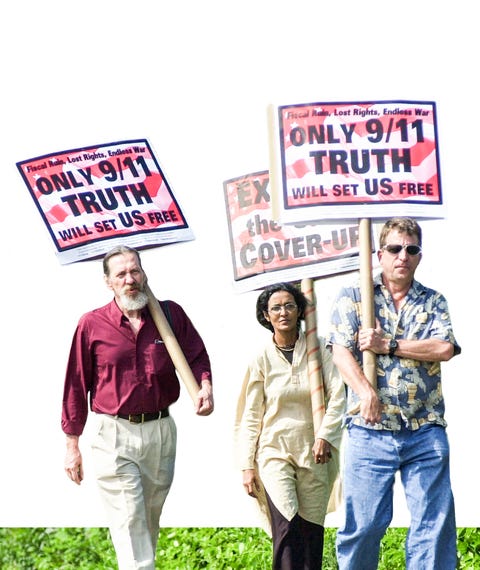
truthers
The term “truther” would evolve to become a shorthand for “conspiracy theorist.”
GETTY IMAGES
By the late-2000s, the influence of Loose Change would be felt at the highest levels of politics and culture. There were A-list celebrity Truthers. There were Truthers coaching NFL football teams. There were even Truthers in Congress and the White House. And while it’s impossible to know how much those people were influenced by Loose Change specifically, it’s hard to imagine they would have been so vocal about the Truther movement had Loose Change not popularized it and made it relatively safe to espouse such an outlandish theory.
Loose Change was made using nothing but archival footage and computer-generated graphics and distributed for free on the Internet. And the film’s DIY style is arguably its greatest legacy. For years, techno-utopians pontificated about how the Internet would democratize the production and dissemination of information, freeing us from the tyranny of media gatekeepers and creating a true marketplace of ideas. Loose Change realized that promise.
Now, 15 years after it was first released, Loose Change also has a more troubling legacy, one that the filmmakers insist they never intended. It was a precursor to the conspiracy boom on the Internet and the mainstreaming of conspiracists—most notably InfoWars founder Alex Jones, who was executive producer on the third version of film—and it’s connected to a number of prominent extremist movements on both the left and the right, including Occupy, the Tea Party, and Birtherism.
When Loose Change was released, it proved the Internet could be a powerful political organizing tool—both online and IRL. But it also foretold the dangers of letting that information ecosystem proliferate unchecked.
The Truth Is Stranger Than Fiction
Loose Change, as a documentary, was an accident. It was originally intended to be a summer popcorn flick.
In 2002, Avery, an 18-year-old film buff from Oneonta, New York, set out to create a fictional theatrical film about a group of friends who discover that the attacks of 9/11 were part of a government conspiracy.
Avery had been rejected from the film program at Purchase College, SUNY, the year before (and would be rejected again in 2003), but he was undeterred. He decided to make a film himself. The original Loose Change script “had car chases and people assembling on the White House at the end,” Avery told Alec Baldwin in a 2012 interview. Avery shot a few scenes and quickly discovered an unfortunate truth about Hollywood blockbusters: They cost a lot of money to make.
But while researching the film, Avery came to believe that his fictional plot had a basis in reality—that 9/11 really was part of a U.S. government conspiracy—and he pivoted to making a documentary about it.
“I watched a lot of innocent people die. I wanted answers about why we were there. I wanted accountability.”
Avery relied almost entirely on archival news footage he collected from DVDs and VHS tapes he bought on eBay. As he pieced the film together, Avery would send early cuts to his childhood friend Korey Rowe, who was 19 years old and on tour in Iraq. In a bizarre coincidence, Rowe had enlisted in the Army in late August of 2001; his first day of basic training was September 11th. “The timing could not have been creepier,” Avery says.
Conspiracy theories about what actually happened on September 11th had been circulating online on sites like 911review.com, whatreallyhappened.com, and reopen911.org. But Avery synthesized these stray bits of “evidence” into a feature-length film that became the conspiracist cult classic.
Avery released the first version of Loose Change on April 13, 2005, on DVD and Bittorrent, the file-distribution network, to little fanfare. Almost immediately, Avery decided to make a second version of the film based on feedback he received online. By this time, Rowe had finished a first tour with the Army and returned to Oneonta embittered. Initially supportive of the U.S. military response to 9/11, Rowe’s attitude shifted in part because of Michael Moore’s anti-Bush-administration film, Fahrenheit 9/11.
Afterward, he was deployed to Kuwait and was part of the “tip of the spear,” the first group of soldiers to invade Iraq. “I started to get this pissed-off attitude and thinking, What the fuck are we doing here?” Rowe told me. “I watched a lot of innocent people die. I wanted answers about why we were there. I wanted accountability.”
While contemplating the second version of the film, the filmmakers met Jason Bermas, who worked at Tino’s Pizza in Oneonta. In his free time, Bermas, then 24, obsessed over 9/11. Skeptical of the official narrative, Bermas had gone down various conspiracist rabbit holes in the early 2000s, eventually landing on The Road to Tyranny, a sprawling, thoroughly unhinged 140-minute 9/11-conspiracy-theory film created by Alex Jones.
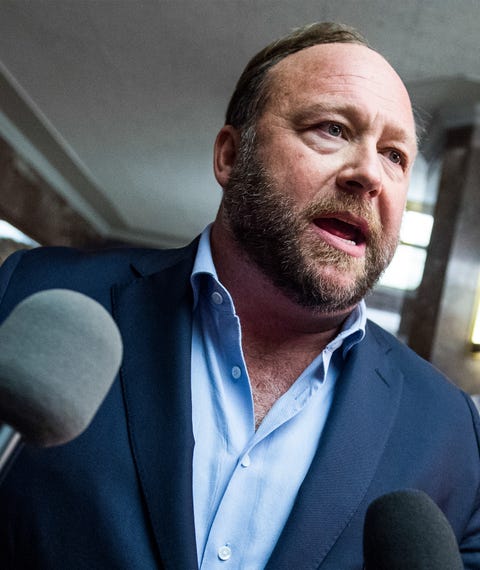
alex jones
Inspiration for a second version came from none other than Alex Jones.
GETTY IMAGES
Bermas spent the next several years scouring peer-to-peer networks, such as Kazaa, for anything he could find related to 9/11, accumulating a trove of documents, images, and videos. A true believer (or disbeliever), Bermas burned these files onto CD-R discs and handed them to anyone who’d take them. He gave a disc to a Tino’s coworker who happened to be a former high school classmate of Avery and Rowe’s.
“When we met Bermas, we said, ‘We’ve got our guy,’” Avery remembers. Bermas joined their filmmaking team, bringing with him his cache of videos and a pugnacious intellectual style. “He was really fucking gung ho,” Avery said. “I’m not confrontational and Korey isn’t either. Bermas will get in your face in ways that Korey and I won’t.”
Bermas does not dispute the description.“People paint conspiracy theorists as introverts tucked away in their basements,” he says. “That ain’t me, bro. I love going out to drink, talking to girls, watching MMA. I have the gift of gab.”
Avery directed, with Rowe serving as producer and Bermas as the chief researcher. It was a peculiar instance of life imitating art. Avery’s original, theatrical Loose Change script revolved around three friends fighting against the powers that be. That’s exactly what happened.
A Lingering Virus
If there was ever a piece of content that defined “going viral,” it’s Loose Change. The film spread misinformation to millions and infected them with the idea that widely agreed-upon facts can, in fact, be total fabrications. The lasting influence of that phenomenon is still evident today, in everything from the modern-day conspiracy-theory boom to the mainstreaming of Alex Jones to the political ascendance of Donald Trump.
A major part of that influence is stylistic. The synth-heavy score, the found-footage clips, and the foreboding voice-over piecing it all together became de rigeur in the conspiracist genre.
“They were the first people who realized that amateurs could make a high-quality piece of video propaganda,” says journalist Jonathan Kay, who studied the film for his 2011 book Among the Truthers. “They also pioneered the use of a spooky techno soundtrack. It looked professional, and that made it seem more credible.”
Some of the most popular far-right propaganda films released in the 2010s, says Kay, include 2016: Obama’s America, Dinesh D’Souza’s 2012 anti-Obama film; 2014’s We Need to Talk About Sandy Hook, which argues the 2012 school shooting at Sandy Hook Elementary in Newtown, Connecticut, was a false-flag mission; and Clinton Cash, a 2016 documentary that accuses Bill and Hillary of corruption, which Steve Bannon, a writer and producer on the film, claims has been downloaded 10 million times.
All are made in the style of Loose Change, as are many of the countless user-generated conspiracy videos, created by at-home sleuths, that flooded YouTube in the 2010s. “That style became inescapable after Loose Change,” Cernovich says.
This content is imported from YouTube. You may be able to find the same content in another format, or you may be able to find more information, at their web site.
McElwain, the Trump-loving conspiracist DJ, says Loose Change’s greater influence, however, was “less about style and more about how you deconstruct and analyze an event or topic.” The film used a connecting-the-dots approach, placing seemingly disparate events alongside one another to suggest a connection.
Loose Change 9/11: An American Coup, a TV-length version of the film, starts with the story of the infamous Reichstag fire of 1933, for instance. At the time, it was believed a Dutch communist named Marinus van der Lubbe set fire to the German parliament building. Loose Change asserts that the Nazis themselves set the fire and used it as a pretext to revoke civil liberties and install fascism. (This is indeed the view of some, though not all, historians.)
The Reichstag fire has absolutely nothing to do with 9/11, of course, but its inclusion suggests Bush masterminded 9/11 for similar reasons, and this priming technique became common among conspiracy films, according to Kay.
“The narrative of such propaganda films typically follows the same pattern: The first third of the movie or so is devoted to cataloging the historical sins of the targeted cabal—be it the U.S. government, the United Nations, the pharmaceutical industry, or what not—using stock publicly available video footage,” Kay writes in Among the Truthers.
“Once the viewers’ mind is adequately softened, the film hits its crucial pivot point, and the narrator commences extrapolating the protagonists’ villainy into the realm of fantasy.” He points to the 2009 films Camp FEMA, which draws a false equivalency between Japanese internment and the government’s response to Hurricane Katrina, and Carbon Eugenics, in which prominent YouTube conspiracist James Corbett equates fighting climate change with 19th-century eugenics.
“Loose Change was the marriage of two genres: documentary and political thriller,” says comedian Tim Dillon, who traffics heavily in conspiracist content on his podcast. (On Patreon, his subscription tiers are “Skull and Bones” and “The Rothschilds,” two groups that come up frequently in conspiracy discussions.) “It was the birth of a certain genre of conspiracy-theory video that we see all the time today.”
The film was also a rallying point for Truthers of all stripes. “Loose Change played a very large role in mainstreaming 9/11 conspiracy theories,” says Marilyn Mayo, a senior research fellow at the Anti-Defamation League who has written extensively on 9/11 conspiracy theories, particularly how they often incorporate wider anti-Semitic conspiracy theories.
After the Truther movement died down, some of its adherents started championing extremist political causes. Some leftist Truthers glommed on to the Occupy movement (a connection conservatives were eager to point out).
Some right-wing Truthers landed in the Tea Party, and Bermas even claims the Tea Party was a direct offshoot of the Truther movement. Indeed, on December 16, 2006, the 233rd anniversary of the Boston Tea Party, several chapters of the 9/11 Truther movement established the 9/11 Truth Tea Party and celebrated casting comically oversized replicas of the 9/11 Commission Report into the Boston Harbor and San Francisco Bay.
It’s unclear if the Tea Party that rose to prominence in the Obama years was a direct descendant of that demonstration, but some of the earliest Tea Party meetups were riddled with staunch 9/11 Truthers..
“There were a lot of right-wing political types who really went into Loose Change,” says Kay. “They were right-wing libertarians. They liked Ron Paul and wanted to audit the Fed. A lot of their conspiracy theories at the time centered on what we would now call globalism. And they were very skeptical of left-wing conspiracists.”
Over time, “truther” became a generalized term for any tinfoil-hat conspiracy theorist. Even “birther,” a term for someone who believed Barack Obama was not born in the U.S. and therefore was ineligible to be president, was derived from “truther,” much in the same way “-gate” became a handy way to label a political scandal after Watergate, according to Michael Adams, an English professor at Indiana University and an expert in American slang. (It should come as no surprise that would-be Congresswoman Greene is both a 9/11 skeptic and an “Obama is a Muslim” truther [he’s not].)
The Truther movement wasn’t just a bunch of mouth-breathing burnouts doing amateur research from their parents’ basements, either. A staggering number of Hollywood figures have publicly questioned the official narrative about 9/11. While it won’t shock you to learn that Charlie Sheen was interested in Loose Change, it might surprise you to learn that his father, renowned actor Martin Sheen, is also a 9/11 Truther. At one point, Martin Sheen, Woody Harrelson, and Ed Asner, who voiced the old man in Pixar’s Up, were even planning to make a dramatic film about how 9/11 was a conspiracy.
Mark Ruffalo was a 9/11 skeptic, as was Rosie O’Donnell. Bermas says Joe Rogan bought ten copies of Loose Change: Second Edition when it was released. Acclaimed historian Howard Zinn signed a petition asking for 9/11 to be reinvestigated (though that’s not exactly surprising). Pete Carroll, head coach of the Seattle Seahawks, admitted in 2015 that he has doubts about the official 9/11 narrative, making him a hero among the Truther movement.
The film’s most significant contribution, though, may have been the mainstreaming of Alex Jones. Prior to Loose Change, Jones was largely unknown outside of Austin, where he became a local celebrity for his rants on public access television. His only brush with mainstream fame was a cameo in the 2001 Richard Linklater film Waking Life.
Loose Change introduced Jones to a generation of news consumers. In Among the Truthers, Kay recounts stories of former Truthers who say they became avid followers of InfoWars, Jones’s online media operation, because of Loose Change. Cernovich asserts that Loose Change built Jones’s grassroots following. Jack Bratich, an associate professor of journalism and media studies at Rutgers University and author of the book Conspiracy Panics: Political Rationality and Popular Culture, says Loose Change “accelerated” Jones’s career. (A spokesperson for Jones responded: “Loose Change film helped accelerate people’s waking up and questioning things. Nothing to do with Alex’s career.” [All sic.])
Bermas rejects the idea that Loose Change legitimized Jones. “If people are buying into Alex Jones’s bullshit, that’s not our fault,” he says.
More broadly, Loose Change warped the importance of questioning government officials and mainstream media into blindly accepting the most batshit, unsubstantiated theories you can find on the Internet. It elevated the status of the amateur online sleuth and bolstered the notion of YouTube videos, Reddit memes, and Facebook posts as potentially legitimate news sources.
McElwain says Loose Change is the film that “red-pilled” him, a reference to the 1999 sci-fi film The Matrix, in which the protagonist, Neo, swallows a red capsule that reveals that everything he once perceived to be true was, in fact, an illusion. “Loose Change was like a SWAT team blowing up the doors,” he says. “It let people know they didn’t have to feel crazy, embarrassed, or alone when asking these questions.”
“Loose Change was like Beatlemania. You can read about it, but unless you experienced it, you can never really understand what it was like.”
Cernovich first saw Loose Change in 2010, and while he didn’t buy its premise, it taught him that people subscribe to conspiracy theories partially for social validation. “Loose Change was produced well enough that people shared it to show off their good taste and gain social status,” he says. “Loose Change was like Beatlemania. You can read about it, but unless you experienced it, you can never really understand what it was like.”
The film is a touchstone in the conspiracy-theory canon, according to Andrew Marantz, a staff writer at The New Yorker and the author of Antisocial: Online Extremists, Techno-Utopians, and the Hijacking of the American Conversation. “Loose Change was the first robust proof that, if you can grab enough of someone’s attention and trust, you can take them pretty far down the rabbit hole,” Marantz says.
Conspiracists might not invoke Loose Change much anymore, but it’s still considered standard viewing. “I still get DMs a couple times a week telling me, ‘Loose Change changed my life,’” Bermas says.
The rise of social media in the late 2000s and early- to mid-2010s allowed conspiracy-minded Internet users to congregate and share misinformation with unprecedented speed and scale. Social media’s digital echo chambers allowed people to receive information that validated their preexisting worldview and allowed for misinformation to go unchallenged.
We now have Truthers of all kinds—Sandy Hook truthers, flat-earth truthers, “[Jeffrey] Epstein didn’t kill himself” truthers, NFL truthers who believe the league is rigged and Stevie Wonder truthers who think the legendary musician isn’t really blind. Most recently, there have been coronavirus truthers, who believe concerns about the pandemic are being exaggerated to make Trump look incompetent.
Moe Rock, a 29-year-old podcast host in Newport Beach, says many of his peers who were red-pilled by Loose Change as teenagers are now COVID-19 truthers, spouting theories that the disease is the work of some nefarious actors. China? Bill Gates? “That documentary has had a tremendous amount of trickle-down effect on our politics and our media,” Rock says.
“Loose Change was the film that sent a lot of my peers down the rabbit hole. It was one of the fundamental catalysts for the online conspiracy-theory boom. Probably the biggest one.”
The filmmakers deny responsibility for these conspiracy theories, a criticism they’ve heard before. “I reject this idea that Loose Change was the start of people thinking everything is a false-flag event,” Bermas says. “I reject that somehow we caused society to go insane.”
He has a point. Three guys from Oneonta are not solely responsible for the breakdown of accepted facts and authority and the proliferation of nonsense presented as fact. They didn’t encourage people to, say, claim the earth is flat. “People act like it’s my fault the world is so fucked-up right now,” Avery says. “I just made a film.”
Avery is back in Oneonta after living in Los Angeles for years, and his relationship to Loose Change is tortured. He’s proud of the film, but he also wants out of its shadow. He believes his association with it made it impossible to break into Hollywood. The reactions to the film have taken a psychological toll.
“I’m still fucked-up from Loose Change,” he says. “I think I’ve always struggled with anxiety and definitely depression, and Loose Change didn’t help with either of those things.” In fact, Avery wishes he’d never even put his name on the film. “That way the film could have existed in a vacuum and I could exist in a vacuum, too.”
Disproving 9 of the Biggest 9/11 Conspiracies
Avery won’t disavow any of the claims made in the film, but he won’t stand by them, either. When I accuse him of trying to have it both ways, he just shrugs it off and says, “I’m just a guy who made a movie,” as if amplifying an antigovernment conspiracy-theory movement is no big deal.
“I can’t sit here and claim to know all the answers to what happened [with 9/11],” Avery says. “That’s speculation and it’s something I swore off doing a long time ago. But if I hadn’t made Loose Change the way I did, it wouldn’t have been successful.
“Loose Change went viral because it was controversial. To say I wish I had made it differently and not speculated and only concentrated on the 9/11 Commission, it wouldn’t have been as interesting.”
That sounds an awful lot like trying to have it both ways.
Truth Will Never Be the Same
Perhaps the most insidious legacy of Loose Change and the Truther movement is that it overshadows legitimate lingering questions about the events of 9/11. To this day, there are FBI agents who maintain the Saudi Arabian government not only had advanced knowledge of the attacks of 9/11 but provided financial and logistical support to at least two of the hijackers.
Several families of 9/11 victims have filed lawsuits against the Saudi government and are still fighting the U.S. government to declassify the full details of the Saudi connection to the attacks.
“Loose Change has kind of dulled our senses to any kind of re-investigation of 9/11.”
“People associate Loose Change with tinfoil-hat whackos and roll their eyes and dismiss any mention of the Saudi connection,” says Sean McCarthy, a popular progressive commenter on Twitter and host of Grubstakers, a podcast about billionaires and the economy. “Loose Change has kind of dulled our senses to any kind of reinvestigation of 9/11.”
Avery is working on a new documentary about a study of the collapse of 7 World Trade Center. The report, which was published by the University of Alaska-Fairbanks, refutes the official narrative about what happened with the building, Avery says. The study was commissioned by Architects & Engineers for 9/11 Truth, a group with more than 3,000 members.
Truthers often dismiss the 9/11 Commission Report because it was conducted by the U.S. government and therefore isn’t impartial. By that logic, we can throw out the Fairbanks study for being biased in favor of the Truth movement.
I point out this contradiction to Avery. The most he’ll give me is to acknowledge the irony.
AKA the origin story for the 'crazier than a shit house rat' conspiracy theory posts that we all read from time to time.
Fifteen years ago, three young men created a 9/11-conspiracy-theory film that laid the groundwork for our culture of outrageous misinformation.
By John McDermott
Sep 10, 2020
https://www.esquire.com/news-politics/a33971104/loose-change-9-11-conspiracy-documentary-history-interview/?source=nl&utm_source=nl_esq&utm_medium=email&date=091020&utm_campaign=nl21461648

The contemporary conspiracy-theory boom reached an astonishing new height (or nadir, depending on your perspective) this August when Marjorie Taylor Greene, an avowed believer of the QAnon conspiracy theory, won the Republican primary for Georgia’s 14th Congressional District, all but ensuring her election to Congress. (A Democrat hasn’t won the seat since the district was apportioned following the 2010 census.)
QAnon started in October 2017 on the infamously noxious message board 4chan, where an anonymous poster, “Q,” a self-proclaimed high-ranking intelligence officer, claimed to have intimate knowledge of President Trump’s crusade to rid Washington, D.C., of a cabal of satanist, pedophilic elitists and bring them to justice.
The alleged child-molesting ring includes the far right’s usual list of suspects—Hillary Clinton, George Soros, Barack Obama—as well as Hollywood figures Ellen DeGeneres, Tom Hanks, and Oprah Winfrey. Not only do theorists allege these people rape children; followers also claim they ritualistically kill and eat their victims in order to ingest adrenochrome, a chemical that supposedly has age-defying effects.
It’s almost a misnomer to call QAnon a conspiracy theory. QAnon is so sprawling and bonkers in scope that it’s something more akin to an all-encompassing political ideology. Adherents use QAnon to explain, justify, or dismiss virtually any political happening. Pizzagate, Black Lives Matter, the COVID-19 pandemic—they’re all products of the same shadowy cabal of elites. Insisting there’s a connection between these issues underscores how incoherent and obviously false QAnon is, but its supporters are legion. Comedian Tim Dillon likens QAnon to a religion because of the blind devotion it inspires.
Jason Campbell
@JasonSCampbell
Donald Trump says "people that are in the dark shadows" and "people you haven't heard of" are 'pulling the strings' for Joe Biden
Once relegated to the fringes of American society, conspiracy theories have achieved mainstream traction under the Trump administration, and Greene’s assured seat in Congress marks an inflection point—the moment when the most absurd of these conspiracy theories infiltrated the highest ranks of the U.S. federal government.
To truly understand how we’ve arrived at this place, we need to go back 15 years and revisit Loose Change, the first time a fringe Internet conspiracy theory percolated to the highest echelons of our cultural and political institutions.
Released on April 13, 2005, by Dylan Avery, a 21-year-old amateur filmmaker, Loose Change was a “documentary” that posited a radical thesis:
What if September 11th—the deadliest terrorist attack on U.S. soil, the tragedy that precipitated the wars in Afghanistan and Iraq, costing the world trillions of dollars in military spending and tens of thousands of innocent deaths—was not the work of 19 jihadi terrorists? What if the American government knew about the attacks ahead of time and allowed them to occur or, even worse, helped execute them?

Produced on a $2,000 budget, the original version of Loose Change was rough and poorly structured, but what it lacked in cinematic polish it made up for in audacity. It stitched together a number of tantalizing pieces of circumstantial evidence. A “mysterious” lack of debris at both the Flight 93 crash site in rural Pennsylvania and at the Pentagon; the collapse of 7 World Trade Center, even though it wasn’t hit in the attack; the majestic manner in which the Twin Towers collapsed (as if, as the film suggested, the result of a controlled demolition).
What’s even more shocking than those claims is the number of people who at least to some degree subscribe to them. In 2016, more than half (54.3 percent) of the American people believed the U.S. government was concealing information about the attacks on 9/11, according to a Chapman University study, making it the most popular conspiracy theory in the country about a U.S. government cover-up, just ahead of the JFK assassination (49.6 percent) and evidence about the existence of aliens (42.6 percent). As far as 9/11 conspiracy theories go, all roads lead back to Loose Change.
Upon release, the film racked up more than 10 million views in just a few months on Google Video, with millions more watching pirated versions, according to the filmmakers. Vanity Fair called it “the first Internet blockbuster.” Alec Baldwin called it “the Gone With the Wind of the [9/11 conspiracy] movement.” Acclaimed filmmaker David Lynch said the film makes “you look at what you thought you saw in a different light.” Indie darling Kevin Smith called the film “fucking riveting.” To this day, conspiracy lovers regard it as a cornerstone of the alternative-media canon.
Loose Change was so popular in its heyday that it achieved a rare kind of fame (or infamy), whereby even people who never saw the film are familiar with its tropes. Memes like “9/11 was an inside job” and “jet fuel can’t melt steel beams” were popularized by the film. People who believed 9/11 conspiracy theories in the mid-2000s referred to themselves as 9/11 Truthers, and Loose Change was their seminal text. The term “truther” would evolve to become a shorthand for “conspiracy theorist.”
truthers
The term “truther” would evolve to become a shorthand for “conspiracy theorist.”
GETTY IMAGES
By the late-2000s, the influence of Loose Change would be felt at the highest levels of politics and culture. There were A-list celebrity Truthers. There were Truthers coaching NFL football teams. There were even Truthers in Congress and the White House. And while it’s impossible to know how much those people were influenced by Loose Change specifically, it’s hard to imagine they would have been so vocal about the Truther movement had Loose Change not popularized it and made it relatively safe to espouse such an outlandish theory.
Loose Change was made using nothing but archival footage and computer-generated graphics and distributed for free on the Internet. And the film’s DIY style is arguably its greatest legacy. For years, techno-utopians pontificated about how the Internet would democratize the production and dissemination of information, freeing us from the tyranny of media gatekeepers and creating a true marketplace of ideas. Loose Change realized that promise.
Now, 15 years after it was first released, Loose Change also has a more troubling legacy, one that the filmmakers insist they never intended. It was a precursor to the conspiracy boom on the Internet and the mainstreaming of conspiracists—most notably InfoWars founder Alex Jones, who was executive producer on the third version of film—and it’s connected to a number of prominent extremist movements on both the left and the right, including Occupy, the Tea Party, and Birtherism.
When Loose Change was released, it proved the Internet could be a powerful political organizing tool—both online and IRL. But it also foretold the dangers of letting that information ecosystem proliferate unchecked.
The Truth Is Stranger Than Fiction
Loose Change, as a documentary, was an accident. It was originally intended to be a summer popcorn flick.
In 2002, Avery, an 18-year-old film buff from Oneonta, New York, set out to create a fictional theatrical film about a group of friends who discover that the attacks of 9/11 were part of a government conspiracy.
Avery had been rejected from the film program at Purchase College, SUNY, the year before (and would be rejected again in 2003), but he was undeterred. He decided to make a film himself. The original Loose Change script “had car chases and people assembling on the White House at the end,” Avery told Alec Baldwin in a 2012 interview. Avery shot a few scenes and quickly discovered an unfortunate truth about Hollywood blockbusters: They cost a lot of money to make.
But while researching the film, Avery came to believe that his fictional plot had a basis in reality—that 9/11 really was part of a U.S. government conspiracy—and he pivoted to making a documentary about it.
“I watched a lot of innocent people die. I wanted answers about why we were there. I wanted accountability.”
Avery relied almost entirely on archival news footage he collected from DVDs and VHS tapes he bought on eBay. As he pieced the film together, Avery would send early cuts to his childhood friend Korey Rowe, who was 19 years old and on tour in Iraq. In a bizarre coincidence, Rowe had enlisted in the Army in late August of 2001; his first day of basic training was September 11th. “The timing could not have been creepier,” Avery says.
Conspiracy theories about what actually happened on September 11th had been circulating online on sites like 911review.com, whatreallyhappened.com, and reopen911.org. But Avery synthesized these stray bits of “evidence” into a feature-length film that became the conspiracist cult classic.
Avery released the first version of Loose Change on April 13, 2005, on DVD and Bittorrent, the file-distribution network, to little fanfare. Almost immediately, Avery decided to make a second version of the film based on feedback he received online. By this time, Rowe had finished a first tour with the Army and returned to Oneonta embittered. Initially supportive of the U.S. military response to 9/11, Rowe’s attitude shifted in part because of Michael Moore’s anti-Bush-administration film, Fahrenheit 9/11.
Afterward, he was deployed to Kuwait and was part of the “tip of the spear,” the first group of soldiers to invade Iraq. “I started to get this pissed-off attitude and thinking, What the fuck are we doing here?” Rowe told me. “I watched a lot of innocent people die. I wanted answers about why we were there. I wanted accountability.”
While contemplating the second version of the film, the filmmakers met Jason Bermas, who worked at Tino’s Pizza in Oneonta. In his free time, Bermas, then 24, obsessed over 9/11. Skeptical of the official narrative, Bermas had gone down various conspiracist rabbit holes in the early 2000s, eventually landing on The Road to Tyranny, a sprawling, thoroughly unhinged 140-minute 9/11-conspiracy-theory film created by Alex Jones.
alex jones
Inspiration for a second version came from none other than Alex Jones.
GETTY IMAGES
Bermas spent the next several years scouring peer-to-peer networks, such as Kazaa, for anything he could find related to 9/11, accumulating a trove of documents, images, and videos. A true believer (or disbeliever), Bermas burned these files onto CD-R discs and handed them to anyone who’d take them. He gave a disc to a Tino’s coworker who happened to be a former high school classmate of Avery and Rowe’s.
“When we met Bermas, we said, ‘We’ve got our guy,’” Avery remembers. Bermas joined their filmmaking team, bringing with him his cache of videos and a pugnacious intellectual style. “He was really fucking gung ho,” Avery said. “I’m not confrontational and Korey isn’t either. Bermas will get in your face in ways that Korey and I won’t.”
Bermas does not dispute the description.“People paint conspiracy theorists as introverts tucked away in their basements,” he says. “That ain’t me, bro. I love going out to drink, talking to girls, watching MMA. I have the gift of gab.”
Avery directed, with Rowe serving as producer and Bermas as the chief researcher. It was a peculiar instance of life imitating art. Avery’s original, theatrical Loose Change script revolved around three friends fighting against the powers that be. That’s exactly what happened.
A Lingering Virus
If there was ever a piece of content that defined “going viral,” it’s Loose Change. The film spread misinformation to millions and infected them with the idea that widely agreed-upon facts can, in fact, be total fabrications. The lasting influence of that phenomenon is still evident today, in everything from the modern-day conspiracy-theory boom to the mainstreaming of Alex Jones to the political ascendance of Donald Trump.
A major part of that influence is stylistic. The synth-heavy score, the found-footage clips, and the foreboding voice-over piecing it all together became de rigeur in the conspiracist genre.
“They were the first people who realized that amateurs could make a high-quality piece of video propaganda,” says journalist Jonathan Kay, who studied the film for his 2011 book Among the Truthers. “They also pioneered the use of a spooky techno soundtrack. It looked professional, and that made it seem more credible.”
Some of the most popular far-right propaganda films released in the 2010s, says Kay, include 2016: Obama’s America, Dinesh D’Souza’s 2012 anti-Obama film; 2014’s We Need to Talk About Sandy Hook, which argues the 2012 school shooting at Sandy Hook Elementary in Newtown, Connecticut, was a false-flag mission; and Clinton Cash, a 2016 documentary that accuses Bill and Hillary of corruption, which Steve Bannon, a writer and producer on the film, claims has been downloaded 10 million times.
All are made in the style of Loose Change, as are many of the countless user-generated conspiracy videos, created by at-home sleuths, that flooded YouTube in the 2010s. “That style became inescapable after Loose Change,” Cernovich says.
This content is imported from YouTube. You may be able to find the same content in another format, or you may be able to find more information, at their web site.
McElwain, the Trump-loving conspiracist DJ, says Loose Change’s greater influence, however, was “less about style and more about how you deconstruct and analyze an event or topic.” The film used a connecting-the-dots approach, placing seemingly disparate events alongside one another to suggest a connection.
Loose Change 9/11: An American Coup, a TV-length version of the film, starts with the story of the infamous Reichstag fire of 1933, for instance. At the time, it was believed a Dutch communist named Marinus van der Lubbe set fire to the German parliament building. Loose Change asserts that the Nazis themselves set the fire and used it as a pretext to revoke civil liberties and install fascism. (This is indeed the view of some, though not all, historians.)
The Reichstag fire has absolutely nothing to do with 9/11, of course, but its inclusion suggests Bush masterminded 9/11 for similar reasons, and this priming technique became common among conspiracy films, according to Kay.
“The narrative of such propaganda films typically follows the same pattern: The first third of the movie or so is devoted to cataloging the historical sins of the targeted cabal—be it the U.S. government, the United Nations, the pharmaceutical industry, or what not—using stock publicly available video footage,” Kay writes in Among the Truthers.
“Once the viewers’ mind is adequately softened, the film hits its crucial pivot point, and the narrator commences extrapolating the protagonists’ villainy into the realm of fantasy.” He points to the 2009 films Camp FEMA, which draws a false equivalency between Japanese internment and the government’s response to Hurricane Katrina, and Carbon Eugenics, in which prominent YouTube conspiracist James Corbett equates fighting climate change with 19th-century eugenics.
“Loose Change was the marriage of two genres: documentary and political thriller,” says comedian Tim Dillon, who traffics heavily in conspiracist content on his podcast. (On Patreon, his subscription tiers are “Skull and Bones” and “The Rothschilds,” two groups that come up frequently in conspiracy discussions.) “It was the birth of a certain genre of conspiracy-theory video that we see all the time today.”
The film was also a rallying point for Truthers of all stripes. “Loose Change played a very large role in mainstreaming 9/11 conspiracy theories,” says Marilyn Mayo, a senior research fellow at the Anti-Defamation League who has written extensively on 9/11 conspiracy theories, particularly how they often incorporate wider anti-Semitic conspiracy theories.
After the Truther movement died down, some of its adherents started championing extremist political causes. Some leftist Truthers glommed on to the Occupy movement (a connection conservatives were eager to point out).
Some right-wing Truthers landed in the Tea Party, and Bermas even claims the Tea Party was a direct offshoot of the Truther movement. Indeed, on December 16, 2006, the 233rd anniversary of the Boston Tea Party, several chapters of the 9/11 Truther movement established the 9/11 Truth Tea Party and celebrated casting comically oversized replicas of the 9/11 Commission Report into the Boston Harbor and San Francisco Bay.
It’s unclear if the Tea Party that rose to prominence in the Obama years was a direct descendant of that demonstration, but some of the earliest Tea Party meetups were riddled with staunch 9/11 Truthers..
“There were a lot of right-wing political types who really went into Loose Change,” says Kay. “They were right-wing libertarians. They liked Ron Paul and wanted to audit the Fed. A lot of their conspiracy theories at the time centered on what we would now call globalism. And they were very skeptical of left-wing conspiracists.”
Over time, “truther” became a generalized term for any tinfoil-hat conspiracy theorist. Even “birther,” a term for someone who believed Barack Obama was not born in the U.S. and therefore was ineligible to be president, was derived from “truther,” much in the same way “-gate” became a handy way to label a political scandal after Watergate, according to Michael Adams, an English professor at Indiana University and an expert in American slang. (It should come as no surprise that would-be Congresswoman Greene is both a 9/11 skeptic and an “Obama is a Muslim” truther [he’s not].)
The Truther movement wasn’t just a bunch of mouth-breathing burnouts doing amateur research from their parents’ basements, either. A staggering number of Hollywood figures have publicly questioned the official narrative about 9/11. While it won’t shock you to learn that Charlie Sheen was interested in Loose Change, it might surprise you to learn that his father, renowned actor Martin Sheen, is also a 9/11 Truther. At one point, Martin Sheen, Woody Harrelson, and Ed Asner, who voiced the old man in Pixar’s Up, were even planning to make a dramatic film about how 9/11 was a conspiracy.
Mark Ruffalo was a 9/11 skeptic, as was Rosie O’Donnell. Bermas says Joe Rogan bought ten copies of Loose Change: Second Edition when it was released. Acclaimed historian Howard Zinn signed a petition asking for 9/11 to be reinvestigated (though that’s not exactly surprising). Pete Carroll, head coach of the Seattle Seahawks, admitted in 2015 that he has doubts about the official 9/11 narrative, making him a hero among the Truther movement.
The film’s most significant contribution, though, may have been the mainstreaming of Alex Jones. Prior to Loose Change, Jones was largely unknown outside of Austin, where he became a local celebrity for his rants on public access television. His only brush with mainstream fame was a cameo in the 2001 Richard Linklater film Waking Life.
Loose Change introduced Jones to a generation of news consumers. In Among the Truthers, Kay recounts stories of former Truthers who say they became avid followers of InfoWars, Jones’s online media operation, because of Loose Change. Cernovich asserts that Loose Change built Jones’s grassroots following. Jack Bratich, an associate professor of journalism and media studies at Rutgers University and author of the book Conspiracy Panics: Political Rationality and Popular Culture, says Loose Change “accelerated” Jones’s career. (A spokesperson for Jones responded: “Loose Change film helped accelerate people’s waking up and questioning things. Nothing to do with Alex’s career.” [All sic.])
Bermas rejects the idea that Loose Change legitimized Jones. “If people are buying into Alex Jones’s bullshit, that’s not our fault,” he says.
More broadly, Loose Change warped the importance of questioning government officials and mainstream media into blindly accepting the most batshit, unsubstantiated theories you can find on the Internet. It elevated the status of the amateur online sleuth and bolstered the notion of YouTube videos, Reddit memes, and Facebook posts as potentially legitimate news sources.
McElwain says Loose Change is the film that “red-pilled” him, a reference to the 1999 sci-fi film The Matrix, in which the protagonist, Neo, swallows a red capsule that reveals that everything he once perceived to be true was, in fact, an illusion. “Loose Change was like a SWAT team blowing up the doors,” he says. “It let people know they didn’t have to feel crazy, embarrassed, or alone when asking these questions.”
“Loose Change was like Beatlemania. You can read about it, but unless you experienced it, you can never really understand what it was like.”
Cernovich first saw Loose Change in 2010, and while he didn’t buy its premise, it taught him that people subscribe to conspiracy theories partially for social validation. “Loose Change was produced well enough that people shared it to show off their good taste and gain social status,” he says. “Loose Change was like Beatlemania. You can read about it, but unless you experienced it, you can never really understand what it was like.”
The film is a touchstone in the conspiracy-theory canon, according to Andrew Marantz, a staff writer at The New Yorker and the author of Antisocial: Online Extremists, Techno-Utopians, and the Hijacking of the American Conversation. “Loose Change was the first robust proof that, if you can grab enough of someone’s attention and trust, you can take them pretty far down the rabbit hole,” Marantz says.
Conspiracists might not invoke Loose Change much anymore, but it’s still considered standard viewing. “I still get DMs a couple times a week telling me, ‘Loose Change changed my life,’” Bermas says.
The rise of social media in the late 2000s and early- to mid-2010s allowed conspiracy-minded Internet users to congregate and share misinformation with unprecedented speed and scale. Social media’s digital echo chambers allowed people to receive information that validated their preexisting worldview and allowed for misinformation to go unchallenged.
We now have Truthers of all kinds—Sandy Hook truthers, flat-earth truthers, “[Jeffrey] Epstein didn’t kill himself” truthers, NFL truthers who believe the league is rigged and Stevie Wonder truthers who think the legendary musician isn’t really blind. Most recently, there have been coronavirus truthers, who believe concerns about the pandemic are being exaggerated to make Trump look incompetent.
Moe Rock, a 29-year-old podcast host in Newport Beach, says many of his peers who were red-pilled by Loose Change as teenagers are now COVID-19 truthers, spouting theories that the disease is the work of some nefarious actors. China? Bill Gates? “That documentary has had a tremendous amount of trickle-down effect on our politics and our media,” Rock says.
“Loose Change was the film that sent a lot of my peers down the rabbit hole. It was one of the fundamental catalysts for the online conspiracy-theory boom. Probably the biggest one.”
The filmmakers deny responsibility for these conspiracy theories, a criticism they’ve heard before. “I reject this idea that Loose Change was the start of people thinking everything is a false-flag event,” Bermas says. “I reject that somehow we caused society to go insane.”
He has a point. Three guys from Oneonta are not solely responsible for the breakdown of accepted facts and authority and the proliferation of nonsense presented as fact. They didn’t encourage people to, say, claim the earth is flat. “People act like it’s my fault the world is so fucked-up right now,” Avery says. “I just made a film.”
Avery is back in Oneonta after living in Los Angeles for years, and his relationship to Loose Change is tortured. He’s proud of the film, but he also wants out of its shadow. He believes his association with it made it impossible to break into Hollywood. The reactions to the film have taken a psychological toll.
“I’m still fucked-up from Loose Change,” he says. “I think I’ve always struggled with anxiety and definitely depression, and Loose Change didn’t help with either of those things.” In fact, Avery wishes he’d never even put his name on the film. “That way the film could have existed in a vacuum and I could exist in a vacuum, too.”
Disproving 9 of the Biggest 9/11 Conspiracies
Avery won’t disavow any of the claims made in the film, but he won’t stand by them, either. When I accuse him of trying to have it both ways, he just shrugs it off and says, “I’m just a guy who made a movie,” as if amplifying an antigovernment conspiracy-theory movement is no big deal.
“I can’t sit here and claim to know all the answers to what happened [with 9/11],” Avery says. “That’s speculation and it’s something I swore off doing a long time ago. But if I hadn’t made Loose Change the way I did, it wouldn’t have been successful.
“Loose Change went viral because it was controversial. To say I wish I had made it differently and not speculated and only concentrated on the 9/11 Commission, it wouldn’t have been as interesting.”
That sounds an awful lot like trying to have it both ways.
Truth Will Never Be the Same
Perhaps the most insidious legacy of Loose Change and the Truther movement is that it overshadows legitimate lingering questions about the events of 9/11. To this day, there are FBI agents who maintain the Saudi Arabian government not only had advanced knowledge of the attacks of 9/11 but provided financial and logistical support to at least two of the hijackers.
Several families of 9/11 victims have filed lawsuits against the Saudi government and are still fighting the U.S. government to declassify the full details of the Saudi connection to the attacks.
“Loose Change has kind of dulled our senses to any kind of re-investigation of 9/11.”
“People associate Loose Change with tinfoil-hat whackos and roll their eyes and dismiss any mention of the Saudi connection,” says Sean McCarthy, a popular progressive commenter on Twitter and host of Grubstakers, a podcast about billionaires and the economy. “Loose Change has kind of dulled our senses to any kind of reinvestigation of 9/11.”
Avery is working on a new documentary about a study of the collapse of 7 World Trade Center. The report, which was published by the University of Alaska-Fairbanks, refutes the official narrative about what happened with the building, Avery says. The study was commissioned by Architects & Engineers for 9/11 Truth, a group with more than 3,000 members.
Truthers often dismiss the 9/11 Commission Report because it was conducted by the U.S. government and therefore isn’t impartial. By that logic, we can throw out the Fairbanks study for being biased in favor of the Truth movement.
I point out this contradiction to Avery. The most he’ll give me is to acknowledge the irony.
Discover What Traders Are Watching
Explore small cap ideas before they hit the headlines.



