



 AI
AI








Tuesday, August 18, 2020 6:03:50 PM
It jumps at me too. Has for ten years, since, Why Israel is not a democracy
Wednesday, May 29, 2002 - 10:00
https://investorshub.advfn.com/boards/read_msg.aspx?message_id=55375128
-
This one from a decent think tank in Australia gives us why it's seen as a democracy.
Israel’s democracy: a systemic problem
Ian Parmeter
Israel will go to the polls for the third time in less than a
year. What makes it so hard for a clear winner to emerge?

Ballots in the September 2019 elections (Photo: Bruno Thevenin via Getty Images)
Published 17 Feb 2020 12:00 0 Comments
Israel
Israel has often been called the only democracy in the Middle East. This is not quite true.
The Economist’s Global Democracy Index for 2019 .. https://www.eiu.com/topic/democracy-index ,
INSERT image from link provided

which ranks 167 countries by five democratic criteria, lists Israel as a “flawed democracy”.* Israel scores well on electoral process/pluralism and political participation, but is marked down on government functioning, political culture, and, in particular, civil liberties, where, Israel scores just 5.88 out of a possible 10.
These failings bring Israel down to 28th on the list, but that’s still much higher than any of its neighbours. The next is Tunisia, likewise a “flawed democracy” at 53rd, with the remainder listed as “hybrid regimes” (nations with regular electoral frauds and other systemic failings) or “authoritarian”.
Against this background, Israel’s system of choosing political representatives is certainly the most democratic in the region. In particular, its procedures and outcomes are underpinned by strong democratic institutions.
The system encourages populism, as political
leaders of all stripes seek to play on fears of
the electorate in order to eke out more votes.
Elections are overseen by the Central Elections Committee (CEC), comprising representatives of party groupings within the Knesset (parliament) and chaired by a judge of the Israeli Supreme Court. This is less transparent than a non-partisan electoral commission as we have in Australia. But an important safeguard is provided in that CEC decisions can be appealed to the Israeli Supreme court.
The range of parties in the Knesset covers virtually the full spectrum of Israeli political opinion – from Jewish nationalist to Israeli Arab. Debate within the Knesset is vigorous: it is certainly not a rubber stamp for the Prime Minister. Media perspectives reflect most shades of Israeli opinion.
The judiciary, which has shown itself to be independent of the political process, plays a vital role in the integrity of the system. The Supreme Court has on occasion overruled CEC decisions: in 1988, 2003, and 2009, the court overturned CEC bans on Arab parties participating in elections (though it upheld a ban against the extreme right-wing party Kach). The courts have jailed a former Prime Minister (Ehud Olmert) for corruption, a former President (Moshe Katsav) for sexual offences, and has most recently indicted the current Prime Minister (Binyamin “Bibi” Netanyahu) on corruption charges.
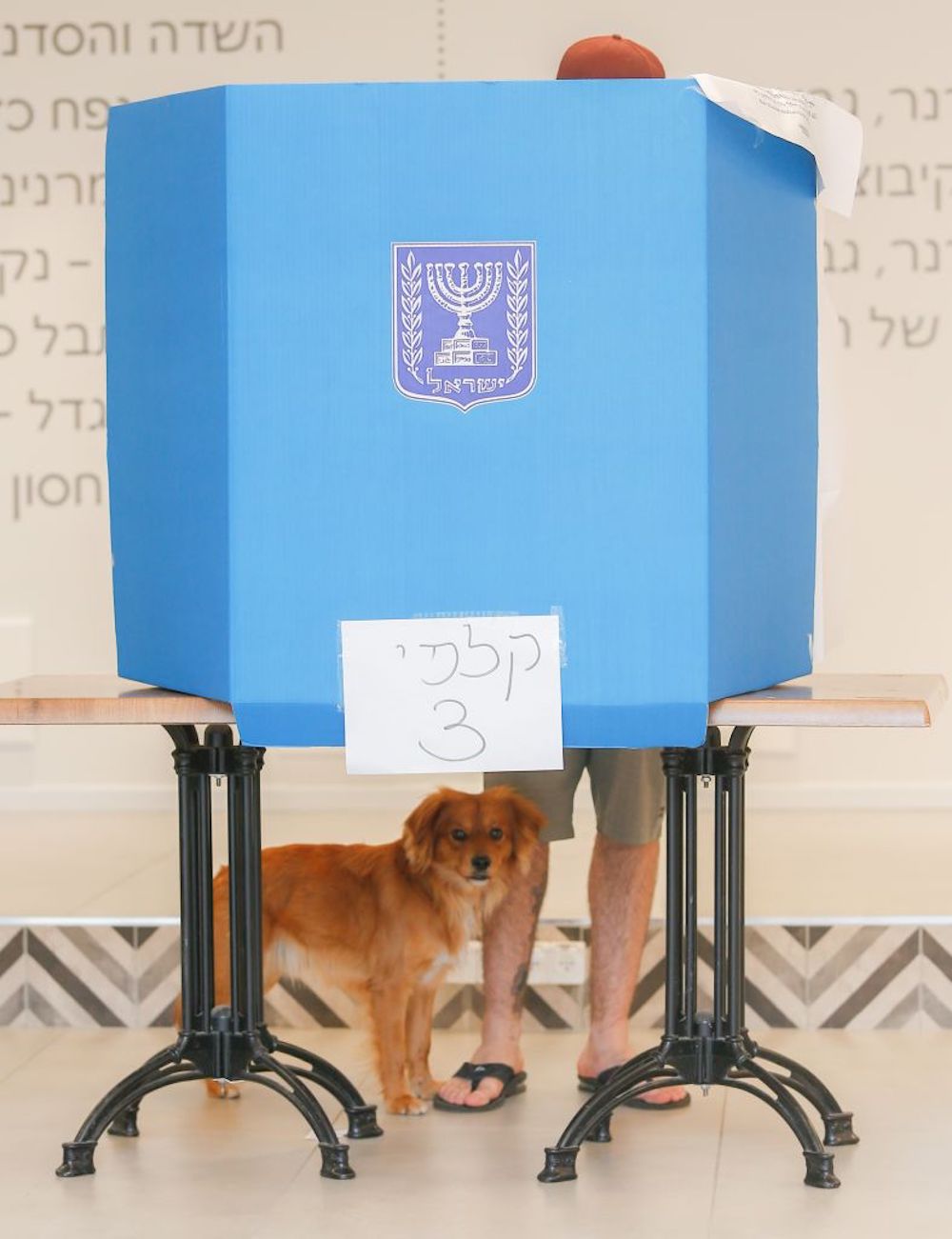
A man casts his vote with his dog during the Israeli general elections in April 2019 (Photo: Nir Keidar via Getty Images)
Too democratic?
A major problem with Israel’s electoral system is that it is arguably too democratic. Strict proportional representation sets a threshold of only 3.25% of total votes cast to obtain a Knesset seat. That inevitably means a large number of parties and party groupings in the chamber – in the current 120-seat Knesset, there are ten groupings – making it almost impossible for one party to win an outright majority of 61 seats.
That in turn means each election is followed by attempts at coalition building by leaders of the two largest parties. After the last two elections these were Likud’s Netanyahu and Benny Gantz, of the centrist Blue and White party.
These negotiations can become extremely grubby as the contenders dilute or abandon principles in order to appeal to special interests of minor parties. Israelis despairing of this process have occasionally drawn on 19th-century German Chancellor Otto Von Bismarck’s likening of parliamentary negotiations to sausage-making: watching either can produce feelings of revulsion.
A further consequence is that the system encourages populism, as political leaders of all stripes seek to play on fears of the electorate in order to eke out more votes. The electorate’s rightward drift has been accentuated by the growing, strongly nationalist settler movement, which now numbers some 700,000, about 10% of Israel’s Jewish population.
Netanyahu’s opponents claim he embodies such populism. They charge that his incitement of Israeli phobias – of Palestinians, Israeli Arabs, Iran, or even European supporters of the Boycott, Divestment, and Sanctions (BDS) movement, which aims to encourage economic action in opposition to Israel’s settlement policies – has been a key factor in his holding office for more than a decade.
https://www.lowyinstitute.org/the-interpreter/israel-s-democracy-systemic-problem
Wednesday, May 29, 2002 - 10:00
https://investorshub.advfn.com/boards/read_msg.aspx?message_id=55375128
-
This one from a decent think tank in Australia gives us why it's seen as a democracy.
Israel’s democracy: a systemic problem
Ian Parmeter
Israel will go to the polls for the third time in less than a
year. What makes it so hard for a clear winner to emerge?

Ballots in the September 2019 elections (Photo: Bruno Thevenin via Getty Images)
Published 17 Feb 2020 12:00 0 Comments
Israel
Israel has often been called the only democracy in the Middle East. This is not quite true.
The Economist’s Global Democracy Index for 2019 .. https://www.eiu.com/topic/democracy-index ,
INSERT image from link provided

which ranks 167 countries by five democratic criteria, lists Israel as a “flawed democracy”.* Israel scores well on electoral process/pluralism and political participation, but is marked down on government functioning, political culture, and, in particular, civil liberties, where, Israel scores just 5.88 out of a possible 10.
These failings bring Israel down to 28th on the list, but that’s still much higher than any of its neighbours. The next is Tunisia, likewise a “flawed democracy” at 53rd, with the remainder listed as “hybrid regimes” (nations with regular electoral frauds and other systemic failings) or “authoritarian”.
Against this background, Israel’s system of choosing political representatives is certainly the most democratic in the region. In particular, its procedures and outcomes are underpinned by strong democratic institutions.
The system encourages populism, as political
leaders of all stripes seek to play on fears of
the electorate in order to eke out more votes.
Elections are overseen by the Central Elections Committee (CEC), comprising representatives of party groupings within the Knesset (parliament) and chaired by a judge of the Israeli Supreme Court. This is less transparent than a non-partisan electoral commission as we have in Australia. But an important safeguard is provided in that CEC decisions can be appealed to the Israeli Supreme court.
The range of parties in the Knesset covers virtually the full spectrum of Israeli political opinion – from Jewish nationalist to Israeli Arab. Debate within the Knesset is vigorous: it is certainly not a rubber stamp for the Prime Minister. Media perspectives reflect most shades of Israeli opinion.
The judiciary, which has shown itself to be independent of the political process, plays a vital role in the integrity of the system. The Supreme Court has on occasion overruled CEC decisions: in 1988, 2003, and 2009, the court overturned CEC bans on Arab parties participating in elections (though it upheld a ban against the extreme right-wing party Kach). The courts have jailed a former Prime Minister (Ehud Olmert) for corruption, a former President (Moshe Katsav) for sexual offences, and has most recently indicted the current Prime Minister (Binyamin “Bibi” Netanyahu) on corruption charges.
A man casts his vote with his dog during the Israeli general elections in April 2019 (Photo: Nir Keidar via Getty Images)
Too democratic?
A major problem with Israel’s electoral system is that it is arguably too democratic. Strict proportional representation sets a threshold of only 3.25% of total votes cast to obtain a Knesset seat. That inevitably means a large number of parties and party groupings in the chamber – in the current 120-seat Knesset, there are ten groupings – making it almost impossible for one party to win an outright majority of 61 seats.
That in turn means each election is followed by attempts at coalition building by leaders of the two largest parties. After the last two elections these were Likud’s Netanyahu and Benny Gantz, of the centrist Blue and White party.
These negotiations can become extremely grubby as the contenders dilute or abandon principles in order to appeal to special interests of minor parties. Israelis despairing of this process have occasionally drawn on 19th-century German Chancellor Otto Von Bismarck’s likening of parliamentary negotiations to sausage-making: watching either can produce feelings of revulsion.
A further consequence is that the system encourages populism, as political leaders of all stripes seek to play on fears of the electorate in order to eke out more votes. The electorate’s rightward drift has been accentuated by the growing, strongly nationalist settler movement, which now numbers some 700,000, about 10% of Israel’s Jewish population.
Netanyahu’s opponents claim he embodies such populism. They charge that his incitement of Israeli phobias – of Palestinians, Israeli Arabs, Iran, or even European supporters of the Boycott, Divestment, and Sanctions (BDS) movement, which aims to encourage economic action in opposition to Israel’s settlement policies – has been a key factor in his holding office for more than a decade.
https://www.lowyinstitute.org/the-interpreter/israel-s-democracy-systemic-problem
It was Plato who said, “He, O men, is the wisest, who like Socrates, knows that his wisdom is in truth worth nothing”
Discover What Traders Are Watching
Explore small cap ideas before they hit the headlines.



