




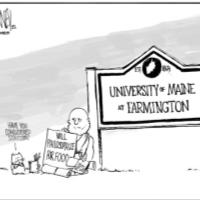
These generals are starting to come out of the woodwork now that Rummy is gone...
At the Pentagon, even those not supporting the surge option argue that the Army needs to grow to sustain the force levels required in Afghanistan and Iraq and to meet other national security threats.
Officials who were briefed on the president’s discussion with the Joint Chiefs said there was a consensus that the review of administration strategy in Iraq must be broadened to include decisions on how to prepare the American military for the global counterterrorism mission beyond Iraq.
In particular, they said there was a need to show enough force strength to deter potential adversaries from aggressive moves based on an assumption that American power was bogged down in Iraq.
“A lot of it was discussed yesterday with President Bush,” said a senior Pentagon official who was briefed on the discussions by one of those in attendance.
The nation faces three choices or “we will break the active component,” General Schoomaker said in an appearance before the Commission on the National Guard and Reserves. He said the choices included reducing demand on the military, which seems unlikely; gaining the guaranteed ability to mobilize the National Guard and Reserve; and increasing the size of the active forces.
On the last point, said that “current demand on the force makes this a wise and prudent action.” He gave no figure on his goal for the Army, but noted that even in an optimistic best case, the Army probably could grow by only 6,000 to 7,000 soldiers per year.
Congress authorized a 30,000-soldier increase in the active-duty Army after the Sept. 11 attacks in what was described as a temporary measure. Army officials say they hope to reach that authorized total troop strength of 512,000 by next year.
Gen. Gordon R. Sullivan, the former Army chief of staff who now heads the Association of the U.S. Army, a private support group, said in an interview that senior Army officers have told him in recent months that the service needs an active duty strength of some 535,000 to 540,000. General Sullivan said that figure assumed assured access to mobilize the National Guard and Reserves.
General Sullivan said his personal view was that the Army needed to have an active duty strength of more than 600,000 if such ability to mobilize the Guard and Reserves could not be guaranteed.
He noted that there has been a debate over the past few years as to whether the Army deployments were a “spike” or a “plateau.”
“Surely, we know by now that it is a plateau,” he said. “We are sending people back with 12 months dwell time. One reason we are doing it is that we don’t have enough to spread this commitment out.”

