



 AI
AI








Sunday, March 29, 2020 7:09:34 PM
Excellent. First, ALL if you haven't yet watched the video, it's under 10 minutes, please DO.
How the Pandemic Will End
The U.S. may end up with the worst COVID-19 outbreak in
the industrialized world. This is how it’s going to play out.
[...]
Bill Gates has been telling anyone who would listen, including the 18 million viewers of his TED Talk...
https://www.ted.com/talks/bill_gates_the_next_outbreak_we_re_not_ready?language=en ..
""
That was Mar. 2015. Five years ago. The transcript is at the bottom of this post, and if you still haven't watched the video yet, please DO.
There are images not in the transcript.
It was a good talk, eh? Good.
Now, since you have seen one of the many warnings given over years, consider the question of preparedness. Think about it.
Ebola
-
The disease was first identified in 1976, in two simultaneous outbreaks: one in Nzara (a town in South Sudan) and the other in Yambuku (Democratic Republic of the Congo), a village near the Ebola River from which the disease takes its name.[11] EVD outbreaks occur intermittently in tropical regions of sub-Saharan Africa.[1] Between 1976 and 2013, the World Health Organization reports 24 outbreaks involving 2,387 cases with 1,590 deaths.[1][12] The largest outbreak to date was the epidemic in West Africa, which occurred from December 2013 to January 2016, with 28,646 cases and 11,323 deaths.[13][14][15] It was declared no longer an emergency on 29 March 2016.[16] Other outbreaks in Africa began in the Democratic Republic of the Congo in May 2017,[17][18] and 2018.[19][20] In July 2019, the World Health Organization declared the Congo Ebola outbreak a world health emergency.[21]
https://en.wikipedia.org/wiki/Ebola_virus_disease
-
How many billions have been spent since 1976 on worldwide militaries?
-
Military Spending
by Max Roser and Mohamed Nagdy
[...]
Absolute spending
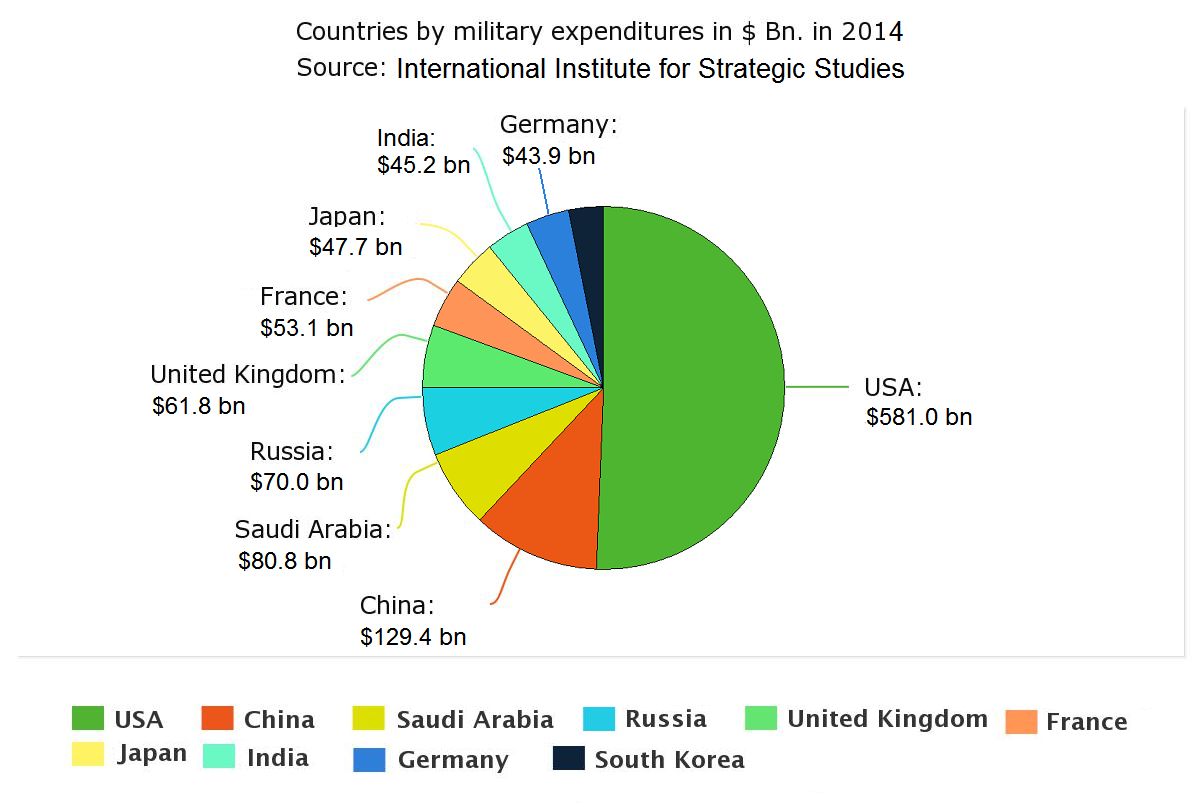
The pie chart shows that world military expenditure in 2014 was dominated by the United States. The US spent 581 Billion US-$ – more than the following nine countries combined.
The second biggest spender is China. On places 3 to 5 follow Saudi Arabia, Russia and the United Kingdom.
https://ourworldindata.org/military-spending
-
How many millions have been spent on preparation for a virus pandemic.
Pandemic Influenza Planning, United States, 1978–2008
John Iskander, Raymond A. Strikas, [...], and Stephen C. Redd
https://www.ncbi.nlm.nih.gov/pmc/articles/PMC3713824/
Don't know.
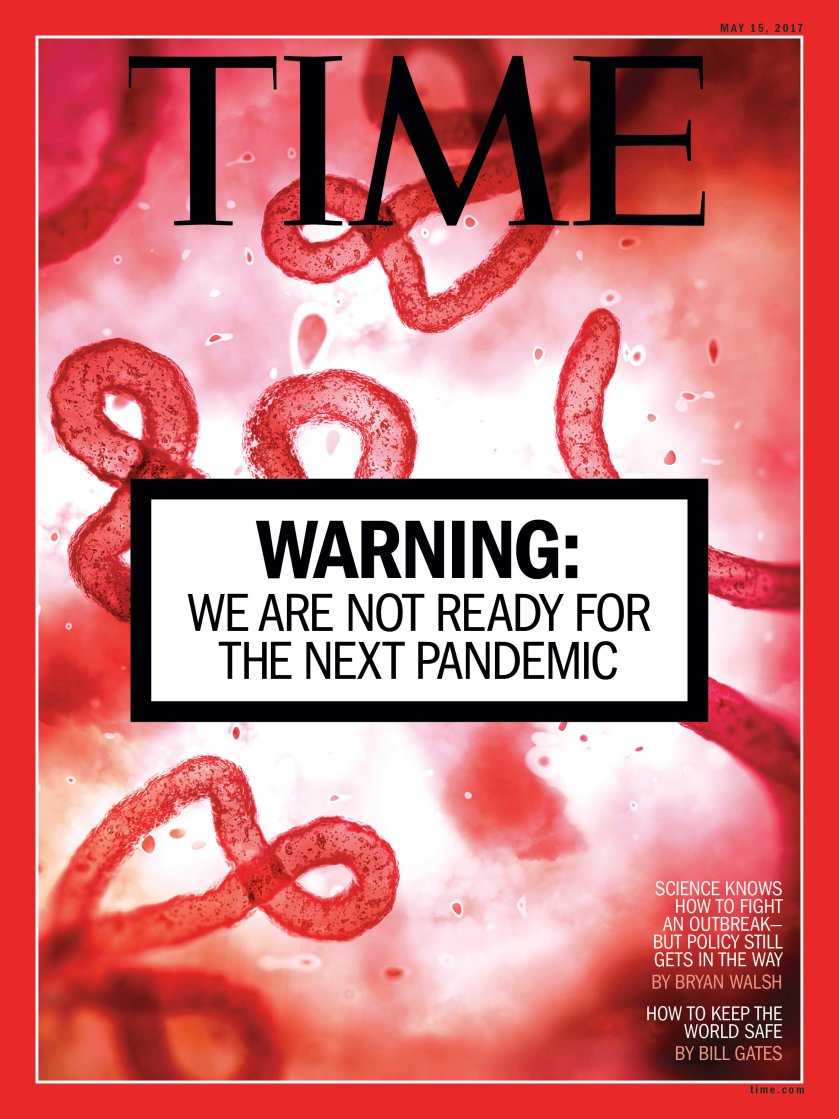
The World Is Not Ready for the Next Pandemic
Bryan Walsh @bryanrwalsh May 4, 2017

John Hackett and Charles Chiu handle Zika samples at the University of California, San Francisco-Abbott Viral Diagnostics and Discovery Center
Cody Pickens for TIME
On a hyperconnected planet rife with hyperinfectious diseases, experts warn we aren't ready to keep America--and the world--safe from the next pandemic
Across China, the virus that could spark the next pandemic is already circulating. It’s a bird flu called H7N9, and true to its name, it mostly infects poultry. Lately, however, it’s started jumping from chickens to humans more readily–bad news, because the virus is a killer. During a recent spike, 88% of people infected got pneumonia, three-quarters ended up in intensive care with severe respiratory problems, and 41% died.
What H7N9 can’t do–yet–is spread easily from person to person, but experts know that could change. The longer the virus spends in humans, the better the chance that it might mutate to become more contagious–and once that happens, it’s only a matter of time before it hops a plane out of China and onto foreign soil, where it could spread through the air like wildfire.
From Ebola in West Africa to Zika in South America to MERS in the Middle East, dangerous outbreaks are on the rise around the world. The number of new diseases per decade has increased nearly fourfold over the past 60 years, and since 1980, the number of outbreaks per year has more than tripled.
Some recent outbreaks registered in the U.S. as no more than a blip in the news, while others, like Ebola, triggered an intense but temporary panic. And while a mutant bug that moves from chickens in China to humans in cities around the world may seem like something out of a Hollywood script, the danger the world faces from H7N9–and countless other pathogens with the potential to cause enormous harm–isn’t science fiction. Rather, it’s the highly plausible nightmare scenario that should be keeping the President up at night.
The U.S. Centers for Disease Control and Prevention (CDC) ranks H7N9 as the flu strain with the greatest potential to cause a pandemic–an infectious-disease outbreak that goes global. If a more contagious H7N9 were to be anywhere near as deadly as it is now, the death toll could be in the tens of millions.
“We are sitting on something big with H7N9,” says Michael Osterholm, the director of the Center for Infectious Disease Research and Policy at the University of Minnesota and a co-author of the new book Deadliest Enemy: Our War Against Killer Germs. “Any one of these cases could trigger something big. By then it’d be way too late.”
Too late because even as the scientific and international communities have begun to take the threat of pandemics more seriously, global health experts–including Bill Gates, World Health Organization director Dr. Margaret Chan and former CDC director Dr. Tom Frieden, to name just a few–warn that nowhere near enough is being done to prepare, leaving the U.S. scarily exposed. That’s because the system for responding to infectious disease is broken. So broken that it recently prompted Gates and his wife Melinda to put their weight behind a major public-private initiative called the Coalition for Epidemic Preparedness Innovations (CEPI). The Gates Foundation alone will devote $100 million over the next five years to CEPI, which will help speed the development of vaccines against known diseases, like MERS, while also investing in next-generation technologies that can counter future threats.
Since President Donald Trump took office, key government positions remain unfilled, including a new director for the CDC. The budget the President proposed in March would have slashed critical funding at the Department of Health and Human Services (HHS) by $15.1 billion, including deep cuts to the National Institutes of Health (NIH), which underwrites more infectious-disease research than any other agency in the world. The budget for the State Department and foreign aid–which power vital efforts to stop diseases overseas, where they usually originate–was set to be cut by 28%. Although a bipartisan congressional spending deal reached on April 30 blocked many of those cuts, the signals Trump has sent are worrying. “It’s early days, but if we compare to what we’ve seen in the past, it raises some alarm bells,” says Jeremy Youde, a global health expert at ANU College of Asia and the Pacific.
The consequences of a major pandemic would be world-changing. The 1918 flu pandemic killed 50 million to 100 million people–at the top end, more than the combined total casualties of World Wars I and II–and for a slew of reasons, humans are arguably more vulnerable today than they were 100 years ago. First of all, there are simply more of us. The number of people on the planet has doubled in the past 50 years, which means more humans to get infected and to infect others, especially in densely populated cities. Because people no longer stay in one place–nearly 4 billion trips were taken by air last year–neither do diseases. An infection in all but the most remote corner of the world can make its way to a major city in a day or less.
For a limited time, TIME is giving all readers special access to subscriber-only stories. For complete access, we encourage you to become a subscriber. Click here ..
https://subscription.time.com/storefront/subscribe-to-time/site/td-flswp1116-template.html?utm_source=time.com&utm_campaign=freedmag .
Climate change also plays a role as warmer temperatures expand the range of disease-carrying animals and insects we’re exposed to, like the Aedes aegypti mosquitoes that transmit Zika. And if nature isn’t bloody-minded enough, genetic-engineering tools have made it easier for terrorist groups or lone madmen to unleash custom-designed killer germs.
In the case of a new pandemic, modern medicine should provide some protection. But experts say it’s more likely that we’ll be caught without a vaccine to prevent it or a drug ready to treat it. That’s true even with many known viruses. When the last Ebola outbreak exploded, in 2014, eventually killing more than 11,000 people, the virus wasn’t a mystery to scientists; it was discovered in 1976. But even though it had been killing people on and off for decades, there were no drugs or vaccines approved to fight it–and there still aren’t today, chiefly because there’s little incentive for pharmaceutical companies to bring them to market.
There are troubling economic implications as well. The 2003 SARS epidemic, which killed fewer than 800 people, cost the global economy $54 billion, much of it in lost trade, transportation disruption and health care costs. The World Bank estimates that the toll from a severe flu pandemic could hit $4 trillion.
One saving grace is that the scientific understanding of that risk is better than ever. Research groups are working feverishly to predict the next pandemic before it even happens. They’re cataloging threats and employing next-generation genetic-sequencing tools to speed the discovery of new or mysterious viruses. They’re helping identify and track outbreaks as they happen.
But microbes evolve about 40 million times as fast as humans do, and we are losing ground. “Of all the things that can kill millions of people in very short order,” says Dr. Ashish Jha, director of the Harvard Global Health Institute, “the one that is most likely to occur over the next 10 years is a pandemic.” The question is how policy–and the government dollars that back it–can catch up with the science and keep the world safe.
Doctors couldn’t tell what was wrong with Joshua Osborn, but they knew they were running out of time to save his life. Since the 14-year-old had returned to Wisconsin from a family trip to Puerto Rico, he’d suffered severe headaches and dangerously high fevers. Over the course of many months, each of the three dozen infectious diseases he was screened for–including West Nile virus, tuberculosis, Epstein-Barr and more–came up negative. Joshua was dying, but no one knew why.
His doctor, desperate, shipped vials of the boy’s spinal fluid and blood to a team of scientists in San Francisco–a specialty lab run by Dr. Charles Chiu at the University of California, San Francisco (UCSF). Chiu is an undisputed leader in the field of genomic diagnosis–the science of using genetic sequences to identify pathogens–and he was Joshua’s last hope.
Joshua’s mystery was extreme in its consequences but not in its details. Up to 25% of pneumonia cases and up to 70% of meningitis and encephalitis cases are caused by unknown pathogens. Doctors are usually able to narrow the cause enough to come up with an effective treatment, but not always. That’s where genomic diagnosis, which involves sequencing all the genetic data in a patient sample in an effort to find all hidden pathogens, will be game-changing.
At the UCSF-Abbott Viral Diagnostics and Discovery Center, Chiu and his team can map blood samples against more than 8 million distinct DNA sequences to see if they match any of the known pathogens on file. For Joshua’s case, they had a suspect pegged in just 97 minutes: something called Leptospira santarosai, a rare pathogen found in parts of the Caribbean, including Puerto Rico.
“Back in the 1980s, it would take two years to do that kind of computational work,” Chiu says. “We’ve developed a program that can analyze 10 million reads in under 30 minutes.” On the strength of Chiu’s diagnosis, Joshua was treated with basic antibiotics, and four weeks later, he was healthy again.
The genetic sequence of a pathogen is a virtually fail-safe fingerprint, which is why tests like Chiu’s can be so effective in diagnosing a single person’s mystery illness. It’s the diagnostic equivalent of fishing for germs with a huge net, instead of a single line. Genetic sequencing is especially valuable when an unknown pathogen starts killing people in droves.
In 2009, a cluster of people living in the southwestern corner of the Democratic Republic of Congo...
https://time.com/magazine/us/4766607/may-15th-2017-vol-189-no-18-u-s/
It's a long one, i still don't know how much has been spent worldwide on preparation for a pandemic as we have now.
Ok, my original intent was to post just this transcript of the Bill Gates's Mar 2015 TED talk in your post. Here it is
The next outbreak? We're not ready
Bill Gates TED 2015
Subtitles in 40 languages
When I was a kid, the disaster we worried about most was a nuclear war. That's why we had a barrel like this down in our basement, filled with cans of food and water. When the nuclear attack came, we were supposed to go downstairs, hunker down, and eat out of that barrel.
Today the greatest risk of global catastrophe doesn't look like this. Instead, it looks like this. If anything kills over 10 million people in the next few decades, it's most likely to be a highly infectious virus rather than a war. Not missiles, but microbes. Now, part of the reason for this is that we've invested a huge amount in nuclear deterrents. But we've actually invested very little in a system to stop an epidemic. We're not ready for the next epidemic.
Let's look at Ebola. I'm sure all of you read about it in the newspaper, lots of tough challenges. I followed it carefully through the case analysis tools we use to track polio eradication. And as you look at what went on, the problem wasn't that there was a system that didn't work well enough, the problem was that we didn't have a system at all. In fact, there's some pretty obvious key missing pieces.
We didn't have a group of epidemiologists ready to go, who would have gone, seen what the disease was, seen how far it had spread. The case reports came in on paper. It was very delayed before they were put online and they were extremely inaccurate. We didn't have a medical team ready to go. We didn't have a way of preparing people. Now, Médecins Sans Frontières did a great job orchestrating volunteers. But even so, we were far slower than we should have been getting the thousands of workers into these countries. And a large epidemic would require us to have hundreds of thousands of workers. There was no one there to look at treatment approaches. No one to look at the diagnostics. No one to figure out what tools should be used. As an example, we could have taken the blood of survivors, processed it, and put that plasma back in people to protect them. But that was never tried.
So there was a lot that was missing. And these things are really a global failure. The WHO is funded to monitor epidemics, but not to do these things I talked about. Now, in the movies it's quite different. There's a group of handsome epidemiologists ready to go, they move in, they save the day, but that's just pure Hollywood.
The failure to prepare could allow the next epidemic to be dramatically more devastating than Ebola Let's look at the progression of Ebola over this year. About 10,000 people died, and nearly all were in the three West African countries. There's three reasons why it didn't spread more. The first is that there was a lot of heroic work by the health workers. They found the people and they prevented more infections. The second is the nature of the virus. Ebola does not spread through the air. And by the time you're contagious, most people are so sick that they're bedridden. Third, it didn't get into many urban areas. And that was just luck. If it had gotten into a lot more urban areas, the case numbers would have been much larger.
So next time, we might not be so lucky. You can have a virus where people feel well enough while they're infectious that they get on a plane or they go to a market. The source of the virus could be a natural epidemic like Ebola, or it could be bioterrorism. So there are things that would literally make things a thousand times worse.
In fact, let's look at a model of a virus spread through the air, like the Spanish Flu back in 1918. So here's what would happen: It would spread throughout the world very, very quickly. And you can see over 30 million people died from that epidemic. So this is a serious problem. We should be concerned.
But in fact, we can build a really good response system. We have the benefits of all the science and technology that we talk about here. We've got cell phones to get information from the public and get information out to them. We have satellite maps where we can see where people are and where they're moving. We have advances in biology that should dramatically change the turnaround time to look at a pathogen and be able to make drugs and vaccines that fit for that pathogen. So we can have tools, but those tools need to be put into an overall global health system. And we need preparedness.
The best lessons, I think, on how to get prepared are again, what we do for war. For soldiers, we have full-time, waiting to go. We have reserves that can scale us up to large numbers. NATO has a mobile unit that can deploy very rapidly. NATO does a lot of war games to check, are people well trained? Do they understand about fuel and logistics and the same radio frequencies? So they are absolutely ready to go. So those are the kinds of things we need to deal with an epidemic.
What are the key pieces? First, we need strong health systems in poor countries. That's where mothers can give birth safely, kids can get all their vaccines. But, also where we'll see the outbreak very early on. We need a medical reserve corps: lots of people who've got the training and background who are ready to go, with the expertise. And then we need to pair those medical people with the military. taking advantage of the military's ability to move fast, do logistics and secure areas. We need to do simulations, germ games, not war games, so that we see where the holes are. The last time a germ game was done in the United States was back in 2001, and it didn't go so well. So far the score is germs: 1, people: 0. Finally, we need lots of advanced R&D in areas of vaccines and diagnostics. There are some big breakthroughs, like the Adeno-associated virus, that could work very, very quickly.
Now I don't have an exact budget for what this would cost, but I'm quite sure it's very modest compared to the potential harm. The World Bank estimates that if we have a worldwide flu epidemic, global wealth will go down by over three trillion dollars and we'd have millions and millions of deaths. These investments offer significant benefits beyond just being ready for the epidemic. The primary healthcare, the R&D, those things would reduce global health equity and make the world more just as well as more safe.
So I think this should absolutely be a priority. There's no need to panic. We don't have to hoard cans of spaghetti or go down into the basement. But we need to get going, because time is not on our side.
In fact, if there's one positive thing that can come out of the Ebola epidemic, it's that it can serve as an early warning, a wake-up call, to get ready. If we start now, we can be ready for the next epidemic.
Thank you.
(Applause)
Available in 40 languages, with the video again - https://www.ted.com/talks/bill_gates_the_next_outbreak_we_re_not_ready/transcript?language=en#t-8
There seems sadly only one conclusion: That every past and present leader of the richest countries in the world has
failed to work toward their country's preparation for COVID-19. Leaders of the poorest countries share some blame too.
See also:
Zardiw, Much also IS actually what Trump did and didn't do.
https://investorshub.advfn.com/boards/read_msg.aspx?message_id=154480710
How the Pandemic Will End
The U.S. may end up with the worst COVID-19 outbreak in
the industrialized world. This is how it’s going to play out.
[...]
Bill Gates has been telling anyone who would listen, including the 18 million viewers of his TED Talk...
https://www.ted.com/talks/bill_gates_the_next_outbreak_we_re_not_ready?language=en ..
""
That was Mar. 2015. Five years ago. The transcript is at the bottom of this post, and if you still haven't watched the video yet, please DO.
There are images not in the transcript.
It was a good talk, eh? Good.
Now, since you have seen one of the many warnings given over years, consider the question of preparedness. Think about it.
Ebola
-
The disease was first identified in 1976, in two simultaneous outbreaks: one in Nzara (a town in South Sudan) and the other in Yambuku (Democratic Republic of the Congo), a village near the Ebola River from which the disease takes its name.[11] EVD outbreaks occur intermittently in tropical regions of sub-Saharan Africa.[1] Between 1976 and 2013, the World Health Organization reports 24 outbreaks involving 2,387 cases with 1,590 deaths.[1][12] The largest outbreak to date was the epidemic in West Africa, which occurred from December 2013 to January 2016, with 28,646 cases and 11,323 deaths.[13][14][15] It was declared no longer an emergency on 29 March 2016.[16] Other outbreaks in Africa began in the Democratic Republic of the Congo in May 2017,[17][18] and 2018.[19][20] In July 2019, the World Health Organization declared the Congo Ebola outbreak a world health emergency.[21]
https://en.wikipedia.org/wiki/Ebola_virus_disease
-
How many billions have been spent since 1976 on worldwide militaries?
-
Military Spending
by Max Roser and Mohamed Nagdy
[...]
Absolute spending
The pie chart shows that world military expenditure in 2014 was dominated by the United States. The US spent 581 Billion US-$ – more than the following nine countries combined.
The second biggest spender is China. On places 3 to 5 follow Saudi Arabia, Russia and the United Kingdom.
https://ourworldindata.org/military-spending
-
How many millions have been spent on preparation for a virus pandemic.
Pandemic Influenza Planning, United States, 1978–2008
John Iskander, Raymond A. Strikas, [...], and Stephen C. Redd
https://www.ncbi.nlm.nih.gov/pmc/articles/PMC3713824/
Don't know.
The World Is Not Ready for the Next Pandemic
Bryan Walsh @bryanrwalsh May 4, 2017

John Hackett and Charles Chiu handle Zika samples at the University of California, San Francisco-Abbott Viral Diagnostics and Discovery Center
Cody Pickens for TIME
On a hyperconnected planet rife with hyperinfectious diseases, experts warn we aren't ready to keep America--and the world--safe from the next pandemic
Across China, the virus that could spark the next pandemic is already circulating. It’s a bird flu called H7N9, and true to its name, it mostly infects poultry. Lately, however, it’s started jumping from chickens to humans more readily–bad news, because the virus is a killer. During a recent spike, 88% of people infected got pneumonia, three-quarters ended up in intensive care with severe respiratory problems, and 41% died.
What H7N9 can’t do–yet–is spread easily from person to person, but experts know that could change. The longer the virus spends in humans, the better the chance that it might mutate to become more contagious–and once that happens, it’s only a matter of time before it hops a plane out of China and onto foreign soil, where it could spread through the air like wildfire.
From Ebola in West Africa to Zika in South America to MERS in the Middle East, dangerous outbreaks are on the rise around the world. The number of new diseases per decade has increased nearly fourfold over the past 60 years, and since 1980, the number of outbreaks per year has more than tripled.
Some recent outbreaks registered in the U.S. as no more than a blip in the news, while others, like Ebola, triggered an intense but temporary panic. And while a mutant bug that moves from chickens in China to humans in cities around the world may seem like something out of a Hollywood script, the danger the world faces from H7N9–and countless other pathogens with the potential to cause enormous harm–isn’t science fiction. Rather, it’s the highly plausible nightmare scenario that should be keeping the President up at night.
The U.S. Centers for Disease Control and Prevention (CDC) ranks H7N9 as the flu strain with the greatest potential to cause a pandemic–an infectious-disease outbreak that goes global. If a more contagious H7N9 were to be anywhere near as deadly as it is now, the death toll could be in the tens of millions.
“We are sitting on something big with H7N9,” says Michael Osterholm, the director of the Center for Infectious Disease Research and Policy at the University of Minnesota and a co-author of the new book Deadliest Enemy: Our War Against Killer Germs. “Any one of these cases could trigger something big. By then it’d be way too late.”
Too late because even as the scientific and international communities have begun to take the threat of pandemics more seriously, global health experts–including Bill Gates, World Health Organization director Dr. Margaret Chan and former CDC director Dr. Tom Frieden, to name just a few–warn that nowhere near enough is being done to prepare, leaving the U.S. scarily exposed. That’s because the system for responding to infectious disease is broken. So broken that it recently prompted Gates and his wife Melinda to put their weight behind a major public-private initiative called the Coalition for Epidemic Preparedness Innovations (CEPI). The Gates Foundation alone will devote $100 million over the next five years to CEPI, which will help speed the development of vaccines against known diseases, like MERS, while also investing in next-generation technologies that can counter future threats.
Since President Donald Trump took office, key government positions remain unfilled, including a new director for the CDC. The budget the President proposed in March would have slashed critical funding at the Department of Health and Human Services (HHS) by $15.1 billion, including deep cuts to the National Institutes of Health (NIH), which underwrites more infectious-disease research than any other agency in the world. The budget for the State Department and foreign aid–which power vital efforts to stop diseases overseas, where they usually originate–was set to be cut by 28%. Although a bipartisan congressional spending deal reached on April 30 blocked many of those cuts, the signals Trump has sent are worrying. “It’s early days, but if we compare to what we’ve seen in the past, it raises some alarm bells,” says Jeremy Youde, a global health expert at ANU College of Asia and the Pacific.
The consequences of a major pandemic would be world-changing. The 1918 flu pandemic killed 50 million to 100 million people–at the top end, more than the combined total casualties of World Wars I and II–and for a slew of reasons, humans are arguably more vulnerable today than they were 100 years ago. First of all, there are simply more of us. The number of people on the planet has doubled in the past 50 years, which means more humans to get infected and to infect others, especially in densely populated cities. Because people no longer stay in one place–nearly 4 billion trips were taken by air last year–neither do diseases. An infection in all but the most remote corner of the world can make its way to a major city in a day or less.
For a limited time, TIME is giving all readers special access to subscriber-only stories. For complete access, we encourage you to become a subscriber. Click here ..
https://subscription.time.com/storefront/subscribe-to-time/site/td-flswp1116-template.html?utm_source=time.com&utm_campaign=freedmag .
Climate change also plays a role as warmer temperatures expand the range of disease-carrying animals and insects we’re exposed to, like the Aedes aegypti mosquitoes that transmit Zika. And if nature isn’t bloody-minded enough, genetic-engineering tools have made it easier for terrorist groups or lone madmen to unleash custom-designed killer germs.
In the case of a new pandemic, modern medicine should provide some protection. But experts say it’s more likely that we’ll be caught without a vaccine to prevent it or a drug ready to treat it. That’s true even with many known viruses. When the last Ebola outbreak exploded, in 2014, eventually killing more than 11,000 people, the virus wasn’t a mystery to scientists; it was discovered in 1976. But even though it had been killing people on and off for decades, there were no drugs or vaccines approved to fight it–and there still aren’t today, chiefly because there’s little incentive for pharmaceutical companies to bring them to market.
There are troubling economic implications as well. The 2003 SARS epidemic, which killed fewer than 800 people, cost the global economy $54 billion, much of it in lost trade, transportation disruption and health care costs. The World Bank estimates that the toll from a severe flu pandemic could hit $4 trillion.
One saving grace is that the scientific understanding of that risk is better than ever. Research groups are working feverishly to predict the next pandemic before it even happens. They’re cataloging threats and employing next-generation genetic-sequencing tools to speed the discovery of new or mysterious viruses. They’re helping identify and track outbreaks as they happen.
But microbes evolve about 40 million times as fast as humans do, and we are losing ground. “Of all the things that can kill millions of people in very short order,” says Dr. Ashish Jha, director of the Harvard Global Health Institute, “the one that is most likely to occur over the next 10 years is a pandemic.” The question is how policy–and the government dollars that back it–can catch up with the science and keep the world safe.
Doctors couldn’t tell what was wrong with Joshua Osborn, but they knew they were running out of time to save his life. Since the 14-year-old had returned to Wisconsin from a family trip to Puerto Rico, he’d suffered severe headaches and dangerously high fevers. Over the course of many months, each of the three dozen infectious diseases he was screened for–including West Nile virus, tuberculosis, Epstein-Barr and more–came up negative. Joshua was dying, but no one knew why.
His doctor, desperate, shipped vials of the boy’s spinal fluid and blood to a team of scientists in San Francisco–a specialty lab run by Dr. Charles Chiu at the University of California, San Francisco (UCSF). Chiu is an undisputed leader in the field of genomic diagnosis–the science of using genetic sequences to identify pathogens–and he was Joshua’s last hope.
Joshua’s mystery was extreme in its consequences but not in its details. Up to 25% of pneumonia cases and up to 70% of meningitis and encephalitis cases are caused by unknown pathogens. Doctors are usually able to narrow the cause enough to come up with an effective treatment, but not always. That’s where genomic diagnosis, which involves sequencing all the genetic data in a patient sample in an effort to find all hidden pathogens, will be game-changing.
At the UCSF-Abbott Viral Diagnostics and Discovery Center, Chiu and his team can map blood samples against more than 8 million distinct DNA sequences to see if they match any of the known pathogens on file. For Joshua’s case, they had a suspect pegged in just 97 minutes: something called Leptospira santarosai, a rare pathogen found in parts of the Caribbean, including Puerto Rico.
“Back in the 1980s, it would take two years to do that kind of computational work,” Chiu says. “We’ve developed a program that can analyze 10 million reads in under 30 minutes.” On the strength of Chiu’s diagnosis, Joshua was treated with basic antibiotics, and four weeks later, he was healthy again.
The genetic sequence of a pathogen is a virtually fail-safe fingerprint, which is why tests like Chiu’s can be so effective in diagnosing a single person’s mystery illness. It’s the diagnostic equivalent of fishing for germs with a huge net, instead of a single line. Genetic sequencing is especially valuable when an unknown pathogen starts killing people in droves.
In 2009, a cluster of people living in the southwestern corner of the Democratic Republic of Congo...
https://time.com/magazine/us/4766607/may-15th-2017-vol-189-no-18-u-s/
It's a long one, i still don't know how much has been spent worldwide on preparation for a pandemic as we have now.
Ok, my original intent was to post just this transcript of the Bill Gates's Mar 2015 TED talk in your post. Here it is
The next outbreak? We're not ready
Bill Gates TED 2015
Subtitles in 40 languages
When I was a kid, the disaster we worried about most was a nuclear war. That's why we had a barrel like this down in our basement, filled with cans of food and water. When the nuclear attack came, we were supposed to go downstairs, hunker down, and eat out of that barrel.
Today the greatest risk of global catastrophe doesn't look like this. Instead, it looks like this. If anything kills over 10 million people in the next few decades, it's most likely to be a highly infectious virus rather than a war. Not missiles, but microbes. Now, part of the reason for this is that we've invested a huge amount in nuclear deterrents. But we've actually invested very little in a system to stop an epidemic. We're not ready for the next epidemic.
Let's look at Ebola. I'm sure all of you read about it in the newspaper, lots of tough challenges. I followed it carefully through the case analysis tools we use to track polio eradication. And as you look at what went on, the problem wasn't that there was a system that didn't work well enough, the problem was that we didn't have a system at all. In fact, there's some pretty obvious key missing pieces.
We didn't have a group of epidemiologists ready to go, who would have gone, seen what the disease was, seen how far it had spread. The case reports came in on paper. It was very delayed before they were put online and they were extremely inaccurate. We didn't have a medical team ready to go. We didn't have a way of preparing people. Now, Médecins Sans Frontières did a great job orchestrating volunteers. But even so, we were far slower than we should have been getting the thousands of workers into these countries. And a large epidemic would require us to have hundreds of thousands of workers. There was no one there to look at treatment approaches. No one to look at the diagnostics. No one to figure out what tools should be used. As an example, we could have taken the blood of survivors, processed it, and put that plasma back in people to protect them. But that was never tried.
So there was a lot that was missing. And these things are really a global failure. The WHO is funded to monitor epidemics, but not to do these things I talked about. Now, in the movies it's quite different. There's a group of handsome epidemiologists ready to go, they move in, they save the day, but that's just pure Hollywood.
The failure to prepare could allow the next epidemic to be dramatically more devastating than Ebola Let's look at the progression of Ebola over this year. About 10,000 people died, and nearly all were in the three West African countries. There's three reasons why it didn't spread more. The first is that there was a lot of heroic work by the health workers. They found the people and they prevented more infections. The second is the nature of the virus. Ebola does not spread through the air. And by the time you're contagious, most people are so sick that they're bedridden. Third, it didn't get into many urban areas. And that was just luck. If it had gotten into a lot more urban areas, the case numbers would have been much larger.
So next time, we might not be so lucky. You can have a virus where people feel well enough while they're infectious that they get on a plane or they go to a market. The source of the virus could be a natural epidemic like Ebola, or it could be bioterrorism. So there are things that would literally make things a thousand times worse.
In fact, let's look at a model of a virus spread through the air, like the Spanish Flu back in 1918. So here's what would happen: It would spread throughout the world very, very quickly. And you can see over 30 million people died from that epidemic. So this is a serious problem. We should be concerned.
But in fact, we can build a really good response system. We have the benefits of all the science and technology that we talk about here. We've got cell phones to get information from the public and get information out to them. We have satellite maps where we can see where people are and where they're moving. We have advances in biology that should dramatically change the turnaround time to look at a pathogen and be able to make drugs and vaccines that fit for that pathogen. So we can have tools, but those tools need to be put into an overall global health system. And we need preparedness.
The best lessons, I think, on how to get prepared are again, what we do for war. For soldiers, we have full-time, waiting to go. We have reserves that can scale us up to large numbers. NATO has a mobile unit that can deploy very rapidly. NATO does a lot of war games to check, are people well trained? Do they understand about fuel and logistics and the same radio frequencies? So they are absolutely ready to go. So those are the kinds of things we need to deal with an epidemic.
What are the key pieces? First, we need strong health systems in poor countries. That's where mothers can give birth safely, kids can get all their vaccines. But, also where we'll see the outbreak very early on. We need a medical reserve corps: lots of people who've got the training and background who are ready to go, with the expertise. And then we need to pair those medical people with the military. taking advantage of the military's ability to move fast, do logistics and secure areas. We need to do simulations, germ games, not war games, so that we see where the holes are. The last time a germ game was done in the United States was back in 2001, and it didn't go so well. So far the score is germs: 1, people: 0. Finally, we need lots of advanced R&D in areas of vaccines and diagnostics. There are some big breakthroughs, like the Adeno-associated virus, that could work very, very quickly.
Now I don't have an exact budget for what this would cost, but I'm quite sure it's very modest compared to the potential harm. The World Bank estimates that if we have a worldwide flu epidemic, global wealth will go down by over three trillion dollars and we'd have millions and millions of deaths. These investments offer significant benefits beyond just being ready for the epidemic. The primary healthcare, the R&D, those things would reduce global health equity and make the world more just as well as more safe.
So I think this should absolutely be a priority. There's no need to panic. We don't have to hoard cans of spaghetti or go down into the basement. But we need to get going, because time is not on our side.
In fact, if there's one positive thing that can come out of the Ebola epidemic, it's that it can serve as an early warning, a wake-up call, to get ready. If we start now, we can be ready for the next epidemic.
Thank you.
(Applause)
Available in 40 languages, with the video again - https://www.ted.com/talks/bill_gates_the_next_outbreak_we_re_not_ready/transcript?language=en#t-8
There seems sadly only one conclusion: That every past and present leader of the richest countries in the world has
failed to work toward their country's preparation for COVID-19. Leaders of the poorest countries share some blame too.
See also:
Zardiw, Much also IS actually what Trump did and didn't do.
https://investorshub.advfn.com/boards/read_msg.aspx?message_id=154480710
It was Plato who said, “He, O men, is the wisest, who like Socrates, knows that his wisdom is in truth worth nothing”
Discover What Traders Are Watching
Explore small cap ideas before they hit the headlines.



