



 AI
AI








Friday, March 20, 2020 5:39:15 AM
Australian Health Protection Principal Committee (AHPPC) coronavirus (COVID-19) statement on 17 March 2020
"Australia blocks arrival of all non-residents in expanded coronavirus travel ban"
A statement from the Australian Health Protection Principal Committee (AHPPC) about coronavirus (COVID-19).
[...]
[...]
Schools
The AHPPC met on Tuesday 17 March to consider the issue of school closures in relation to the community transmission of COVID-19. The Committee’s advice is that pre-emptive closures are not proportionate or effective as a public health intervention to prevent community transmission of COVID-19 at this time.
There is currently limited information on the contribution of children to transmission of COVID-19. The WHO-China Joint Mission noted the primary role of household transmission and observed that children tended to be infected by adults in the household. In China, 2.4% of total reported cases were under the age of 19 years old. Worldwide, of those cases under 19 years of age, very few were severe or critical. This contrasts distinctly with the severity pattern observed with other respiratory viruses, where young children are particularly at risk of severe disease.
Previous studies suggest that the potential reduction in community transmission from pre-emptive school closures may be offset by the care arrangements that are in place for children who are not at school. Children may require care from older carers who are more vulnerable to severe disease, or may continue to associate (and transmit infection) outside of school settings.
Broadly, the health evidence on school closures from previous respiratory epidemics shows the costs are often underestimated and the benefits are overestimated. This may be even more so in relation to COVID-19 as, unlike influenza, the impact on otherwise healthy children has been minimal to date.
School closure is associated with considerable costs. Studies have estimated that around 15% of the total workforce and 30% of the healthcare workforce may need to take time off work to care for children. This burden will be significant and will fall disproportionately on those in casual or tenuous work circumstances.
At this stage, the spread of COVID-19 in the community is at quite low levels. It may be many months before the level of Australian community infection is again as low as it is at the moment. For pre-emptive school closures to be effective, closure for at least several months is required and it would be unclear when they could be re-opened.
School closures for shorter defined periods may be considered as part of a suite of more stringent distancing measures later in the outbreak, in anticipation of a peak in infection rates.
Short term reactive school closure may also be warranted to allow cleaning and contact tracing to occur in response to an outbreak in a given school.
More than 70 countries around the world have implemented either nationwide or localised school closures, at different times in the evolution of the local COVID-19 epidemic, however it should be noted the majority of these have not been successful in controlling the outbreak. Some of these countries are now considering their position in relation to re-opening schools.
Singapore has had success in limiting the transmission of COVID-19 in the community without closing schools. Other countries are working in different contexts, including Northern Hemisphere countries making decisions at the end of winter with COVID-19 being accompanied by influenza in the community.
The advice in relation to school closures will continue to be reviewed at daily meetings of the AHPPC.
Schools should implement a range of other strategies to reduce transmission, including the promotion of personal hygiene measures (frequent handwashing, reducing face-to-face contact, cough etiquette), physical distancing, reducing public gatherings (e.g. face-to-face school assemblies), and reducing the mixing of students (e.g. reduced use of common areas, staggered lunchtimes, and reduced after-school activities and inter-school activities).
Schools should also reinforce existing policies to exclude students and staff who are unwell, and current policies requiring quarantine for those who have recently travelled overseas. It is also important that the learning needs of students who are excluded from school are met.
Boarding Schools
https://www.health.gov.au/news/australian-health-protection-principal-committee-ahppc-coronavirus-covid-19-statement-on-17-march-2020
-
Coronavirus data reveals how COVID-19 is spreading in Australia
Digital Story Innovation Team
By Inga Ting, Michael Workman and Mark Doman
Updated 31 minutes ago
Related Story: A coronavirus vaccine is being tested on humans. When will it be ready?
https://www.abc.net.au/news/2020-03-18/coronavirus-vaccine-human-trial-covid19-immunity-hopes/12067024
Related Story: 'Like a lottery': Health experts warn young people with no risk factors are dying from COVID-19
https://www.abc.net.au/news/health/2020-03-18/coronavirus-covid-younger-people-also-risk-serious-illness-death/12059326
Related Story: The big hit: An extended coronavirus shutdown may change sport as we know it in Australia
https://www.abc.net.au/news/2020-03-18/coronavirus-shutdown-may-change-sport-as-we-know-it-afl-nrl/12062522
The number of confirmed cases of COVID-19 in Australia is doubling every 3-4 days, with the national tally now surpassing 870.
[INSERT: SoxFan's site at bottom shows 876 now, so again, it's very good for up-to-date figures in every country.]
The figures come from a national database of every confirmed case since January 25, when NSW and Victoria reported the country's first four cases.
The database, compiled by ABC News, tracks confirmed cases by gender, age, location, source of infection and other information published in case reports from state and federal health authorities.
It is supplemented with additional reporting by ABC News and updated daily to show the spread of the disease across Australia's states and territories.
The latest update was just after 6:30pm AEDT on Friday, March 20.
(Tap/hover on any chart for more information.)
[...]
To date, state and territory health authorities have reported 877 confirmed cases of COVID-19 in Australia.
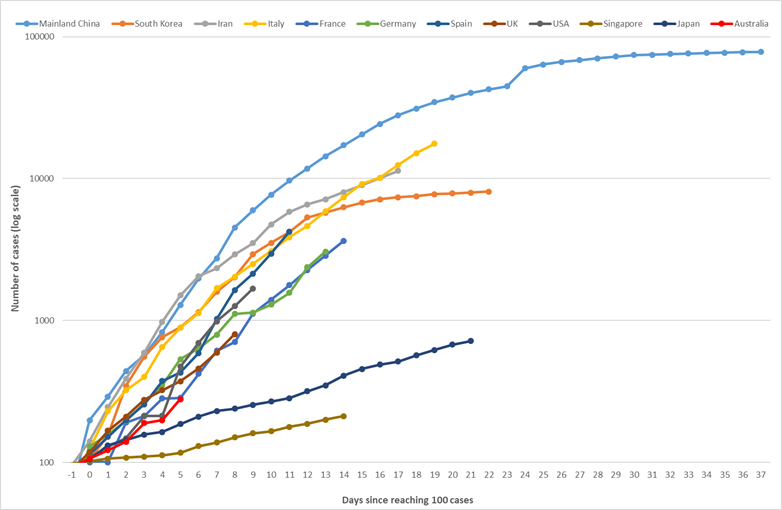
But the number of confirmed cases is only part of the story. An important measure of the spread of infectious disease is the growth rate — in other words, how long it takes for the number of confirmed cases to double.
This is easier to see when the number of confirmed cases is plotted on a log scale.
[...]
The chart above shows the number of confirmed cases in Australia doubles every 3-4 days.
Each tick on the vertical axis is twice the value of the previous tick. You can estimate the growth rate by counting the number of days it takes for the line to travel from one tick to the next.
Here is the same chart but for each of the states and territories. It shows the largest states are on roughly the same growth trajectory.
[...]
However, when these numbers are adjusted for the size of each age group, they show people in their 50s have the highest rates of diagnosis, closely followed by people in their 30s and 60s.
Across the country, the available data shows more men than women have tested positive for coronavirus. However, authorities have not provided gender data for four per cent of confirmed cases.
[...]
In small number of cases, authorities have named the countries visited by people who have tested positive for the virus. Among these cases, the United States was the most common country visited, followed by Italy, China, Iran and the UK.
https://www.abc.net.au/news/2020-03-17/coronavirus-data-reveals-how-covid-19-is-spreading-in-australia/12060704
Soxfan's covid site .. https://www.worldometers.info/coronavirus/
https://investorshub.advfn.com/boards/read_msg.aspx?message_id=154419975
"Australia blocks arrival of all non-residents in expanded coronavirus travel ban"
A statement from the Australian Health Protection Principal Committee (AHPPC) about coronavirus (COVID-19).
[...]
[...]
Schools
The AHPPC met on Tuesday 17 March to consider the issue of school closures in relation to the community transmission of COVID-19. The Committee’s advice is that pre-emptive closures are not proportionate or effective as a public health intervention to prevent community transmission of COVID-19 at this time.
There is currently limited information on the contribution of children to transmission of COVID-19. The WHO-China Joint Mission noted the primary role of household transmission and observed that children tended to be infected by adults in the household. In China, 2.4% of total reported cases were under the age of 19 years old. Worldwide, of those cases under 19 years of age, very few were severe or critical. This contrasts distinctly with the severity pattern observed with other respiratory viruses, where young children are particularly at risk of severe disease.
Previous studies suggest that the potential reduction in community transmission from pre-emptive school closures may be offset by the care arrangements that are in place for children who are not at school. Children may require care from older carers who are more vulnerable to severe disease, or may continue to associate (and transmit infection) outside of school settings.
Broadly, the health evidence on school closures from previous respiratory epidemics shows the costs are often underestimated and the benefits are overestimated. This may be even more so in relation to COVID-19 as, unlike influenza, the impact on otherwise healthy children has been minimal to date.
School closure is associated with considerable costs. Studies have estimated that around 15% of the total workforce and 30% of the healthcare workforce may need to take time off work to care for children. This burden will be significant and will fall disproportionately on those in casual or tenuous work circumstances.
At this stage, the spread of COVID-19 in the community is at quite low levels. It may be many months before the level of Australian community infection is again as low as it is at the moment. For pre-emptive school closures to be effective, closure for at least several months is required and it would be unclear when they could be re-opened.
School closures for shorter defined periods may be considered as part of a suite of more stringent distancing measures later in the outbreak, in anticipation of a peak in infection rates.
Short term reactive school closure may also be warranted to allow cleaning and contact tracing to occur in response to an outbreak in a given school.
More than 70 countries around the world have implemented either nationwide or localised school closures, at different times in the evolution of the local COVID-19 epidemic, however it should be noted the majority of these have not been successful in controlling the outbreak. Some of these countries are now considering their position in relation to re-opening schools.
Singapore has had success in limiting the transmission of COVID-19 in the community without closing schools. Other countries are working in different contexts, including Northern Hemisphere countries making decisions at the end of winter with COVID-19 being accompanied by influenza in the community.
The advice in relation to school closures will continue to be reviewed at daily meetings of the AHPPC.
Schools should implement a range of other strategies to reduce transmission, including the promotion of personal hygiene measures (frequent handwashing, reducing face-to-face contact, cough etiquette), physical distancing, reducing public gatherings (e.g. face-to-face school assemblies), and reducing the mixing of students (e.g. reduced use of common areas, staggered lunchtimes, and reduced after-school activities and inter-school activities).
Schools should also reinforce existing policies to exclude students and staff who are unwell, and current policies requiring quarantine for those who have recently travelled overseas. It is also important that the learning needs of students who are excluded from school are met.
Boarding Schools
https://www.health.gov.au/news/australian-health-protection-principal-committee-ahppc-coronavirus-covid-19-statement-on-17-march-2020
-
Coronavirus data reveals how COVID-19 is spreading in Australia
Digital Story Innovation Team
By Inga Ting, Michael Workman and Mark Doman
Updated 31 minutes ago
Related Story: A coronavirus vaccine is being tested on humans. When will it be ready?
https://www.abc.net.au/news/2020-03-18/coronavirus-vaccine-human-trial-covid19-immunity-hopes/12067024
Related Story: 'Like a lottery': Health experts warn young people with no risk factors are dying from COVID-19
https://www.abc.net.au/news/health/2020-03-18/coronavirus-covid-younger-people-also-risk-serious-illness-death/12059326
Related Story: The big hit: An extended coronavirus shutdown may change sport as we know it in Australia
https://www.abc.net.au/news/2020-03-18/coronavirus-shutdown-may-change-sport-as-we-know-it-afl-nrl/12062522
The number of confirmed cases of COVID-19 in Australia is doubling every 3-4 days, with the national tally now surpassing 870.
[INSERT: SoxFan's site at bottom shows 876 now, so again, it's very good for up-to-date figures in every country.]
The figures come from a national database of every confirmed case since January 25, when NSW and Victoria reported the country's first four cases.
The database, compiled by ABC News, tracks confirmed cases by gender, age, location, source of infection and other information published in case reports from state and federal health authorities.
It is supplemented with additional reporting by ABC News and updated daily to show the spread of the disease across Australia's states and territories.
The latest update was just after 6:30pm AEDT on Friday, March 20.
(Tap/hover on any chart for more information.)
[...]
To date, state and territory health authorities have reported 877 confirmed cases of COVID-19 in Australia.
But the number of confirmed cases is only part of the story. An important measure of the spread of infectious disease is the growth rate — in other words, how long it takes for the number of confirmed cases to double.
This is easier to see when the number of confirmed cases is plotted on a log scale.
[...]
The chart above shows the number of confirmed cases in Australia doubles every 3-4 days.
Each tick on the vertical axis is twice the value of the previous tick. You can estimate the growth rate by counting the number of days it takes for the line to travel from one tick to the next.
Here is the same chart but for each of the states and territories. It shows the largest states are on roughly the same growth trajectory.
[...]
However, when these numbers are adjusted for the size of each age group, they show people in their 50s have the highest rates of diagnosis, closely followed by people in their 30s and 60s.
Across the country, the available data shows more men than women have tested positive for coronavirus. However, authorities have not provided gender data for four per cent of confirmed cases.
[...]
In small number of cases, authorities have named the countries visited by people who have tested positive for the virus. Among these cases, the United States was the most common country visited, followed by Italy, China, Iran and the UK.
https://www.abc.net.au/news/2020-03-17/coronavirus-data-reveals-how-covid-19-is-spreading-in-australia/12060704
Soxfan's covid site .. https://www.worldometers.info/coronavirus/
https://investorshub.advfn.com/boards/read_msg.aspx?message_id=154419975
It was Plato who said, “He, O men, is the wisest, who like Socrates, knows that his wisdom is in truth worth nothing”
Discover What Traders Are Watching
Explore small cap ideas before they hit the headlines.



