Democratic Advantage in Partisanship Among Largest at Similar Points in Time
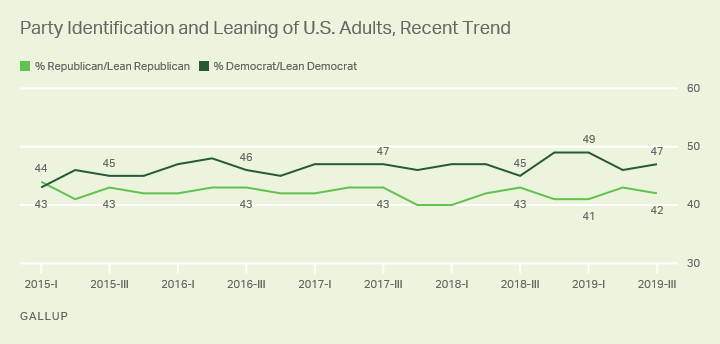
U.S. partisanship gives an indication of relative strength of each party heading into next year's presidential election, as vote preference is highly correlated with partisanship. Although Democrats usually hold an advantage in partisanship, Republicans vote at higher rates than Democrats do, which makes U.S. elections competitive.
Partisanship in the third quarter of the year prior to a presidential election year has not always been a strong predictor of what would happen in the coming election. Nevertheless, the current Democratic advantage is among the larger ones for the party over the past two decades. Democrats held larger advantages in 1999 (six points) and 2007 (10 points). The party won the popular vote but lost the Electoral College vote in the 2000 election and won both in 2008.
In other years, the parties were more evenly matched, with the ensuing elections resulting in a mix of Republican (2004, 2016) and Democratic (1992, 1996, 2012) victories. Implications
Democrats are heading into the presidential election year in a relatively strong position compared with Republicans. The Democratic Party is also in a more advantageous position than they have been at similar points in the past. However, their positioning is slightly weaker than it was at the end of 2018 and beginning of 2019.
Americans' party preferences have often shifted in the year leading up to Election Day. Thus, movement toward a larger Democratic advantage, or a smaller one, would certainly not be unexpected.
Which direction such a shift will go a long way to determining whether President Trump earns a second term or is replaced by a Democratic president.


 Market Data
  Markets


 AI
AI