



 AI
AI








Wednesday, September 25, 2019 3:22:19 AM
See US/UN/Australia past betrayal, bottom article. West Papua: Day of violence sees at least 27 dead
24 September 2019
"Australia slammed for locking up refugees on secret ASIO advice"
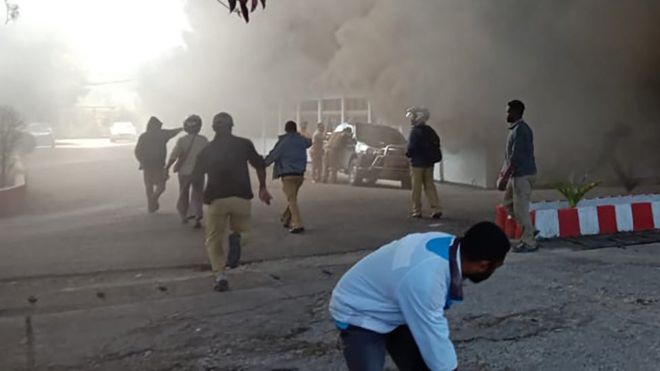
A new wave of violence has hit the restive Indonesian region of West Papua after hundreds of
protesters, mostly high school students, set fire to several buildings in a town on Monday.
At least 23 people died in the regional capital Wamena, some of whom were trapped inside burning buildings.
The protests were reportedly triggered by a teacher's racist comments - an allegation the police called a "hoax".
More - https://www.bbc.com/news/world-asia-49806182
-
Why nearly 2 million people are demanding an independence vote for West Papua province
By Tasha Wibawa
Updated 30 Aug 2019, 11:07am

Photo: West Papuans claim they have been victims of decades of human rights abuses by the
Indonesian government. (Flickr: Matt Brown/ mural by Dale Grimshaw)
Earlier this week, a petition signed by more than 1.8 million people calling for an independence referendum
in Indonesia's West Papua province was delivered to United Nations human rights chief Michelle Bachelet.
[...]

Indonesia's acquisition of West Papua has been the cause of controversy for more than 60 years.
In 2003, the province of West Papua was split by the Indonesian Government into West Papua and Papua.
Internationally, they are still referred to collectively as their historic name of West Papua, but the people from the region refer to themselves as Papuans.
West Papua shares its borders and cultural ethnicity with Papua New Guinea, but while PNG was colonised by the British, prior to German and Australian administration, West Papua was colonised by the Dutch, setting it on a different course.
They are now the easternmost provinces of Indonesia.
According to the Indonesian Centre of Statistics and the World Bank, West Papua's regional GDP per capita is significantly higher than the national average, mainly due to mining.
However, it is also the most impoverished region in the country with the highest mortality rates in children and expectant mothers, as well as the poorest literacy rates.
What is happening now and what is the history?

Photo: Indonesia took over West Papua from Dutch colonial rule in 1963 and formalised its
sovereignty over the region in 1969. (AP: Trisnadi)
Control of West Papua was agreed to be transferred to Indonesia from the Dutch with the assistance of the United States government as a part of a US Cold War strategy to distance Indonesia from Soviet influence in 1962.
Prior to this, Australia had also supported the West Papuan bid for Independence, but backtracked due to a Cold War security logic to minimise 'the arc of instability' .. https://www.abc.net.au/news/2013-10-28/rollo-west-papua-complicity/5049204 [the article is outed below].

Photo: Protesters rallied against alleged human
rights abuses outside the Indonesian Embassy
in Canberra. (Facebook: Lewis Prai Wellip)
The Netherlands and Indonesia signed the New York Agreement, which would place Indonesia under UN Temporary Executive Authority until a referendum that would allow all adult West Papuans to decide on the fate of their independence, called the Act of Free Choice.
https://www.abc.net.au/news/2019-01-30/west-papuans-fight-for-another-independence-referendum/10584336
The article linked-in above, a more revealing history of the remnants of colonial repression.
Ending our pragmatic complicity in West Papua
The Drum
By Stuart Rollo
Posted 28 Oct 2013, 3:59pm

Photo: Tony Abbott's recently pledged support
for Indonesian sovereignty over West Papua.
(AFP: Adek Berry)
Australia doesn't have to decide between protecting its security and ending its decades-long complicity in the repression of West Papuans, writes Stuart Rollo.
A newly released report .. http://www.humanrights.asia/news/press-releases/AHRC-PRL-017-2013 .. from the Hong Kong-based Asian Human Rights Commission claims that two Iroquois attack helicopters supplied by Australia were deployed by the Indonesian military as part of their violent crackdown in West Papua in the 1970s.
The helicopters, synonymous with the Vietnam war and popularly referred to as 'Hueys', were part of the "genocidal" operation that killed over 4,000 Papuans between 1977 and 1978.
The news of Australian military hardware being used to murder West Papuan civilians comes to light just weeks after Tony Abbott's recent pledge to Indonesian president Susilo Bambang Yudhoyono .. http://www.pm.gov.au/media/2013-09-30/joint-press-statement-jakarta .. to "do everything that we possibly can to discourage and prevent" people using Australia "as a platform for grandstanding against Indonesia".
Taken together, these events highlight both the Australian Government's military and diplomatic support of Indonesian oppression in West Papua. Unfortunately, these instances just scratch the surface of Australia's historical complicity in the suppression of West Papuan human rights, collateral damage in the pursuit of self-interested national security objectives.
Cold war security logic, the fear of Indonesia as a potential military opponent, and the desire to minimise the 'arc of instability' to Australia's north have defined the Australian Government's policy on West Papua since 1962, the year Indonesia received a UN-mandated green light to occupy the region, replacing the Dutch as the resident colonial power.
Until 1962, the Australian Government had favoured a policy of gradual unification of West Papua with Papua New Guinea, the state which makes up the other half of the resource rich island of New Guinea. However, as then Indonesian president Sukarno began reinforcing his diplomatic offensive for control over West Papua with a massive Soviet-backed arms build-up in the early 1960s, the United States made the decision to appease the Indonesian government in order to arrest its feared slide towards communism. Australia soon followed suit.
On August 15, 1962, the 'New York Agreement' that would hand over control of West Papua to Indonesia was signed at the UN to the satisfaction of all concerned, except for the West Papuan people themselves who had no say in the matter.
The 'New York Agreement' stipulated that a vote on West Papuan independence must be conducted within six years of the Indonesian occupation. Despite the open secret that the Agreement itself amounted to the annexation of West Papua by Indonesia, in 1969 the Indonesian Government, now led by the nationalist dictator General Suharto, conducted the farcical 'Act of Free Choice', in which 1,026 Papuans, handpicked by, and under heavy duress from, the Indonesian government, signed over their country's freedom without the consent of the other 800,000 West Papuans.
One of Australia's earliest betrayals of the West Papuan people occurred on the eve of the 'Act of Free Choice', when two West Papuan politicians crossed the border into the then Australian administered territory of Papua New Guinea. They carried testimonies from West Papuan leaders calling for independence, with which they hoped to dissuade the United Nations from rubber stamping their recolonisation by Indonesia. They were not only refused any help to travel to the United Nations in New York by the Australian government, but, in accordance with an agreement reached with the Indonesian foreign minister Adam Malik, the Australians detained the men, along with many other West Papuan political activists, on Manus Island, now home to the Australian asylum seeker processing facility in PNG.
The UN was able to wash its hands of the whole affair, and the United States and Australia now had a right-wing strongman ruling over a unified territory as a regional bulwark against communism.
A special brand of Javanese imperialism ensued. The policy of Transmigrasi, under which millions of Javanese are encouraged to emigrate from their overpopulated island to the less-populous periphery of Indonesia, was pursued aggressively in West Papua. Ostensibly the transmigration policy was designed to reduce poverty by lowering the population density in Java, and to increase national prosperity by encouraging the exploitation of Indonesia's natural resources.
In West Papua, it has resulted in the Papuans becoming an ethnic minority in their own country. Multinational corporations began extracting the natural wealth of the Papuan people. The Suharto government signed the first contract with American multinational Freeport McMoRan in 1967, two years before West Papua was even officially part of Indonesia. Today, the same company is mining the world's largest gold deposit in Grasberg in West Papua, in which Anglo-Australian miner Rio Tinto has taken a 40 per cent stake. The Javanese migrants reap the benefits of wealth and job creation fuelled by the exploitation of West Papuan natural resources, the Government in Jakarta piles up the tax receipts from the multinational mining companies .. http://www.thejakartapost.com/news/2010/05/14/resourcerich-west-papua-who-benefits.html .. which operate outside of internationally recognised environmental standards, and the Papuans themselves remain the poorest ethnic group in Indonesia.
Despite the steady stream of information coming from West Papua highlighting the ongoing murders, tortures, environmental destruction, and suppression of civil liberties, Tony Abbott still confided in his Indonesian counterpart that he "admire(s) and respect(s) what you and your government have done to improve the autonomy and the life of the people of West Papua and I am confident that they can have the best possible life and the best possible future as a part of an indissoluble Indonesia, as an integral part of Indonesia". Regardless of the ease with which Mr Abbott paternalistically speaks on behalf of a million West Papuans who disagree with him, it is doubtful that he himself truly believes this statement.
What he and a plethora of Australian policymakers do believe, however, is that the appeasement of Indonesian nationalism is in the broader security interests of Australia. The Australian Defence White Paper of 2013 .. http://www.defence.gov.au/whitepaper2013/ .. states that "The stability and security of Indonesia ... is of singular importance" and that "Australia's strong partnership with Indonesia remains our most important regional strategic relationship and the partnership continues to deepen and broaden in support of our significant shared interests". These interests of course include trade and access to seven of our top ten trading partners requires passage through Indonesian territorial waters, but more importantly they include 'regional stability'.
There has been a consensus for decades among policymakers that the primary threat to Australian security is a direct attack traversing through, or emanating from, the Indonesian archipelago. Policymakers believe that such an eventuality is much less likely to occur under a government in Jakarta that is intent on maintaining the territorial status-quo. An Indonesian rump state, bent on regaining resource-rich territory that it sees as rightfully its own, West Papua say, is another story altogether, and one that Australian policymakers are attempting to avoid by supporting Jakarta's territorial claims.
The desire to minimise the likelihood of military conflict with Indonesia is not the only thing stopping Australian support for West Papuan independence. Over the past decade, the Australian Defence Force has intervened in a number of vulnerable states in what policymakers describe as the 'arc of instability' to Australia's north. The perception that an independent West Papua would be a highly unstable state, which would require the commitment of a large amount of Australian aid and military support to remain viable, is another facet of why the Australian government favours Indonesian repression over West Papuan independence.
But perhaps the most cynical reason behind Australia's ongoing opposition to West Papuan independence involves the most toxic issue in Australian domestic politics, asylum seekers. The independence of West Papua would have the potential to create an exodus of hundreds of thousands of Javanese leaving the country. At the same time the impact of the loss of income from West Papuan resources, which makes up a large portion of the Indonesian government's revenue, would wreak havoc on the Indonesian economy. These events could combine to create a refugee torrent on Australia's doorstep that would make the current situation seem like a trickle. Once again, many Australian politicians and policymakers see the ongoing Indonesian occupation of West Papua, and all that it entails, as a small price to pay to avoid such a situation.
The solution to this dilemma lies in addressing the security concerns, not in offering up the West Papuan people as a scapegoat for them. The Australian relationship with Indonesia suffered a serious setback after East Timorese independence but it swiftly normalised - no war was fought. The potential for instability in both West Papua and Indonesia as a result of independence is real, but the support and stabilisation of both states as they transition is not beyond the capabilities of a resolute international community.
Similar concerns surrounded the issue of East Timorese independence 20 years ago. Pressure from the international community changed the concept of an independent East Timor from a dream into reality in less than a decade. The Australian role in East Timorese independence was undoubtedly the greatest foreign policy achievement of the Howard government. Australia's newly elected Liberal government should give heed to this historical parallel, and begin work to reverse the betrayals which Australia has so pragmatically inflicted on the West Papuan people. It could start by apologising for its historical role in arming Indonesia's repressive military, and reaffirming support for freedom of speech within Australia's borders.
Stuart Rollo is a freelance writer and essayist focusing on Asia-Pacific politics, international security, and Australian national affairs. View his full profile here.
https://www.abc.net.au/news/2013-10-28/rollo-west-papua-complicity/5049204
See also:
Indonesia riots: police draw Islamic-State links to deadly Jakarta protests that killed seven
https://investorshub.advfn.com/boards/read_msg.aspx?message_id=149008152
[Australia's] Manus Island detention centre to close, Papua New Guinea prime minister says
https://investorshub.advfn.com/boards/read_msg.aspx?message_id=122214334
2014 - Papua New Guinean revivalist churches push dangerous campaign for 'faith-healing' of AIDS
https://investorshub.advfn.com/boards/read_msg.aspx?message_id=104566892
2013 - Guns and Viagra at the Wutung border
https://investorshub.advfn.com/boards/read_msg.aspx?message_id=83607319
2004, My Dime - Tell me, zit, since you are big on advertising anything and everthing that
gives you (Republicans) an edge, no matter how deceiving or lacking in substance...
https://investorshub.advfn.com/boards/read_msg.aspx?message_id=3324546
13 years, and we are still seeing, and saying, the same.
24 September 2019
"Australia slammed for locking up refugees on secret ASIO advice"
A new wave of violence has hit the restive Indonesian region of West Papua after hundreds of
protesters, mostly high school students, set fire to several buildings in a town on Monday.
At least 23 people died in the regional capital Wamena, some of whom were trapped inside burning buildings.
The protests were reportedly triggered by a teacher's racist comments - an allegation the police called a "hoax".
More - https://www.bbc.com/news/world-asia-49806182
-
Why nearly 2 million people are demanding an independence vote for West Papua province
By Tasha Wibawa
Updated 30 Aug 2019, 11:07am

Photo: West Papuans claim they have been victims of decades of human rights abuses by the
Indonesian government. (Flickr: Matt Brown/ mural by Dale Grimshaw)
Earlier this week, a petition signed by more than 1.8 million people calling for an independence referendum
in Indonesia's West Papua province was delivered to United Nations human rights chief Michelle Bachelet.
[...]

Indonesia's acquisition of West Papua has been the cause of controversy for more than 60 years.
In 2003, the province of West Papua was split by the Indonesian Government into West Papua and Papua.
Internationally, they are still referred to collectively as their historic name of West Papua, but the people from the region refer to themselves as Papuans.
West Papua shares its borders and cultural ethnicity with Papua New Guinea, but while PNG was colonised by the British, prior to German and Australian administration, West Papua was colonised by the Dutch, setting it on a different course.
They are now the easternmost provinces of Indonesia.
According to the Indonesian Centre of Statistics and the World Bank, West Papua's regional GDP per capita is significantly higher than the national average, mainly due to mining.
However, it is also the most impoverished region in the country with the highest mortality rates in children and expectant mothers, as well as the poorest literacy rates.
What is happening now and what is the history?

Photo: Indonesia took over West Papua from Dutch colonial rule in 1963 and formalised its
sovereignty over the region in 1969. (AP: Trisnadi)
Control of West Papua was agreed to be transferred to Indonesia from the Dutch with the assistance of the United States government as a part of a US Cold War strategy to distance Indonesia from Soviet influence in 1962.
Prior to this, Australia had also supported the West Papuan bid for Independence, but backtracked due to a Cold War security logic to minimise 'the arc of instability' .. https://www.abc.net.au/news/2013-10-28/rollo-west-papua-complicity/5049204 [the article is outed below].

Photo: Protesters rallied against alleged human
rights abuses outside the Indonesian Embassy
in Canberra. (Facebook: Lewis Prai Wellip)
The Netherlands and Indonesia signed the New York Agreement, which would place Indonesia under UN Temporary Executive Authority until a referendum that would allow all adult West Papuans to decide on the fate of their independence, called the Act of Free Choice.
https://www.abc.net.au/news/2019-01-30/west-papuans-fight-for-another-independence-referendum/10584336
The article linked-in above, a more revealing history of the remnants of colonial repression.
Ending our pragmatic complicity in West Papua
The Drum
By Stuart Rollo
Posted 28 Oct 2013, 3:59pm

Photo: Tony Abbott's recently pledged support
for Indonesian sovereignty over West Papua.
(AFP: Adek Berry)
Australia doesn't have to decide between protecting its security and ending its decades-long complicity in the repression of West Papuans, writes Stuart Rollo.
A newly released report .. http://www.humanrights.asia/news/press-releases/AHRC-PRL-017-2013 .. from the Hong Kong-based Asian Human Rights Commission claims that two Iroquois attack helicopters supplied by Australia were deployed by the Indonesian military as part of their violent crackdown in West Papua in the 1970s.
The helicopters, synonymous with the Vietnam war and popularly referred to as 'Hueys', were part of the "genocidal" operation that killed over 4,000 Papuans between 1977 and 1978.
The news of Australian military hardware being used to murder West Papuan civilians comes to light just weeks after Tony Abbott's recent pledge to Indonesian president Susilo Bambang Yudhoyono .. http://www.pm.gov.au/media/2013-09-30/joint-press-statement-jakarta .. to "do everything that we possibly can to discourage and prevent" people using Australia "as a platform for grandstanding against Indonesia".
Taken together, these events highlight both the Australian Government's military and diplomatic support of Indonesian oppression in West Papua. Unfortunately, these instances just scratch the surface of Australia's historical complicity in the suppression of West Papuan human rights, collateral damage in the pursuit of self-interested national security objectives.
Cold war security logic, the fear of Indonesia as a potential military opponent, and the desire to minimise the 'arc of instability' to Australia's north have defined the Australian Government's policy on West Papua since 1962, the year Indonesia received a UN-mandated green light to occupy the region, replacing the Dutch as the resident colonial power.
Until 1962, the Australian Government had favoured a policy of gradual unification of West Papua with Papua New Guinea, the state which makes up the other half of the resource rich island of New Guinea. However, as then Indonesian president Sukarno began reinforcing his diplomatic offensive for control over West Papua with a massive Soviet-backed arms build-up in the early 1960s, the United States made the decision to appease the Indonesian government in order to arrest its feared slide towards communism. Australia soon followed suit.
On August 15, 1962, the 'New York Agreement' that would hand over control of West Papua to Indonesia was signed at the UN to the satisfaction of all concerned, except for the West Papuan people themselves who had no say in the matter.
The 'New York Agreement' stipulated that a vote on West Papuan independence must be conducted within six years of the Indonesian occupation. Despite the open secret that the Agreement itself amounted to the annexation of West Papua by Indonesia, in 1969 the Indonesian Government, now led by the nationalist dictator General Suharto, conducted the farcical 'Act of Free Choice', in which 1,026 Papuans, handpicked by, and under heavy duress from, the Indonesian government, signed over their country's freedom without the consent of the other 800,000 West Papuans.
One of Australia's earliest betrayals of the West Papuan people occurred on the eve of the 'Act of Free Choice', when two West Papuan politicians crossed the border into the then Australian administered territory of Papua New Guinea. They carried testimonies from West Papuan leaders calling for independence, with which they hoped to dissuade the United Nations from rubber stamping their recolonisation by Indonesia. They were not only refused any help to travel to the United Nations in New York by the Australian government, but, in accordance with an agreement reached with the Indonesian foreign minister Adam Malik, the Australians detained the men, along with many other West Papuan political activists, on Manus Island, now home to the Australian asylum seeker processing facility in PNG.
The UN was able to wash its hands of the whole affair, and the United States and Australia now had a right-wing strongman ruling over a unified territory as a regional bulwark against communism.
A special brand of Javanese imperialism ensued. The policy of Transmigrasi, under which millions of Javanese are encouraged to emigrate from their overpopulated island to the less-populous periphery of Indonesia, was pursued aggressively in West Papua. Ostensibly the transmigration policy was designed to reduce poverty by lowering the population density in Java, and to increase national prosperity by encouraging the exploitation of Indonesia's natural resources.
In West Papua, it has resulted in the Papuans becoming an ethnic minority in their own country. Multinational corporations began extracting the natural wealth of the Papuan people. The Suharto government signed the first contract with American multinational Freeport McMoRan in 1967, two years before West Papua was even officially part of Indonesia. Today, the same company is mining the world's largest gold deposit in Grasberg in West Papua, in which Anglo-Australian miner Rio Tinto has taken a 40 per cent stake. The Javanese migrants reap the benefits of wealth and job creation fuelled by the exploitation of West Papuan natural resources, the Government in Jakarta piles up the tax receipts from the multinational mining companies .. http://www.thejakartapost.com/news/2010/05/14/resourcerich-west-papua-who-benefits.html .. which operate outside of internationally recognised environmental standards, and the Papuans themselves remain the poorest ethnic group in Indonesia.
Despite the steady stream of information coming from West Papua highlighting the ongoing murders, tortures, environmental destruction, and suppression of civil liberties, Tony Abbott still confided in his Indonesian counterpart that he "admire(s) and respect(s) what you and your government have done to improve the autonomy and the life of the people of West Papua and I am confident that they can have the best possible life and the best possible future as a part of an indissoluble Indonesia, as an integral part of Indonesia". Regardless of the ease with which Mr Abbott paternalistically speaks on behalf of a million West Papuans who disagree with him, it is doubtful that he himself truly believes this statement.
What he and a plethora of Australian policymakers do believe, however, is that the appeasement of Indonesian nationalism is in the broader security interests of Australia. The Australian Defence White Paper of 2013 .. http://www.defence.gov.au/whitepaper2013/ .. states that "The stability and security of Indonesia ... is of singular importance" and that "Australia's strong partnership with Indonesia remains our most important regional strategic relationship and the partnership continues to deepen and broaden in support of our significant shared interests". These interests of course include trade and access to seven of our top ten trading partners requires passage through Indonesian territorial waters, but more importantly they include 'regional stability'.
There has been a consensus for decades among policymakers that the primary threat to Australian security is a direct attack traversing through, or emanating from, the Indonesian archipelago. Policymakers believe that such an eventuality is much less likely to occur under a government in Jakarta that is intent on maintaining the territorial status-quo. An Indonesian rump state, bent on regaining resource-rich territory that it sees as rightfully its own, West Papua say, is another story altogether, and one that Australian policymakers are attempting to avoid by supporting Jakarta's territorial claims.
The desire to minimise the likelihood of military conflict with Indonesia is not the only thing stopping Australian support for West Papuan independence. Over the past decade, the Australian Defence Force has intervened in a number of vulnerable states in what policymakers describe as the 'arc of instability' to Australia's north. The perception that an independent West Papua would be a highly unstable state, which would require the commitment of a large amount of Australian aid and military support to remain viable, is another facet of why the Australian government favours Indonesian repression over West Papuan independence.
But perhaps the most cynical reason behind Australia's ongoing opposition to West Papuan independence involves the most toxic issue in Australian domestic politics, asylum seekers. The independence of West Papua would have the potential to create an exodus of hundreds of thousands of Javanese leaving the country. At the same time the impact of the loss of income from West Papuan resources, which makes up a large portion of the Indonesian government's revenue, would wreak havoc on the Indonesian economy. These events could combine to create a refugee torrent on Australia's doorstep that would make the current situation seem like a trickle. Once again, many Australian politicians and policymakers see the ongoing Indonesian occupation of West Papua, and all that it entails, as a small price to pay to avoid such a situation.
The solution to this dilemma lies in addressing the security concerns, not in offering up the West Papuan people as a scapegoat for them. The Australian relationship with Indonesia suffered a serious setback after East Timorese independence but it swiftly normalised - no war was fought. The potential for instability in both West Papua and Indonesia as a result of independence is real, but the support and stabilisation of both states as they transition is not beyond the capabilities of a resolute international community.
Similar concerns surrounded the issue of East Timorese independence 20 years ago. Pressure from the international community changed the concept of an independent East Timor from a dream into reality in less than a decade. The Australian role in East Timorese independence was undoubtedly the greatest foreign policy achievement of the Howard government. Australia's newly elected Liberal government should give heed to this historical parallel, and begin work to reverse the betrayals which Australia has so pragmatically inflicted on the West Papuan people. It could start by apologising for its historical role in arming Indonesia's repressive military, and reaffirming support for freedom of speech within Australia's borders.
Stuart Rollo is a freelance writer and essayist focusing on Asia-Pacific politics, international security, and Australian national affairs. View his full profile here.
https://www.abc.net.au/news/2013-10-28/rollo-west-papua-complicity/5049204
See also:
Indonesia riots: police draw Islamic-State links to deadly Jakarta protests that killed seven
https://investorshub.advfn.com/boards/read_msg.aspx?message_id=149008152
[Australia's] Manus Island detention centre to close, Papua New Guinea prime minister says
https://investorshub.advfn.com/boards/read_msg.aspx?message_id=122214334
2014 - Papua New Guinean revivalist churches push dangerous campaign for 'faith-healing' of AIDS
https://investorshub.advfn.com/boards/read_msg.aspx?message_id=104566892
2013 - Guns and Viagra at the Wutung border
https://investorshub.advfn.com/boards/read_msg.aspx?message_id=83607319
2004, My Dime - Tell me, zit, since you are big on advertising anything and everthing that
gives you (Republicans) an edge, no matter how deceiving or lacking in substance...
https://investorshub.advfn.com/boards/read_msg.aspx?message_id=3324546
13 years, and we are still seeing, and saying, the same.
It was Plato who said, “He, O men, is the wisest, who like Socrates, knows that his wisdom is in truth worth nothing”
Discover What Traders Are Watching
Explore small cap ideas before they hit the headlines.



