



 AI
AI








Friday, August 09, 2019 4:33:23 AM
Climate crisis reducing land’s ability to sustain humanity, says IPCC
"Trump withdrew from the Paris climate deal a year ago. Here’s what has changed."
UN report finds ecosystems never before under such threat and restoration is urgent
How climate’s impact on land threatens civilisation – and how to fix it
https://www.theguardian.com/environment/2019/aug/08/how-climates-impact-on-land-threatens-civilisation-and-how-to-fix-it
Damian Carrington Environment editor
@dpcarrington
Thu 8 Aug 2019 18.00 AEST
Last modified on Fri 9 Aug 2019 01.50 AEST

Deforestation in Brazil’s Para state. Stripping land wholesale, for uses such as cattle
farms and coffee plantations, can affect the climate which then affects the health of
the land. Photograph: Andre Penner/AP
The climate crisis is damaging the ability of the land to sustain humanity, with cascading risks becoming increasingly severe as global temperatures rise, according to a landmark UN report compiled by some of the world’s top scientists.
Global heating is increasing droughts, soil erosion and wildfires while diminishing crop yields in the tropics and thawing permafrost near the poles, says the report by the Intergovernmental Panel on Climate Change.
Further heating will lead to unprecedented climate conditions at lower latitudes, with potential growth in hunger, migration and conflict and increased damage to the great northern forests.
The report .. https://www.ipcc.ch/report/srccl/ , approved by the world’s governments, makes clear that humanity faces a stark choice between a vicious or virtuous circle. Continued destruction of forests and huge emissions from cattle and other intensive farming practices will intensify the climate crisis, making the impacts on land still worse.

Cattle ranch in drought-hit California, US. Intensive farming is a heavy user of water
and big cause of greenhouse gas emissions. Photograph: Lucy Nicholson/Reuters
However, action now to allow soils and forests to regenerate and store carbon, and to cut meat consumption by people and food waste, could play a big role in tackling the climate crisis, the report says.
Such moves would also improve human health, reduce poverty and tackle the huge losses of wildlife across the globe, the IPCC says.
Burning of fossil fuels should end as well to avoid “irreversible loss in land ecosystem services required for food, health and habitable settlements”, the report says.
“This is a perfect storm,” said Dave Reay, a professor at the University of Edinburgh who was an expert reviewer for the IPCC report. “Limited land, an expanding human population, and all wrapped in a suffocating blanket of climate emergency. Earth has never felt smaller, its natural ecosystems never under such direct threat.”
[Insert YouTube of embedded video]
7:53 It's time we stopped treating soil like dirt – video
Piers Forster, a professor at the University of Leeds, said: “This important report shows we need to substantially change the way we use our land to limit temperature change below 1.5C. In a nutshell we need less pasture [for livestock] and more trees.” The land-use advice was contained in an IPCC report in October .. https://www.theguardian.com/environment/2018/oct/08/global-warming-must-not-exceed-15c-warns-landmark-un-report .
Prof Jim Skea, from the IPPC, said the land was already struggling and climate change was adding to its burdens. Almost three-quarters of ice-free land was now directly affected by human activity, the report says.
Poor land use is also behind almost a quarter of the planet’s greenhouse gas emissions – the destruction of forests, huge cattle herds and overuse of chemical fertilisers being key factors.
IMAGE: Most of the world's land is used by humans
Emissions relating to fertilisers .. https://www.resilience.org/stories/2019-07-05/beware-of-the-n-bomb/ .. have risen ninefold since the early 1960s. Rising temperatures are causing deserts to spread, particularly in Asia and Africa, and the Americas and Mediterranean are at risk, the report says.
One of the most stark conclusions in the IPCC report is that soil, upon which humanity is entirely dependent, is being lost more than 100 times faster than it is being formed in ploughed areas; and lost 10 to 20 times faster even on fields that are not tilled.
The report recommends strong action from governments and business, including ending deforestation and enabling new forests to grow, reforming farming subsidies, supporting small farmers and breeding more resilient crops. Many of those solutions, however, would take decades to have an impact, the IPCC says.
Avoiding meat and dairy is ‘single biggest way’ to reduce your impact on Earth
Read more > https://www.theguardian.com/environment/2018/may/31/avoiding-meat-and-dairy-is-single-biggest-way-to-reduce-your-impact-on-earth

Saplings being planted in Inner Mongolia this year to control desertification as
temperatures rise. Photograph: Xinhua/Barcroft Images
[Insert: As Swine Fever Roils Asia, Hogs Are Culled and Dinner Plans Change
[...]
The current outbreak was first reported in mainland China in August. Since then, the virus has spread to pig herds in every mainland Chinese province, as well as to Vietnam, Cambodia and Mongolia.
https://investorshub.advfn.com/boards/read_msg.aspx?message_id=149530821]
Consumers in rich nations could act immediately by reducing their consumption of intensively produced meat and dairy foods – products that have a huge environmental impact .. https://www.theguardian.com/environment/2018/may/31/avoiding-meat-and-dairy-is-single-biggest-way-to-reduce-your-impact-on-earth .
“There is much more we could do in that space that we are not doing, partly because it is difficult,” said Pete Smith, a professor at the University of Aberdeen and a senior IPCC author. “You wouldn’t want to tell people what to eat, that would go down badly. But you could incentivise.”
The IPCC report suggests “factoring environmental costs into food”. Previous studies have suggested meat taxes .. https://www.theguardian.com/environment/2015/nov/24/meat-tax-far-less-unpalatable-than-government-thinks-research-finds , or subsidised fruit and vegetables. Meat production ties up most farmland and cutting consumption could release millions of square kilometres for forestry or bioenergy crops, the report says, as could cutting food waste.
Caterina Brandmayr, of the Green Alliance thinktank, said: “The key message from the IPCC is urgency: we need to act now to plant new forests, restore our ecosystems, and, yes, to eat less meat.”
David Viner, a professor at the University of East Anglia and a senior IPCC author, said: “Land is a vital resource and we have to look after it if we are going to have a sustainable future.”
https://www.theguardian.com/environment/2019/aug/08/climate-crisis-reducing-lands-ability-to-sustain-humanity-says-ipcc
--
'Warning flag': IPCC finds rapid land warming threatens food security
By Peter Hannam
August 8, 2019 — 6.00pm
Temperatures over the world's land areas are warming at about twice the global rate, expanding deserts in Australia, Africa and Asia, and hitting food security hard, a new UN report finds.
The Intergov ernmental Panel on Climate Change (IPCC) found that surface air temperatures between 2006 and 2015 were 1.53 degrees warmer than the pre-industrial average of 1850-1900. By contrast, the combined warming of land and oceans was 0.87 degrees, the IPCC's special report on land said.
Compared with current conditions, though, land areas have warmed by about 1.8 degrees, and global mean temperatures by 1.1 degrees, said Stefan Rahmstorf from the Potsdam Institute for Climate Impact Research.
Insert YouTube of embedded video
Understanding drought
"Climate change, including increases in frequency and intensity of extremes, has adversely impacted food security and terrestrial ecosystems, as well as contributed to desertification and land degradation in many regions," the report's Summary for Policymakers said.
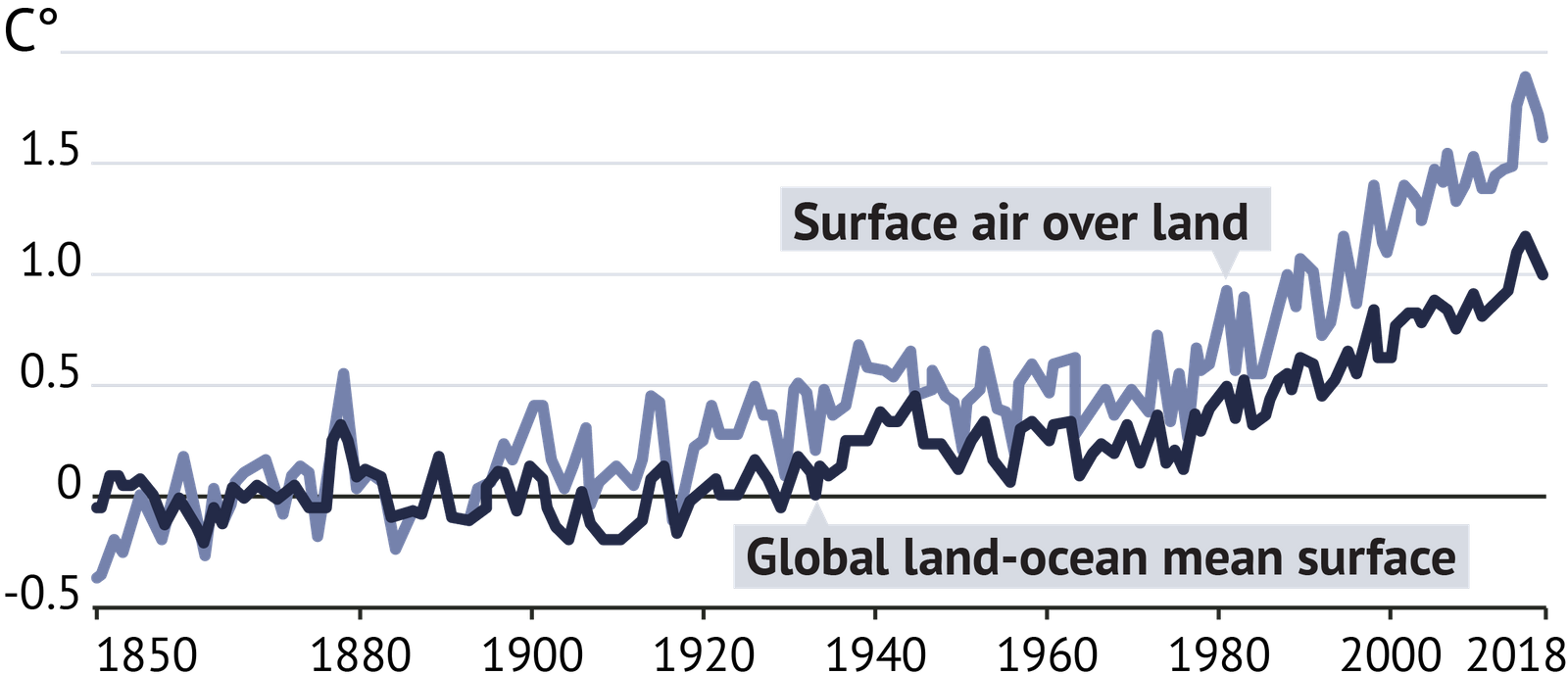
The report, compiled by 107 authors from 52 nations and released in Geneva on Thursday, noted humans typically relied on land for their homes and the great bulk of their food, fibre and feed for animals.
Mark Howden, director of the Climate Change Institute at the Australian National University and an IPCC vice-chair, said the report was "a warning flag" about the threats and "how hard we need to go" to cut greenhouse gas emissions.
Land's effect on climate
About a quarter of the earth's ice-free land was already subject to human-caused degradation, with soil losses as much as 100 times higher than soil formation, the report said.
Related Article
Commonwealth Bank warns climate change could slash farm productivity
https://www.theage.com.au/environment/climate-change/commonwealth-bank-warns-climate-change-could-slash-farm-productivity-20190807-p52evm.html
Australia, sub-Saharan Africa and parts of east and central Asia were singled out as regions where rising evapotranspiration (caused by hotter temperatures and reduced rainfall) were causing deserts to expand.
Climate change would "ramp up" existing degradation, such as through erosion caused by more intense rainfall events, Professor Howden said.
But land would also affect the climate because land-clearing, methane from livestock, fertiliser, and other emissions related to farming and forestry are major sources of greenhouse gases.
"Just under a third of our emissions come from our food systems, globally," he said.
On the flip side, reducing land clearing and increasing soil carbon sequestration would help reduce the damaging trends, as would consumers switching to more plant-based diets rather than meat-based ones, the report said.
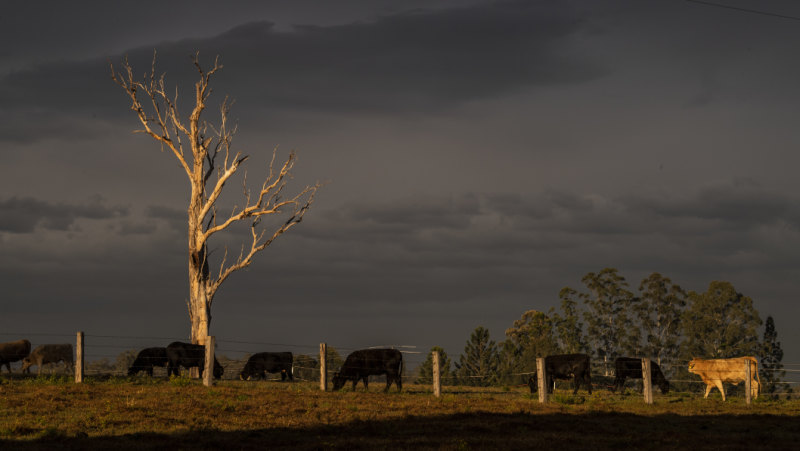
Temperatures are rising over land much faster than the global average with climate change. Australia is one
nation where arid regions are expanding, the IPCC says in a new report. Louise Kennerly
'Not safe at 2 degrees'
Andy Pitman, director of the ARC Centre of Excellence for Climate Extremes, said the thermal inertia of the oceans meant land warmed faster than the seas.
Where lands dry out, the cooling role of evaporation diminishes, so extreme temperatures are more intense.
Related Article
'Quite scary': Rising temperatures threaten Melbourne, Sydney's water security
https://www.theage.com.au/environment/climate-change/quite-scary-rising-temperatures-threaten-melbourne-sydney-s-water-security-20190801-p52cz7.html
"It's why the 2-degree ceiling agreed in Paris [at the climate summit in 2015] isn't safe," Professor Pitman said. "Two degrees in the global mean [translates to] very, very sizeable amounts of warming in heatwave conditions over land."
He cited farming regions such as Moree in northern NSW where last January's average temperatures "slaughtered" previous records, beating the norm by close to 4 degrees.
"We're seeing those extreme temperatures rapidly rising in part because in some regions we're seeing a drying," Professor Pitman said.
Australia has warmed about a degree in the past century, and the Bureau of Meteorology says day-time temperatures were both the hottest on record in the year to June .. http://www.bom.gov.au/climate/updates/articles/a034.shtml .. and for the first seven months of this year .. http://www.bom.gov.au/climate/current/month/aus/summary.shtml .
Average soil moisture for the 12 months to June 30 were also the lowest on record at just 8.5 per cent for the top metre. That beat the record low of 8.7 per cent 1914-15 and compared with an average of 12 per cent, the bureau said.
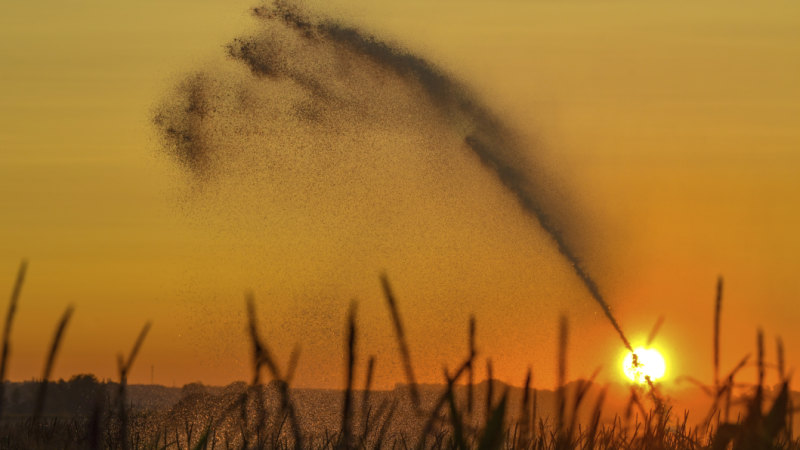
Rising temperatures and increase evaporation will affect crops and other food supplies, undermining food
security, the IPCC said. DPA
The IPCC report said warming, changing precipitation patterns and the greater frequency of some extreme events "has already affected food security".
"Changes in climate can amplify environmentally induced migration both within countries and across borders," the report said, adding increased displacement and threatened livelihoods may "contribute to exacerbated stresses for conflict", it said.
Alana Mann, a lead researcher at the Sydney Environment Institute, said the report should be "a big wake-up call", not least for the cities where people "assume supermarket shelves will always be full".
Related Article
When climate change interferes with ability 'to listen to the earth'
https://www.theage.com.au/environment/climate-change/when-climate-change-interferes-with-ability-to-listen-to-the-earth-20190730-p52c6g.html
Dr Mann said the report also highlighted how land management had to be brought back closer to what the environment could sustain.
"All of [excessive extraction] is about driving production of food at the expense of the environment," she said.
Bushfire risks rise
The report noted populations could increasingly be exposed to wildfire as temperatures over land increase.
"Across the globe, we're seeing both changes in the intensity and seasonality of fires ... that's happening in Australia as well," Professor Howden said. "The projections are for those issues associated for fires to increase."
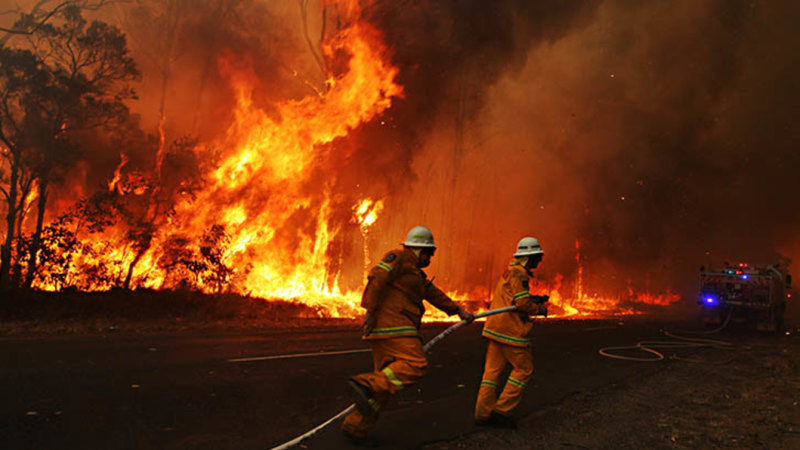
Extreme fire weather days are increasing in number over much of Australia, and the coming season is
expected to be another active one for fire crews.Credit:Nick Moir.
Richard Thornton, chief executive of the Bushfire and Natural Hazard CRC, said authorities in Australia were preparing for another above-average fire season for much of the country.
"The evidence is all piling up from a hazards perspective," Dr Thornton said. "The future doesn't look like the past."
NSW RFS
Verified account @NSWRFS
The NSW RFS Large Air Tanker (LAT) has made its first ever
drop on the Lindfield Park Road fire at Port Macquarie this
afternoon. The fire has flared in the strong winds however
does remain behind identified containment lines. #NSWRFS #nswfires
With video
Peter Hannam writes on environment issues for The Sydney Morning Herald and The Age.
https://www.theage.com.au/environment/climate-change/warning-flag-ipcc-finds-rapid-land-warming-threatens-food-security-20190808-p52f6m.html
"Trump withdrew from the Paris climate deal a year ago. Here’s what has changed."
UN report finds ecosystems never before under such threat and restoration is urgent
How climate’s impact on land threatens civilisation – and how to fix it
https://www.theguardian.com/environment/2019/aug/08/how-climates-impact-on-land-threatens-civilisation-and-how-to-fix-it
Damian Carrington Environment editor
@dpcarrington
Thu 8 Aug 2019 18.00 AEST
Last modified on Fri 9 Aug 2019 01.50 AEST

Deforestation in Brazil’s Para state. Stripping land wholesale, for uses such as cattle
farms and coffee plantations, can affect the climate which then affects the health of
the land. Photograph: Andre Penner/AP
The climate crisis is damaging the ability of the land to sustain humanity, with cascading risks becoming increasingly severe as global temperatures rise, according to a landmark UN report compiled by some of the world’s top scientists.
Global heating is increasing droughts, soil erosion and wildfires while diminishing crop yields in the tropics and thawing permafrost near the poles, says the report by the Intergovernmental Panel on Climate Change.
Further heating will lead to unprecedented climate conditions at lower latitudes, with potential growth in hunger, migration and conflict and increased damage to the great northern forests.
The report .. https://www.ipcc.ch/report/srccl/ , approved by the world’s governments, makes clear that humanity faces a stark choice between a vicious or virtuous circle. Continued destruction of forests and huge emissions from cattle and other intensive farming practices will intensify the climate crisis, making the impacts on land still worse.

Cattle ranch in drought-hit California, US. Intensive farming is a heavy user of water
and big cause of greenhouse gas emissions. Photograph: Lucy Nicholson/Reuters
However, action now to allow soils and forests to regenerate and store carbon, and to cut meat consumption by people and food waste, could play a big role in tackling the climate crisis, the report says.
Such moves would also improve human health, reduce poverty and tackle the huge losses of wildlife across the globe, the IPCC says.
Burning of fossil fuels should end as well to avoid “irreversible loss in land ecosystem services required for food, health and habitable settlements”, the report says.
“This is a perfect storm,” said Dave Reay, a professor at the University of Edinburgh who was an expert reviewer for the IPCC report. “Limited land, an expanding human population, and all wrapped in a suffocating blanket of climate emergency. Earth has never felt smaller, its natural ecosystems never under such direct threat.”
[Insert YouTube of embedded video]
7:53 It's time we stopped treating soil like dirt – video
Piers Forster, a professor at the University of Leeds, said: “This important report shows we need to substantially change the way we use our land to limit temperature change below 1.5C. In a nutshell we need less pasture [for livestock] and more trees.” The land-use advice was contained in an IPCC report in October .. https://www.theguardian.com/environment/2018/oct/08/global-warming-must-not-exceed-15c-warns-landmark-un-report .
Prof Jim Skea, from the IPPC, said the land was already struggling and climate change was adding to its burdens. Almost three-quarters of ice-free land was now directly affected by human activity, the report says.
Poor land use is also behind almost a quarter of the planet’s greenhouse gas emissions – the destruction of forests, huge cattle herds and overuse of chemical fertilisers being key factors.
IMAGE: Most of the world's land is used by humans
Emissions relating to fertilisers .. https://www.resilience.org/stories/2019-07-05/beware-of-the-n-bomb/ .. have risen ninefold since the early 1960s. Rising temperatures are causing deserts to spread, particularly in Asia and Africa, and the Americas and Mediterranean are at risk, the report says.
One of the most stark conclusions in the IPCC report is that soil, upon which humanity is entirely dependent, is being lost more than 100 times faster than it is being formed in ploughed areas; and lost 10 to 20 times faster even on fields that are not tilled.
The report recommends strong action from governments and business, including ending deforestation and enabling new forests to grow, reforming farming subsidies, supporting small farmers and breeding more resilient crops. Many of those solutions, however, would take decades to have an impact, the IPCC says.
Avoiding meat and dairy is ‘single biggest way’ to reduce your impact on Earth
Read more > https://www.theguardian.com/environment/2018/may/31/avoiding-meat-and-dairy-is-single-biggest-way-to-reduce-your-impact-on-earth

Saplings being planted in Inner Mongolia this year to control desertification as
temperatures rise. Photograph: Xinhua/Barcroft Images
[Insert: As Swine Fever Roils Asia, Hogs Are Culled and Dinner Plans Change
[...]
The current outbreak was first reported in mainland China in August. Since then, the virus has spread to pig herds in every mainland Chinese province, as well as to Vietnam, Cambodia and Mongolia.
https://investorshub.advfn.com/boards/read_msg.aspx?message_id=149530821]
Consumers in rich nations could act immediately by reducing their consumption of intensively produced meat and dairy foods – products that have a huge environmental impact .. https://www.theguardian.com/environment/2018/may/31/avoiding-meat-and-dairy-is-single-biggest-way-to-reduce-your-impact-on-earth .
“There is much more we could do in that space that we are not doing, partly because it is difficult,” said Pete Smith, a professor at the University of Aberdeen and a senior IPCC author. “You wouldn’t want to tell people what to eat, that would go down badly. But you could incentivise.”
The IPCC report suggests “factoring environmental costs into food”. Previous studies have suggested meat taxes .. https://www.theguardian.com/environment/2015/nov/24/meat-tax-far-less-unpalatable-than-government-thinks-research-finds , or subsidised fruit and vegetables. Meat production ties up most farmland and cutting consumption could release millions of square kilometres for forestry or bioenergy crops, the report says, as could cutting food waste.
Caterina Brandmayr, of the Green Alliance thinktank, said: “The key message from the IPCC is urgency: we need to act now to plant new forests, restore our ecosystems, and, yes, to eat less meat.”
David Viner, a professor at the University of East Anglia and a senior IPCC author, said: “Land is a vital resource and we have to look after it if we are going to have a sustainable future.”
https://www.theguardian.com/environment/2019/aug/08/climate-crisis-reducing-lands-ability-to-sustain-humanity-says-ipcc
--
'Warning flag': IPCC finds rapid land warming threatens food security
By Peter Hannam
August 8, 2019 — 6.00pm
Temperatures over the world's land areas are warming at about twice the global rate, expanding deserts in Australia, Africa and Asia, and hitting food security hard, a new UN report finds.
The Intergov ernmental Panel on Climate Change (IPCC) found that surface air temperatures between 2006 and 2015 were 1.53 degrees warmer than the pre-industrial average of 1850-1900. By contrast, the combined warming of land and oceans was 0.87 degrees, the IPCC's special report on land said.
Compared with current conditions, though, land areas have warmed by about 1.8 degrees, and global mean temperatures by 1.1 degrees, said Stefan Rahmstorf from the Potsdam Institute for Climate Impact Research.
Insert YouTube of embedded video
Understanding drought
"Climate change, including increases in frequency and intensity of extremes, has adversely impacted food security and terrestrial ecosystems, as well as contributed to desertification and land degradation in many regions," the report's Summary for Policymakers said.
The report, compiled by 107 authors from 52 nations and released in Geneva on Thursday, noted humans typically relied on land for their homes and the great bulk of their food, fibre and feed for animals.
Mark Howden, director of the Climate Change Institute at the Australian National University and an IPCC vice-chair, said the report was "a warning flag" about the threats and "how hard we need to go" to cut greenhouse gas emissions.
Land's effect on climate
About a quarter of the earth's ice-free land was already subject to human-caused degradation, with soil losses as much as 100 times higher than soil formation, the report said.
Related Article
Commonwealth Bank warns climate change could slash farm productivity
https://www.theage.com.au/environment/climate-change/commonwealth-bank-warns-climate-change-could-slash-farm-productivity-20190807-p52evm.html
Australia, sub-Saharan Africa and parts of east and central Asia were singled out as regions where rising evapotranspiration (caused by hotter temperatures and reduced rainfall) were causing deserts to expand.
Climate change would "ramp up" existing degradation, such as through erosion caused by more intense rainfall events, Professor Howden said.
But land would also affect the climate because land-clearing, methane from livestock, fertiliser, and other emissions related to farming and forestry are major sources of greenhouse gases.
"Just under a third of our emissions come from our food systems, globally," he said.
On the flip side, reducing land clearing and increasing soil carbon sequestration would help reduce the damaging trends, as would consumers switching to more plant-based diets rather than meat-based ones, the report said.
Temperatures are rising over land much faster than the global average with climate change. Australia is one
nation where arid regions are expanding, the IPCC says in a new report. Louise Kennerly
'Not safe at 2 degrees'
Andy Pitman, director of the ARC Centre of Excellence for Climate Extremes, said the thermal inertia of the oceans meant land warmed faster than the seas.
Where lands dry out, the cooling role of evaporation diminishes, so extreme temperatures are more intense.
Related Article
'Quite scary': Rising temperatures threaten Melbourne, Sydney's water security
https://www.theage.com.au/environment/climate-change/quite-scary-rising-temperatures-threaten-melbourne-sydney-s-water-security-20190801-p52cz7.html
"It's why the 2-degree ceiling agreed in Paris [at the climate summit in 2015] isn't safe," Professor Pitman said. "Two degrees in the global mean [translates to] very, very sizeable amounts of warming in heatwave conditions over land."
He cited farming regions such as Moree in northern NSW where last January's average temperatures "slaughtered" previous records, beating the norm by close to 4 degrees.
"We're seeing those extreme temperatures rapidly rising in part because in some regions we're seeing a drying," Professor Pitman said.
Australia has warmed about a degree in the past century, and the Bureau of Meteorology says day-time temperatures were both the hottest on record in the year to June .. http://www.bom.gov.au/climate/updates/articles/a034.shtml .. and for the first seven months of this year .. http://www.bom.gov.au/climate/current/month/aus/summary.shtml .
Average soil moisture for the 12 months to June 30 were also the lowest on record at just 8.5 per cent for the top metre. That beat the record low of 8.7 per cent 1914-15 and compared with an average of 12 per cent, the bureau said.
Rising temperatures and increase evaporation will affect crops and other food supplies, undermining food
security, the IPCC said. DPA
The IPCC report said warming, changing precipitation patterns and the greater frequency of some extreme events "has already affected food security".
"Changes in climate can amplify environmentally induced migration both within countries and across borders," the report said, adding increased displacement and threatened livelihoods may "contribute to exacerbated stresses for conflict", it said.
Alana Mann, a lead researcher at the Sydney Environment Institute, said the report should be "a big wake-up call", not least for the cities where people "assume supermarket shelves will always be full".
Related Article
When climate change interferes with ability 'to listen to the earth'
https://www.theage.com.au/environment/climate-change/when-climate-change-interferes-with-ability-to-listen-to-the-earth-20190730-p52c6g.html
Dr Mann said the report also highlighted how land management had to be brought back closer to what the environment could sustain.
"All of [excessive extraction] is about driving production of food at the expense of the environment," she said.
Bushfire risks rise
The report noted populations could increasingly be exposed to wildfire as temperatures over land increase.
"Across the globe, we're seeing both changes in the intensity and seasonality of fires ... that's happening in Australia as well," Professor Howden said. "The projections are for those issues associated for fires to increase."
Extreme fire weather days are increasing in number over much of Australia, and the coming season is
expected to be another active one for fire crews.Credit:Nick Moir.
Richard Thornton, chief executive of the Bushfire and Natural Hazard CRC, said authorities in Australia were preparing for another above-average fire season for much of the country.
"The evidence is all piling up from a hazards perspective," Dr Thornton said. "The future doesn't look like the past."
NSW RFS
Verified account @NSWRFS
The NSW RFS Large Air Tanker (LAT) has made its first ever
drop on the Lindfield Park Road fire at Port Macquarie this
afternoon. The fire has flared in the strong winds however
does remain behind identified containment lines. #NSWRFS #nswfires
With video
Peter Hannam writes on environment issues for The Sydney Morning Herald and The Age.
https://www.theage.com.au/environment/climate-change/warning-flag-ipcc-finds-rapid-land-warming-threatens-food-security-20190808-p52f6m.html
It was Plato who said, “He, O men, is the wisest, who like Socrates, knows that his wisdom is in truth worth nothing”
Discover What Traders Are Watching
Explore small cap ideas before they hit the headlines.



