










Saturday, June 15, 2019 1:52:11 AM
Gulf of Oman tanker 'attacks': What we know
"Iran urges Europe to normalize economic ties with it or face consequences"
6 hours ago
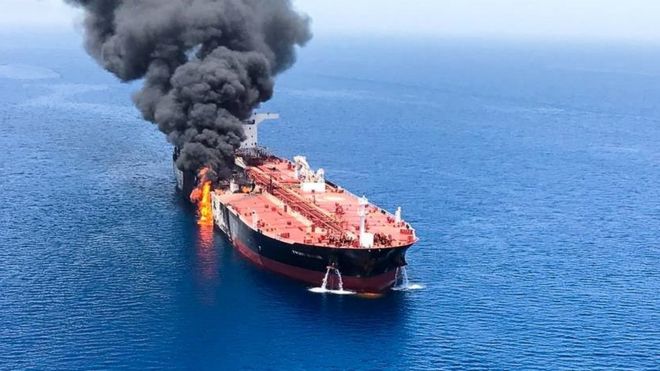
Norwegian-owned tanker Front Altair, carrying 75,000 tonnes of naphtha, was set ablaze
Two tankers have been damaged by explosions in the Gulf of Oman, a strategic waterway crucial to global energy supplies.
It is the second time in the past few weeks that tankers appear to have been attacked in the region and comes amid escalating tension between Iran and the United States.
US Secretary of State Mike Pompeo said Iran was behind what he described as the latest in a series of "unprovoked attacks". He said the US had made its assessment based on intelligence about the type of weapons used.
But a senior Iranian official told the BBC: "Iran has no connection with the incident."
To back up its version of events, the US military released a video which it says shows Iran's Revolutionary Guard removing an unexploded limpet mine from one of the ships .. https://www.bbc.co.uk/news/world-middle-east-48633016 – hours after the initial detonations.
More - https://www.bbc.com/news/world-middle-east-48627014
Conflicting reports, both can't be right.
Trump administration providing ‘false’ information about Gulf of Oman attack, says Japanese tanker owner
Chief executive of Japanese company operating Kokuka Courageous says 'flying objects' were cause of damage to vessel
The ship operator said “flying objects” that may have been bullets were the cause of damage to the vessel, rather than mines used by Iranian forces, as the US has suggested.
Yutaka Katada, chief executive of the Japanese company operating the ship called Kokuka Courageous, one of two vessels attacked near the Strait of Hormuz on Thursday, said the damage could not have been caused by mines or torpedos that are shot underwater, since the damage was reportedly above the ship’s waterline.
“It seems that something flew towards them. That created the hole, is the report I’ve received,” Mr Katada said at a press conference in Tokyo on Friday, the Financial Times reported. Mr Katada also described reports of a mine attack as "false" according to several outlets in attendance at the press conference.
https://investorshub.advfn.com/boards/read_msg.aspx?message_id=149401686
So
UN chief calls for independent investigation into tanker attacks in Gulf of Oman
Amid conflicting reports, Antonio Guterres says only independent probe can determine cause of incident

Two oil tankers were struck in Gulf of Oman on Thursday (AFP)
By MEE and agencies
Published date: 14 June 2019 16:20 UTC | Last update: 5 hours 49 min ago
The head of the United Nations called for an investigation into this week's attacks on two oil tankers in the Gulf of Oman, hours after crew members' eyewitness accounts appeared to contradict .. https://www.middleeasteye.net/news/japanese-company-claims-flying-objects-damaged-its-oil-tanker-gulf-oman .. the US's version of events.
UN Secretary-General Antonio Guterres told reporters on Friday that the international body condemned the incident and he called for an independent probe into what happened.
"It's very important to know the truth and it's very important that responsibilities are clarified. Obviously that can only be done if there is an independent entity that verifies those facts," he said, as quoted by Reuters.
A timeline of US-Iran tensions
----------
Tensions have skyrocketed between the Washington and Tehran since US President Donald Trump announced last May that he was pulling out of the 2015 Iranian nuclear deal.
Here's a timeline of key events that have led to, and marked, the recent escalation:
8 May 2018: US President Donald Trump announces plans to pull out of a 2015 nuclear deal with Iran. Under that agreement, the Iranian government agreed to curb its nuclear programme in exchange for a lifting of international sanctions.
Trump also says Washington will reimpose "the highest levels of economic sanctions" on Tehran.
5 November 2018: The US reimposes sanctions on Iran's oil, banking and transport sectors. At the same time, Trump says he wants to gradually impose sanctions on the Iranian oil industry, citing concerns about upsetting energy markets and causing global price spikes.
8 April: The Trump administration blacklists Iran's elite military force, the Islamic Revolutionary Guard Corps (IRGC). The move marks the first time Washington has formally labelled another country's military a terrorist group.
30 April: Iranian President Hassan Rouhani signs a bill into law that declares all US troops in the Middle East as terrorists, and defines the US as a state-sponsor of terrorism.
2 May: The US stops issuing waivers to countries that import oil from Iran. Those waivers had allowed certain states, including Turkey, China, Japan, India and South Korea, to keep buying Iranian oil, despite American sanctions - and provided a lifeline for Tehran.
6 May: US National Security Adviser John Bolton announces that the Trump administration is deploying an aircraft carrier, as well as ships and bombers, to the Gulf. The move was meant to send a "clear and unmistakable message" to the Iranian government, Bolton said, amid intelligence reports that Tehran was planning attacks against American troops in the region.
7 May: Iran says it plans to withdraw from parts of the 2015 nuclear agreement with major world powers. The move comes one year after US President Donald Trump withdrew from the deal.
8 May: The Trump administration announces a new round of economic sanctions that will target Iran's metals trade - iron, steel, aluminium and copper, specifically.
9 May: As the drums of war began to beat louder in certain circles in Washington, Trump tells reporters that he "would like to see them [Iran] call me" - a sign the US president is perhaps seeking to de-escalate the situation.
12 May: The United Arab Emirates says four oil tankers were damaged in "acts of sabotage" off the coast of Fujairah, just outside the Strait of Hormuz. The UAE did not assign blame for the incident, but said it would launch an investigation into what happened.
13 May: Mike Pompeo makes a surprise visit to Brussels, where he seeks to get European leaders on board with Washington's "maximum pressure" strategy against Tehran. The US secretary of state gets a lukewarm reception, however, with the European Union's foreign policy chief instead urging the US to show "maximum restraint".
14 May: Iran's Supreme Leader Ali Khamenei says the country will not go to war with the US. "Neither we nor they - who know war will not be in their interest - are after war," Khamenei says.
15 May: Anwar Gargash, the UAE's minister of state for foreign affairs, says the country is committed to "de-escalation" with Iran, while refusing to assign blame for the 12 May "sabotage" of the oil tankers.
That same day, the US orders non-emergency government employees to leave Iraq, citing fears of an imminent attack by Iranian-backed proxies in that country.
19 May: A Katyusha rocket is fired into Baghdad's Green Zone, an area that houses government offices and foreign diplomatic missions, including the US embassy in Iraq.
21 May: A previously unknown Iraqi group claims responsibility for the rocket fired into the Green Zone. The Operations of Martyr Ali Mansour says the attack is retaliation for Trump's decision to pardon a soldier who killed an Iraqi detainee in 2009.
In Washington that same day, US lawmakers are briefed by members of the Trump administration about its claims that Iran poses a threat to the country. Several members of Congress tell reporters they left the meetings unconvinced.
24 May: Washington announces plans to deploy 1,500 additional troops to the Middle East to counter Iranian threats, a decision Iran blasted as "extremely dangerous".
28 May: US National Security Adviser John Bolton says the attack on four vessels off the Emirati coast was caused by "naval mines almost certainly from Iran".
30 May-1 June: Saudi Arabia hosts a summit in Mecca to discuss recent tensions with Iran. On the eve of the talks, Riyadh blasts what it called Iranian "interference" in the region and demanded "firmness" over attacks in the Gulf.
7 June: The US imposes sanctions on Iran's largest petrochemicals holding group, accusing Persian Gulf Petrochemical Industries Company of providing financial support to an engineering firm with ties to the IRGC.
13 June: Two oil tankers suffer damage after an unspecified attack in the Gulf of Oman. Hours after the incident, US Secretary of State Mike Pompeo points the finger at Iran, without providing evidence to back up his claim.
Iran immediately denies it was involved in the attacks, accusing Washington of seeking to derail diplomatic efforts to de-escalate the situation.
14 June: The head of the United Nations calls for an independent investigation into the incidents in the Gulf of Oman.
Earlier in the day, US Central Command releases a video that it says shows Iranian IRGC members removing an unexploded mine from one of the damaged ships. That comes after Trump himself says the incident has Iran "written all over it".
Meanwhile, the owner of the Japanese vessel says crew members reported seeing objects flying towards them - which would appear to refute the US's version of events. "The crew told us something came flying at the ship and they found a hole," the owner says. "Then some crew witnessed the second shot."
----------
Guterres added that only the Security Council could order a UN investigation, the news agency said.
The US has blamed Iran for the attack on the tankers, which were sailing in the Gulf of Oman after leaving ports in Saudi Arabia and the United Arab Emirates, respectively, when they were struck.
The Japanese-owned Kokuka Courageous and the Norwegian Front Altair vessels sustained minor damage.
A few hours after the incident, US Secretary of State Mike Pompeo said all the evidence pointed to Tehran. Pompeo did not reveal specific details, however, to back up that assessment.
Gulf of Oman attacks: Only those who want escalation will benefit
Read More > https://www.middleeasteye.net/opinion/gulf-oman-attacks-attempt-snuff-out-us-iran-mediation-efforts
US President Donald Trump also said the incident had Iran "written all over it".
That was echoed by British Foreign Secretary Jeremy Hunt, who on Friday blamed Iran and its elite military unit, the Islamic Revolutionary Guard Corps (IRGC), for the attacks.
"These latest attacks build on a pattern of destabilising Iranian behaviour and pose a serious danger to the region," Hunt said in a statement.
Earlier in the day, US Central Command (CENTCOM) released a video it said showed IRGC members removing an unexploded mine from the Japanese ship.
But that account appeared to be disputed by eyewitness reports shared by the company that owns the Kokuka Courageous.
Yutaka Katada, president of Kokuka Santiago, said the vessel's crew members reported seeing objects flying towards them.
"The crew told us something came flying at the ship and they found a hole," Katada said. "Then some crew witnessed the second shot."
Iran has denied the allegations it was involved in the attacks.
Instead, Iranian leaders accused the US of seeking to sabotage diplomatic efforts to ease recent tensions between the two countries.
Iranian Foreign Minister Mohammad Javid Zarif said Washington had "immediately jumped to make allegations against Iran without a shred of factual or circumstantial evidence".
Calls for calm
It's not the first time the US has blamed Iran for an attack without providing much evidence to back up its claims.
Over the last month, as tensions surged between Washington and Tehran, senior Trump administration officials accused Tehran of myriad things - all of which Iranian leaders have rejected.
Those accusations include that Iran is planning to attack US forces and interests in the Middle East, that the country sabotaged ships off the coast of the UAE in May, and that Iran or one of its proxies fired a rocket at the US embassy in Baghdad.
A widening gulf: US provides scant evidence to back up Iran threat claims
Read More > https://www.middleeasteye.net/news/US-scant-evidence-Iran-threat-claims-analysis
Iran has denied all those accusations.
Meanwhile, also on Friday, the secretary general of the Arab League appeared to blame Iran for the tanker attacks.
Ahmed Aboul Gheit said he didn't believe any Arab country was "trying to obstruct naval lanes or to shoot itself in the foot by acting the way we have seen in the Gulf of Oman or in the Hormuz Strait", Reuters reported.
"My call to our Iranian brothers - be careful and reverse course because you're pushing everybody towards a confrontation that no one would be safe if it happens," he told reporters.
Several countries have urged both the US and Iran to exercise caution and seek to de-escalate the recent tensions.
Iraqi Prime Minister Adel Abdul Malki spoke on the phone with Pompeo on Friday, his office said in a statement, and called for "calm".
The two leaders "exchanged views on developments in the region amid the current crisis between the United States and the Islamic Republic of Iran ... as well as efforts to maintain security and stability and avoid an escalation", the statement said.
https://www.middleeasteye.net/news/un-chief-calls-independent-probe-tanker-attacks-gulf-oman
"Iran urges Europe to normalize economic ties with it or face consequences"
6 hours ago
Norwegian-owned tanker Front Altair, carrying 75,000 tonnes of naphtha, was set ablaze
Two tankers have been damaged by explosions in the Gulf of Oman, a strategic waterway crucial to global energy supplies.
It is the second time in the past few weeks that tankers appear to have been attacked in the region and comes amid escalating tension between Iran and the United States.
US Secretary of State Mike Pompeo said Iran was behind what he described as the latest in a series of "unprovoked attacks". He said the US had made its assessment based on intelligence about the type of weapons used.
But a senior Iranian official told the BBC: "Iran has no connection with the incident."
To back up its version of events, the US military released a video which it says shows Iran's Revolutionary Guard removing an unexploded limpet mine from one of the ships .. https://www.bbc.co.uk/news/world-middle-east-48633016 – hours after the initial detonations.
More - https://www.bbc.com/news/world-middle-east-48627014
Conflicting reports, both can't be right.
Trump administration providing ‘false’ information about Gulf of Oman attack, says Japanese tanker owner
Chief executive of Japanese company operating Kokuka Courageous says 'flying objects' were cause of damage to vessel
The ship operator said “flying objects” that may have been bullets were the cause of damage to the vessel, rather than mines used by Iranian forces, as the US has suggested.
Yutaka Katada, chief executive of the Japanese company operating the ship called Kokuka Courageous, one of two vessels attacked near the Strait of Hormuz on Thursday, said the damage could not have been caused by mines or torpedos that are shot underwater, since the damage was reportedly above the ship’s waterline.
“It seems that something flew towards them. That created the hole, is the report I’ve received,” Mr Katada said at a press conference in Tokyo on Friday, the Financial Times reported. Mr Katada also described reports of a mine attack as "false" according to several outlets in attendance at the press conference.
https://investorshub.advfn.com/boards/read_msg.aspx?message_id=149401686
So
UN chief calls for independent investigation into tanker attacks in Gulf of Oman
Amid conflicting reports, Antonio Guterres says only independent probe can determine cause of incident

Two oil tankers were struck in Gulf of Oman on Thursday (AFP)
By MEE and agencies
Published date: 14 June 2019 16:20 UTC | Last update: 5 hours 49 min ago
The head of the United Nations called for an investigation into this week's attacks on two oil tankers in the Gulf of Oman, hours after crew members' eyewitness accounts appeared to contradict .. https://www.middleeasteye.net/news/japanese-company-claims-flying-objects-damaged-its-oil-tanker-gulf-oman .. the US's version of events.
UN Secretary-General Antonio Guterres told reporters on Friday that the international body condemned the incident and he called for an independent probe into what happened.
"It's very important to know the truth and it's very important that responsibilities are clarified. Obviously that can only be done if there is an independent entity that verifies those facts," he said, as quoted by Reuters.
A timeline of US-Iran tensions
----------
Tensions have skyrocketed between the Washington and Tehran since US President Donald Trump announced last May that he was pulling out of the 2015 Iranian nuclear deal.
Here's a timeline of key events that have led to, and marked, the recent escalation:
8 May 2018: US President Donald Trump announces plans to pull out of a 2015 nuclear deal with Iran. Under that agreement, the Iranian government agreed to curb its nuclear programme in exchange for a lifting of international sanctions.
Trump also says Washington will reimpose "the highest levels of economic sanctions" on Tehran.
5 November 2018: The US reimposes sanctions on Iran's oil, banking and transport sectors. At the same time, Trump says he wants to gradually impose sanctions on the Iranian oil industry, citing concerns about upsetting energy markets and causing global price spikes.
8 April: The Trump administration blacklists Iran's elite military force, the Islamic Revolutionary Guard Corps (IRGC). The move marks the first time Washington has formally labelled another country's military a terrorist group.
30 April: Iranian President Hassan Rouhani signs a bill into law that declares all US troops in the Middle East as terrorists, and defines the US as a state-sponsor of terrorism.
2 May: The US stops issuing waivers to countries that import oil from Iran. Those waivers had allowed certain states, including Turkey, China, Japan, India and South Korea, to keep buying Iranian oil, despite American sanctions - and provided a lifeline for Tehran.
6 May: US National Security Adviser John Bolton announces that the Trump administration is deploying an aircraft carrier, as well as ships and bombers, to the Gulf. The move was meant to send a "clear and unmistakable message" to the Iranian government, Bolton said, amid intelligence reports that Tehran was planning attacks against American troops in the region.
7 May: Iran says it plans to withdraw from parts of the 2015 nuclear agreement with major world powers. The move comes one year after US President Donald Trump withdrew from the deal.
8 May: The Trump administration announces a new round of economic sanctions that will target Iran's metals trade - iron, steel, aluminium and copper, specifically.
9 May: As the drums of war began to beat louder in certain circles in Washington, Trump tells reporters that he "would like to see them [Iran] call me" - a sign the US president is perhaps seeking to de-escalate the situation.
12 May: The United Arab Emirates says four oil tankers were damaged in "acts of sabotage" off the coast of Fujairah, just outside the Strait of Hormuz. The UAE did not assign blame for the incident, but said it would launch an investigation into what happened.
13 May: Mike Pompeo makes a surprise visit to Brussels, where he seeks to get European leaders on board with Washington's "maximum pressure" strategy against Tehran. The US secretary of state gets a lukewarm reception, however, with the European Union's foreign policy chief instead urging the US to show "maximum restraint".
14 May: Iran's Supreme Leader Ali Khamenei says the country will not go to war with the US. "Neither we nor they - who know war will not be in their interest - are after war," Khamenei says.
15 May: Anwar Gargash, the UAE's minister of state for foreign affairs, says the country is committed to "de-escalation" with Iran, while refusing to assign blame for the 12 May "sabotage" of the oil tankers.
That same day, the US orders non-emergency government employees to leave Iraq, citing fears of an imminent attack by Iranian-backed proxies in that country.
19 May: A Katyusha rocket is fired into Baghdad's Green Zone, an area that houses government offices and foreign diplomatic missions, including the US embassy in Iraq.
21 May: A previously unknown Iraqi group claims responsibility for the rocket fired into the Green Zone. The Operations of Martyr Ali Mansour says the attack is retaliation for Trump's decision to pardon a soldier who killed an Iraqi detainee in 2009.
In Washington that same day, US lawmakers are briefed by members of the Trump administration about its claims that Iran poses a threat to the country. Several members of Congress tell reporters they left the meetings unconvinced.
24 May: Washington announces plans to deploy 1,500 additional troops to the Middle East to counter Iranian threats, a decision Iran blasted as "extremely dangerous".
28 May: US National Security Adviser John Bolton says the attack on four vessels off the Emirati coast was caused by "naval mines almost certainly from Iran".
30 May-1 June: Saudi Arabia hosts a summit in Mecca to discuss recent tensions with Iran. On the eve of the talks, Riyadh blasts what it called Iranian "interference" in the region and demanded "firmness" over attacks in the Gulf.
7 June: The US imposes sanctions on Iran's largest petrochemicals holding group, accusing Persian Gulf Petrochemical Industries Company of providing financial support to an engineering firm with ties to the IRGC.
13 June: Two oil tankers suffer damage after an unspecified attack in the Gulf of Oman. Hours after the incident, US Secretary of State Mike Pompeo points the finger at Iran, without providing evidence to back up his claim.
Iran immediately denies it was involved in the attacks, accusing Washington of seeking to derail diplomatic efforts to de-escalate the situation.
14 June: The head of the United Nations calls for an independent investigation into the incidents in the Gulf of Oman.
Earlier in the day, US Central Command releases a video that it says shows Iranian IRGC members removing an unexploded mine from one of the damaged ships. That comes after Trump himself says the incident has Iran "written all over it".
Meanwhile, the owner of the Japanese vessel says crew members reported seeing objects flying towards them - which would appear to refute the US's version of events. "The crew told us something came flying at the ship and they found a hole," the owner says. "Then some crew witnessed the second shot."
----------
Guterres added that only the Security Council could order a UN investigation, the news agency said.
The US has blamed Iran for the attack on the tankers, which were sailing in the Gulf of Oman after leaving ports in Saudi Arabia and the United Arab Emirates, respectively, when they were struck.
The Japanese-owned Kokuka Courageous and the Norwegian Front Altair vessels sustained minor damage.
A few hours after the incident, US Secretary of State Mike Pompeo said all the evidence pointed to Tehran. Pompeo did not reveal specific details, however, to back up that assessment.
Gulf of Oman attacks: Only those who want escalation will benefit
Read More > https://www.middleeasteye.net/opinion/gulf-oman-attacks-attempt-snuff-out-us-iran-mediation-efforts
US President Donald Trump also said the incident had Iran "written all over it".
That was echoed by British Foreign Secretary Jeremy Hunt, who on Friday blamed Iran and its elite military unit, the Islamic Revolutionary Guard Corps (IRGC), for the attacks.
"These latest attacks build on a pattern of destabilising Iranian behaviour and pose a serious danger to the region," Hunt said in a statement.
Earlier in the day, US Central Command (CENTCOM) released a video it said showed IRGC members removing an unexploded mine from the Japanese ship.
But that account appeared to be disputed by eyewitness reports shared by the company that owns the Kokuka Courageous.
Yutaka Katada, president of Kokuka Santiago, said the vessel's crew members reported seeing objects flying towards them.
"The crew told us something came flying at the ship and they found a hole," Katada said. "Then some crew witnessed the second shot."
Iran has denied the allegations it was involved in the attacks.
Instead, Iranian leaders accused the US of seeking to sabotage diplomatic efforts to ease recent tensions between the two countries.
Iranian Foreign Minister Mohammad Javid Zarif said Washington had "immediately jumped to make allegations against Iran without a shred of factual or circumstantial evidence".
Calls for calm
It's not the first time the US has blamed Iran for an attack without providing much evidence to back up its claims.
Over the last month, as tensions surged between Washington and Tehran, senior Trump administration officials accused Tehran of myriad things - all of which Iranian leaders have rejected.
Those accusations include that Iran is planning to attack US forces and interests in the Middle East, that the country sabotaged ships off the coast of the UAE in May, and that Iran or one of its proxies fired a rocket at the US embassy in Baghdad.
A widening gulf: US provides scant evidence to back up Iran threat claims
Read More > https://www.middleeasteye.net/news/US-scant-evidence-Iran-threat-claims-analysis
Iran has denied all those accusations.
Meanwhile, also on Friday, the secretary general of the Arab League appeared to blame Iran for the tanker attacks.
Ahmed Aboul Gheit said he didn't believe any Arab country was "trying to obstruct naval lanes or to shoot itself in the foot by acting the way we have seen in the Gulf of Oman or in the Hormuz Strait", Reuters reported.
"My call to our Iranian brothers - be careful and reverse course because you're pushing everybody towards a confrontation that no one would be safe if it happens," he told reporters.
Several countries have urged both the US and Iran to exercise caution and seek to de-escalate the recent tensions.
Iraqi Prime Minister Adel Abdul Malki spoke on the phone with Pompeo on Friday, his office said in a statement, and called for "calm".
The two leaders "exchanged views on developments in the region amid the current crisis between the United States and the Islamic Republic of Iran ... as well as efforts to maintain security and stability and avoid an escalation", the statement said.
https://www.middleeasteye.net/news/un-chief-calls-independent-probe-tanker-attacks-gulf-oman
It was Plato who said, “He, O men, is the wisest, who like Socrates, knows that his wisdom is in truth worth nothing”
Discover What Traders Are Watching
Explore small cap ideas before they hit the headlines.



