



 AI
AI








Wednesday, April 10, 2019 4:24:14 AM
Nearly 200 million people on our doorstep are about to vote for a new leader. Here's why it matters to Australia.
"Indonesians disappointed by highly anticipated first presidential debate ahead of April election"
Millions of Indonesians are set to vote for both a new leader and a new legislature. Here's how the world's biggest democratic election in a single day works – and why it matters to Australia.
James Massola
By James Massola
April 10, 2019 — 3.59pm
Indonesians are in the midst of a fierce electoral contest with potentially enormous consequences.President Joko Widodo is a former furniture salesman and local mayor who grew up in a poor family in central Java. He is facing off against Prabowo Subianto, a millionaire businessman, former military general and son-in-law of dictator Suharto. Prabowo's military service was controversial in East Timor, West Papua and during the anti-Suharto riots in Jakarta in 1998.
They are involved in a re-match of Indonesia's most recent national poll in 2014.
[...]
Why should Australians care?
Lots of reasons. Indonesia is one of our nearest neighbours. It is a key ally in the war on extremism, Islamic terrorism, drug smuggling and people smuggling. It is arguably the leading nation in the ASEAN grouping. Though imperfect, it's a thriving democracy in a region in which human rights and liberal values are in retreat. As Indonesia develops economically – and this is especially so after the signing of a free trade deal with Australia this year – the economic opportunities presented by a market of 260 million people on our doorstep are staggering.
[...]
What do the presidential candidates stand for?
Joko "Jokowi" Widodo, 57,a former governor of Jakarta, is the incumbent and candidate for the PDI-P (the Indonesian Democratic Party of Struggle) and a coalition of other parties while his opponent, strongman Prabowo Subianto, 67, leads a coalition of parties including his own Gerindra (Greater Indonesia).
Indonesian people cast their ballot for the Indonesia Presidential elections at a polling station on July 9, 2014.
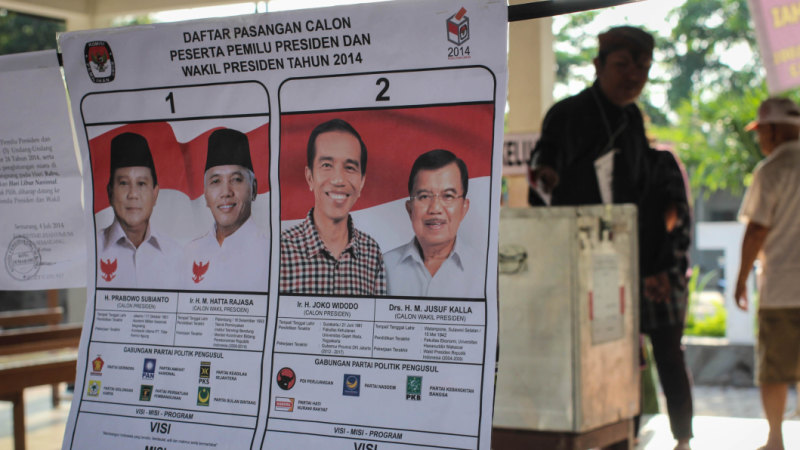
Indonesian people cast their ballot for the Indonesia Presidential elections at a polling station on July 9,
2014. Alamy
Both make much of their committment to Pancasila, Indonesia's state ideology, which can be summed up as belief in one God, humanity, the unity of Indonesia, democracy and social justice.
Jokowi, as he is widely known, has promised to keep up his huge infrastructure building program, which has seen thousands of kilometres of new highways opened as well as rail, an underground metro rail line in Jakarta, new airports and seaports. He also wants to improve the country's education system, which is chronically under-funded and over-crowded.
Prabowo has promised to crack down on corruption, ensure that more of the money earned from Indonesia's natural resources stays in the country, reduce electricity prices, tackle stunting of children caused by malnourishment, creating more jobs – and to make Indonesia great again (yes, really).
Both men are appealing to conservative Muslim voters for support, though Prabowo more so than Jokowi.
[...]
Where do they stand on China?
Both men are, broadly speaking, friendly with China if not also a little wary of the giant northern neighbour and trading partner. Although it has been slow to get on board, Joko's administration recently offered China the chance to invest in 28 projects worth $US127.5 billion as part of its region-wide Belt and Road Initiative. Up until now, Indonesia has held back from this huge initiative in a way that nearby neighbours such as Malaysia, for example, has not. Prabowo, for his part, has sugested he could review some BRI projects if elected and has also played the nationalism card in terms of local jobs, asking why Chinese workers have been brought in when Indonesians could do the job.
Where do they stand on relations with Australia?
Tthe Coalition's decision to dump Malcolm Turnbull and switch to Scott Morrison annoyed Jokowi and directly damaged Australian-Indonesia relations. The relationship between the nations seems to be a permanent roller-coaster ride: think of the execution of two members of the Bali Nine, the interception of asylum-seeker boats, Australia attempting to listen in on former president Susilo Bambang Yudhoyono's phone, and the suspension of the live cattle trade.
The warmth between Jokowi and Turnbull was genuine and it helped ground the relationship; Turnbull's ousting, poorly explained, was a genuine setback. Morrison's subsequent decision to consider moving Australia's Israeli embassy effectively poured petrol on an already inflamed situation. The rights of the Palestinian people to have their own homeland unites Indonesians like few other issues, and the Morrison announcement of a possible embassy move infuriated people of all political persuasions in Indonesia as it was seen as direct blow to Palestinian aspirations.
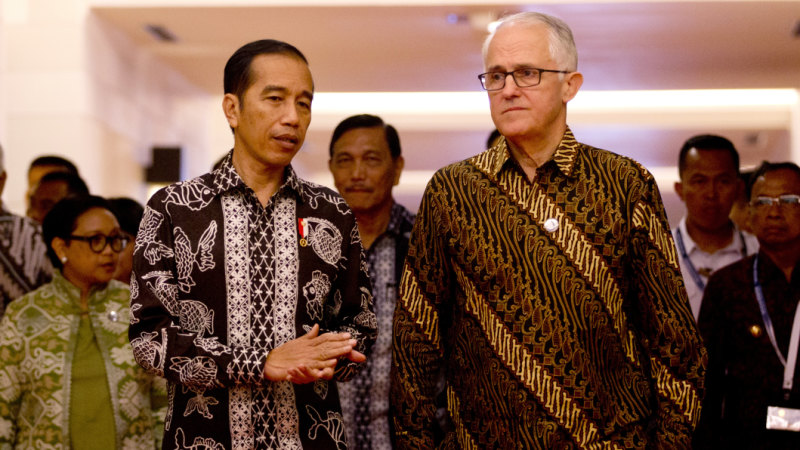
Jokowi and then prime minister Malcolm Turnbull in 2018. Credit:AP
On the positive side, after umpteen delays, the free trade deal between Australia and Indonesia was finally signed this year, though not before Morrison backed away from his embassy plan. Prabowo, for all his nationalist stylings, handled the embassy issue in an orthodox fashion – essentially, he said the location of Australia's embassy was a matter for Australia.
https://www.theage.com.au/world/asia/nearly-200-million-people-on-our-doorstep-are-about-to-vote-for-a-new-leader-here-s-why-it-matters-to-australia-20190409-p51cbg.html
"Indonesians disappointed by highly anticipated first presidential debate ahead of April election"
Millions of Indonesians are set to vote for both a new leader and a new legislature. Here's how the world's biggest democratic election in a single day works – and why it matters to Australia.
James Massola
By James Massola
April 10, 2019 — 3.59pm
Indonesians are in the midst of a fierce electoral contest with potentially enormous consequences.President Joko Widodo is a former furniture salesman and local mayor who grew up in a poor family in central Java. He is facing off against Prabowo Subianto, a millionaire businessman, former military general and son-in-law of dictator Suharto. Prabowo's military service was controversial in East Timor, West Papua and during the anti-Suharto riots in Jakarta in 1998.
They are involved in a re-match of Indonesia's most recent national poll in 2014.
[...]
Why should Australians care?
Lots of reasons. Indonesia is one of our nearest neighbours. It is a key ally in the war on extremism, Islamic terrorism, drug smuggling and people smuggling. It is arguably the leading nation in the ASEAN grouping. Though imperfect, it's a thriving democracy in a region in which human rights and liberal values are in retreat. As Indonesia develops economically – and this is especially so after the signing of a free trade deal with Australia this year – the economic opportunities presented by a market of 260 million people on our doorstep are staggering.
[...]
What do the presidential candidates stand for?
Joko "Jokowi" Widodo, 57,a former governor of Jakarta, is the incumbent and candidate for the PDI-P (the Indonesian Democratic Party of Struggle) and a coalition of other parties while his opponent, strongman Prabowo Subianto, 67, leads a coalition of parties including his own Gerindra (Greater Indonesia).
Indonesian people cast their ballot for the Indonesia Presidential elections at a polling station on July 9, 2014.
Indonesian people cast their ballot for the Indonesia Presidential elections at a polling station on July 9,
2014. Alamy
Both make much of their committment to Pancasila, Indonesia's state ideology, which can be summed up as belief in one God, humanity, the unity of Indonesia, democracy and social justice.
Jokowi, as he is widely known, has promised to keep up his huge infrastructure building program, which has seen thousands of kilometres of new highways opened as well as rail, an underground metro rail line in Jakarta, new airports and seaports. He also wants to improve the country's education system, which is chronically under-funded and over-crowded.
Prabowo has promised to crack down on corruption, ensure that more of the money earned from Indonesia's natural resources stays in the country, reduce electricity prices, tackle stunting of children caused by malnourishment, creating more jobs – and to make Indonesia great again (yes, really).
Both men are appealing to conservative Muslim voters for support, though Prabowo more so than Jokowi.
[...]
Where do they stand on China?
Both men are, broadly speaking, friendly with China if not also a little wary of the giant northern neighbour and trading partner. Although it has been slow to get on board, Joko's administration recently offered China the chance to invest in 28 projects worth $US127.5 billion as part of its region-wide Belt and Road Initiative. Up until now, Indonesia has held back from this huge initiative in a way that nearby neighbours such as Malaysia, for example, has not. Prabowo, for his part, has sugested he could review some BRI projects if elected and has also played the nationalism card in terms of local jobs, asking why Chinese workers have been brought in when Indonesians could do the job.
Where do they stand on relations with Australia?
Tthe Coalition's decision to dump Malcolm Turnbull and switch to Scott Morrison annoyed Jokowi and directly damaged Australian-Indonesia relations. The relationship between the nations seems to be a permanent roller-coaster ride: think of the execution of two members of the Bali Nine, the interception of asylum-seeker boats, Australia attempting to listen in on former president Susilo Bambang Yudhoyono's phone, and the suspension of the live cattle trade.
The warmth between Jokowi and Turnbull was genuine and it helped ground the relationship; Turnbull's ousting, poorly explained, was a genuine setback. Morrison's subsequent decision to consider moving Australia's Israeli embassy effectively poured petrol on an already inflamed situation. The rights of the Palestinian people to have their own homeland unites Indonesians like few other issues, and the Morrison announcement of a possible embassy move infuriated people of all political persuasions in Indonesia as it was seen as direct blow to Palestinian aspirations.
Jokowi and then prime minister Malcolm Turnbull in 2018. Credit:AP
On the positive side, after umpteen delays, the free trade deal between Australia and Indonesia was finally signed this year, though not before Morrison backed away from his embassy plan. Prabowo, for all his nationalist stylings, handled the embassy issue in an orthodox fashion – essentially, he said the location of Australia's embassy was a matter for Australia.
https://www.theage.com.au/world/asia/nearly-200-million-people-on-our-doorstep-are-about-to-vote-for-a-new-leader-here-s-why-it-matters-to-australia-20190409-p51cbg.html
It was Plato who said, “He, O men, is the wisest, who like Socrates, knows that his wisdom is in truth worth nothing”
Discover What Traders Are Watching
Explore small cap ideas before they hit the headlines.



