AP FACT CHECK: Blue high-tax states fund red low-tax states
But you are fine with supply side voodoo economics, tax cuts that do not pay for themselves and with an anti-science Party that doesn't see the economic opportunity in a green initiative that most of the world sees?
Choosing beliefs over facts, evidence and science IS 'operating from emotion'.
There is no Dem plan that proposes to pay for anything with just a higher tax on the 1%. Like ALL progressive tax proposals it taxes higher brackets at higher rates. it was 90% during the Eisenhower years.
It is the progressive tax system that draws more tax revenue from high GDP Blue States and REDISTIBUTES it to lower GDP Red States, with few exceptions.
That is also where most of Defense spending comes from as well.
Ditto for Infrastructure, every now and then, The CDC, NASA, Ag subsidies, oil and gas subsidies and on and on and on.
AP FACT CHECK: Blue high-tax states fund red low-tax states
By STEPHEN OHLEMACHER Published December 09, 2017 MarketsAssociated Press
Republican leaders have spent months promoting the myth that red low-tax states are subsidizing blue high-tax states because of the deduction for state and local taxes.
An Associated Press Fact Check finds it's actually the other way around. High-tax, traditionally Democratic states (blue), subsidize low-tax, traditionally Republican states (red) — in a big way.
Republicans are trying to eliminate the deduction as part of the sweeping tax package working its way through Congress. They added back a deduction for up to $10,000 in property taxes, in a concession to Republicans from high-tax states such as New York and New Jersey. California Republicans are pushing to extend the deduction to local income taxes, too.
It is true that taxpayers in high-tax states benefit the most from the deduction. However, these states send far more tax dollars to Washington than residents in low-tax states.
In fact, most high-tax states send more money to Washington than they get back in federal spending. Most low-tax states make a profit from the federal government's system of taxing and spending.
HOUSE SPEAKER PAUL RYAN:
— Ryan said the rest of the country is "propping up profligate, big-government states."
— "States that got their act together are paying for states that didn't," the Wisconsin Republican said.
TREASURY SECRETARY STEVEN MNUCHIN:
— "We are getting the federal government out of the business of subsidizing states. That is going to impact high-tax states."
THE FACTS:
Connecticut residents paid an average of $15,643 per person in federal taxes in 2015, according to a report by the Rockefeller Institute of Government. Massachusetts paid $13,582 per person, New Jersey paid $13,137 and New York paid $12,820.
California residents paid an average of $10,510.
At the other end, Mississippi residents paid an average of $5,740 per person, while West Virginia paid $6,349, Kentucky paid $6,626 and South Carolina paid $6,665.
Low-tax red states also fare better when you take into account federal spending.
Mississippi received $2.13 for every tax dollar the state sent to Washington in 2015, according to the Rockefeller study. West Virginia received $2.07, Kentucky got $1.90 and South Carolina got $1.71.
Meanwhile, New Jersey received 74 cents in federal spending for tax every dollar the state sent to Washington. New York received 81 cents, Connecticut received 82 cents and Massachusetts received 83 cents.
California fared a bit better than other blue states. It received 96 cents for every dollar the state sent to Washington.
On average, states received $1.14 in federal spending for every tax dollar they sent to Washington. That's why the federal government has a budget deficit.
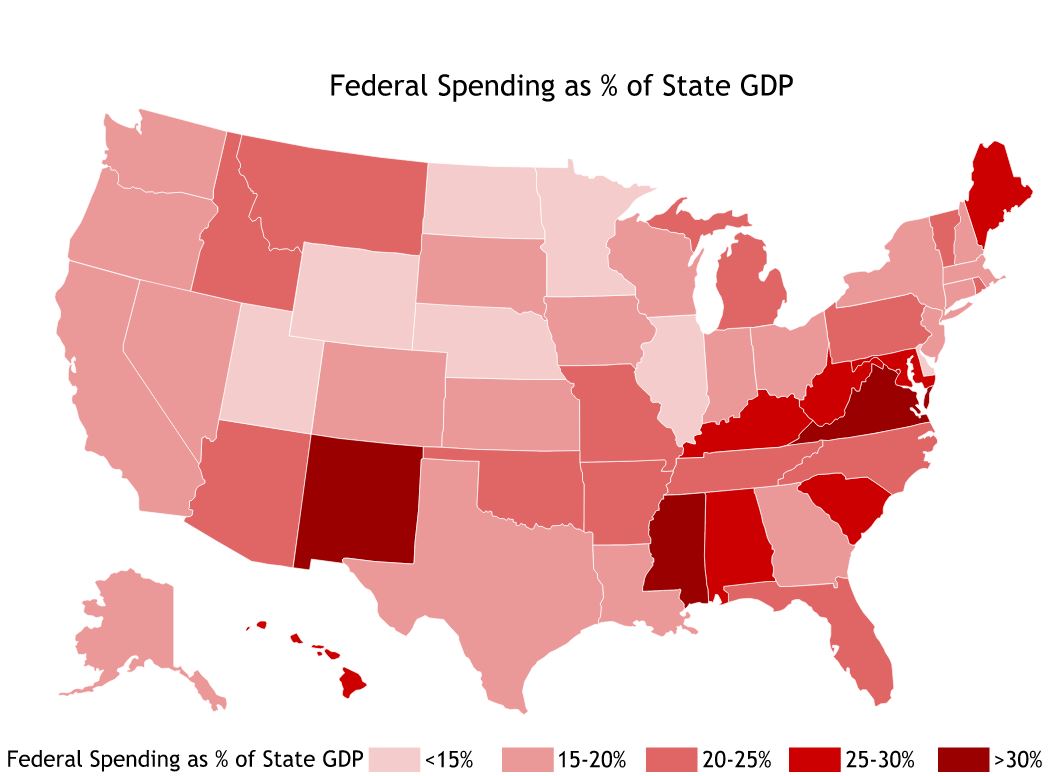
These are proportional numbers, so they are a function of both the amount of federal spending as well as the overall size of GDP. So, in California, for example, which receives immense amounts of government spending, is nevertheless a state where federal spending is offset by a very large private sector.
In a more rural state with few major private industries, such as New Mexico, the state shows up as being highly reliant on federal spending.
By this measure, the state most reliant on federal spending is Mississippi where federal spending is equal to 32 percent of the state's GDP. The state least reliant on federal spending is Wyoming where federal spending is equal to 11 percent of the state's GDP:
But I cannot be a Leftist because they operate from emotion while ignoring economic realities.




 AI
AI