










Sunday, December 30, 2018 5:39:42 AM
The Wall
"The LYIN' PRESIDENT said.."
The real costs of a barrier between the United States and Mexico
Leer en Español ..
https://www.brookings.edu/es/essay/el-muro-el-verdadero-costo-de-la-barrera-entre-estados-unidos-y-mexico/
Vanda Felbab-Brown August 2017
[...]
What the wall’s price tag would be
[Trump's lie is 12 billion. Homeland Security says 22 billion. Senior Democrats say 70 billion. Actually, while the 70
looks closest to the mark (see video below) taking everything into consideration, the real cost is anyone's guess.]
INSERT VIDEO
9 Things That COULD Happen if Trump Builds "The Wall"!
Pablito's Way
Published on Jan 31, 2017
So what exactly would happen if President Donald Trump actually built "The Wall"?! Learn
all about the possible effects of a giant wall separating the United States and Mexico!
https://www.youtube.com/watch?v=UdUIXvwuwto
[...]
Why the wall wouldn’t stop smuggling
Why the DHS believes that a 30–foot tall wall cannot be scaled and a tunnel cannot be built deeper than six feet below ground is not clear.
Drug smugglers have been using tunnels to get drugs into the United States ever since Mexico’s most famous drug trafficker, Joaquín “El Chapo” Guzmán of the Sinaloa Cartel, pioneered the method in 1989. And the sophistication of these tunnels has only grown over time. In April 2016, U.S. law enforcement officials discovered a drug tunnel that ran more than half a mile from Tijuana to San Diego and was equipped with ventilation vents, rails, and electricity. It is the longest such tunnel to be found so far, but one of 13 of great length and technological expertise discovered since 2006. Altogether, between 1990 and 2016, 224 tunnels have been unearthed at the U.S.–Mexico border.
[...]
While President Trump accuses Mexico of exporting violent crime and drugs to the United States, many Mexican officials as well as people like Valeria, who are on the ground in the fight against the drug wars, complain of a tide of violence and corruption that flows in the opposite direction. Some 70 percent of the firearms seized in Mexico between 2009 and 2014 originated in the United States. Although amounting to over 73,000 guns, these seizures still likely represented only a fraction of the weapons smuggled from the United States. Moreover, billions of dollars per year are made in the illegal retail drug market in the United States and smuggled back to Mexico, where the cartels depend on this money for their basic operations. Sometimes, sophisticated money–laundering schemes, such as trade–based deals, are used; but large parts of the proceeds are smuggled as bulk cash hidden in secret compartments and among goods in the cars and trains daily crossing the border south to Mexico.
[...]
Both the George W. Bush administration and the Obama administration recognized the joint responsibility for drug trafficking between the United States and Mexico, an attitude that allowed for unprecedented collaborative efforts to fight crime and secure borders. This collaboration allowed U.S. law enforcement and intelligence agents to operate in Mexico and help their Mexican counterparts in intelligence development, training, vetting, establishment of police procedures and protocols, and interdiction operations. The collaboration also led to Mexico being far more willing than it ever had been before to patrol both its northern border with the United States and its southern border with Central America, as part of the effort to help apprehend undocumented workers trying to cross into the United States.
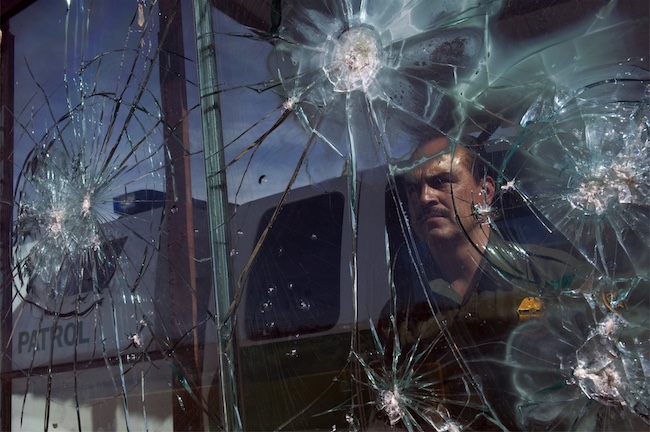
A U.S. Border Patrol officer looks through bullet-proof glass at the border near El Paso. Getty Images
The Trump administration’s hostility to Mexico could jeopardize this progress. In retaliation for building the wall, for any efforts the U.S. might make to force Mexico to pay for the wall, or for the collapse of NAFTA, the Mexican government could, for example, give up on its efforts to secure its southern border or stop sharing counterterrorism intelligence with the United States. Yet Mexico’s cooperation is far more important for U.S. security than any wall.
[...]
What the wall would mean for crime in the U.S.
Although President Trump has railed against the “carnage” of crime in the United States, the crime statistics, with few exceptions, tell a very different story.
From 1991 to 2015, U.S. homicides fell 36%
In 2014, 14,249 people were murdered, the lowest homicide rate since 1991 when there were 24,703, and part of a pattern of steady decline in violent crime over that entire period. In 2015, however, murders in the U.S. did shoot up to 15,696. This increase was largely driven by three cities—Baltimore, Chicago, and Washington, D.C. Baltimore and Chicago have decreasing populations, and all three have higher poverty and unemployment than the national average, high income and racial inequality, and troubled relations between residents and police—conditions conducive to a rise in violent crime. In 2016, homicides fell in Washington and Baltimore, but continued rising in Chicago.
There is no evidence, however, that undocumented residents accounted for either the rise in crime or even for a substantial number of the crimes, in Chicago or elsewhere. The vast majority of violent crimes, including murders, are committed by native–born Americans. Multiple criminological studies show that foreign–born individuals commit much lower levels of crime than do the native–born. In California, for example, where there is a large immigrant population, including of undocumented migrants, U.S.–born men were incarcerated at a rate 2.5 times higher than foreign–born men.
Unfortunately, the Trump administration is promoting a policing approach that insists on prioritizing hunting down undocumented workers, including by using regular police forces, and this kind of misguided law enforcement policy is spreading:
[...]
“Many of the people being targeted [for deportation] have
for decades lived lawful, safe, and productive lives here.”
[...]
How the wall would hurt the U.S. economy
If immigrants are not responsible for any significant amount of crime in the United States and in fact are considerably less likely than native–born citizens to commit crime, then what about the other justification for President Trump’s vilification of immigrants, legal and illegal, and his determination to wall them out: Do immigrants steal U.S. jobs and suppress U.S. wages?
-
Life of a typical migrant farm worker
Profile
75% born in Mexico
53% undocumented
Schedule
14 hours a day
6 days a week
Pay
$11k per year
No overtime pay
No benefits
Risks
Heat stress, infections, poison, respiratory illness
-
There is little evidence to support such claims. According to a comprehensive National Academies of Sciences, Engineering, and Medicine analysis, immigration does not significantly impact the overall employment levels of most native–born workers. The impact of immigrant labor on the wages of native–born workers is also low. Immigrant labor does have some negative effects on the employment and wages of native–born high school dropouts, however, and also on prior immigrants, because all three groups compete for low–skilled jobs and the newest immigrants are often willing to work for less than their competition. To a large extent, however, undocumented workers often work the unpleasant, back–breaking jobs that native–born workers are not willing to do. Sectors with large numbers of undocumented workers include agriculture, construction, manufacturing, hospitality services, and seafood processing. The fish–cutting industry, for example, is unable to recruit a sufficient number of legal workers and therefore is overwhelmingly dependent on an undocumented workforce. Skinning, deboning, and cutting fish is a smelly, slimy, grimy, chilly, monotonous, and exacting job. Many workers rapidly develop carpal tunnel syndrome. It can be a dangerous job, with machinery for cutting off fish heads and deboning knives everywhere frequently leading to amputated fingers. The risk of infections from cuts and the bloody water used to wash fish is also substantial. Over the past ten years, multiple exposés have revealed that both in the United States and abroad, workers in the fishing and seafood processing industries, often undocumented in other countries also, are subjected to forced labor conditions, and sometimes treated like slaves.
[...]
Trade, investment, joint production, and travel across the U.S.–Mexico border remain a way of life for border communities, including those in the United States. Disrupting them will create substantial economic costs for both countries. And a significantly weakened Mexican economy will also exacerbate Mexico’s severe criminal violence and encourage violence–driven immigration to the United States.
[...]
What the wall would do to communities and the environment
If erected, Trump’s wall will not be the first significant barrier to be built on the border. That distinction goes to the 700–mile fence the U.S. began to put up—over protests from those on both sides of the border—some years ago.
These people include 26 federally–recognized Native American Nations in the U.S. and eight Indigenous Peoples in Mexico.
[...]
Trump’s wall will, of course, exacerbate the damage to these Native American communities, causing great pain and anger among the inhabitants. “If someone came into your house and built a wall in your living room, tell me, how would you feel about that?” asked Verlon Jose, vice chairman of the Tohono O’odham Nation, in an interview by The New York Times’ Fernanda Santos in February 2017. Stretching out his arms to embrace the saguaro desert around him, he said, “This is our home.” Many in his tribe want to resist the construction of the wall. Others fear that if the border barrier is weaker on the tribal land, drug smuggling will be funneled there as happened before with the fence, harming and ensnarling the community.
As Native American communities, conservation biologists, and the U.S. Fish and Wildlife Service all have highlighted, the wall will also have significant environmental costs in areas that host some of the greatest biodiversity in North America.
[...]
A poisoned U.S.–Mexican relationship could also prevent the renegotiation of water sharing agreements that are critical to the environment as well as to water and food security, and to farming. For example, the 1970 Boundary Treaty between the United States and Mexico specifies that officials from both the U.S. and Mexico must agree if either side wants to build any structure that could affect the flow of the Rio Grande or its flood waters, water that is vital to livestock and agriculture along the border. The fence was built despite Mexico’s objections to it, and because its steel slats become clogged with debris during the rainy season, it has caused floods affecting cities and previously protected areas on both sides of the border, resulting in millions of dollars in damages.
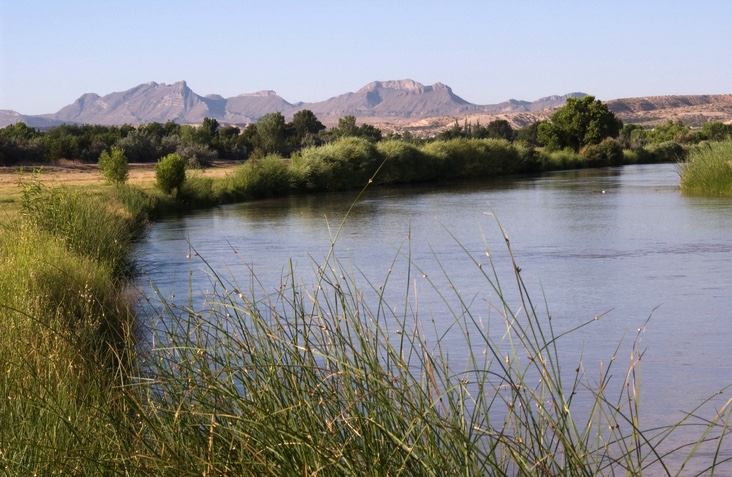
The Rio Grande curving through Big Bend Ranch State Park, Texas. Getty Images
It wasn’t just Mexico that didn’t want that fence. U.S. farmers and businessmen along the Texas border in the Rio Grande valley opposed it, too, since it blocks their access to the river water and also augments the severity of floods. Now the wall is to be brought to flood plain areas in Texas where water issues precisely like these had prevented the construction of the fence before.
Meanwhile, manufacturing, agriculture, hydraulic fracking, energy production, and ecosystems on both sides of the border depend on equitable and effective water sharing from the Rio Grande and the Colorado River, with both sides vulnerable to water scarcities. Over the decades there have been many challenges to the joint agreements governing water usage, and both Mexico and the U.S. have at times considered themselves the aggrieved parties. But in general, U.S.–Mexico cooperation over both the Rio Grande and Colorado rivers has been exceptional by international standards and has been hugely beneficial to both partners to the various treaties. That kind of co–operation is now at risk.
If in retaliation for the Trump administration’s vitriolic, anti–Mexican language and policies, Mexico decided not live up to its side of the water bargain, U.S. farmers and others along the Rio Grande would be under severe threat of losing their livelihoods. One of them is Dale Murden in Monte Alto, who on his 20,000–acre farm cultivates sugarcane, grapefruit, cotton, citrus, and grain. Named in January 2017 the Citrus King of Texas, the former Texas Farm Bureau state director has dedicated his life to agriculture in southern Texas, relying on a Latino workforce. Yet he has memories of devastating water shortages in 2011 and 2013, when because of a severe drought Mexico could not send its allocation of the Rio Conches to the United States and 30 percent of his land became unproductive, with many crops dying. At that time he hoped that the U.S. State Department could persuade Mexico to release some water, even as Mexican farmers were also facing immense water shortages and devastation. U.S. diplomacy did work, no doubt helped by the rain that replenished Mexico’s tributaries of the Rio Grande. Without the rain, Mexico would not have been able to pay back its accumulated water debt. But without collaborative U.S.–Mexico diplomacy and an atmosphere of a closer–than–ever U.S.–Mexico cooperation, Mexico still could have failed to deliver the water despite the rain. That positive spirit of cooperation also produced one of the world’s most enlightened, environmentally–sensitive, and water–use–savvy version of a water treaty, the so–called Minute 319 of the 1944 Colorado River U.S.–Mexico water agreement. Unique in its recognition of the Colorado River delta as a water user, the update committed the United States to sending a so–called “pulse flow” to that ecosystem, thus helping to restore those unique wetlands. The United States also agreed to pay $18 million for water conservation in Mexico. In turn, Mexico delivered 124,000 acre–feet of Mexican water to Lake Mead. It was a win–win–win: for U.S. farmers, Mexican farmers, and ecosystems. But those were the good days of the U.S.–Mexico relationship, before the Trump administration. A new update to the treaty is under negotiation—once again a vital agreement and a lifeline for some 40 million people on both sides of the border that could fall prey to the Trump administration’s approach to Mexico.
[...]
Rather than a line of separation, the border should be conceived of as a membrane, connecting the tissues of communities on both sides, enabling mutually beneficial trade, manufacturing, ecosystem improvements, and security, while enhancing inter–cultural exchanges.
In 1971, When First Lady Pat Nixon attended the inauguration of Friendship Park—that tragic place that allows separated families only the most limited amount of contact—she said, “I hope there won’t be a fence here too long.” She supported two–way positive exchanges between the United States and Mexico, not barriers. In fact, for her visit, she had the fence in Friendship Park torn down. Unfortunately, it’s still there, bigger, taller, and harder than when she visited, and with the wall about to get much worse yet.
Vanda Felbab-Brown is a senior fellow at the Brookings Institution. She is an expert on international and internal conflicts and nontraditional security threats, including insurgency, organized crime, urban violence, and illicit economies. Her fieldwork and research have covered, among others, Afghanistan, South Asia, Burma, Indonesia, the Andean region, Mexico, Morocco, Somalia, and eastern Africa. Her books include The Extinction Market: Wildlife Trafficking and How to Counter It (Hurst, 2017) and Shooting Up: Counterinsurgency and the War on Drugs (Brookings Institution Press, 2010). She received her doctorate in political science from MIT and her bachelor’s from Harvard University.
https://www.brookings.edu/essay/the-wall-the-real-costs-of-a-barrier-between-the-united-states-and-mexico/
"The LYIN' PRESIDENT said.."
The real costs of a barrier between the United States and Mexico
Leer en Español ..
https://www.brookings.edu/es/essay/el-muro-el-verdadero-costo-de-la-barrera-entre-estados-unidos-y-mexico/
Vanda Felbab-Brown August 2017
[...]
What the wall’s price tag would be
[Trump's lie is 12 billion. Homeland Security says 22 billion. Senior Democrats say 70 billion. Actually, while the 70
looks closest to the mark (see video below) taking everything into consideration, the real cost is anyone's guess.]
INSERT VIDEO
9 Things That COULD Happen if Trump Builds "The Wall"!
Pablito's Way
Published on Jan 31, 2017
So what exactly would happen if President Donald Trump actually built "The Wall"?! Learn
all about the possible effects of a giant wall separating the United States and Mexico!
https://www.youtube.com/watch?v=UdUIXvwuwto
[...]
Why the wall wouldn’t stop smuggling
Why the DHS believes that a 30–foot tall wall cannot be scaled and a tunnel cannot be built deeper than six feet below ground is not clear.
Drug smugglers have been using tunnels to get drugs into the United States ever since Mexico’s most famous drug trafficker, Joaquín “El Chapo” Guzmán of the Sinaloa Cartel, pioneered the method in 1989. And the sophistication of these tunnels has only grown over time. In April 2016, U.S. law enforcement officials discovered a drug tunnel that ran more than half a mile from Tijuana to San Diego and was equipped with ventilation vents, rails, and electricity. It is the longest such tunnel to be found so far, but one of 13 of great length and technological expertise discovered since 2006. Altogether, between 1990 and 2016, 224 tunnels have been unearthed at the U.S.–Mexico border.
[...]
While President Trump accuses Mexico of exporting violent crime and drugs to the United States, many Mexican officials as well as people like Valeria, who are on the ground in the fight against the drug wars, complain of a tide of violence and corruption that flows in the opposite direction. Some 70 percent of the firearms seized in Mexico between 2009 and 2014 originated in the United States. Although amounting to over 73,000 guns, these seizures still likely represented only a fraction of the weapons smuggled from the United States. Moreover, billions of dollars per year are made in the illegal retail drug market in the United States and smuggled back to Mexico, where the cartels depend on this money for their basic operations. Sometimes, sophisticated money–laundering schemes, such as trade–based deals, are used; but large parts of the proceeds are smuggled as bulk cash hidden in secret compartments and among goods in the cars and trains daily crossing the border south to Mexico.
[...]
Both the George W. Bush administration and the Obama administration recognized the joint responsibility for drug trafficking between the United States and Mexico, an attitude that allowed for unprecedented collaborative efforts to fight crime and secure borders. This collaboration allowed U.S. law enforcement and intelligence agents to operate in Mexico and help their Mexican counterparts in intelligence development, training, vetting, establishment of police procedures and protocols, and interdiction operations. The collaboration also led to Mexico being far more willing than it ever had been before to patrol both its northern border with the United States and its southern border with Central America, as part of the effort to help apprehend undocumented workers trying to cross into the United States.
A U.S. Border Patrol officer looks through bullet-proof glass at the border near El Paso. Getty Images
The Trump administration’s hostility to Mexico could jeopardize this progress. In retaliation for building the wall, for any efforts the U.S. might make to force Mexico to pay for the wall, or for the collapse of NAFTA, the Mexican government could, for example, give up on its efforts to secure its southern border or stop sharing counterterrorism intelligence with the United States. Yet Mexico’s cooperation is far more important for U.S. security than any wall.
[...]
What the wall would mean for crime in the U.S.
Although President Trump has railed against the “carnage” of crime in the United States, the crime statistics, with few exceptions, tell a very different story.
From 1991 to 2015, U.S. homicides fell 36%
In 2014, 14,249 people were murdered, the lowest homicide rate since 1991 when there were 24,703, and part of a pattern of steady decline in violent crime over that entire period. In 2015, however, murders in the U.S. did shoot up to 15,696. This increase was largely driven by three cities—Baltimore, Chicago, and Washington, D.C. Baltimore and Chicago have decreasing populations, and all three have higher poverty and unemployment than the national average, high income and racial inequality, and troubled relations between residents and police—conditions conducive to a rise in violent crime. In 2016, homicides fell in Washington and Baltimore, but continued rising in Chicago.
There is no evidence, however, that undocumented residents accounted for either the rise in crime or even for a substantial number of the crimes, in Chicago or elsewhere. The vast majority of violent crimes, including murders, are committed by native–born Americans. Multiple criminological studies show that foreign–born individuals commit much lower levels of crime than do the native–born. In California, for example, where there is a large immigrant population, including of undocumented migrants, U.S.–born men were incarcerated at a rate 2.5 times higher than foreign–born men.
Unfortunately, the Trump administration is promoting a policing approach that insists on prioritizing hunting down undocumented workers, including by using regular police forces, and this kind of misguided law enforcement policy is spreading:
[...]
“Many of the people being targeted [for deportation] have
for decades lived lawful, safe, and productive lives here.”
[...]
How the wall would hurt the U.S. economy
If immigrants are not responsible for any significant amount of crime in the United States and in fact are considerably less likely than native–born citizens to commit crime, then what about the other justification for President Trump’s vilification of immigrants, legal and illegal, and his determination to wall them out: Do immigrants steal U.S. jobs and suppress U.S. wages?
-
Life of a typical migrant farm worker
Profile
75% born in Mexico
53% undocumented
Schedule
14 hours a day
6 days a week
Pay
$11k per year
No overtime pay
No benefits
Risks
Heat stress, infections, poison, respiratory illness
-
There is little evidence to support such claims. According to a comprehensive National Academies of Sciences, Engineering, and Medicine analysis, immigration does not significantly impact the overall employment levels of most native–born workers. The impact of immigrant labor on the wages of native–born workers is also low. Immigrant labor does have some negative effects on the employment and wages of native–born high school dropouts, however, and also on prior immigrants, because all three groups compete for low–skilled jobs and the newest immigrants are often willing to work for less than their competition. To a large extent, however, undocumented workers often work the unpleasant, back–breaking jobs that native–born workers are not willing to do. Sectors with large numbers of undocumented workers include agriculture, construction, manufacturing, hospitality services, and seafood processing. The fish–cutting industry, for example, is unable to recruit a sufficient number of legal workers and therefore is overwhelmingly dependent on an undocumented workforce. Skinning, deboning, and cutting fish is a smelly, slimy, grimy, chilly, monotonous, and exacting job. Many workers rapidly develop carpal tunnel syndrome. It can be a dangerous job, with machinery for cutting off fish heads and deboning knives everywhere frequently leading to amputated fingers. The risk of infections from cuts and the bloody water used to wash fish is also substantial. Over the past ten years, multiple exposés have revealed that both in the United States and abroad, workers in the fishing and seafood processing industries, often undocumented in other countries also, are subjected to forced labor conditions, and sometimes treated like slaves.
[...]
Trade, investment, joint production, and travel across the U.S.–Mexico border remain a way of life for border communities, including those in the United States. Disrupting them will create substantial economic costs for both countries. And a significantly weakened Mexican economy will also exacerbate Mexico’s severe criminal violence and encourage violence–driven immigration to the United States.
[...]
What the wall would do to communities and the environment
If erected, Trump’s wall will not be the first significant barrier to be built on the border. That distinction goes to the 700–mile fence the U.S. began to put up—over protests from those on both sides of the border—some years ago.
These people include 26 federally–recognized Native American Nations in the U.S. and eight Indigenous Peoples in Mexico.
[...]
Trump’s wall will, of course, exacerbate the damage to these Native American communities, causing great pain and anger among the inhabitants. “If someone came into your house and built a wall in your living room, tell me, how would you feel about that?” asked Verlon Jose, vice chairman of the Tohono O’odham Nation, in an interview by The New York Times’ Fernanda Santos in February 2017. Stretching out his arms to embrace the saguaro desert around him, he said, “This is our home.” Many in his tribe want to resist the construction of the wall. Others fear that if the border barrier is weaker on the tribal land, drug smuggling will be funneled there as happened before with the fence, harming and ensnarling the community.
As Native American communities, conservation biologists, and the U.S. Fish and Wildlife Service all have highlighted, the wall will also have significant environmental costs in areas that host some of the greatest biodiversity in North America.
[...]
A poisoned U.S.–Mexican relationship could also prevent the renegotiation of water sharing agreements that are critical to the environment as well as to water and food security, and to farming. For example, the 1970 Boundary Treaty between the United States and Mexico specifies that officials from both the U.S. and Mexico must agree if either side wants to build any structure that could affect the flow of the Rio Grande or its flood waters, water that is vital to livestock and agriculture along the border. The fence was built despite Mexico’s objections to it, and because its steel slats become clogged with debris during the rainy season, it has caused floods affecting cities and previously protected areas on both sides of the border, resulting in millions of dollars in damages.
The Rio Grande curving through Big Bend Ranch State Park, Texas. Getty Images
It wasn’t just Mexico that didn’t want that fence. U.S. farmers and businessmen along the Texas border in the Rio Grande valley opposed it, too, since it blocks their access to the river water and also augments the severity of floods. Now the wall is to be brought to flood plain areas in Texas where water issues precisely like these had prevented the construction of the fence before.
Meanwhile, manufacturing, agriculture, hydraulic fracking, energy production, and ecosystems on both sides of the border depend on equitable and effective water sharing from the Rio Grande and the Colorado River, with both sides vulnerable to water scarcities. Over the decades there have been many challenges to the joint agreements governing water usage, and both Mexico and the U.S. have at times considered themselves the aggrieved parties. But in general, U.S.–Mexico cooperation over both the Rio Grande and Colorado rivers has been exceptional by international standards and has been hugely beneficial to both partners to the various treaties. That kind of co–operation is now at risk.
If in retaliation for the Trump administration’s vitriolic, anti–Mexican language and policies, Mexico decided not live up to its side of the water bargain, U.S. farmers and others along the Rio Grande would be under severe threat of losing their livelihoods. One of them is Dale Murden in Monte Alto, who on his 20,000–acre farm cultivates sugarcane, grapefruit, cotton, citrus, and grain. Named in January 2017 the Citrus King of Texas, the former Texas Farm Bureau state director has dedicated his life to agriculture in southern Texas, relying on a Latino workforce. Yet he has memories of devastating water shortages in 2011 and 2013, when because of a severe drought Mexico could not send its allocation of the Rio Conches to the United States and 30 percent of his land became unproductive, with many crops dying. At that time he hoped that the U.S. State Department could persuade Mexico to release some water, even as Mexican farmers were also facing immense water shortages and devastation. U.S. diplomacy did work, no doubt helped by the rain that replenished Mexico’s tributaries of the Rio Grande. Without the rain, Mexico would not have been able to pay back its accumulated water debt. But without collaborative U.S.–Mexico diplomacy and an atmosphere of a closer–than–ever U.S.–Mexico cooperation, Mexico still could have failed to deliver the water despite the rain. That positive spirit of cooperation also produced one of the world’s most enlightened, environmentally–sensitive, and water–use–savvy version of a water treaty, the so–called Minute 319 of the 1944 Colorado River U.S.–Mexico water agreement. Unique in its recognition of the Colorado River delta as a water user, the update committed the United States to sending a so–called “pulse flow” to that ecosystem, thus helping to restore those unique wetlands. The United States also agreed to pay $18 million for water conservation in Mexico. In turn, Mexico delivered 124,000 acre–feet of Mexican water to Lake Mead. It was a win–win–win: for U.S. farmers, Mexican farmers, and ecosystems. But those were the good days of the U.S.–Mexico relationship, before the Trump administration. A new update to the treaty is under negotiation—once again a vital agreement and a lifeline for some 40 million people on both sides of the border that could fall prey to the Trump administration’s approach to Mexico.
[...]
Rather than a line of separation, the border should be conceived of as a membrane, connecting the tissues of communities on both sides, enabling mutually beneficial trade, manufacturing, ecosystem improvements, and security, while enhancing inter–cultural exchanges.
In 1971, When First Lady Pat Nixon attended the inauguration of Friendship Park—that tragic place that allows separated families only the most limited amount of contact—she said, “I hope there won’t be a fence here too long.” She supported two–way positive exchanges between the United States and Mexico, not barriers. In fact, for her visit, she had the fence in Friendship Park torn down. Unfortunately, it’s still there, bigger, taller, and harder than when she visited, and with the wall about to get much worse yet.
Vanda Felbab-Brown is a senior fellow at the Brookings Institution. She is an expert on international and internal conflicts and nontraditional security threats, including insurgency, organized crime, urban violence, and illicit economies. Her fieldwork and research have covered, among others, Afghanistan, South Asia, Burma, Indonesia, the Andean region, Mexico, Morocco, Somalia, and eastern Africa. Her books include The Extinction Market: Wildlife Trafficking and How to Counter It (Hurst, 2017) and Shooting Up: Counterinsurgency and the War on Drugs (Brookings Institution Press, 2010). She received her doctorate in political science from MIT and her bachelor’s from Harvard University.
https://www.brookings.edu/essay/the-wall-the-real-costs-of-a-barrier-between-the-united-states-and-mexico/
It was Plato who said, “He, O men, is the wisest, who like Socrates, knows that his wisdom is in truth worth nothing”
Discover What Traders Are Watching
Explore small cap ideas before they hit the headlines.



