










Sunday, February 25, 2018 8:43:05 PM
Humidity, storms, rain... What is going on with WA's weather?
"Roseau, Dominica Radar"
Hannah Barry October 16 2017
Humidity, thunderstorms, soaring temperatures ... it's the question on everyone's mind:
What is going on with WA's weather?
http://www.watoday.com.au/wa-news/humidity-storms-rain-what-is-going-on-with-was-weather-20171016-gz1wn0.html
-
Fierce storm smashes Albany as gusts of up to 139km/h topple trees and silos
Tim Carrier September 21 2017
http://www.watoday.com.au/wa-news/fierce-storm-smashes-albany-as-gusts-of-up-to-139kmh-topple-trees-and-silos-20170921-gymaq6.html
-
'Unusual' thunderstorm hits Perth's south, tearing off roofs, flooding homes
By James Carmody
Updated about 5 hours ago
Video: 'Unusual' storm hits Perth's south, tearing off roofs and flooding homes (ABC News)
http://www.abc.net.au/news/2018-02-26/unusual-storm-perth-rockingham/9483818
The Department of Fire and Emergency Services has attended dozens of call outs for storm damage in Perth's southern suburbs after a severe thunderstorm hit Rockingham.
Winds of 130 kilometres an hour were recorded on Garden Island off the coast around 10:30am on Sunday before the storm hit the mainland.
The roof was torn off a fish and chips store on the Rockingham foreshore letting in heavy rainfall which caused the restaurant's fryers to overflow.
Four fire crews raced to make it safe with the oil creating a significant fire risk.
Damaging winds brought down trees in Rockingham, Waikiki and Mardella.
Hail and torrential rainfall created localised flooding on some streets and in some homes.
twisted metal roof sheeting and insulation laying in a heap by a pool.
Photo: The storm ripped the roof off an apartment building in Harrison Street, Rockingham. (ABC News: Charlotte Hamlyn)
http://www.abc.net.au/news/2018-02-25/rockingham-storm-damage/9483002
State Emergency Services crews were called to more than 16 properties Sunday morning, with dozens more call outs expected through Sunday night.
Bureau of Meteorology forecaster Adam Conroy said it was not an average thunderstorm.
"This cell is reasonably unusual in that it formed over water and was very intense
and observing wind gusts of 130 kilometres per hour is very strong," he said.
"It's certainly enough to cause damage particularly to trees and that sort of thing and can also cause property damages which is what we've seen out of this."
"The thunderstorms also have reasonably low bases, which means there's a fair bit of lightning activity with it and a fair risk of that lightning hitting the ground."
That risk led Surf Life Saving WA to close a number of beaches south of Perth including Secret Harbour and San Remo.
The storm was expected to track through the south of WA through the South West and into the Great Southern.
A severe thunderstorm warning for people in the Central Wheat Belt district was cancelled about 9:40pm Sunday night.
http://www.abc.net.au/news/2018-02-25/unusual-storm-hits-perth27s-south/9482936
-
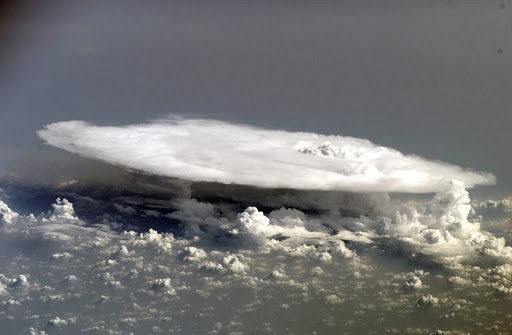
What causes thunderstorms?
Thunderstorms form when an air mass becomes so unstable that it overturns (convects) violently. "Unstable" means that the air in the lowest layers is unusually warm and humid, or that the upper layers are unusually cool, or oftentimes, both.
Pockets of rising near-surface air in an unstable air mass expand and cool, and as some of the water vapor present condenses into a cloud it releases heat, which then makes the air parcel even warmer, forcing it to rise still higher in the atmosphere.
If the lower level air is sufficiently warm and humid, and the higher altitude air is sufficiently cool, this process continues until a tall convective cloud -- the thunderstorm -- is formed. The result can be a storm extending as high as 40,000 to 60,000 feet (8 to 12 miles). The upper portions of the storm -- even in the warm tropics -- are made of ice: ice crystals, graupel, snow, and sometimes hail. About 50% of the rain reaching the surface in a thunderstorm originated as ice in the upper reaches of the storm.
The updrafts in thunderstorms can be very strong -- 50 knots or more -- which can help support the weight of hailstones as they grow. Such updrafts cause extreme turbulence for aircraft, which will only fly through the strongest portions of thunderstorms if the pilots have no other choice. Despite the large stresses this puts on planes (and their passengers), modern jet aircraft are designed to withstand those stresses.
The following enhanced photograph shows the classic supercell thunderstorm, a particularly large, intense, and destructive storm that can produce large hail and tornadoes:
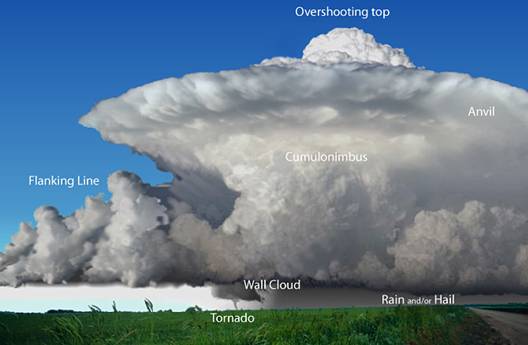
Thunderstorms are most common in the afternoon over land, when daytime heating of the land by the sun causes the lower part of the troposphere .. http://www.weatherquestions.com/What_is_the_troposphere.htm .. to become unstable from higher temperatures and more water vapor in the air.
Or, some thunderstorms can form as result of the upper atmosphere becoming unusually cool, due to the approach of an upper air disturbance. In this case storms can form at any time of day, even when there hasn't been daytime heating of the lower atmosphere over land.
There must be sufficient water vapor in order for the storm to form, since cloud and precipitation originates as water vapor. This is the fuel for the thunderstorm. As the storm uses this fuel, it is converted to rainfall. Eventually, the storm stabilizes the atmosphere by using up the excess water vapor and cooling the lower atmosphere, and warming the upper atmosphere.
Technically, lightning must be produced in order for the resulting cloud system to be called a thunderstorm. A discussion of what causes lightning can be found here ,,
http://www.weatherquestions.com/What_causes_lightning.htm .
Interesting facts:
NATURE'S AWESOME POWER It is estimated that there are around 44,000 thunderstorms that occur around the Earth every day. The average thunderstorm releases the energy equivalent of a 20 kiloton nuclear weapon, or a small nuclear power plant.
(page last updated 11/28/2010)
http://www.weatherquestions.com/What_causes_thunderstorms.htm
"Roseau, Dominica Radar"
Hannah Barry October 16 2017
Humidity, thunderstorms, soaring temperatures ... it's the question on everyone's mind:
What is going on with WA's weather?
http://www.watoday.com.au/wa-news/humidity-storms-rain-what-is-going-on-with-was-weather-20171016-gz1wn0.html
-
Fierce storm smashes Albany as gusts of up to 139km/h topple trees and silos
Tim Carrier September 21 2017
http://www.watoday.com.au/wa-news/fierce-storm-smashes-albany-as-gusts-of-up-to-139kmh-topple-trees-and-silos-20170921-gymaq6.html
-
'Unusual' thunderstorm hits Perth's south, tearing off roofs, flooding homes
By James Carmody
Updated about 5 hours ago
Video: 'Unusual' storm hits Perth's south, tearing off roofs and flooding homes (ABC News)
http://www.abc.net.au/news/2018-02-26/unusual-storm-perth-rockingham/9483818
The Department of Fire and Emergency Services has attended dozens of call outs for storm damage in Perth's southern suburbs after a severe thunderstorm hit Rockingham.
Winds of 130 kilometres an hour were recorded on Garden Island off the coast around 10:30am on Sunday before the storm hit the mainland.
The roof was torn off a fish and chips store on the Rockingham foreshore letting in heavy rainfall which caused the restaurant's fryers to overflow.
Four fire crews raced to make it safe with the oil creating a significant fire risk.
Damaging winds brought down trees in Rockingham, Waikiki and Mardella.
Hail and torrential rainfall created localised flooding on some streets and in some homes.
twisted metal roof sheeting and insulation laying in a heap by a pool.
Photo: The storm ripped the roof off an apartment building in Harrison Street, Rockingham. (ABC News: Charlotte Hamlyn)
http://www.abc.net.au/news/2018-02-25/rockingham-storm-damage/9483002
State Emergency Services crews were called to more than 16 properties Sunday morning, with dozens more call outs expected through Sunday night.
Bureau of Meteorology forecaster Adam Conroy said it was not an average thunderstorm.
"This cell is reasonably unusual in that it formed over water and was very intense
and observing wind gusts of 130 kilometres per hour is very strong," he said.
"It's certainly enough to cause damage particularly to trees and that sort of thing and can also cause property damages which is what we've seen out of this."
"The thunderstorms also have reasonably low bases, which means there's a fair bit of lightning activity with it and a fair risk of that lightning hitting the ground."
That risk led Surf Life Saving WA to close a number of beaches south of Perth including Secret Harbour and San Remo.
The storm was expected to track through the south of WA through the South West and into the Great Southern.
A severe thunderstorm warning for people in the Central Wheat Belt district was cancelled about 9:40pm Sunday night.
http://www.abc.net.au/news/2018-02-25/unusual-storm-hits-perth27s-south/9482936
-
What causes thunderstorms?
Thunderstorms form when an air mass becomes so unstable that it overturns (convects) violently. "Unstable" means that the air in the lowest layers is unusually warm and humid, or that the upper layers are unusually cool, or oftentimes, both.
Pockets of rising near-surface air in an unstable air mass expand and cool, and as some of the water vapor present condenses into a cloud it releases heat, which then makes the air parcel even warmer, forcing it to rise still higher in the atmosphere.
If the lower level air is sufficiently warm and humid, and the higher altitude air is sufficiently cool, this process continues until a tall convective cloud -- the thunderstorm -- is formed. The result can be a storm extending as high as 40,000 to 60,000 feet (8 to 12 miles). The upper portions of the storm -- even in the warm tropics -- are made of ice: ice crystals, graupel, snow, and sometimes hail. About 50% of the rain reaching the surface in a thunderstorm originated as ice in the upper reaches of the storm.
The updrafts in thunderstorms can be very strong -- 50 knots or more -- which can help support the weight of hailstones as they grow. Such updrafts cause extreme turbulence for aircraft, which will only fly through the strongest portions of thunderstorms if the pilots have no other choice. Despite the large stresses this puts on planes (and their passengers), modern jet aircraft are designed to withstand those stresses.
The following enhanced photograph shows the classic supercell thunderstorm, a particularly large, intense, and destructive storm that can produce large hail and tornadoes:
Thunderstorms are most common in the afternoon over land, when daytime heating of the land by the sun causes the lower part of the troposphere .. http://www.weatherquestions.com/What_is_the_troposphere.htm .. to become unstable from higher temperatures and more water vapor in the air.
Or, some thunderstorms can form as result of the upper atmosphere becoming unusually cool, due to the approach of an upper air disturbance. In this case storms can form at any time of day, even when there hasn't been daytime heating of the lower atmosphere over land.
There must be sufficient water vapor in order for the storm to form, since cloud and precipitation originates as water vapor. This is the fuel for the thunderstorm. As the storm uses this fuel, it is converted to rainfall. Eventually, the storm stabilizes the atmosphere by using up the excess water vapor and cooling the lower atmosphere, and warming the upper atmosphere.
Technically, lightning must be produced in order for the resulting cloud system to be called a thunderstorm. A discussion of what causes lightning can be found here ,,
http://www.weatherquestions.com/What_causes_lightning.htm .
Interesting facts:
NATURE'S AWESOME POWER It is estimated that there are around 44,000 thunderstorms that occur around the Earth every day. The average thunderstorm releases the energy equivalent of a 20 kiloton nuclear weapon, or a small nuclear power plant.
(page last updated 11/28/2010)
http://www.weatherquestions.com/What_causes_thunderstorms.htm
It was Plato who said, “He, O men, is the wisest, who like Socrates, knows that his wisdom is in truth worth nothing”
Discover What Traders Are Watching
Explore small cap ideas before they hit the headlines.



