



 AI
AI








Sunday, July 03, 2016 3:23:31 AM
South China Sea: Beijing plans military drills running up to court ruling
"The Solution for the Spratly Islands Ought to Look Like This"
Tensions rise ahead of verdict due on 12 July on territorial dispute between China and Philippines
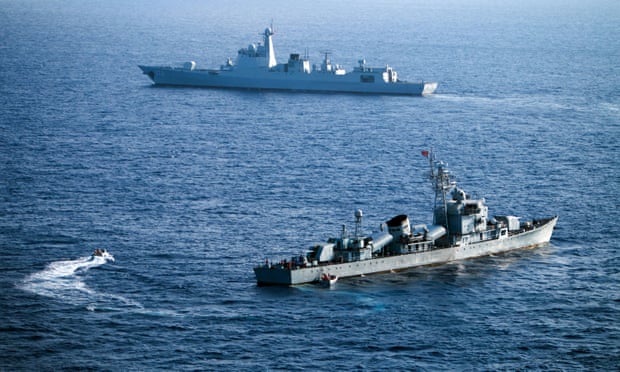
Beijing claims sovereignty over almost the whole of the South China Sea, on the basis of a segmented line that first
appeared on Chinese maps in the 1940s, pitting it against several neighbours. Photograph: STR/AFP/Getty Images
Reuters
Sunday 3 July 2016 14.01 AEST
China will hold military drills around the disputed Paracel Islands in the South China Sea .. https://www.theguardian.com/world/south-china-sea , the country’s maritime safety administration has said, ahead of a decision by an international court in Beijing’s dispute with the Philippines.
China regularly holds exercises in the area, where its territorial claims overlap .. https://www.theguardian.com/world/2016/jun/04/south-china-sea-us-warns-beijing-against-building-great-wall-of-self-isolation .. with Vietnam, the Philippines, Malaysia, Brunei and Taiwan.
--
Obama backs Vietnam in South China Sea dispute with Beijing
Read more > https://www.theguardian.com/world/2016/may/24/obama-backs-vietnam-in-south-china-sea-dispute-with-beijing
--
Tensions have been rising ahead of a ruling due on 12 July from the arbitration court .. https://www.theguardian.com/world/2016/apr/19/south-china-sea-britain-court-arbitration-ruling-binding .. in The Hague, Netherlands, that is hearing the dispute.
In a brief statement the Chinese said the drills would take place from 5 to 11 July and gave coordinates covering an area from the east of China’s Hainan island down to and including the Paracels.
Other ships were prohibited from entering those waters during that time, it said.
The Paracels are also claimed by Vietnam and Taiwan .. https://www.theguardian.com/world/taiwan .
China has built a runway on Woody Island .. https://www.theguardian.com/world/2016/feb/17/china-places-missiles-woody-south-china-sea-islands , the site of the largest Chinese presence on the Paracels, and placed surface-to-air missiles there, according to US officials.
China .. https://www.theguardian.com/world/china .. argues it is within its rights and claims the islands have been Chinese territory since ancient times.
About $5tn in ship-borne trade passes every year though the energy-rich, strategic waters of the South China Sea.
https://www.theguardian.com/world/2016/jul/03/south-china-sea-beijing-plans-military-drills-running-up-to-court-ruling
---
Nuechterlein: Is China on a collision course in the South China Sea?
Here’s how China’s neighbors see the South China Sea issue.
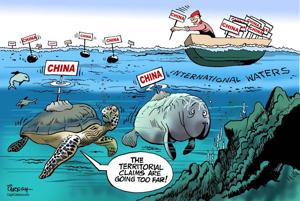
PARESH NATH | Cagle Cartoons

LOUJIE | China Daily
Posted: Sunday, July 3, 2016 2:00 am
Donald Nuechterlein
We may be on the verge of serious trouble with China in Southeast Asia if Beijing continues to push its territorial claims in the South China Sea. While Secretary of State John Kerry was in Beijing recently attending an economic conference, Secretary of Defense Ashton Carter was in Singapore meeting with other defense chiefs at a security conference known as the Shangri-La Dialogue. Both sought to warn China’s leaders that the South China Sea is a danger zone.
In Singapore, Carter directed criticism at China for its actions in Asia, charging that Beijing risked erecting a “Great Wall of self-isolation” with its aggressive policies. The following day, China’s deputy chief of the general staff, Admiral Sun Jianguo, leveled strong criticism at U.S. policies in East Asia, asserting that it encouraged and enabled smaller states to “bully” China. Referring to Carter’s speech, Admiral Sun declared: “We were not isolated in the past, we are not isolated now, and we will not be isolated in the future.” (WSJ, June 6).
Recently, I gave a UVa–sponsored seminar a hypothetical scenario dealing with crisis in the South China Sea. Here’s the case:
“The International Court has ruled that the Philippine claim to an area of rock formations in the South China Sea known as Scarborough Shoal is legal and that it has a right to the resources beneath it. China, which is not a member of the court, rejects the decision and reiterates its historical claim to most of the South China Sea. Recently the U.S. concluded a new defense agreement with the Philippines that reopens Clark air base to the U.S. Air Force and also permits our Navy to return to Subic Bay naval base. In addition, the U.S. will build three air bases in the southern Philippines facing South China Sea shipping lanes. The U.S. has also agreed to sell Vietnam modern weaponry. In return, Vietnam agreed to let the U.S. Navy use Cam Ranh Bay naval base, which the U.S. built during the Vietnam War. Further south, Singapore continues to permit the Navy to use its port facilities. New intelligence reports a flotilla of barges and dredging vessels has assembled at a Chinese port and is preparing for movement into the South China Sea. Several Chinese patrol craft are standing by to escort them to an unknown destination. The Philippine government is asking Washington how it will respond if these ships arrive at Scarborough Shoal and begin dredging operations. (China undertook a similar operation in the adjacent Spratly Islands in 2013-14 and constructed air fields and a port.)”
Seminar discussions highlighted a crucial issue for U.S. policy: Is the South China Sea a vital U.S. interest that may have to be defended with force? Or, is this a major interest that requires vigorous diplomacy but no use of force? Members were divided on this question, but concluded that the United States should not shirk its commitments in East Asia and permit China unilaterally to expand its territorial claims in Southeast Asia.
What’s likely to happen? Two possibilities are open: 1) a truce between Beijing and Washington to avoid armed conflict; 2) a clash between our navies in international waters, resulting in a diplomatic crisis.
A cooling off in tensions, in effect a truce, would occur if China instructs its navy not to harass U.S. and allied ships transiting China’s declared territorial waters off the Spratlys, Beijing also would not press its territorial claims to Scarborough Shoal.
A diplomatic crisis could lead to military action if China rejects the Hague Court’s decision and reinforces its claims by sending naval vessels to patrol the disputed areas. In this case, the United States and other maritime powers, notably Japan, would either have to concede to China’s extension of its power in Southeast Asia; or, take countering military action. If it chose the first course, Washington risks a collapse of its carefully constructed Asian coalition designed to restrain a belligerent China.
China has a long history of patience in pursuing its goals in Asia. This may be a time when its leaders show restraint and wait for a more opportune time to challenge Washington’s preeminence in Southeast Asia. Still, if hardline nationalist elements should prevail in Beijing, we may be in for a serious confrontation before the November elections.
Donald Nuechterlein is a political scientist and author who lives near Charlottesville. Contact him at nuechtd@cstone.net
http://www.roanoke.com/opinion/commentary/nuechterlein-is-china-on-a-collision-course-in-the-south/article_38643263-c837-5823-92d6-a6f7f90928bd.html
"The Solution for the Spratly Islands Ought to Look Like This"
Tensions rise ahead of verdict due on 12 July on territorial dispute between China and Philippines
Beijing claims sovereignty over almost the whole of the South China Sea, on the basis of a segmented line that first
appeared on Chinese maps in the 1940s, pitting it against several neighbours. Photograph: STR/AFP/Getty Images
Reuters
Sunday 3 July 2016 14.01 AEST
China will hold military drills around the disputed Paracel Islands in the South China Sea .. https://www.theguardian.com/world/south-china-sea , the country’s maritime safety administration has said, ahead of a decision by an international court in Beijing’s dispute with the Philippines.
China regularly holds exercises in the area, where its territorial claims overlap .. https://www.theguardian.com/world/2016/jun/04/south-china-sea-us-warns-beijing-against-building-great-wall-of-self-isolation .. with Vietnam, the Philippines, Malaysia, Brunei and Taiwan.
--
Obama backs Vietnam in South China Sea dispute with Beijing
Read more > https://www.theguardian.com/world/2016/may/24/obama-backs-vietnam-in-south-china-sea-dispute-with-beijing
--
Tensions have been rising ahead of a ruling due on 12 July from the arbitration court .. https://www.theguardian.com/world/2016/apr/19/south-china-sea-britain-court-arbitration-ruling-binding .. in The Hague, Netherlands, that is hearing the dispute.
In a brief statement the Chinese said the drills would take place from 5 to 11 July and gave coordinates covering an area from the east of China’s Hainan island down to and including the Paracels.
Other ships were prohibited from entering those waters during that time, it said.
The Paracels are also claimed by Vietnam and Taiwan .. https://www.theguardian.com/world/taiwan .
China has built a runway on Woody Island .. https://www.theguardian.com/world/2016/feb/17/china-places-missiles-woody-south-china-sea-islands , the site of the largest Chinese presence on the Paracels, and placed surface-to-air missiles there, according to US officials.
China .. https://www.theguardian.com/world/china .. argues it is within its rights and claims the islands have been Chinese territory since ancient times.
About $5tn in ship-borne trade passes every year though the energy-rich, strategic waters of the South China Sea.
https://www.theguardian.com/world/2016/jul/03/south-china-sea-beijing-plans-military-drills-running-up-to-court-ruling
---
Nuechterlein: Is China on a collision course in the South China Sea?
Here’s how China’s neighbors see the South China Sea issue.
PARESH NATH | Cagle Cartoons
LOUJIE | China Daily
Posted: Sunday, July 3, 2016 2:00 am
Donald Nuechterlein
We may be on the verge of serious trouble with China in Southeast Asia if Beijing continues to push its territorial claims in the South China Sea. While Secretary of State John Kerry was in Beijing recently attending an economic conference, Secretary of Defense Ashton Carter was in Singapore meeting with other defense chiefs at a security conference known as the Shangri-La Dialogue. Both sought to warn China’s leaders that the South China Sea is a danger zone.
In Singapore, Carter directed criticism at China for its actions in Asia, charging that Beijing risked erecting a “Great Wall of self-isolation” with its aggressive policies. The following day, China’s deputy chief of the general staff, Admiral Sun Jianguo, leveled strong criticism at U.S. policies in East Asia, asserting that it encouraged and enabled smaller states to “bully” China. Referring to Carter’s speech, Admiral Sun declared: “We were not isolated in the past, we are not isolated now, and we will not be isolated in the future.” (WSJ, June 6).
Recently, I gave a UVa–sponsored seminar a hypothetical scenario dealing with crisis in the South China Sea. Here’s the case:
“The International Court has ruled that the Philippine claim to an area of rock formations in the South China Sea known as Scarborough Shoal is legal and that it has a right to the resources beneath it. China, which is not a member of the court, rejects the decision and reiterates its historical claim to most of the South China Sea. Recently the U.S. concluded a new defense agreement with the Philippines that reopens Clark air base to the U.S. Air Force and also permits our Navy to return to Subic Bay naval base. In addition, the U.S. will build three air bases in the southern Philippines facing South China Sea shipping lanes. The U.S. has also agreed to sell Vietnam modern weaponry. In return, Vietnam agreed to let the U.S. Navy use Cam Ranh Bay naval base, which the U.S. built during the Vietnam War. Further south, Singapore continues to permit the Navy to use its port facilities. New intelligence reports a flotilla of barges and dredging vessels has assembled at a Chinese port and is preparing for movement into the South China Sea. Several Chinese patrol craft are standing by to escort them to an unknown destination. The Philippine government is asking Washington how it will respond if these ships arrive at Scarborough Shoal and begin dredging operations. (China undertook a similar operation in the adjacent Spratly Islands in 2013-14 and constructed air fields and a port.)”
Seminar discussions highlighted a crucial issue for U.S. policy: Is the South China Sea a vital U.S. interest that may have to be defended with force? Or, is this a major interest that requires vigorous diplomacy but no use of force? Members were divided on this question, but concluded that the United States should not shirk its commitments in East Asia and permit China unilaterally to expand its territorial claims in Southeast Asia.
What’s likely to happen? Two possibilities are open: 1) a truce between Beijing and Washington to avoid armed conflict; 2) a clash between our navies in international waters, resulting in a diplomatic crisis.
A cooling off in tensions, in effect a truce, would occur if China instructs its navy not to harass U.S. and allied ships transiting China’s declared territorial waters off the Spratlys, Beijing also would not press its territorial claims to Scarborough Shoal.
A diplomatic crisis could lead to military action if China rejects the Hague Court’s decision and reinforces its claims by sending naval vessels to patrol the disputed areas. In this case, the United States and other maritime powers, notably Japan, would either have to concede to China’s extension of its power in Southeast Asia; or, take countering military action. If it chose the first course, Washington risks a collapse of its carefully constructed Asian coalition designed to restrain a belligerent China.
China has a long history of patience in pursuing its goals in Asia. This may be a time when its leaders show restraint and wait for a more opportune time to challenge Washington’s preeminence in Southeast Asia. Still, if hardline nationalist elements should prevail in Beijing, we may be in for a serious confrontation before the November elections.
Donald Nuechterlein is a political scientist and author who lives near Charlottesville. Contact him at nuechtd@cstone.net
http://www.roanoke.com/opinion/commentary/nuechterlein-is-china-on-a-collision-course-in-the-south/article_38643263-c837-5823-92d6-a6f7f90928bd.html
It was Plato who said, “He, O men, is the wisest, who like Socrates, knows that his wisdom is in truth worth nothing”
Discover What Traders Are Watching
Explore small cap ideas before they hit the headlines.



