



 AI
AI







Tuesday, April 19, 2016 9:24:06 AM
4-18-16: CEO Steve King Quoted in BioProcessIntl Report on Cancer Immunotherapies (12pg. Report by Angelo DePalma, PhD)...
4-18-16: “Cancer Immunotherapies: Fulfilling the Promise of Protein & Cell Therapies”
by Angelo DePalma, PhD...
http://www.bioprocessintl.com/manufacturing/cell-therapies/cancer-immunotherapies-fulfilling-the-promise-of-protein-and-cell-therapies
PDF(12pgs): http://www.bioprocessintl.com/wp-content/uploads/2016/04/SpecRPT-Immunotherapy.pdf

With few exceptions, both small-molecule and biological cancer treatments have contributed only incrementally towards achieving long-term responses or outright cures. In this regard, emerging cell- and protein-based cancer immunotherapies represent game-changing strategies for treating even refractory cancer. With long-term responses now possible, medical science may be on the verge of delivering on the long-unfulfilled promise of making cancer a manageable disease. But impediments to commercializing cancer immunotherapies are substantial. Producing cell-based treatments entails substantial hands-on manipulation and perfecting the logistics of harvesting and expanding therapeutic cells and delivering them to patients. Given the handling requirements and high cost of goods (CoG) for cell-based immunotherapies, reimbursement considerations will force developers to demonstrate indisputable value. Those developing immunotherapies based on monoclonal antibodies (MAbs) will experience fewer such issues thanks to platform manufacturing technologies, but even they are likely to be priced to perfection.
Issues In Protein Immunotherapy - ”Immunotherapy Squared” Bavituximab, a monoclonal antibody from Peregrine Pharmaceuticals (Tustin, CA), is a classic protein immunotherapy targeting phosphatidylserine (PS), a novel immune system checkpoint. PS exists on the inside membrane layer of every cell, but it externalizes when cells die. “In circulation, PS signals the immune system to engulf dying cells,” explains Steve King, Peregrine’s CEO. PS also limits the immune response. As tumors proliferate, they often outgrow their blood supply so that many cells die, sending more PS into circulation. Tumors also release microparticles containing PS, ultimately suppressing immune response to the tumor by keeping the host’s immune system busy fighting particles and dead cells.
Peregrine’s collaboration with AstraZeneca for clinical development could be described as “immunotherapy squared.” Bavituximab’s presumed mode of action is to block immunosuppression while activating a tumor-killing T-cell immune response. AstraZeneca’s investigational anti-PD-L1 immune checkpoint inhibitor, durvalumab, targets the programmed cell death ligand PD-L1, which helps tumors go undetected by the immune system. Both companies believe that combining the enhanced T-cell–mediated antitumor activity with a checkpoint inhibitor will extend the ability of tumor-specific T-cells to attack cancerous cells.
Like many small biopharmaceutical companies with a promising pipeline product, Peregrine chooses to emphasize clinical development over manufacturing or process development, confident that if bavituximab succeeds in the clinic, then CoG issues will resolve themselves. “Our process flexibility assures that we could duplicate the entire facility and all its infrastructure in an open warehouse space almost anywhere,” Steve King affirms. “We built the current facility with the idea of supporting production lots early in commercialization. At that point you have substantial revenue, so all your manufacturing avenues open up. And the risk of sticking with the same systems, at the same scale, from a comparability standpoint is negligible.”
Downstream operations could very well become a bottleneck. Peregrine has learned through its contract manufacturing business, Avid Bioservices, that high yields — even from 1,000-L or 2,000-L bioreactors — impose operational & financial pressures on downstream processing and purification. Protein A affinity chromatography columns, for example, begin at about $1mm for resin alone and go up from there. “That’s a big investment for a small-to-midsized company,” King admits. Peregrine is handling such challenges through a hybrid approach of maintaining a revenue-generating mfg. business that mitigates the cost of preparing for commercialization of its own products. “Not many companies have that flexibility.”
Blocking the Immunity Blockers: In November 2015, Faron Pharmaceuticals (Turku, Finland). . . Read the rest of this 12-pg. Special Report in the eBook – Just fill out the form to view and download it.
ANGELO DEPALMA: PhD in organic chemistry from the SUNY/Stony Brook, freelance writer - was a chemist 1st at Brookhaven National Laboratory and then at Schering-Plough. For over 25yrs, has written for dozens of technical online & print publications, as well as product & service companies in biotechnology, bioprocessing, pharmaceutical chemistry, pharmaceutical development, drug discovery, and laboratory instrumentation.
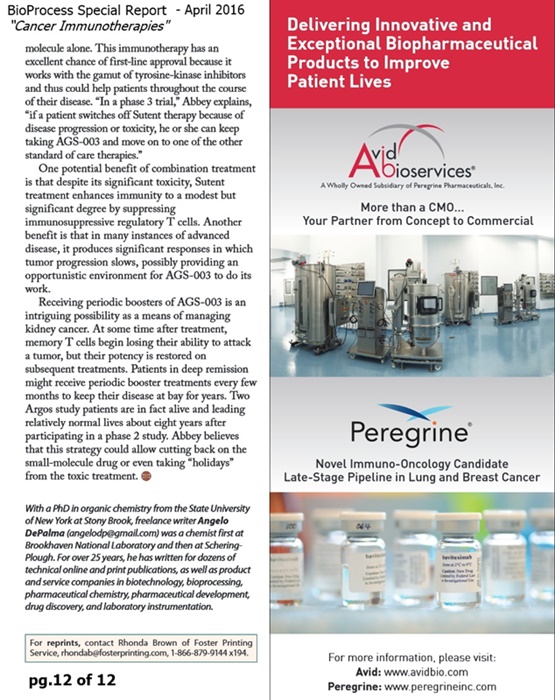
4-18-16: “Cancer Immunotherapies: Fulfilling the Promise of Protein & Cell Therapies”
by Angelo DePalma, PhD...
http://www.bioprocessintl.com/manufacturing/cell-therapies/cancer-immunotherapies-fulfilling-the-promise-of-protein-and-cell-therapies
PDF(12pgs): http://www.bioprocessintl.com/wp-content/uploads/2016/04/SpecRPT-Immunotherapy.pdf

With few exceptions, both small-molecule and biological cancer treatments have contributed only incrementally towards achieving long-term responses or outright cures. In this regard, emerging cell- and protein-based cancer immunotherapies represent game-changing strategies for treating even refractory cancer. With long-term responses now possible, medical science may be on the verge of delivering on the long-unfulfilled promise of making cancer a manageable disease. But impediments to commercializing cancer immunotherapies are substantial. Producing cell-based treatments entails substantial hands-on manipulation and perfecting the logistics of harvesting and expanding therapeutic cells and delivering them to patients. Given the handling requirements and high cost of goods (CoG) for cell-based immunotherapies, reimbursement considerations will force developers to demonstrate indisputable value. Those developing immunotherapies based on monoclonal antibodies (MAbs) will experience fewer such issues thanks to platform manufacturing technologies, but even they are likely to be priced to perfection.
Issues In Protein Immunotherapy - ”Immunotherapy Squared” Bavituximab, a monoclonal antibody from Peregrine Pharmaceuticals (Tustin, CA), is a classic protein immunotherapy targeting phosphatidylserine (PS), a novel immune system checkpoint. PS exists on the inside membrane layer of every cell, but it externalizes when cells die. “In circulation, PS signals the immune system to engulf dying cells,” explains Steve King, Peregrine’s CEO. PS also limits the immune response. As tumors proliferate, they often outgrow their blood supply so that many cells die, sending more PS into circulation. Tumors also release microparticles containing PS, ultimately suppressing immune response to the tumor by keeping the host’s immune system busy fighting particles and dead cells.
Peregrine’s collaboration with AstraZeneca for clinical development could be described as “immunotherapy squared.” Bavituximab’s presumed mode of action is to block immunosuppression while activating a tumor-killing T-cell immune response. AstraZeneca’s investigational anti-PD-L1 immune checkpoint inhibitor, durvalumab, targets the programmed cell death ligand PD-L1, which helps tumors go undetected by the immune system. Both companies believe that combining the enhanced T-cell–mediated antitumor activity with a checkpoint inhibitor will extend the ability of tumor-specific T-cells to attack cancerous cells.
Like many small biopharmaceutical companies with a promising pipeline product, Peregrine chooses to emphasize clinical development over manufacturing or process development, confident that if bavituximab succeeds in the clinic, then CoG issues will resolve themselves. “Our process flexibility assures that we could duplicate the entire facility and all its infrastructure in an open warehouse space almost anywhere,” Steve King affirms. “We built the current facility with the idea of supporting production lots early in commercialization. At that point you have substantial revenue, so all your manufacturing avenues open up. And the risk of sticking with the same systems, at the same scale, from a comparability standpoint is negligible.”
Downstream operations could very well become a bottleneck. Peregrine has learned through its contract manufacturing business, Avid Bioservices, that high yields — even from 1,000-L or 2,000-L bioreactors — impose operational & financial pressures on downstream processing and purification. Protein A affinity chromatography columns, for example, begin at about $1mm for resin alone and go up from there. “That’s a big investment for a small-to-midsized company,” King admits. Peregrine is handling such challenges through a hybrid approach of maintaining a revenue-generating mfg. business that mitigates the cost of preparing for commercialization of its own products. “Not many companies have that flexibility.”
Blocking the Immunity Blockers: In November 2015, Faron Pharmaceuticals (Turku, Finland). . . Read the rest of this 12-pg. Special Report in the eBook – Just fill out the form to view and download it.
ANGELO DEPALMA: PhD in organic chemistry from the SUNY/Stony Brook, freelance writer - was a chemist 1st at Brookhaven National Laboratory and then at Schering-Plough. For over 25yrs, has written for dozens of technical online & print publications, as well as product & service companies in biotechnology, bioprocessing, pharmaceutical chemistry, pharmaceutical development, drug discovery, and laboratory instrumentation.




